
Galaxies grow in two main ways: they pull in fresh gas from the cosmic web and convert it into new stars, and they merge with neighboring galaxies to combine their mass. Both processes are scaffolded by invisible dark matter halos that act like gravitational basins, funneling raw material inward. But growth is never unlimited. No, Earth does not grow in size in the way galaxies do, because any added mass is far too small and is balanced by loss processes over time does the earth grow in size. Feedback from supernovae and supermassive black holes heats or expels gas, and the environment a galaxy lives in can strangle its fuel supply entirely. Understanding how these forces push and pull against each other is the key to understanding why galaxies look the way they do today.
How Do Galaxies Grow From Gas to Stars and Mergers

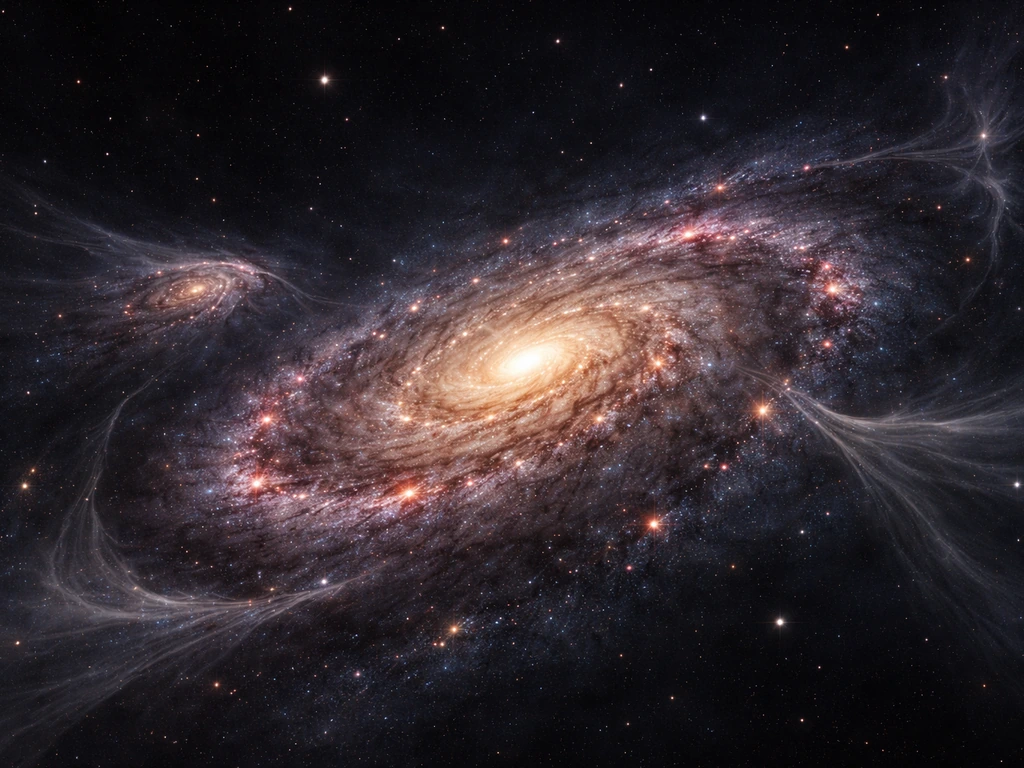
Big-picture pathways for galaxy growth
Think of galaxy growth like a town expanding. It can grow by attracting new residents (gas inflow), by merging with a neighboring town (galaxy collisions), or by building new infrastructure from existing resources (internal star formation from already-captured gas). All three happen, often at the same time, but which one dominates depends heavily on the galaxy's mass, its age in cosmic terms, and the neighborhood it lives in.
Early in the universe, from roughly redshift z=6 down to z=2, gas inflow from the cosmic web was the dominant engine. Galaxies were smaller, the universe was denser, and cold gas streams flowed steadily along cosmic filaments directly into forming galactic disks. Mergers were also frequent because galaxies were packed closer together in a younger, smaller universe. As cosmic time progressed, both of these fuel sources declined, and today's massive galaxies are largely living off what they already have, with growth happening slowly or not at all. That slow, mixed evolution is also why galaxy mass buildup does not happen all at once over time how galaxies grow over time. Does the moon grow? It is a different kind of growth story, driven by orbital evolution and tides rather than galaxy fueling.
- Cold gas accretion from cosmic filaments: dominant at high redshift (z > 2), supplying raw material for rapid star formation
- Galaxy mergers: both major (mass ratios roughly 1:1 to 1:6) and minor (ratios down to 1:10), reshaping structure and triggering starbursts
- Internal recycling: gas expelled by supernovae falls back, is re-processed, and partially re-accreted over Gyr timescales
- Environmental suppression: dense cluster environments strip and starve galaxies, halting further growth
How galaxies add mass: gas accretion vs mergers
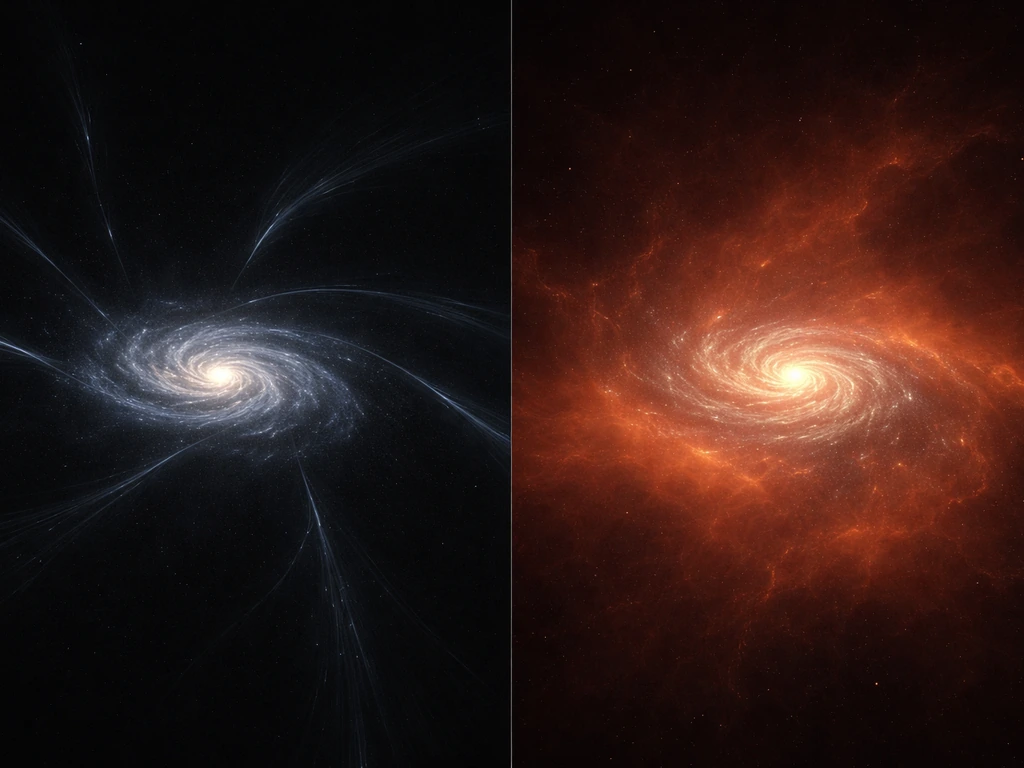
Cold streams vs hot shock: two modes of gas accretion
When gas falls toward a galaxy, it can arrive in two very different states. In the cold-mode, gas flows in along filaments without ever being shock-heated, arriving at temperatures around 10,000 K and diving nearly unimpeded into the disk. In the hot-mode, infalling gas slams into the halo and is shock-heated to the virial temperature, sometimes millions of degrees, before it slowly radiates energy and cools back down to form stars. Which mode wins depends almost entirely on the mass of the dark matter halo surrounding the galaxy.
The critical dividing line sits at a halo mass of roughly 6 x 10^11 solar masses. Below that threshold, virial shocks don't develop in most halos that form before z~2, and cold streams flow straight in. Above it, a stable shock can form and the hot mode takes over. In practice, even massive halos at high redshift can be penetrated by narrow cold streams that thread through the hot shocked gas, which is why some of the most intensely star-forming galaxies in the early universe were still being fed cold gas. Between halo masses of 10^11 and 10^12 solar masses at z=0, only about 5 to 15 percent of disk stellar mass came from shock-heated gas, confirming that cold mode dominates across most of the relevant history.
The best observational window into cold accretion comes from Lyman-alpha blobs at high redshift, z~2 to 6. These extended glowing structures, sometimes hundreds of thousands of light-years across, can be powered by gravitational energy released as cold gas falls inward. Models show that if at least 20 percent of the binding energy of accreting gas is radiated as Lyman-alpha photons, the predicted luminosities, line widths, and number densities match what we observe. Some blobs also show infalling gas kinematics in integral-field spectroscopy, consistent with the cold-stream picture.
Mergers: the other engine of mass growth
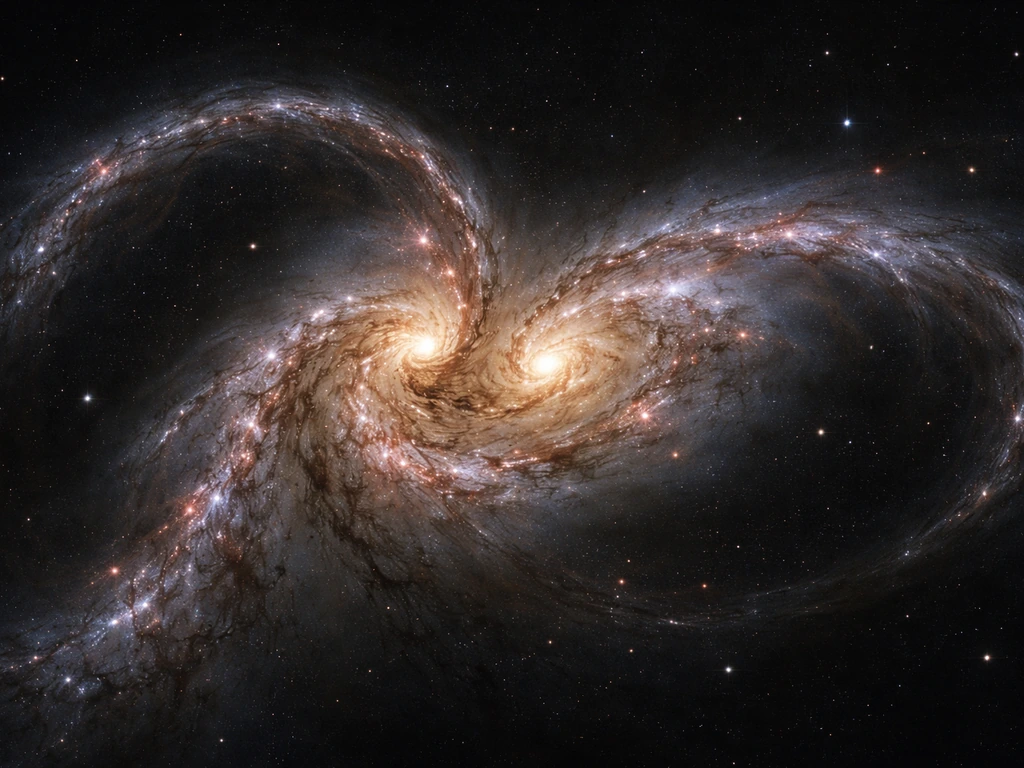
Galaxy mergers add mass in one dramatic burst rather than the slow drip of accretion. A major merger, where two galaxies of comparable mass collide, compresses gas, triggers a starburst, and can fundamentally reshape the galaxy's structure. At z > 1, starburst events sitting more than 0.6 dex above the star-forming main sequence are almost always associated with a major merger with mass ratios between roughly 1:1 and 1:6, and the merger fraction among such starbursts rises to at least 70 percent.
Minor mergers, where a smaller satellite is absorbed by a larger host, are actually more important for morphological change than most people expect. Essentially all of the spheroidal (elliptical) structure we see in z=0 galaxies was driven by mergers with mass ratios greater than 1:10, and minor mergers account for roughly a third of total morphological transformation over cosmic time, becoming the dominant driver after z~1. Think of it like a river constantly absorbing small tributaries: each one is unremarkable alone, but the cumulative effect reshapes the whole system.
A common misconception is that major mergers always quench star formation. In IllustrisTNG simulations, only 1.4 percent of star-forming post-merger galaxies quench within 125 million years of coalescence, compared to 0.7 percent of matched non-merging controls. By 1.5 billion years after the merger, the quenched fraction of post-merger galaxies becomes statistically indistinguishable from controls. Mergers can trigger both starbursts and eventual slowdowns, but they rarely hit a hard off switch.
How stars get made: star formation and gas physics
Gas accreted or merged into a galaxy doesn't automatically become stars. It has to cool, collapse under its own gravity, and reach the densities needed for nuclear fusion to ignite. The relationship between gas surface density and star formation rate surface density follows the Kennicutt-Schmidt law, with a power-law index of about 1.4, meaning denser gas regions form stars at a disproportionately higher rate. This holds across several orders of magnitude, from quiescent spiral arms to starburst cores.
When you focus specifically on molecular gas (the cold, dense phase traced by CO emission), the relationship becomes nearly linear, and you get a roughly constant molecular gas depletion timescale of about 2 billion years across and within galaxies. That's how long it would take a galaxy to use up its molecular gas reservoir at its current star formation rate. It's a useful clock: galaxies with high star formation rates burn through gas quickly, while quiescent galaxies coast for billions of years.
At the extreme end, galaxies being fed by intense cold streams at high redshift can achieve star formation rates of 1000 solar masses per year, compared to the Milky Way's modest 1 to 2 solar masses per year today. The physics is the same: more gas, higher density, faster star formation. The inputs just scale up dramatically in those early, gas-rich environments.
Feedback and limits: why growth slows or stops
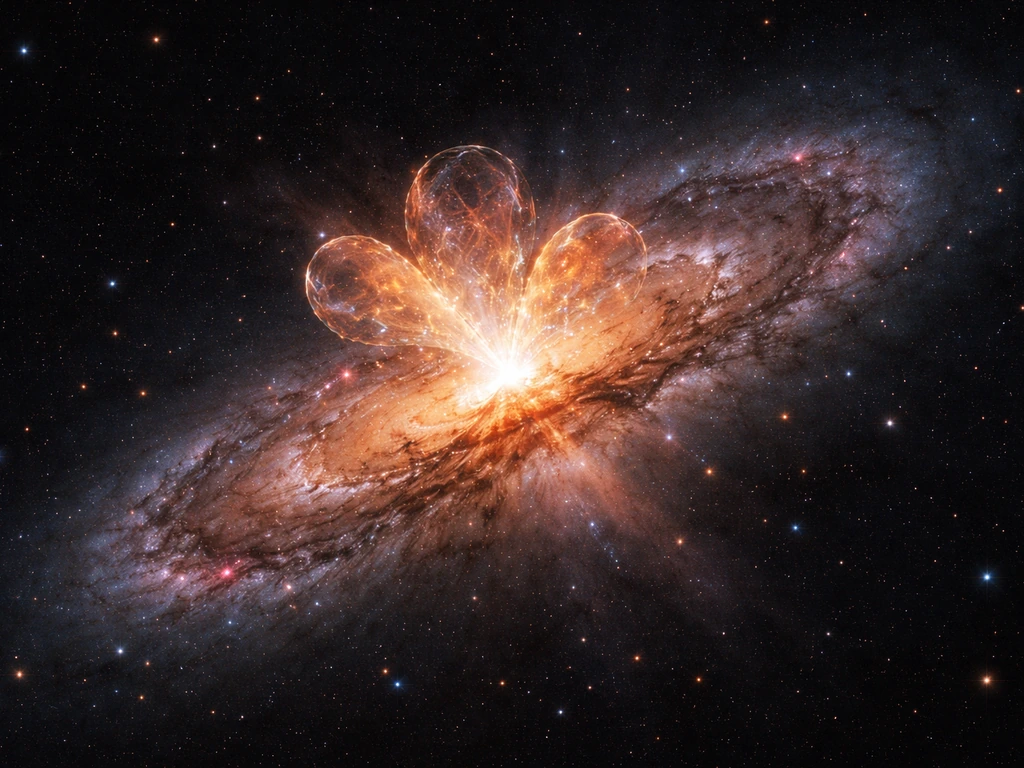
Every growing system runs into constraints eventually. The Sun’s evolution also depends on how it burns fuel over time, so its behavior changes from year to year as its internal conditions evolve. But stars themselves also face limits, so the real question becomes whether do stars grow or ultimately reach an end state. For galaxies, the main brakes are the stars and black holes they already contain. As stars form, the most massive ones explode as supernovae within a few million years, injecting enormous energy into the surrounding gas. This heats the interstellar medium, drives outflows, and can even eject material entirely from the galaxy. For dwarf galaxies around 10^8 solar masses, roughly 90 percent of supernova-driven ejecta escapes the shallow gravitational well. For a Milky Way-sized galaxy, only about 20 percent escapes permanently, with most of the rest eventually raining back down.
When gas fractions exceed a critical value of about 0.3, stellar feedback can expel a few tens of percent of the interstellar medium over a single orbital period. The mass-loading factor (how many solar masses of gas are expelled per solar mass of new stars formed) scales inversely with the circular velocity of the galaxy, so low-mass galaxies feel this brake far more strongly than massive ones. A&A 2022 shows that observational comparisons of metal loading in outflows favor momentum-driven winds at low galaxy masses rather than energy-driven ones, providing useful constraints for feedback-regulation models blank" rel="noopener noreferrer">mass-loading factor. This is part of why dwarf galaxies don't keep growing into giants despite accreting gas: they blow most of it out.
For massive galaxies, the more powerful brake is the supermassive black hole at the center, the active galactic nucleus or AGN. When the black hole is actively accreting, it releases prodigious energy that can heat molecular gas, reduce the available fuel supply by roughly a factor of two compared to non-AGN galaxies, and either suppress star formation efficiency or reduce the cold gas fraction directly. In galaxy clusters, radio jets from AGN inflate giant bubbles in the hot intracluster medium, preventing cooling flows that would otherwise deliver fuel to the central galaxy.
Two distinct quenching channels operate here. Mass quenching is internal: above a certain stellar mass, AGN feedback becomes efficient enough to heat the halo and prevent cooling. Environment quenching is external: in dense clusters, galaxies lose their gas supply through a process called strangulation, where the hot intracluster medium strips the galaxy's extended gas reservoir over a timescale of roughly 4 billion years for galaxies with stellar masses below 10^11 solar masses. The slow timescale is a diagnostic fingerprint: if quenching were fast (ram-pressure stripping alone), galaxies would shut off in hundreds of millions of years. The 4-Gyr strangulation clock tells us the galaxy slowly used up what it had rather than being instantly emptied.
The role of dark matter halos and cosmic environment
Every galaxy lives inside a dark matter halo, and that halo is the real growth infrastructure. Dark matter doesn't emit or absorb light, but it does two critical things: it provides the gravitational well that traps baryonic gas in the first place, and it determines whether that gas arrives cold or shock-heated. The hot/cold accretion divide at ~6 x 10^11 solar masses in halo mass is entirely a dark matter halo property. The baryons just follow the gravitational map the dark matter draws.
On larger scales, galaxies don't live in isolation. They're embedded in the cosmic web, a network of filaments, sheets, voids, and nodes. Filament nodes (the intersections where filaments meet) tend to host the most massive galaxies and clusters, because those are the sites where the most dark matter, and therefore the most gas, has accumulated over cosmic time. Isolated field galaxies have steady but modest inflow. Cluster galaxies may have their inflow completely cut off.
Ram-pressure stripping is the most dramatic environmental effect. As a galaxy moves through the hot, dense intracluster medium at speeds of hundreds to thousands of kilometers per second, the ICM acts like a headwind that blows the galaxy's neutral hydrogen (HI) and even some molecular gas out into a visible tail behind it. NGC 4522 in the Virgo Cluster may have lost up to 90 percent of its gas this way. Interestingly, the stripped molecular gas in tails like NGC 4388's still forms stars, following the same Kennicutt-Schmidt relation with a depletion time of roughly 2 billion years. Stripping doesn't automatically kill star formation; it just relocates it.
This is a useful parallel to other large-scale growth systems: just as the growth of geological formations like volcanoes depends on the underlying tectonic environment, and just as the growth of stars depends on conditions in the surrounding nebula, galaxy growth is inseparable from the dark matter and cosmic-web context it happens within.
Observable signs and timescales of growth across the universe
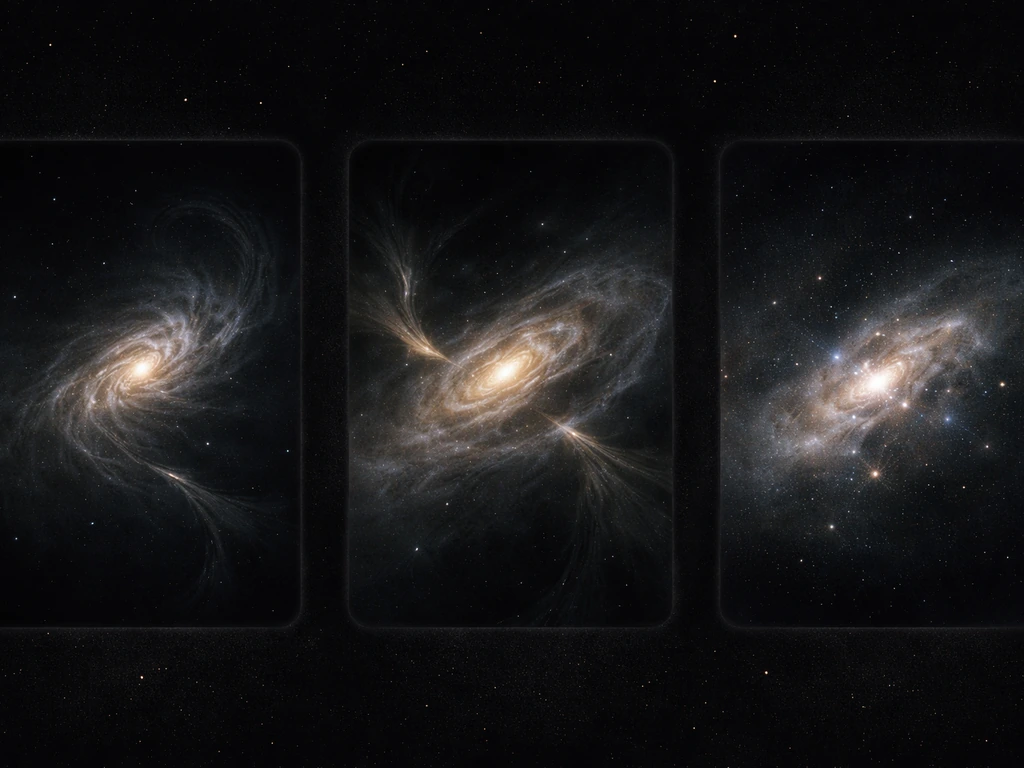
One of the most satisfying things about galaxy growth science is that we can actually see the evidence in real data. Different growth modes leave different fingerprints, and matching those fingerprints to timescales lets us reconstruct a galaxy's history the way a doctor reads an X-ray.
| Growth mode | Key observable signatures | Typical timescale / redshift |
|---|---|---|
| Cold gas accretion | Extended Lyman-alpha emission (blobs), infalling gas kinematics, low metallicity, blue colors | z ~ 2–6, sustained over Gyr in field galaxies |
| Major merger | Disturbed morphology, tidal tails, starburst offset >0.6 dex above main sequence, merger pair fraction | Peaks z > 1; post-merger settling ~1.5 Gyr |
| Minor merger | Stellar shells, asymmetric halos, gradual spheroid buildup, minor structural distortions | Dominates after z ~ 1, cumulative effect over many Gyr |
| Steady star formation (disk growth) | Baryonic Tully-Fisher relation, ordered rotation, molecular gas depletion time ~2 Gyr | Sustained from z~2 to present in disk galaxies |
| Supernova feedback / outflows | Blue-shifted absorption lines, metal-enriched outflows, reduced gas fractions in low-mass galaxies | Active when SFR is high; timescale ~ orbital period |
| AGN feedback (quenching) | Reduced molecular gas fraction, low SFE, radio jets, X-ray cavities in ICM | Active in massive galaxies; z ~ 1–2 peak but ongoing |
| Strangulation (environment) | Rising metallicity with declining SFR, HI deficiency, no obvious disturbance morphology | ~4 Gyr timescale for M* < 10^11 solar masses |
| Ram-pressure stripping | HI tail, CO tail, 'jellyfish' morphology, SFR in stripped tail | Ongoing in clusters; detectable HI deficiency in Gyr |
The mass-metallicity relation is especially powerful as a growth diagnostic. As galaxies grow, they enrich their gas with metals (elements heavier than helium) produced in stellar interiors. But if fresh, low-metallicity gas is streaming in, it dilutes that enrichment. The MOSDEF survey measured gas-phase metallicity for roughly 300 galaxies at z~2.3 and 150 at z~3.3, and the evolution of the mass-metallicity relation over z=0 to 3.3 traces the balance between inflows (diluting metals) and outflows (expelling them). A galaxy growing primarily by cold accretion looks chemically younger than its stellar mass would predict.
Morphology tells a parallel story. The Faber-Jackson relation (luminosity proportional to velocity dispersion to the fourth power) is a tight scaling relation for elliptical galaxies, and its tightness tells us that mergers, despite being violent, produce remarkably consistent dynamical outcomes. Meanwhile, the baryonic Tully-Fisher relation for disk galaxies, recently measured out to z~0.08 by the MIGHTEE-HI survey with no evidence for evolution over the last billion years, tells us that disk galaxy structure has been remarkably stable in the recent universe, with mergers and accretion keeping pace with each other without dramatically reshaping the disk.
If you want to go deeper, the most productive next steps are to get comfortable with three concepts: the star-forming main sequence (the tight correlation between stellar mass and SFR that defines normal galaxy evolution), the Kennicutt-Schmidt law (which translates gas content into star formation rates), and the role of feedback in regulating both. Those three ideas connect almost every observation back to the underlying growth mechanisms described here. Galaxy growth isn't a single process; it's a negotiation between gravity pulling things together and energy blowing them apart, playing out over billions of years across the largest structures in the universe. The same broad idea of slow accumulation and strong limits can also help explain how the giant planets grew to be so large.
FAQ
If a galaxy is fed by “cold mode” gas, does that automatically mean it forms stars quickly?
Cold and hot accretion describe how gas behaves as it falls into the dark matter halo, not how stars form. Even in the cold mode, gas still must cool, become dense, and then follow the gas-to-stars rules. In other words, cold streams mainly change how efficiently fuel reaches the galaxy, while star formation depends on cooling, collapse, and local gas density.
How can I tell which growth mode is currently dominating in a real galaxy?
A single snapshot can be misleading because growth channels can trade dominance over time. For example, a galaxy may look “quenched” now, even if it had strong cold inflow earlier, but the present gas depletion time and recent feedback history determine today’s star formation. Interpreting observations usually requires combining multiple diagnostics like metallicity, gas fractions, and morphology, not just one property.
Is the hot-versus-cold accretion threshold the same for all galaxies, at all times?
Halo mass is a guideline, but redshift and gas density matter too. Narrow cold streams can penetrate stable hot halos at higher redshift, and the efficiency of shock heating depends on how gas is supplied and mixed. So the hot/cold divide is not a hard wall where one mode always wins for every galaxy in every epoch.
Does quenching always happen quickly after the galaxy stops getting gas?
Quenching does not always mean the galaxy becomes immediately “red and dead.” Using the strangulation clock, gas supply can decline over roughly billions of years, and star formation can fade gradually while the galaxy still retains some cold gas. That gradual decline is different from rapid shutdown processes, so the timescale you infer matters as much as the final outcome.
If ram-pressure strips a galaxy’s gas, will it always stop forming stars immediately?
Ram-pressure stripping mainly removes gas from the galaxy, but it does not guarantee the loss of all star formation because stripped gas can remain dense enough to form stars in tails. Whether star formation continues depends on gas densities, shielding and pressure in the tail, and the rate at which new dense clouds can form after stripping.
Do major mergers always “turn off” star formation permanently?
Major mergers can trigger starbursts, but they do not automatically produce long-term quenching. Many systems return to star formation on timescales of order a billion years, especially if fresh gas is available or if feedback does not permanently heat or remove the remaining reservoir. The merger mainly changes the short-term gas dynamics and densities.
Can a galaxy grow in stellar mass without changing its morphology much?
To avoid double-counting, it helps to separate mass growth from morphology growth. Total stellar mass can build gradually through accretion, while structural transformation (like making a spheroid) is often driven by mergers, including minor ones. So a galaxy can grow in stars without looking dramatically reshaped in the same period.
If feedback ejects gas, does the galaxy stop growing for good?
Not necessarily. Feedback from supernovae and AGN can heat gas, eject some of it, and also change how much gas remains bound. If a significant fraction of outflowing gas later reaccretes, the net effect can be more like regulating star formation than preventing future growth. Observations of gas reservoirs and metallicity evolution can help distinguish regulation from permanent loss.
Why does the Kennicutt-Schmidt law sometimes seem less predictive when using total gas instead of molecular gas?
The Kennicutt-Schmidt law links gas surface density to star formation surface density, but it is an empirical relation with scatter and regime changes. The “molecular” version is more linear and gives a clearer depletion-time interpretation because it traces the star-forming phase more directly. Using only total gas can blur the picture when atomic and molecular fractions vary.
If a galaxy is forming fewer stars, is it always because it has less gas?
A low star formation rate does not always mean low gas supply. The galaxy may have gas but not in the dense molecular phase, or heating by AGN and halo processes may prevent efficient cooling and collapse. Checking molecular gas content and gas depletion time helps separate “no fuel” from “fuel not converted into stars.”
Why can two galaxies with similar stellar mass have different growth histories?
Stellar mass is not the same thing as the dynamical mass budget. Mergers and inflow can increase stellar mass, while dark matter halos evolve through assembly and accretion that do not directly show up in starlight. So when comparing growth across galaxies, it helps to track both stellar properties and, where possible, halo-scale indicators like velocity dispersions or clustering.
If a galaxy has low metallicity for its mass, does that always mean it is growing mainly by fresh gas inflow?
Metallicity dilution and enrichment are time-dependent, so a “chemically young” gas phase usually points to recent inflow relative to how old the stars are. However, outflows can also remove metals, which can mimic dilution signatures. Using metallicity together with gas fraction or star formation efficiency reduces this ambiguity.
When a galaxy sits above or below the star-forming main sequence, how do I know whether that is due to mergers or feedback?
The star-forming main sequence describes normal star formation relative to stellar mass, but offsets from it can have different causes. A starburst can come from a merger-driven gas compression, yet an AGN can suppress star formation without necessarily raising a galaxy far above the main sequence. Interpreting offsets is more reliable when paired with indicators of interaction, AGN activity, or gas content.
How much does environment matter compared with a galaxy’s own mass in deciding how it grows?
For satellite and cluster galaxies, environment can dominate both supply and survival of gas, while field galaxies often have steadier inflow. A galaxy’s location can therefore change which growth channel is effective, even if its internal mass is the same. Comparing similar stellar masses across environments helps clarify the role of the cosmic-web context.
Does Attraction Grow in Space? Forces and Biology Explained
Explains whether gravity, magnetism, and biology growth change in space, with limits and experiment ideas.