No, the Moon does not grow in any way you would notice watching it from your backyard. Its physical radius and mass are essentially fixed on human timescales. What you are actually seeing when the Moon looks bigger or brighter on a given night is a combination of geometry, orbital mechanics, and some fascinating tricks your own brain plays on you. That said, there are real, measurable changes happening in the Earth-Moon system, and over billions of years the Moon has gone through genuine physical evolution. Even though the Moon is not growing, Earth itself does change over extremely long timescales due to processes like plate tectonics and erosion. Let's untangle all of it.
Does the Moon Grow? Phases, Mass Changes, and Timescales

Marcus Whitmore
20 Apr 2026
What 'grow' even means for the Moon
When we talk about growth on this site, we usually mean an increase in mass, volume, or physical size, whether that's a cell adding cytoplasm, a crystal accreting new mineral layers, or a glacier thickening with fresh snowfall. Growth requires an energy source, a supply of raw material, and a mechanism to incorporate that material. By that definition, the Moon is essentially not growing today. It has no metabolism, no internal chemistry pulling in new mass, and no ongoing accretion of material significant enough to measure in a human lifetime.
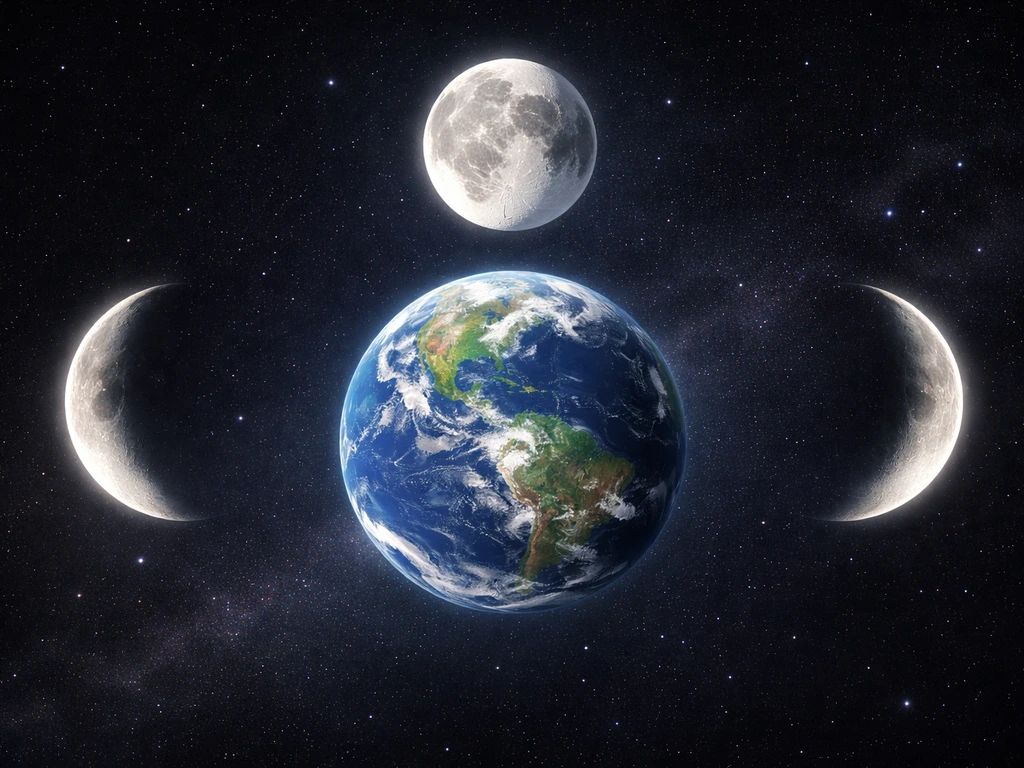
The confusion usually comes from two very different things people lump together: the Moon's actual physical size (its radius, roughly 1,737 km, and its mass, about 7.34 × 10²² kg) versus how it looks to us on any given night. Those two things can change completely independently of each other. A balloon doesn't get bigger just because you move it closer to your face, but it sure looks like it does.
How the Moon actually formed and evolved physically
The Moon's origin story is a growth story, just an ancient one. Understanding how galaxies grow follows a similar theme, where gravity and available material drive large-scale assembly over cosmic time growth story. The same physics that let the early planets accrete matter also explains why the giant planets became so massive over time growth story. The leading model holds that roughly 4.5 billion years ago, a Mars-sized body slammed into the early Earth, ejecting a massive cloud of debris that eventually coalesced into the Moon. That early Moon was almost certainly covered in a global magma ocean, and as it cooled over hundreds of millions of years, minerals crystallized out and the crust solidified. That cooling process is still technically ongoing, just extremely slowly.
During its first billion years, the Moon also experienced a period called the Late Heavy Bombardment, when asteroid and comet impacts added small amounts of mass and sculpted the cratered surface we see today. Since then, the bombardment rate has dropped dramatically, and mass additions from impacts are essentially negligible on any human timescale.
Over the last several hundred million years, geological evidence actually points in the opposite direction from growth. NASA researchers studying thrust fault scarps on the lunar surface conclude that the Moon has shrunk by more than about 50 meters (roughly 150 feet) in radius due to interior cooling. Geologic models constrained by the pattern of surface faults suggest the total radius change over the past 3.8 billion years has stayed within about plus or minus 1 kilometer. That is a vanishingly small change for a body with a radius of 1,737 km, and it trends toward shrinking, not growing.
Why the Moon looks like it's growing: phases and the brightness illusion
Here is where most of the everyday confusion lives. The Moon's apparent size and brightness change noticeably throughout each month, and that can genuinely feel like it is growing or shrinking. But none of it reflects a change in the Moon's physical dimensions. It is all geometry and optics.
Lunar phases: illumination, not size
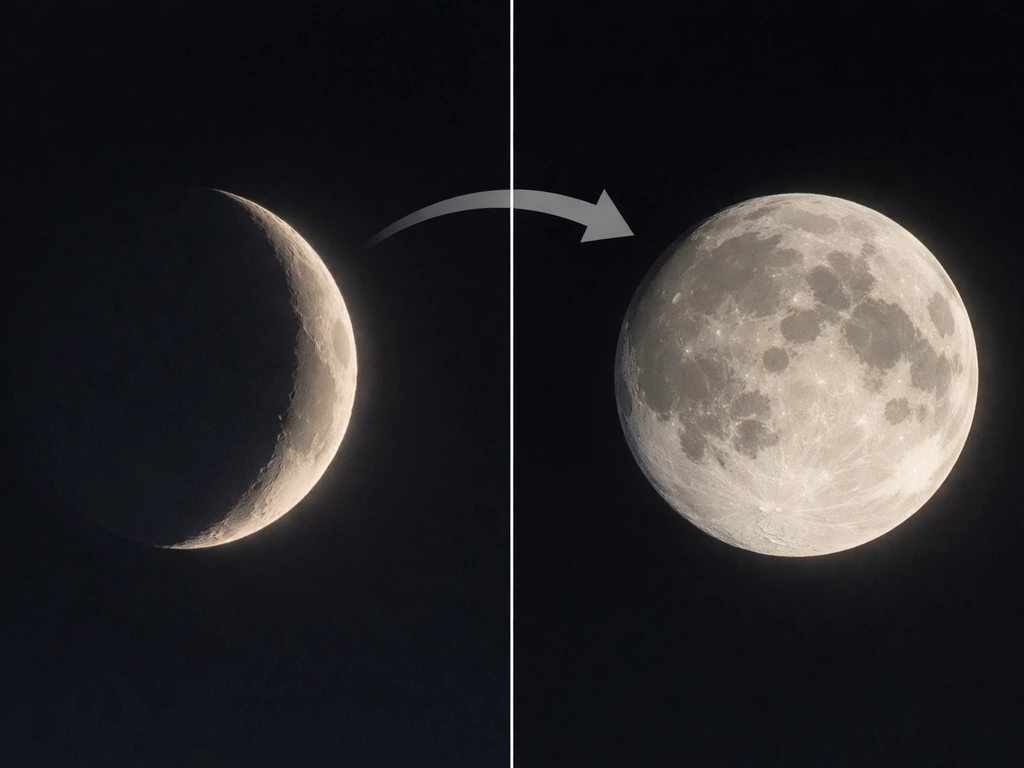
The Moon goes through its familiar cycle of crescent, quarter, gibbous, and full because of how sunlight falls on it as it orbits Earth. During a full Moon, the entire sunlit hemisphere faces us, and it appears as a bright, complete disk. During a crescent phase, only a sliver is lit. The Moon itself has not changed size one bit. You are just seeing different fractions of its sunlit surface, the same way a lamp illuminates only part of a sphere if you look at it from an angle.
Orbital distance: the real size-change driver
The Moon's orbit around Earth is not a perfect circle. It is an ellipse, which means the Moon is sometimes closer to Earth (perigee) and sometimes farther away (apogee). At perigee, the Moon can appear up to about 14% larger in angular diameter than at apogee, simply because of distance. This is why you sometimes hear about a 'supermoon,' which is just a full Moon that happens to coincide with perigee. The Moon has not grown. You are closer to it, in the same way a friend's face looks larger as they walk toward you.
The Moon illusion: your brain is the culprit
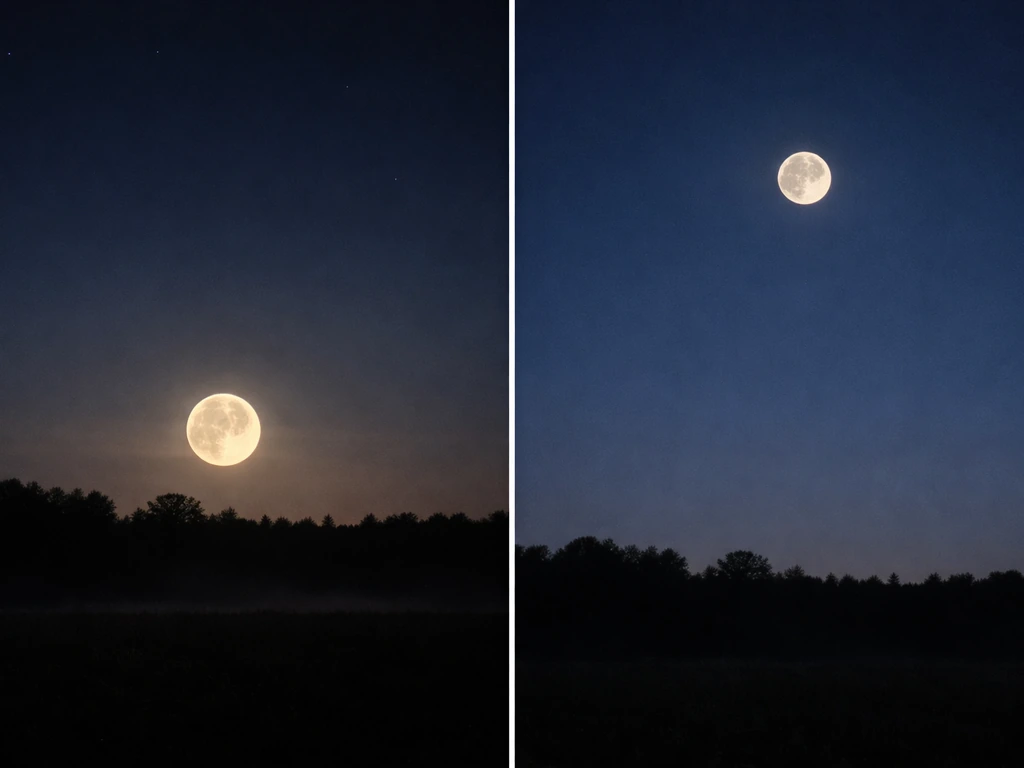
There is one more trick at play. When the Moon sits near the horizon, it reliably looks enormous compared to when it is high overhead, even though its measured angular diameter is essentially identical in both positions. This is the Moon illusion, and it is entirely in your head, literally. Your brain uses visual cues from the landscape (trees, buildings, the horizon itself) to judge distance, and it scales perceived size accordingly. Remove those cues, say by viewing the Moon through a paper tube, and it immediately looks the same size it does overhead. NASA describes this as the brain misinterpreting depth cues and adjusting its size estimate. Real growth has nothing to do with it.
The opposition surge: why a full Moon is extra bright
Even the Moon's brightness has a quirk that can make it seem to 'pop' suddenly. At a full Moon, Earth, Moon, and Sun align so that each dust grain and rock on the lunar surface casts its shadow directly behind it, away from our view. This eliminates most of the shadows that normally darken the surface. The result is a brightness surge, called the opposition surge, that can increase the Moon's apparent brightness by roughly 20% at very small solar phase angles. The surface has not changed; the lighting geometry has. Think of how a road's surface seems to glow white when you look directly away from the sun but looks darker from the side.
What is actually changing: the Earth-Moon tidal system
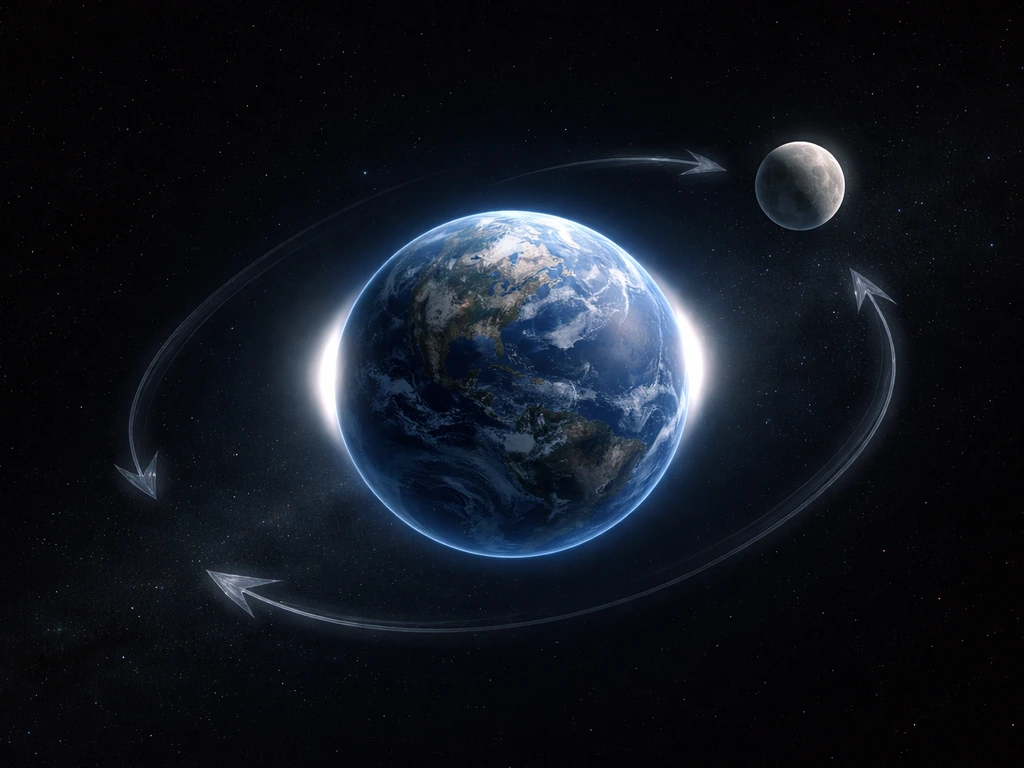
There is a real, measurable change in the Earth-Moon system, but it is not the Moon's physical size. In space, attraction can behave in more complex ways due to changing distances and local gravitational fields, but it is not about the Moon physically growing attraction in space. The Moon is slowly moving away from Earth. Lunar Laser Ranging (LLR) experiments, which bounce laser pulses off retroreflectors left on the Moon during Apollo missions, measure the round-trip travel time with extraordinary precision. The data show the Moon is receding from Earth at about 3.8 centimeters per year (with a well-constrained uncertainty of around plus or minus 0.07 cm/yr in careful analyses).
This recession is driven by tidal interactions. Earth's rotation carries its tidal bulge slightly ahead of the Moon's orbital position, and the gravitational interaction between that bulge and the Moon transfers angular momentum from Earth's rotation to the Moon's orbit. Earth's day gets fractionally longer, and the Moon drifts fractionally farther away. At 3.8 cm/year, it would take over 26 million years for the Moon to move just 1,000 km farther out. You will not notice this in your lifetime, or in a thousand lifetimes.
It is worth being clear about what LLR measures and what it does not. It constrains orbital motion very precisely, but it does not directly measure the Moon's radius or mass as separate physical quantities. The recession figure tells us where the Moon is, not how big it is.
Is there any measurable increase in the Moon's mass or radius today?
The short, honest answer is no, not in any meaningful sense for human timescales. Micrometeorites constantly rain down on the Moon, adding the tiniest increments of mass, but the rate is far too small to register as growth by any practical measure. The Moon has no atmosphere to capture gas, no liquid water to accumulate, and no biological or chemical mechanism driving material in. The dominant long-term physical trend, interior cooling, is causing the Moon to very slowly contract, not expand.
| What's changing | Rate or magnitude | Human-scale noticeable? |
|---|---|---|
| Moon's radius (thermal contraction) | ~50 m over hundreds of millions of years | No |
| Moon's orbital distance from Earth | ~3.8 cm per year (recession) | No |
| Moon's apparent angular size (perigee vs apogee) | Up to ~14% difference in appearance | Yes, but not real growth |
| Moon's apparent brightness (phases, opposition surge) | Large monthly variation; ~20% surge at full Moon | Yes, but not real growth |
| Moon's apparent size near horizon (Moon illusion) | Can appear significantly larger | Yes, purely a perception effect |
This pattern mirrors what we see in other non-biological systems covered on this site. Whether you are looking at how volcanoes grow through lava accumulation or how stars grow by fusing hydrogen, growth requires a continuous input of mass or energy. The Moon has no such ongoing input at a meaningful rate. Without a feedstock, there is no growth mechanism. The Moon is, in that sense, a finished product cooling down from a much more dynamic past.
How to think critically about Moon-size claims
When you see a headline claiming the Moon is growing, or a photo making it look enormous, run through a quick mental checklist before accepting it at face value.
- Ask what timescale the claim is about. Changes that happen over hundreds of millions of years are real but irrelevant to what you see tonight.
- Distinguish apparent size from physical size. Angular diameter in the sky and actual radius in kilometers are different quantities.
- Check whether 'distance' is doing the work. A closer Moon looks bigger; that is geometry, not growth.
- Consider the source's precision. NASA's Lunar Laser Ranging data gives recession to within fractions of a millimeter per year. Social media posts rarely do.
- Look for a mechanism. What would be adding mass or volume to the Moon? If no clear answer exists, the claim is almost certainly about appearance, not reality.
- Verify the timescale of geological claims. Statements about the Moon shrinking by 50 meters apply to hundreds of millions of years, not to recent decades.
NASA's LLR data and USGS geological analyses are the most reliable primary sources for questions about the Moon's physical evolution. For phase and apparent-size questions, planetarium software like Stellarium lets you simulate the Moon's angular diameter at any date, so you can see for yourself how much it changes across an orbit without needing to take anyone's word for it.
The Moon is a useful reminder that 'growing' is not a single thing. On this site we focus a lot on how organisms grow through cell division and how crystals grow by accretion, and in both cases there is a mechanism, a feedstock, and energy driving the process. The Moon had all three during its formation. It doesn't today, which is exactly why it isn't growing. What you see changing in the sky each night is nothing more than light and distance doing what geometry dictates. The Sun, like the Moon, does not grow noticeably from year to year in any human-observable way.
FAQ
If the Moon is not growing, why do some craters look new or “fresh” after a while?
They usually are not new in a human timeframe. What changes is visibility, lighting, contrast, and whether you are comparing photos from different phases and angles. True new impacts are extremely rare from our perspective and would typically be confirmed by transient observations or follow-up detections, not by normal month-to-month viewing.
Does the Moon’s orbit making it closer make it seem bigger for longer, like it is actually expanding?
Angular size increases only when you are observing near perigee, and it does so over days to a couple of weeks, not gradually over months. Also, “supermoon” effects depend on phase (full versus crescent), your viewing location, and atmospheric conditions, so it can look dramatic without any real size change.
Could the Moon be shrinking or growing in a way our measurements would miss?
It is possible to miss very tiny changes, but there are strong constraints from geology and precision orbital timing. The article notes contraction trends from cooling and that human timescales show effectively fixed radius, while recession measurements constrain orbital distance rather than radius or mass.
Does “opposition surge” mean the Moon’s surface got brighter because of change in material?
No, the surge is mostly a lighting and viewing-geometry effect. When the Sun is nearly behind the observer’s line of sight relative to the Moon, shadows can be minimized and fine surface particles reflect light differently, producing a brightness spike without any new material being added.
If the Moon is receding from Earth, does that eventually make it look smaller permanently?
Yes, the average angular size will slowly decrease because the distance is increasing. But at about 3.8 cm per year, the change is far below what you can notice visually, and noticeable differences would require long time spans plus careful comparisons under similar conditions.
Can the Earth’s tides change the Moon’s size or shape?
Tidal forces do distort the Moon slightly, but that is not the same as long-term growth in radius or mass. The dominant measurable secular effect discussed here is orbital evolution (Earth’s day lengthening and the Moon moving outward), not permanent expansion.
Are there realistic scenarios where dust or impacts could make the Moon noticeably bigger within a few decades?
For the Moon to “grow” in a noticeable way, the needed mass would have to be far larger than what typical micrometeorites and occasional impacts add over decades. Without an atmosphere to retain and accumulate ejecta, any additional material does not translate into a measurable radius increase on human timescales.
Why do some videos claim the Moon is getting bigger each year, and how can I test it quickly?
Most claims confuse distance and optics, or they use inconsistent reference points in photos. A quick check is to compare angular size on the same phase (for example, full Moon), from the same general location, and over multiple months using planetarium software to predict how much the angular diameter should vary from orbital geometry.
Does the Moon ever “switch” between being larger and smaller because of speed or wobble?
Not in a way that changes its physical dimensions. You can see small timing and apparent-motion differences because its orbit is eccentric and its viewpoint changes with Earth’s rotation, but the physical size is fixed. The apparent size variations discussed come from distance and viewing geometry, not from speed causing expansion.
Next Article
How Did the Giant Planets Grow So Large? Key Processes
Step-by-step guide to how Jupiter, Saturn, Uranus, and Neptune accreted solids and captured gas, with growth limits and