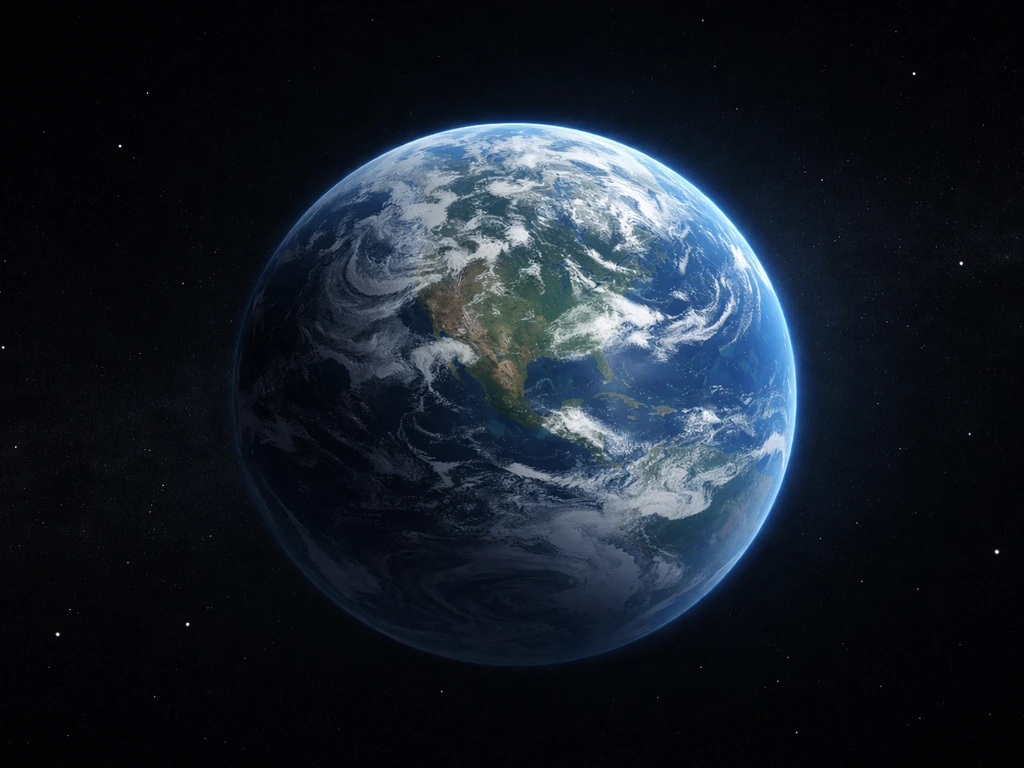
Earth does gain a small amount of mass every year from cosmic dust and meteorite material raining down from space, but the increase is so tiny relative to Earth's total mass that its radius stays effectively constant. At the same time, Earth loses mass through atmospheric escape. When scientists carefully balance those two sides of the ledger, the net change is negligible. What most people think of as Earth 'growing' is really geological remodeling: mountains rising, seafloors spreading, coastlines shifting. That's real change, but it's recycling, not expansion.
Does the Earth Grow Over Time? Size, Mass, and Evidence

Marcus Whitmore
24 Apr 2026
What does 'Earth grows' even mean?

Before you can answer whether Earth grows, you have to pin down what 'grow' means in this context. There are at least three different things the question could be asking, and they have very different answers.
- Increase in total mass: Is Earth getting heavier over time because material is falling onto it from space?
- Increase in physical radius: Is the planet's outer shell literally expanding outward, making the planet geometrically bigger?
- Apparent growth of landforms: Are mountains, continents, coastlines, or other surface features visibly growing or spreading?
The first question is about mass accretion versus mass loss, and it has a quantifiable, measurable answer. The second is closely tied to the first but also involves the planet's internal structure and pressure. The third is about geology and plate tectonics, which involves real, measurable movement but not expansion in the way a living organism grows. This site spends a lot of time on how biological organisms hit hard size limits, and Earth runs into analogous constraints for similar physical reasons.
Does Earth gain or lose mass over time?
Yes to both, and the two sides roughly cancel each other out. Let's walk through each.
Mass coming in: cosmic dust and meteorites
NASA confirms that meteoroid material continuously enters Earth's atmosphere. The best estimates put the total infall of cosmic dust at around 40,000 tons per year, though the uncertainty is genuinely large: some modeling puts the daily atmospheric input anywhere between 3 and 300 metric tons per day, which gives you a sense of how hard this is to measure precisely. A Nature study pins the figure at closer to 30,000 tons per year for dust particles in the 20 to 400 micrometer size range.
Here's the catch: most of that material never makes it to the surface intact. Research suggests roughly 80% of incoming cosmic dust mass is vaporized during atmospheric entry. Of what survives, estimates suggest only about 2,700 tons per year (give or take 1,400 tons) actually reaches the surface as particles. So the physical mass addition to Earth's solid body is a small fraction of the headline 40,000-ton figure.
Mass going out: atmospheric escape
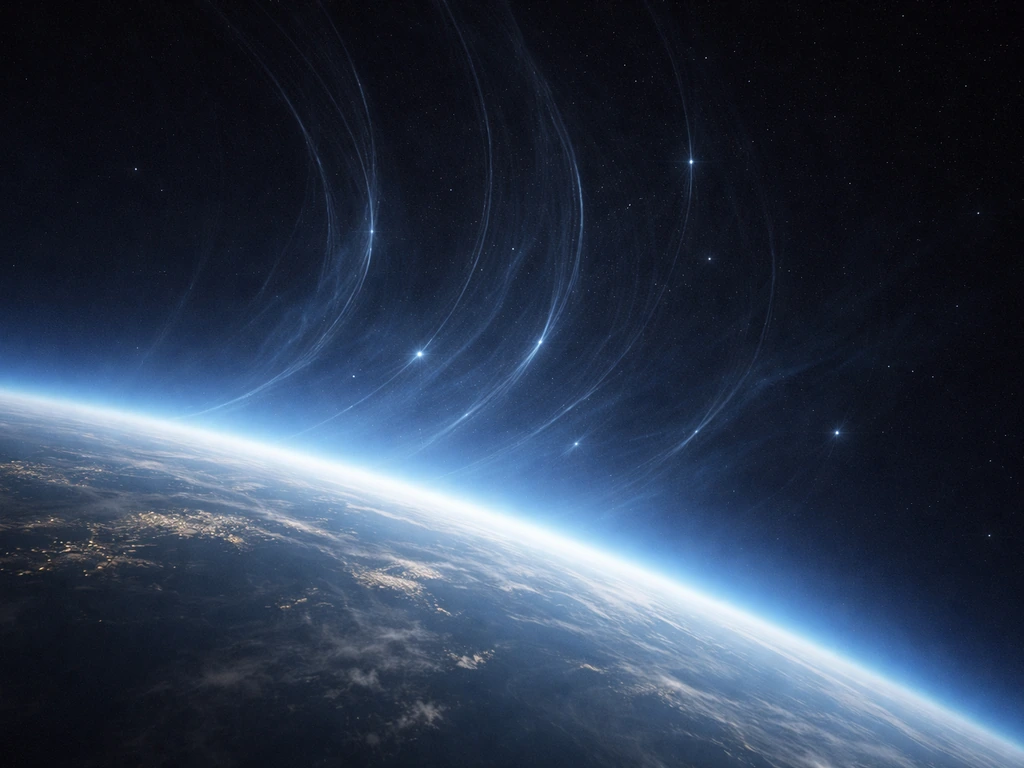
Earth also bleeds mass to space, mostly through atmospheric escape. The main mechanisms are Jeans escape (where fast-moving light molecules like hydrogen reach escape velocity at the top of the atmosphere), polar wind, and solar-wind sputtering. Hydrogen loss runs at roughly 3 kilograms per second, which sounds dramatic until you realize that's about 95,000 tons per year. Heavier gases like oxygen escape much more slowly. When you add it all up, atmospheric escape currently removes slightly more mass than cosmic dust adds, making Earth's net mass change a very small negative number.
What the satellite data actually shows
The most precise measurement of Earth's total mass comes from tracking the gravitational parameter GM (Earth's mass multiplied by the gravitational constant) using blank" rel="noopener noreferrer">Satellite Laser Ranging. SLR measures the two-way travel time of laser pulses bounced off satellites to derive distances with millimeter-level precision. The key finding: SLR results confirm that GM does not change secularly, meaning there is no detectable long-term trend in Earth's total mass beyond measurement uncertainties. The blank" rel="noopener noreferrer">GRACE and GRACE-FO satellites add detail here. They measure time-varying gravity fields almost monthly, but what they detect is mostly mass redistribution (water moving between ice sheets, oceans, and land) rather than any net planetary gain or loss.
Can we actually measure changes in Earth's size today?
Modern geodesy can detect changes at the millimeter scale, which is remarkable. IERS technical notes show that radial displacements of reference points on Earth's surface can reach around 1.7 mm, and Earth Orientation Parameters tracked by VLBI, GPS, and SLR reveal shifts in Earth's rotation and orientation with extraordinary precision. The International Terrestrial Reference Frame (ITRF), built partly from SLR data, is the foundational coordinate system scientists use to detect any large-scale shape changes.
What do those measurements actually show? No secular (long-term, one-directional) increase in Earth's radius. Do stars grow in the same sense, or are their size changes driven by very different processes like fusion and mass loss Earth's radius. Earth's radius Earth's radius (see also: does the earth grow in size) for the direct answer to the question of radius change over time, which is the related consideration most people care about here..
What shows up instead is seasonal and decadal variation driven by mass redistribution: ice melting, groundwater depletion, ocean mass shifting. GRACE-FO expresses most of these as equivalent water height in millimeters per year, not as planetary radius growth. The planet's shape wobbles slightly with the seasons, but it isn't getting geometrically bigger.
Geological 'growth': the stuff that actually looks like growing
This is where it gets interesting, especially for anyone who arrived here thinking about how mountains form or why continents look like puzzle pieces. Geology offers several real, ongoing processes that could be called growth if you squint a little.
Plate tectonics and seafloor spreading
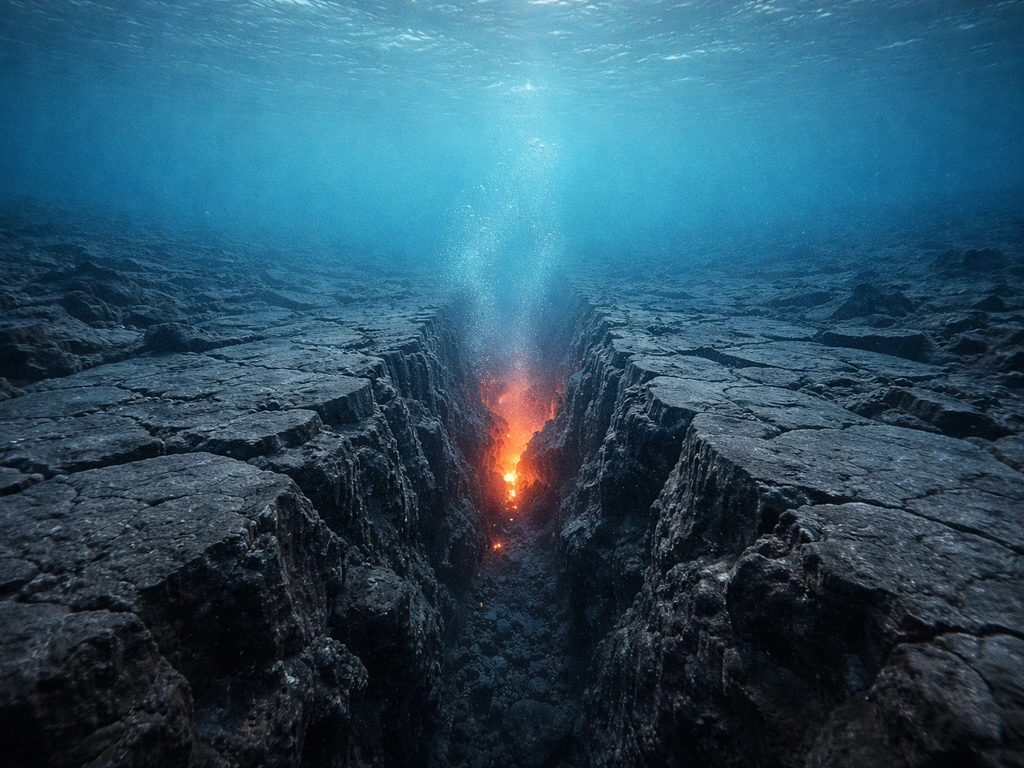
New oceanic crust is constantly being created at mid-ocean ridges, where tectonic plates pull apart and magma wells up to fill the gap. Seafloor spreading rates range from about 0.1 cm per year at slow-spreading ridges to as fast as 17 cm per year at fast-spreading ones like the East Pacific Rise. That's real material being added to the seafloor. But here's the catch: an equal amount of oceanic crust is being destroyed at subduction zones, where one plate slides under another and gets recycled back into the mantle. The total surface area of Earth's crust stays roughly constant. It's a conveyor belt, not an expanding balloon.
Mountain building and uplift
Tectonic collision zones like the Himalayas are actively growing upward. Typical tectonic uplift rates run in the range of fractions of a millimeter to about 1 or 2 mm per year in most regions, with hotspots like the Himalayas reaching 5 to 9 mm per year. If you left a GPS stake in the ground in Nepal and came back in a million years, you'd find it significantly higher.
But erosion works just as hard in the opposite direction, wearing mountains down as fast as they rise on geological timescales. Research on the Alpine mobile belt shows that over long enough periods, a balance between uplift and the sedimentary cycle keeps continental surfaces near sea level rather than piling up indefinitely.
Sedimentation and volcanic additions
Sediment accumulates in river deltas, ocean basins, and lake beds over time. Volcanic eruptions add new material to the surface, and in places like Hawaii, entirely new landmasses have grown from the seafloor up. These are genuine additions of material to specific locations. But again, this is redistribution within the Earth system: eroded rock from one place becomes sediment somewhere else. The planet's total mass budget isn't meaningfully altered.
Why Earth can't expand like a living organism
Living organisms grow because they take in external resources (food, water, sunlight), convert them into biological material, and add that material to their structure through cell division and tissue building. Earth has no equivalent mechanism. There is no metabolic process directing incoming dust to specific locations to build new planetary structure. The incoming material is dwarfed by Earth's existing mass of roughly 6 x 10^24 kilograms, and the forces involved (gravity, tectonic pressure, thermal convection) operate in a closed loop rather than a directional growth program.
Think of it this way: a cell that stops receiving nutrients stops growing and eventually dies. Earth's geological activity is powered by internal heat left over from its formation and from radioactive decay, not by net material accumulation. That heat drives plate tectonics, volcanism, and mountain building indefinitely, but it doesn't translate into a planet that gets physically larger. The same physical logic applies, interestingly, when you compare Earth to other planetary bodies.
It’s the same logic behind the question does attraction grow in space, where gravity reshapes motion rather than causing steady structural expansion planetary bodies. The question of why giant planets grew so large during the solar system's formation is a different story, because those planets had access to enormous gas reservoirs during the disk phase. Earth formed in a region where that wasn't possible.
Similarly, questions about whether the Moon or the Sun change size over time involve very different mechanisms and timescales. Similarly, questions about whether the Moon or the Sun change size over time involve very different mechanisms and timescales do stars grow. The same question, does the sun grow every year, has a different answer because stars change size on very long, physical evolutionary timescales does the Moon or the Sun change size over time.
The same question, though, is trickier for lunar size because the Moon's mass can change through impacts and escape in ways that don't translate into steady growth does the moon grow.
How to estimate the change for yourself
You don't need a physics degree to get a feel for the numbers. Here's a practical way to think through the mass budget.
- Start with the accretion side: ~40,000 tons of cosmic dust enters the atmosphere per year. Multiply by 0.20 (the fraction that isn't vaporized) to get roughly 8,000 tons potentially surviving entry. Then use the surface-reach estimate of ~2,700 tons per year as a cross-check.
- Now estimate the loss side: hydrogen escapes at roughly 3 kg/s. Multiply by 3,600 seconds per hour, 24 hours per day, and 365 days per year to get approximately 95,000 tons per year of hydrogen loss alone.
- Compare those two numbers. Even before accounting for other escape mechanisms, loss is outpacing gain. Net change: a very small negative number.
- Put it in perspective: Earth's mass is about 6 x 10^24 kg. Even 100,000 tons of net annual change is 10^8 kg, which is 10^8 / 6x10^24, or about 1.7 x 10^-17 of Earth's mass per year. That's 0.000000000000002% per year. You would need billions of years for it to add up to anything remotely detectable as a size change.
- For geological rates, take a tectonic uplift rate of 5 mm/year (Himalayas). Over 1 million years, that's 5 km of potential uplift, but erosion balances it. Over human lifetimes, it's 50 cm, unmeasurable without sensitive instruments.
Those calculations won't win you a peer-reviewed publication, but they give you a calibrated intuition. When someone claims Earth is 'rapidly expanding,' you now have a quick mental yardstick to evaluate whether the numbers they're citing are physically plausible.
A quick comparison of Earth's change mechanisms
| Mechanism | Direction | Rate / Magnitude | Net effect on size |
|---|---|---|---|
| Cosmic dust accretion | Mass in | ~30,000–40,000 t/yr entering atmosphere; ~2,700 t/yr reaching surface | Negligible increase |
| Atmospheric escape (hydrogen) | Mass out | ~3 kg/s (~95,000 t/yr) | Negligible decrease |
| Seafloor spreading | Surface remodeling | 0.1–17 cm/yr of new crust at ridges | No net size increase (offset by subduction) |
| Tectonic uplift | Local elevation gain | Fractions of mm/yr to ~9 mm/yr (Himalayas) | No net radius growth (balanced by erosion) |
| Sedimentation / volcanism | Local material addition | Variable; localized | Redistribution only, no net expansion |
| Overall net change | Slight mass loss | Fraction of 10^-17 per year | Undetectable in any human timescale |
How to fact-check claims about Earth's growth

You'll occasionally run into 'Expanding Earth' hypotheses online, which claim that Earth has been physically growing in radius over geological time. This idea was seriously considered before plate tectonics was established, but modern geodesy, seismology, and the mass-budget evidence above have ruled it out as a primary mechanism for Earth's surface evolution. Here's how to evaluate any claim you encounter.
- Check the geodesy: IERS Earth Orientation Parameters and SLR-derived GM values are publicly available. If Earth were meaningfully expanding, these datasets would show it. They don't.
- Look for the mass budget: any credible claim of Earth growing needs to account for both accretion and atmospheric escape. If a source only cites incoming meteorites without mentioning loss, treat it with skepticism.
- Distinguish redistribution from expansion: GRACE and GRACE-FO data are publicly accessible via NASA's GRACE Tellus portal. They show mass moving around Earth's surface, not a planet gaining mass overall.
- Understand tectonic timescales: plate movements happen over millions of years. Claims of rapid expansion usually misinterpret local uplift or spreading rates as global size increase.
- Consult authoritative sources: NASA's planetary science pages, IERS technical notes, and peer-reviewed geology journals (accessible via Google Scholar) are your best anchors for fact-checking.
- Ask about mechanism: real growth requires a directed mechanism. Ask any claim 'what physical process is driving this, and where is the energy coming from?' If the answer doesn't involve a coherent physical mechanism, it's a red flag.
The bottom line is that Earth is geologically alive and constantly reshaping itself, which can genuinely look like growth if you're watching a volcano build a new island or a mountain range push skyward. Galaxies grow in a similarly complex way, driven by mergers, gas accretion, and ongoing star formation rather than simple uniform expansion how do galaxies grow.
If you want a closer look at what “growth” looks like in geology, see how do volcanoes grow by building new rock and land over time. But at the planetary scale, Earth's mass is stable, its radius is stable, and the churning you see at the surface is a closed loop powered by internal heat, not an expansion driven by net material gain.
That's actually a fascinating constraint, and understanding it gives you a much sharper lens for thinking about how growth works, and why it always has limits, whether you're looking at a single cell, an organism, or an entire planet.
FAQ
If Earth’s mass doesn’t increase, why do some people say Earth is expanding?
Many claims confuse real surface-area change with whole-planet geometry. For example, mid-ocean ridge creation adds seafloor, but subduction destroys similar amounts elsewhere, so total crustal surface area stays roughly steady. Also, seasonal radius “wobbles” from mass moving around (ice, oceans, groundwater) can look like size change unless you measure long-term trends.
Does Earth’s radius change at any timescale, or is it always constant?
Short-term changes happen, mostly because mass redistributes within the Earth system. Seasonal, decadal, and drought and ice-loss cycles can shift the geoid and cause millimeter-scale radial displacements, but satellite laser ranging and gravity measurements show no detectable long-term secular increase in radius.
How much net mass would Earth gain if cosmic dust exceeded atmospheric escape by a little?
In principle you could estimate it as (dust that reaches the surface plus any other incoming sources) minus (escape rates). The key catch is that current best estimates already show the two nearly cancel and, when measured via GM (gravitational parameter), there is no long-term trend beyond uncertainties. Even if the sign flipped in a model, the expected radius change would still be tiny compared with current measurement limits.
Are impacts from meteorites enough to make Earth grow over millions of years?
Large impacts are dramatic locally, but they are rare and still tiny compared with Earth’s total mass. Most cosmic material is dust or small particles, much of which vaporizes in the atmosphere, and the net budget over geologic time remains near balance when you include ongoing escape and other losses.
Does radioactive decay or internal heat add mass, which could make Earth larger?
No. Radioactive decay releases energy (heat) rather than creating new matter. It can change temperatures, drive tectonics, and affect Earth’s dynamics, but it does not produce net mass accumulation or steadily increase the planet’s size.
What about volcanic eruptions, do they increase Earth’s total size?
Volcanoes add rock and sometimes build new land, but they are mostly recycling material already inside Earth. Over long periods, erupted crust can be subducted and returned to the mantle, so the net planetary “mass budget” does not translate into continuous growth of radius.
If seafloor is spreading, why doesn’t Earth’s total crust area increase?
Because spreading at ridges is balanced by subduction at trenches. The process is a global conveyor belt: crust is created, then destroyed elsewhere at comparable rates, keeping the total surface area of oceanic crust roughly steady.
Could Earth grow in some direction even if overall mass and radius don’t change?
Yes, redistribution can make parts of Earth bulge while others shrink slightly. Equivalent-height gravity signals from GRACE and GRACE-FO largely reflect where mass is located, so one region can gain water or ice while another loses it, without any net global geometric expansion.
What measurement would best detect a true long-term expansion in radius?
You would look for a secular trend in Earth’s gravitational parameter (GM) and precise geodetic reference-frame metrics over many years. Satellite laser ranging is especially useful for detecting long-term changes in mass-related quantities, while the International Terrestrial Reference Frame helps track surface geometry at millimeter precision.
How do “expanding Earth” theories usually get the reasoning wrong?
They often treat one component in isolation, like ridge crust production, and ignore the compensating sink like subduction. They may also use short time windows where seasonal or decadal mass redistribution can masquerade as a long-term trend.
Does the answer change if you define “grow” as become denser or heavier instead of bigger?
Not in the sense of a sustained increase. Cosmic dust adds a small amount, but atmospheric escape removes slightly more, and precise gravity-based measurements show no long-term change in GM beyond uncertainties. You can have density and structure changes internally, but not an ongoing net mass gain that would keep increasing GM.
Next Article
Does the Earth Grow in Size? What Changes and Why
Earth does not grow bigger in any runaway way; tiny size changes occur via mass loss or redistribution, not unlimited ex