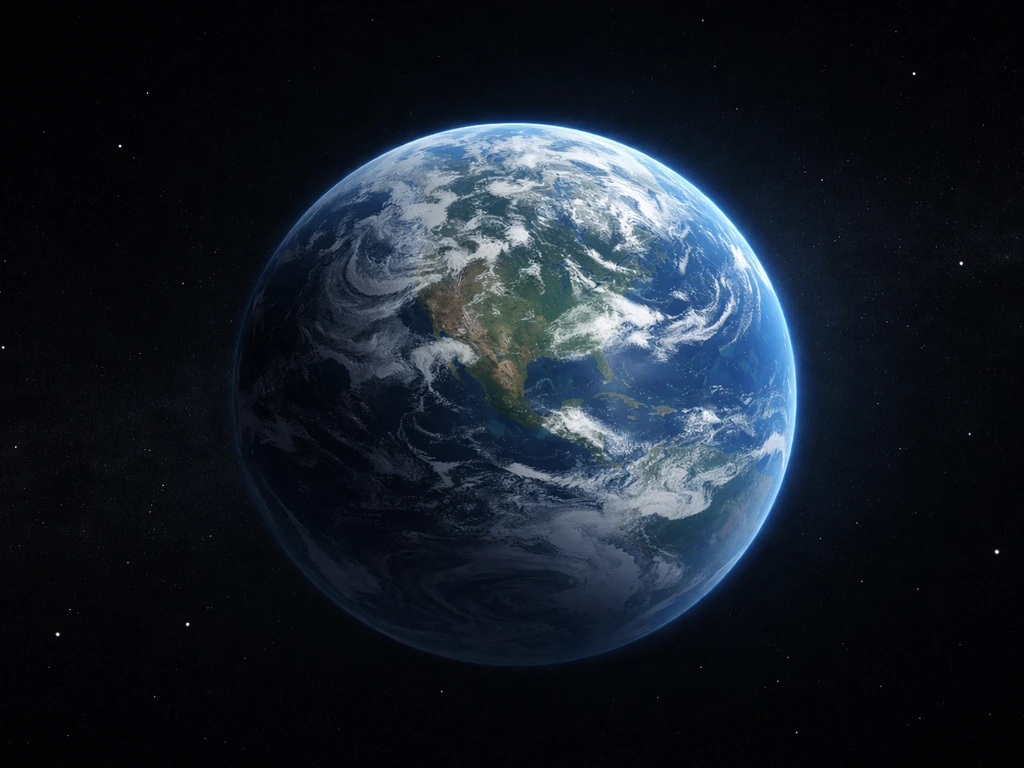
No, Earth does not grow in size the way a living organism does. That same idea applies to the specific question, “does the earth grow over time,” and the short answer is that it does not meaningfully increase in overall size. Its mean radius stays remarkably stable at about 6,371 kilometers, and no natural process is currently adding enough mass or energy to push that number meaningfully upward. What does change, constantly and measurably, is Earth's shape, the distribution of its mass, and the height of local features. Those changes get mistaken for 'growth' all the time, but they are not the same thing.
Does the Earth Grow in Size? What Changes and Why
Marcus Whitmore
20 Apr 2026
The quick answer: does Earth get physically bigger?
Earth's overall radius is not increasing. Satellites have been tracking Earth's gravity field and physical figure for decades, and the data consistently show that changes in Earth's effective radius are vanishingly small and dominated by mass redistribution, not by a planet swelling outward. Think of it like squeezing a water balloon: you can push mass around, change the shape, and shift the center of gravity, but the total volume of rubber and water does not increase. That is essentially what is happening on Earth.
The planet does gain and lose small amounts of mass every year through a cosmic exchange, but even those contributions are so tiny relative to Earth's total mass (about 6 x 10^24 kilograms) that they produce no perceptible radius change on any human timescale. So if you searched for this wondering whether Earth is silently ballooning outward, the answer is no.
Why Earth can't grow like a living thing
When a cell grows, it actively builds new material from chemical inputs, guided by genetic instructions and fueled by metabolic energy. Earth has none of that machinery. It is a nearly closed physical system bound by gravity, and changing its radius meaningfully would require a sustained, massive input of both mass and energy that simply is not happening. Attraction between objects, though, can feel stronger or weaker in space depending on how their mass is arranged there.
Here is the key constraint: expanding Earth's radius means increasing its gravitational potential energy. Without a continuous external source driving that expansion, any small perturbation just redistributes mass internally. The planet settles back toward its equilibrium shape, an oblate spheroid slightly flattened at the poles and bulged at the equator. That shape is controlled by Earth's rotation rate and internal density structure, not by any growth process.
This is a theme that comes up across planetary science. When asking whether the moon grows, or whether the sun grows every year, or how the giant planets grew so large in the first place, the answer always comes back to the same physics: without a sustained mass or energy input, planets reach an equilibrium and stay close to it. That same equilibrium idea is the key to understanding how do galaxies grow, too how planets reach equilibrium.
That same equilibrium idea also applies to attraction in space: without a sustained change in mass or energy, gravitational effects do not steadily build up the answer always comes back to the same physics. Stars grow only as they evolve internally, not by steadily expanding outward as time passes Stars do not physically grow. Stars do not physically grow at a steady rate just because time passes; instead their changes come from internal evolution and fuel burning the moon grows.
Understanding whether the moon grows helps explain how mass and energy inputs drive equilibrium changes in bodies across the solar system. That same idea applies to the moon: its size changes, if at all, are driven by mass and energy exchanges rather than steady outward growth Understanding whether the moon grows. Earth hit that equilibrium billions of years ago.
What could actually change Earth's size (and by how much)
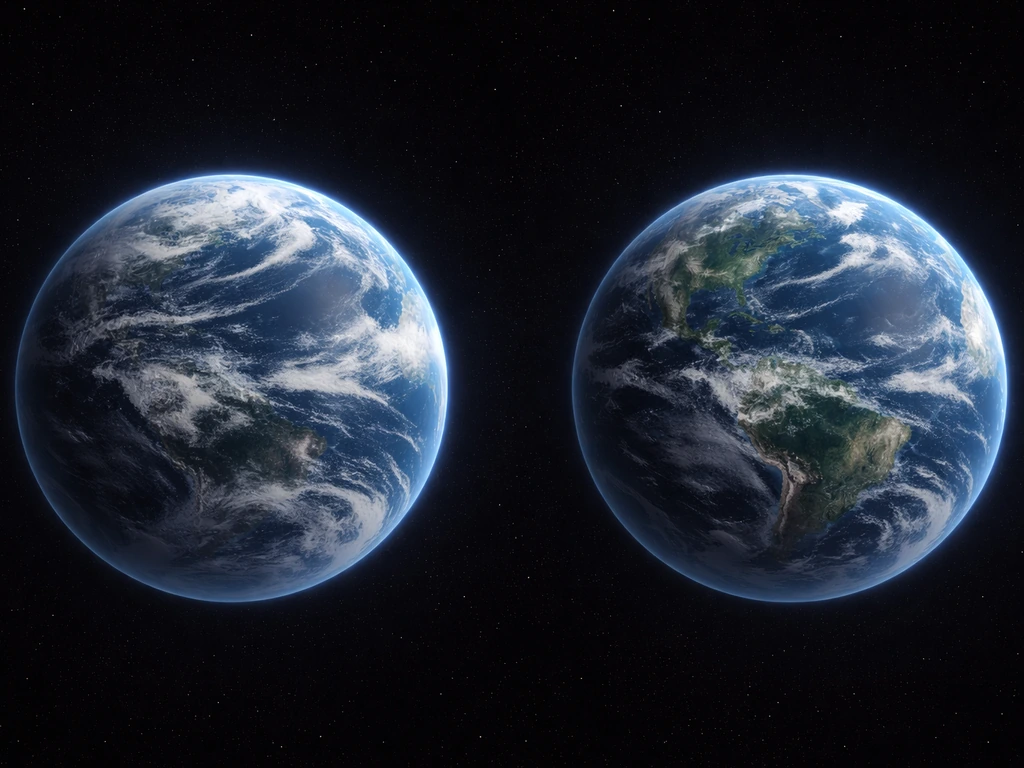
There are real processes that affect Earth's mass and, theoretically, its size. They just do not add up to anything dramatic.
Mass coming in: meteoritic dust and debris
Earth is constantly sweeping up cosmic material as it orbits the sun. Tiny meteoroid particles, micrometeorites, and occasional larger rocks rain down continuously. Estimates put this infall at roughly 40,000 tonnes per year. That sounds like a lot until you remember that Earth's total mass is about 6,000,000,000,000,000,000,000 tonnes. The incoming material is a rounding error.
Mass going out: atmospheric escape
At the same time, Earth leaks mass from the top of its atmosphere. Light gases like hydrogen and helium move fast enough to exceed escape velocity and drift off into space. Estimates for this loss run around 100,000 tonnes per year, which actually exceeds the incoming meteoric material. That means Earth is on a very slight net mass-losing trend, not gaining. Either way, both numbers are negligibly small.
Erosion, sedimentation, and volcanism
Erosion grinds down mountains and carries material to the oceans. Sedimentation builds up layers on the seafloor. Volcanism adds new rock at the surface and releases gases into the atmosphere. Volcanism adds new rock at the surface and releases gases into the atmosphere, and if you are curious about the mechanics of local buildup, see how do volcanoes grow as a related perspective. None of these change Earth's total radius because they are just moving material around within the system. A mountain wearing down does not shrink the planet; it just flattens a local feature and deposits the sediment somewhere else.
Plate tectonics, mountain building, and sea level: change without growth
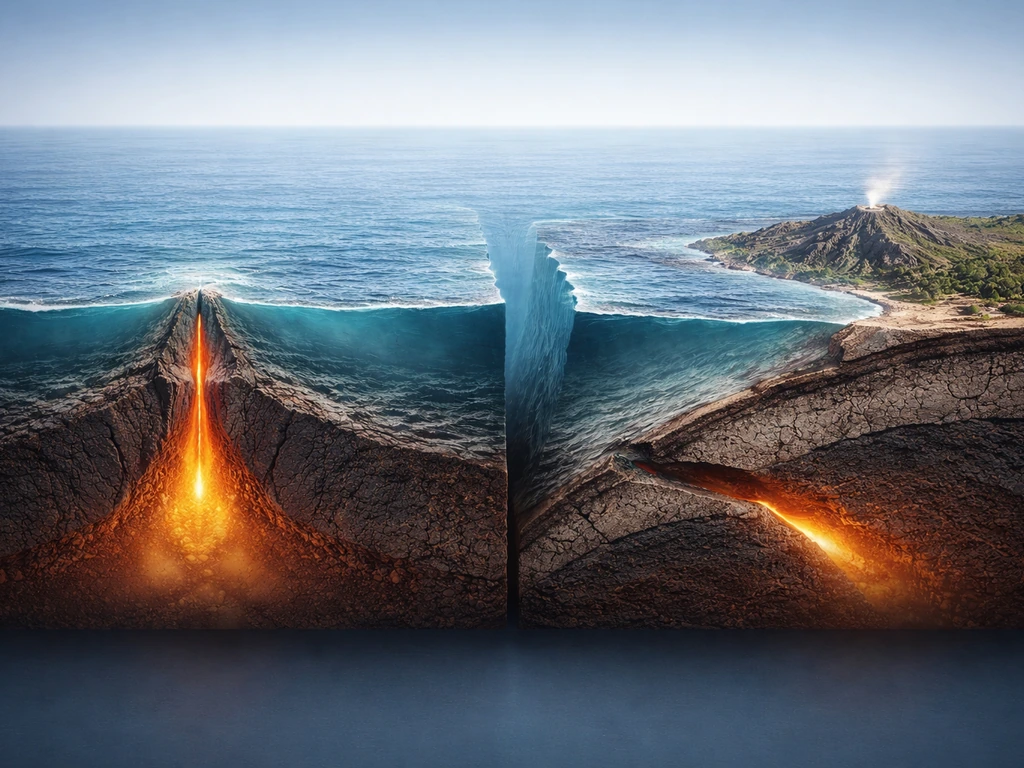
This is where a lot of the confusion lives. Plate tectonics is genuinely dramatic. Ocean floors spread at mid-ocean ridges, continents collide and push up mountain ranges, and subduction zones drag old crust back into the mantle. It looks like Earth is changing size, but what is really happening is a constant recycling of the crust.
When two continental plates collide and the Himalayas rise a few millimeters per year, Earth's mean radius is not increasing. The crust is thickening locally while the mantle material below adjusts. Meanwhile, at subduction zones, about the same volume of crust is being consumed back into the mantle. The net effect on total Earth volume is essentially zero.
Sea level changes add another layer of apparent complexity. When ice sheets melt, ocean water mass increases and sea levels rise, currently at roughly 2 to 3 millimeters per year when you account for both thermal expansion and added meltwater mass. But sea level rising is not the same as Earth's radius growing. It is a redistribution of water mass from ice on land to liquid in oceans, and it shifts the geoid (the gravity-based reference surface) rather than physically inflating the planet.
How scientists actually measure these changes
The tools scientists use to track Earth's figure and mass are remarkably precise, and they all tell the same story.
| Method | What it measures | Typical signal scale |
|---|---|---|
| Satellite Laser Ranging (SLR) | Earth's gravity field shape (including J2, the oblateness term) and long-term figure changes | Changes in J2 of order 10^-11 per year |
| GRACE / GRACE-FO gravimetry | Time-variable gravity from mass redistribution (ice, ocean, groundwater) | Equivalent water height changes of centimeters seasonally, millimeters per year secularly |
| GPS / GNSS geodesy | Surface deformation, tectonic motion, post-glacial rebound | Millimeters per year for most signals |
| Satellite radar altimetry | Sea surface height | 2-3 mm/yr sea level rise rate |
Satellite Laser Ranging (SLR) has been tracking Earth's gravity field since the 1970s using satellites like LAGEOS. By bouncing laser pulses off these satellites and measuring the return time with extreme precision, scientists can detect tiny shifts in Earth's gravitational pull and, from that, infer changes in how mass is distributed. The key parameter they track is called J2, which describes Earth's oblateness. The secular trend in J2 runs at the order of 10^-11 per year. That is not a typo. It is an almost unimaginably small number.
GRACE and its successor GRACE-FO (Gravity Recovery and Climate Experiment) take a different approach. blank" rel="noopener noreferrer">Two satellites fly in tandem about 220 kilometers apart, and as they pass over regions of varying mass (a melting glacier, a depleted aquifer, a swelling ocean), the gravity difference slightly changes the gap between them. That gap is measured to within a micron. GRACE data are reported as changes in 'equivalent water thickness' relative to a time-mean baseline, typically in centimeters for seasonal signals. The point is that GRACE is measuring blank" rel="noopener noreferrer">redistribution of mass, not an expanding planet.
GPS networks complement all of this by tracking actual surface motion. Post-glacial rebound, where land that was compressed under ice sheets slowly rises after glaciers retreat, is clearly visible in GPS data in places like Scandinavia and Canada. That land is rising at rates of up to a centimeter per year in some locations. Again, the crust is moving, not the planet growing.
What the long-term data actually show
Put it all together and the picture is clear. Earth's mean radius is not on an upward trend. The signals scientists detect are:
- Seasonal mass shifts as water moves between atmosphere, land ice, and ocean (centimeter-scale gravity signals, fully reversible each year)
- Long-term ice loss from Greenland and Antarctica adding to ocean mass at roughly 2 mm/yr equivalent sea level (redistribution, not radius growth)
- Post-glacial rebound lifting previously ice-covered land (local surface uplift, not global expansion)
- Volcanic outgassing adding trace gases to the atmosphere (negligible mass effect)
- Net mass exchange with space: roughly 40,000 tonnes/year in from meteorites, roughly 100,000 tonnes/year out from atmospheric escape, leaving a tiny net loss
Glacial cycles deserve special mention here. Over tens of thousands of years, ice sheets grow and shrink, loading and unloading the crust. When ice loads up, the crust depresses and the mantle flows outward slightly. When ice retreats, the land rebounds. These are real, measurable radius changes at the local level, but they cancel out globally. The planet is not expanding; it is breathing very slowly in response to ice mass shifts.
Volcanism contributes similarly. New seafloor generated at mid-ocean ridges adds fresh crust, and volcanoes build new land (Hawaii being the obvious example), but subduction removes an equivalent volume of old crust elsewhere. Over geological time, this conveyor belt keeps Earth's total volume in approximate balance. Compared to something like how volcanoes grow locally, the planetary net effect is negligible.
The bottom line from five decades of satellite geodesy is straightforward: any changes in Earth's mean radius are so small they fall within measurement noise for most practical purposes. We are talking about a planet whose radius is stable to within a fraction of a millimeter per year when you account for all the redistribution signals. That is about as close to 'not growing' as a planet can get.
Want to verify this yourself? Here is where to look
If you want to dig into the real data rather than just taking anyone's word for it, here are practical places to start.
- NASA's GRACE Tellus website (grace.jpl.nasa.gov) publishes monthly mass grid data showing how Earth's gravity field shifts over time. You can download and visualize the data yourself.
- The International Laser Ranging Service (ILRS) publishes SLR-based analyses of Earth's gravity field, including J2 trend data, going back over 30 years.
- NASA's Earth Observatory regularly publishes accessible summaries of sea level, ice mass, and gravity change findings from GRACE-FO, with graphs that make the trends easy to read.
- The IPCC reports include detailed chapters on sea level contributions (ice melt vs. thermal expansion vs. ocean mass) that directly address the mass redistribution question.
- For a hands-on sense of scale, calculate what 40,000 tonnes per year means as a fraction of Earth's total mass (6 x 10^24 kg). The result is about 6.7 x 10^-18 per year, a number so small it makes clear why no radius change is detectable.
Earth is a dynamic, constantly changing system, and studying it reveals incredible processes. But 'dynamic' is not the same as 'growing.' The planet redistributes, recycles, and reshapes itself continuously, while staying almost exactly the same size it has been for billions of years. how do galaxies grow.
FAQ
If Earth’s radius is stable, why do some measurements make it look like it’s changing?
On human timescales, Earth’s mean radius change is effectively undetectable compared with normal measurement variability. The main signals are mass redistribution (ice melt, groundwater changes, ocean density changes) and crustal motion (uplift, subsidence), not a steady outward expansion.
Can Earth physically “grow” in some places but not overall?
Yes, locally. If you live near an area that is rebounding after past glaciation, you can see vertical motion that looks like “the ground is rising,” and coastal regions can see the opposite. Those are vertical crustal changes and water redistribution, not the entire planet getting bigger.
Does rising sea level mean Earth is growing in size?
Sea level rise can make coastlines retreat and change how you interpret “size,” but it does not mean the planet’s radius is increasing. It mainly reflects added meltwater and thermal expansion of seawater, which shifts mass and the geoid rather than inflating the solid Earth globally.
Are meteors adding enough mass to make Earth larger?
Yes, but only as a small net balance over long periods, and the effect on radius is far too tiny to matter. Earth gains some mass from incoming dust and meteoroids and loses more from atmospheric escape, so the net trend is slightly mass-losing, not ballooning outward.
What about Earth’s shape changing, does that count as growing?
Earth can change its shape in measurable ways, for example the pole-equator flattening term and short-term variations in how mass is distributed. However, these changes do not translate into a sustained increase in the planet’s overall volume or radius.
How should I interpret GRACE/GRACE-FO results if I’m wondering about radius growth?
The “equivalent water thickness” estimates from GRACE-like missions are presented relative to a baseline and mainly track water moving around (glaciers, aquifers, soil moisture, and the oceans). They are not measuring an actual expansion of the Earth, and converting them into a “radius change” would be misleading.
Could Earth start expanding if enough mass were added, even slowly?
In principle, if Earth permanently absorbed a large amount of mass from outside, it could alter its radius through gravity and internal pressure changes, but there is no known continuous process adding enough mass and energy to drive a noticeable expansion. The current “cosmic exchange” is orders of magnitude too small.
If plates move and mountains rise, why doesn’t Earth get bigger?
No. Earth’s internal recycling (plate tectonics, erosion, sedimentation, volcanism, and subduction) moves material around so the total volume stays nearly balanced. You can get substantial regional changes, like mountain building or new seafloor formation, without a global radius increase.
How can glacial cycles cause radius changes if the planet isn’t growing?
For “breathing” in the glacial cycle context, local radius-related effects can occur because ice loading depresses the crust and unloading lets it rebound. Globally, the net effect cancels because the mass is still part of Earth’s system and is rebalanced over the cycle.
What measurement should I look at to tell “redistribution” from real growth?
If you’re looking for the right quantity, focus on mean radius, Earth’s gravity field parameters tied to figure, and geodetic observables that separate redistribution from solid-Earth motion. Avoid conflating vertical land motion and sea level with an actual global increase in Earth’s size.
Next Article
Does the Sun Grow Every Year? What Changes and Why
No. The Sun’s mass stays nearly constant year to year; brightness and size change only slightly over long time.