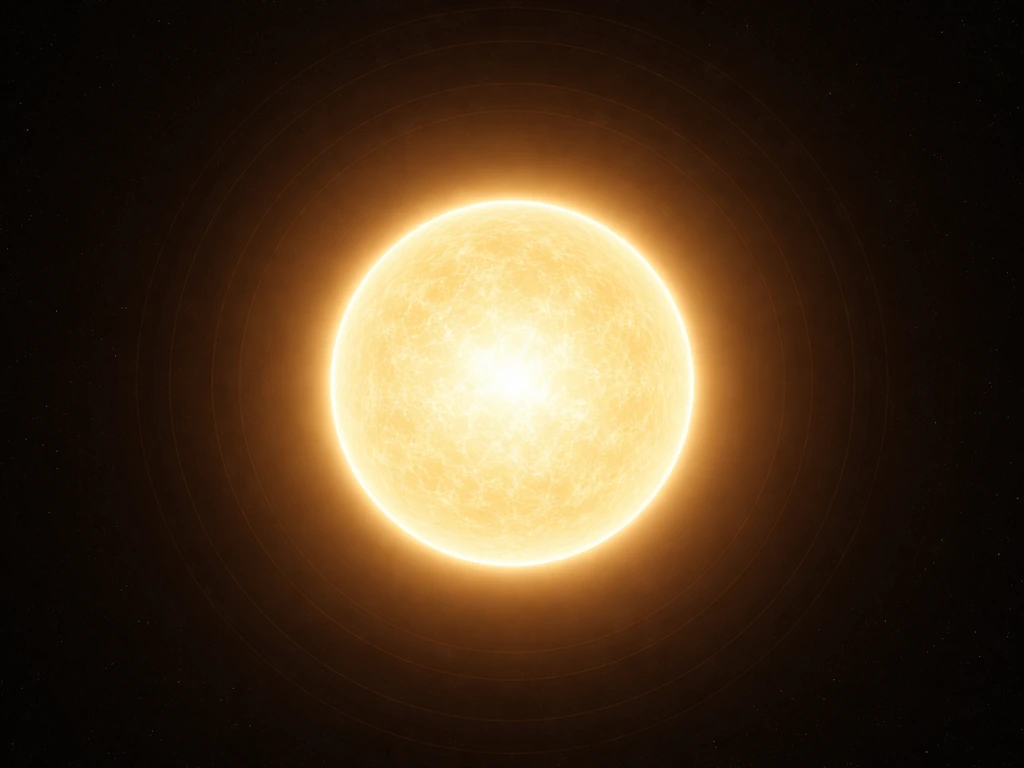
Yes, the Sun does grow, but not quite in the way you might picture. It isn't piling on mass the way a snowball rolls downhill. What's actually happening is a slow, steady increase in brightness over billions of years, driven by changes deep inside its core, alongside a future dramatic expansion that will eventually puff it into a red giant. The short answer: the Sun grows in luminosity (energy output) over its lifetime, and it will grow in physical size near its death, but right now, on a day-to-day or even century-to-century timescale, its size is essentially fixed.
Does the Sun Grow Over Time? Size, Mass, and Brightness

Marcus Whitmore
4 Apr 2026
What "the Sun grows" can actually mean
When people ask whether the Sun grows, they usually mean one of three different things, and each has a different answer. First, does the Sun gain mass over time, getting physically heavier? Second, does it expand in size, taking up more space in the sky? Third, does it grow in brightness or energy output? These aren't the same thing, and mixing them up is where most confusion starts.
Right now, the Sun is actually losing a tiny amount of mass every second. Nuclear fusion converts hydrogen into helium, and in that process a small fraction of mass is converted directly into energy (this is Einstein's E=mc² at work). On top of that, the solar wind streams charged particles out into space continuously. So in terms of raw mass, the Sun is very slowly shrinking, not growing.
But in terms of luminosity, which is the total power it radiates, it has been growing steadily since it formed and will continue to do so for billions of years. These two facts can coexist because mass loss and luminosity increase are driven by the same underlying process: nuclear fusion burning through the Sun's hydrogen fuel.
How the Sun got its mass in the first place
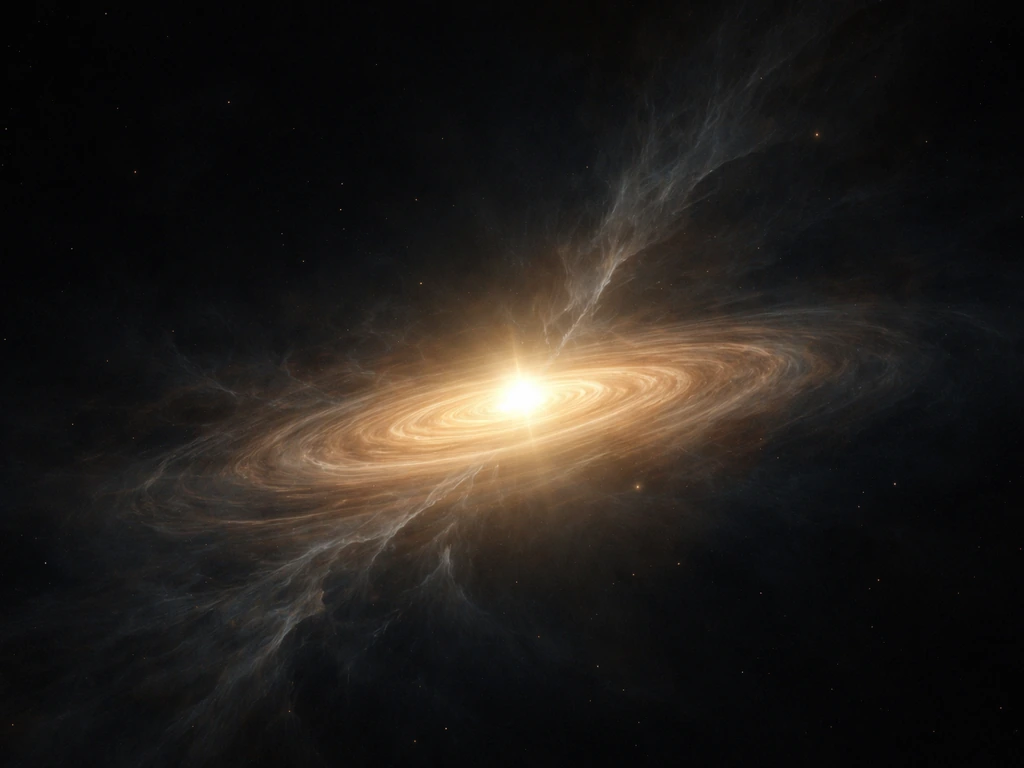
To understand how the Sun "grew" into what it is today, you have to go back about 4.6 billion years to a cold, dense cloud of gas and dust called a nebula. Gravity is the engine here. A slight overdensity in the cloud causes material to pull toward a center point. As more gas falls inward, the core heats up, pressure rises, and you get a protostar: a hot, dense ball of gas that hasn't yet ignited sustained nuclear fusion but is actively accumulating mass from the surrounding disk of material.
This accretion phase is the Sun's real "growth" period in terms of mass. Think of it like water draining toward a bathtub plug, except the drain keeps growing as more water rushes in. Over millions of years, the protostar gathered enough mass that the core temperature hit roughly 10 million Kelvin, the threshold for hydrogen fusion to begin. At that point, the Sun joined what astronomers call the main sequence, a stable phase of life where it has been sitting for the past 4.6 billion years. It's not gaining significant mass anymore. The growth-in-mass chapter is essentially over.
What makes the Sun's brightness change over time
Once on the main sequence, the Sun's story shifts from growing in mass to growing in luminosity. In the core, hydrogen nuclei fuse into helium. Helium is denser than the hydrogen it replaced, so the core slowly contracts and heats up over billions of years. A hotter core means faster fusion reactions, which means more energy poured out. The result is a gradual but relentless brightening. Astronomers estimate the Sun is about 30% more luminous today than it was when it first ignited, and it will be roughly 10% brighter 1 billion years from now.
There's also a shorter-term brightness variation worth knowing about. The Sun has an approximately 11-year activity cycle driven by changes in its magnetic field. During solar maximum, there are more sunspots, flares, and active regions. But NASA data shows that the Sun's total brightness changes by only about 0.
1% between the minimum and maximum of a cycle. That's a rounding error compared to the long-term luminosity trend. The Sun's total power output, the luminosity, sits at roughly 3. 846 × 10²⁶ watts, and short-term magnetic cycles barely dent that number.
NASA GSFC Cosmicopia explains that solar luminosity is measured in watts, meaning joules per second, and it gives a numerical value of about 3. 8×10^26 W for the Sun’s luminosity [solar luminosity measured in watts](https://cosmicopia. gsfc. nasa.
gov/qa_sun. html).
Why the Sun can't just keep growing forever
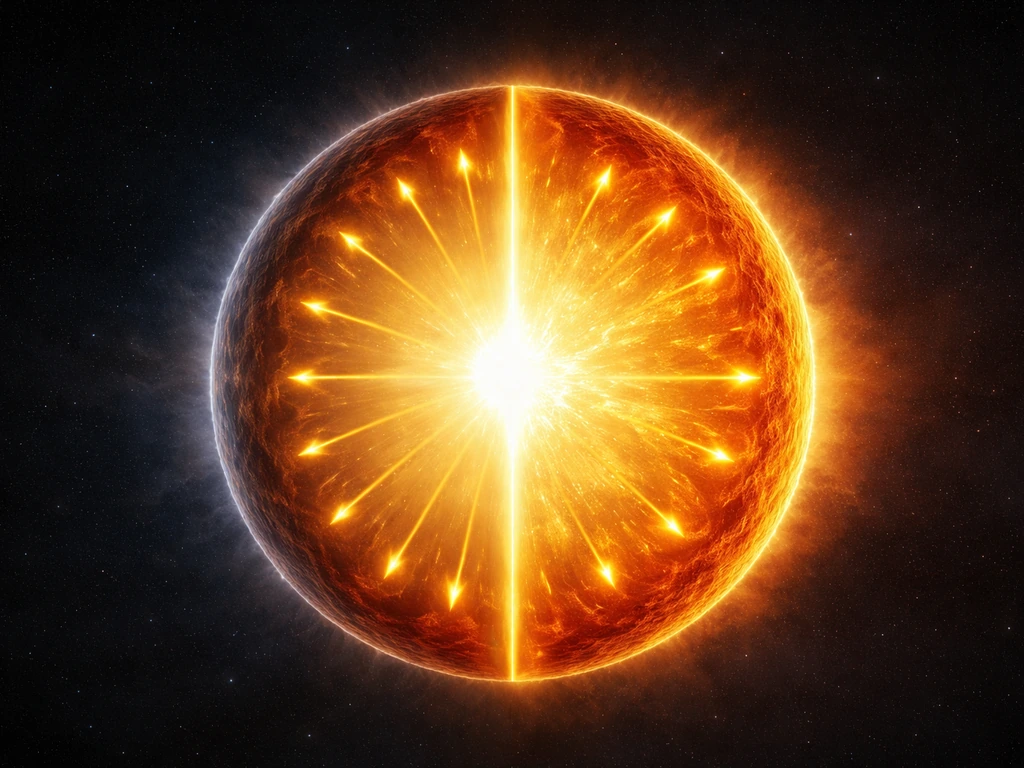
This is the part that connects most directly to what this site is about: every growing system eventually hits a wall. For living cells, that wall is the surface-area-to-volume ratio and nutrient diffusion limits. For the Sun, the walls are gravity, fuel supply, and a balancing act called hydrostatic equilibrium.
Hydrostatic equilibrium is the tug-of-war that keeps the Sun stable. Gravity pulls every layer of the Sun inward toward the center. Radiation pressure and thermal pressure from fusion push outward. As long as these two forces balance, the Sun holds a steady size. This is why you can't just pump more energy into the Sun and expect it to keep expanding indefinitely, it would simply radiate more and rebalance. The structure is self-regulating, much like how a living organism's body regulates temperature rather than letting it spiral upward.
The fuel supply is the ultimate constraint. The Sun has enough hydrogen in its core to sustain fusion for a total of about 10 billion years. It's already used roughly half of that. Once core hydrogen runs out in about 5 billion years, the core will contract and heat up dramatically, causing the outer layers to expand enormously. The Sun will swell into a red giant, potentially engulfing Mercury and Venus and scorching Earth. That's a genuine physical size increase, but it's the final chapter, not ongoing growth.
It's worth zooming out here. The question of whether the Sun can grow without bound is the same kind of question you'd ask about any physical system. whether an atom can grow indefinitely runs into quantum mechanical limits. Stars run into thermodynamic and gravitational ones. Growth always has a ceiling.
How scientists actually measure and model solar growth
Astronomers can't watch the Sun age in real time, so they reverse-engineer its history and future using stellar models. The standard solar model is built by solving a set of equations describing stellar structure: how pressure, temperature, density, and energy generation relate to each other at every layer of the Sun. Scientists adjust the model's inputs (like initial chemical composition and opacity) until the model's predictions match what we can directly observe today, including the Sun's current luminosity, radius, and surface temperature.
One powerful check on these models comes from helioseismology, studying sound waves that ripple through the Sun's interior. These waves create tiny oscillations in the Sun's surface that telescopes can detect, and the pattern of those oscillations reveals the internal density and temperature profile. It's similar to how seismologists use earthquake waves to map Earth's interior, though the Sun's "quakes" are driven by convection rather than tectonic movement.
By comparing the Sun to other stars of known age and mass, astronomers can validate their models across the entire main-sequence lifespan. When we look at stars slightly older than the Sun, they're slightly brighter. When we look at younger analogs, they're dimmer. The pattern holds cleanly across thousands of observations, confirming that the gradual luminosity increase is real and predictable, not a quirk of any single model.
For perspective, this kind of slow, physics-constrained growth shares interesting parallels with questions like whether the Earth itself grows over geological time. In both cases, the answer depends heavily on what you mean by "grow" and which timescale you're examining.
Sun growth vs. other kinds of cosmic growth
It helps to put solar evolution in context by comparing it to related but distinct phenomena. Here's how solar "growth" stacks up against other things people often wonder about:
| System | Type of Growth | Timescale | Primary Driver | Has a Hard Limit? |
|---|---|---|---|---|
| The Sun (now) | Luminosity increase | Billions of years | Core hydrogen fusion | Yes, hydrogen fuel supply |
| The Sun (end of life) | Physical size expansion (red giant) | ~5 billion years from now | Core collapse, shell fusion | Yes, mass ejection ends it |
| A protostar | Mass accumulation | Millions of years | Gravitational accretion | Yes, disk material runs out |
| The Universe | Spatial expansion | Ongoing since Big Bang | Dark energy | Unknown |
| Earth | Mass gain (minimal) | Ongoing (very slowly) | Meteorite infall minus erosion | Effectively yes |
If questions about how large-scale structures expand interest you, you might also find it useful to look into how the universe itself grows, since that's a form of expansion driven by entirely different physics than stellar evolution.
Myths, misconceptions, and what to take away
Myth: the Sun is actively expanding right now

Not in any meaningful way. The Sun's physical radius is remarkably stable during its main-sequence phase. Day to day, year to year, even century to century, the Sun's diameter holds steady at about 1.39 million kilometers. The red giant expansion is real but billions of years away. Saying "the Sun is expanding" in present tense is misleading.
Myth: the 11-year solar cycle means the Sun is growing and shrinking
The solar cycle changes the Sun's magnetic activity and causes small fluctuations in brightness, but again, only about 0. An arXiv analysis of total solar irradiance variability finds measured TSI changes are only around the ~0.1% level over the 11-year solar cycle and on shorter timescales. 1% variation in total output. This is not structural growth or shrinkage. Think of it like a person's heartbeat changing their blood pressure slightly, it's a rhythm, not a growth phase.
Myth: stars can grow indefinitely if given enough gas
There is actually an upper mass limit for stars, around 150 to 300 times the mass of the Sun. Above that threshold, radiation pressure becomes so intense it blows material off the star faster than gravity can hold it. So even in extreme environments with abundant gas, a star can't just keep piling on mass. The self-regulating nature of stars, that same hydrostatic equilibrium, enforces a ceiling. This is directly analogous to the way atomic structure in DC physics contexts sets boundaries on how particles can grow or combine.
What this means for how you think about "growth"
The Sun is a useful case study precisely because it forces you to be specific about what you mean by growth. Mass? Brightness? Physical size? Each has a different answer, a different mechanism, and a different set of limits. That same precision matters whether you're studying cell division, crystal formation, or star evolution. Growth without specifying the variable being measured is too vague to be useful.
For curious learners, the practical next steps are simple. When you encounter any claim about the Sun "growing" or "shrinking," ask which property is changing (mass, radius, luminosity, temperature), over what timescale, and driven by what mechanism. For solar luminosity, the driver is core fusion chemistry. For physical expansion, the driver will eventually be post-main-sequence shell burning. For short-term brightness flickers, the driver is magnetic cycles.
If you want to extend this line of thinking further, it's worth asking related questions about other scales. For instance, whether space itself grows is a genuinely different question from whether the objects inside it grow, and the distinction matters enormously in cosmology. Similarly, whether the human body grows differently in space shows how growth mechanisms shift when you remove familiar physical constraints like gravity. In every case, the question isn't just "does it grow?" but "what exactly is changing, and why?"
FAQ
If the Sun is not growing in size right now, can the Sun still expand slightly over a human lifetime?
No. On main-sequence timescales, the Sun’s radius changes so slowly that it is effectively constant for human observation, and any small changes you notice are typically due to measurement method, Earth’s viewing geometry, or instrumental calibration rather than true expansion.
Does the Sun’s mass increase because fusion makes the Sun, or decrease because it burns fuel?
No. The solar “mass loss” is tiny compared with the Sun’s total mass, and the ongoing fusion buildup of energy does not translate into net mass gain. Most of the mass change you can point to comes from fusion converting a small fraction of mass into energy, plus a small amount carried away by the solar wind.
How much does the Sun’s brightness actually change over the 11-year solar cycle?
It changes in brightness, but not enough to look dramatic. The long-term increase in luminosity is gradual over billions of years, while the 11-year magnetic cycle alters total brightness by about a tenth of a percent, which is small compared with the steady trend.
If luminosity is increasing, why doesn’t the Sun blow up immediately?
The Sun’s surface temperature is not locked, but it does not “run away” in the main-sequence phase. As luminosity slowly rises, the surface properties adjust so the Sun stays in hydrostatic equilibrium, which is why the overall structure remains stable.
When will the Sun grow in radius the most, and what phase causes it?
Yes, but only at specific stages. In the red-giant future, the Sun will physically expand dramatically because core hydrogen exhaustion leads to contraction and hotter shell burning. Until that evolutionary transition, radius changes are minimal.
If the Sun gets brighter, does that mean its surface gets hotter, or is it bigger, or both?
You would need to compare luminosity and radius together. A slightly higher luminosity can correspond to either a brighter surface temperature, a larger emitting area, or both. The key is that luminosity depends on both radius and temperature, so “brighter” alone is not the full story.
Why can two people measure slightly different “solar output” and get different answers?
Don’t rely on the solar constant value you measure on one day. Weather, atmospheric effects, and solar activity can affect your readings, so professionals look at long-term calibrated measurements to separate measurement noise and magnetic-cycle variation from the billions-of-years luminosity trend.
How do scientists estimate future changes if we cannot watch the Sun age in real time?
Stellar models assume the Sun’s age, initial composition, and how energy is transported through its layers (radiation and convection). The models are tuned so they reproduce current observations like luminosity and surface temperature, and they are tested using helioseismology before being used to predict the future.
Does faster fusion automatically mean the Sun will keep expanding during the main sequence?
Yes, and this can reduce confusion when people hear about “expansion.” Even though energy output increases over time, the Sun does not keep expanding because the pressure forces adjust to maintain balance. Expansion is mainly a post-main-sequence event tied to structural changes, not a steady response to burning faster.
What ultimately stops the Sun from brightening and growing indefinitely?
The internal physics makes growth “ceilinged.” The Sun’s ability to change is constrained by fuel availability (core hydrogen) and by the requirement to stay in hydrostatic equilibrium. Once the core runs low on hydrogen, the structure can change sharply, but not while it still has enough fuel to sustain the main-sequence balance.
Next Article
What Controls When and How Fast Cells Grow and Divide
Learn what controls cell division timing and speed: checkpoints, signals, resources, DNA damage, stress, and failure lea