Earth does grow, but not in the way most people picture. It is not swelling outward like a balloon or piling on mass the way a growing child does. The honest answer depends entirely on what you mean by "grow." Does it gain mass? A little, net negative actually. Does its radius increase? Not in any measurable way. Does its surface change and build up new material? Absolutely, every single day. Let's unpack each meaning so you can walk away with a genuinely useful answer.
Does Earth Grow? Mass, Size, and Life Growth Explained

Marcus Whitmore
6 Apr 2026
What could "Earth grows" even mean?
The word "grow" does a lot of heavy lifting depending on context. For a planet, scientists usually distinguish between at least four possible meanings: (1) mass increasing over time via new material arriving from space, (2) physical dimensions like radius or diameter measurably expanding, (3) surface-level changes where terrain is built up by volcanism, sedimentation, or tectonics, and (4) biological growth on Earth's surface, meaning living things like forests, coral reefs, or soil organisms expanding their coverage. Each of these has a completely different answer, and conflating them is the main reason "does Earth grow?" seems so confusing at first glance.
In planetary science, "growth" most often refers to accretion, the process by which solids clump together into larger objects. That is how Earth formed roughly 4.5 billion years ago: dust, pebbles, and planetesimals smashed together until you had a planet. Today, accretion still happens at a trickle. But the planet is far from its formation phase, and any ongoing "growth" is tiny compared to what it once was.
Does Earth's total mass actually increase?
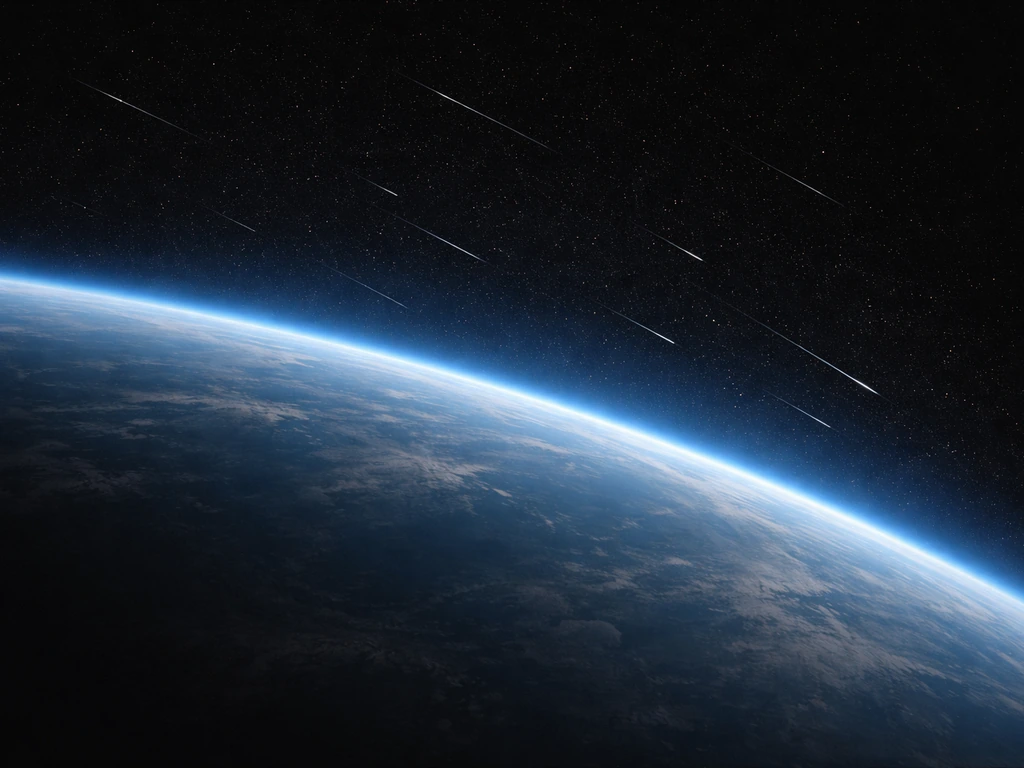
This is the most directly measurable version of the question, and the answer is: barely, and probably net negative. Earth sits inside a constant gentle rain of space material. Micrometeorites and cosmic dust are the biggest contributors, with estimates around 40,000 ± 20,000 tonnes per year arriving from space. Some of that is vaporized in the upper atmosphere, and some reaches the surface as tiny glassy particles you can actually collect from rooftop gutters or deep-sea sediment. Larger meteorites add mass occasionally, but they are rare enough that they don't shift the long-term average much.
On the loss side, Earth continuously bleeds gas from the top of its atmosphere. Hydrogen and helium are light enough to reach escape velocity and drift off into space. Common estimates put hydrogen loss at roughly 95,000 tonnes per year and helium loss at about 1,600 tonnes per year. You can even work this out yourself: a recent atmospheric escape model puts the hydrogen escape rate at approximately 4×10^10 mol H per year. Multiply that by hydrogen's molar mass (about 1 gram per mol) and convert, and you get roughly 40,000 tonnes per year of hydrogen alone, which is in the same ballpark as the incoming dust flux.
Run the rough mass balance and Earth is losing more than it gains. The net result is a very slight, very slow decrease in mass over geological time, not growth. This is not dramatic. Earth's total mass is about 5.97×10^24 kg, so even losing 50,000 tonnes per year is like removing one grain of sand from an entire beach every million years.
Is Earth's radius or diameter getting bigger?
No, not in any way we can detect. Earth's mean radius sits at about 6,371 km and is not trending upward. The reason comes down to how gravity works at planetary scale. Earth is large enough that it is essentially in hydrostatic equilibrium: its internal pressure and self-gravity balance each other out. Any small addition of mass mostly compresses the interior slightly rather than pushing the surface outward. It is a bit like adding a handful of water to an already-full sponge. The outside does not bulge; the inside just gets denser.
Scientists monitor Earth's shape and gravity field continuously using satellite geodesy. The gravitational parameter called J2 (Earth's oblateness, or how much it bulges at the equator compared to the poles) is tracked using satellite laser ranging (SLR). Decadal changes in J2 have been measured, but they reflect mass redistribution within the Earth system, things like ice melting and ocean water moving, not isotropic radius growth. If Earth were genuinely expanding, it would show up as an unexplained, planet-wide signal in these measurements. It does not.
NASA's GRACE and GRACE-FO satellite missions reinforce this. GRACE measures Earth's time-variable gravity field every month by tracking tiny changes in the distance between two satellites flying in formation. It can resolve mass changes equivalent to about 1 to 2 centimeters of water spread over regions of roughly 300 km or more. The data consistently show mass redistribution: water shifting between aquifers, ice sheets, and oceans. There is no unaccounted global expansion signal hiding in the GRACE record.
How Earth's surface does "grow" (geologically speaking)
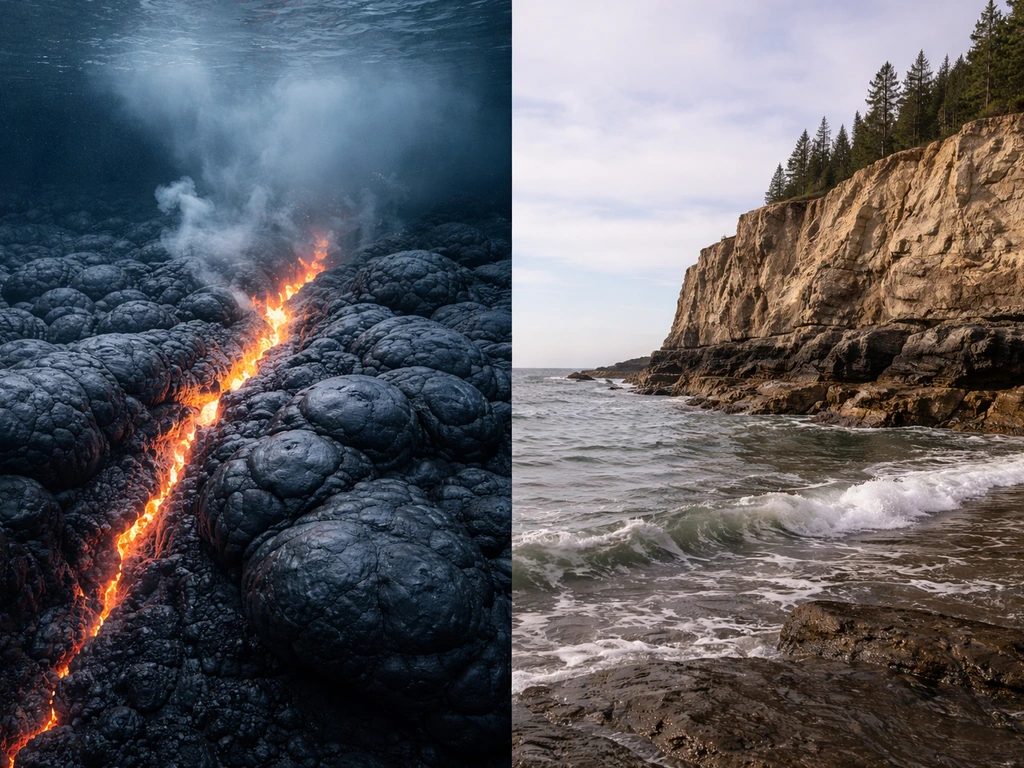
Even if the planet is not gaining radius, its surface is constantly being reshaped and, in places, genuinely built up. This is where the idea of Earth "growing" gets interesting and where connecting it to broader growth principles pays off.
Volcanism: Earth making new rock
blank" rel="noopener noreferrer">Mid-ocean ridges pour out roughly 3 km³ of magma per year globally. Mid-ocean ridge volcanism produces on the order of tens of cubic kilometers of melt per year globally, a key input to how new ocean crust (and thus seafloor) is created at spreading centers blank" rel="noopener noreferrer">Mid-ocean ridge melt production. Continental volcanic systems add another ~1 km³ per year. New seafloor is continuously being created at spreading centers, which is why Iceland literally gets a little wider each year as the Eurasian and North American plates pull apart. New lava islands form in Hawaii. Volcanic plateaus build up over millions of years. This is real material being added to the surface from Earth's interior.
Sedimentation: building up layer by layer
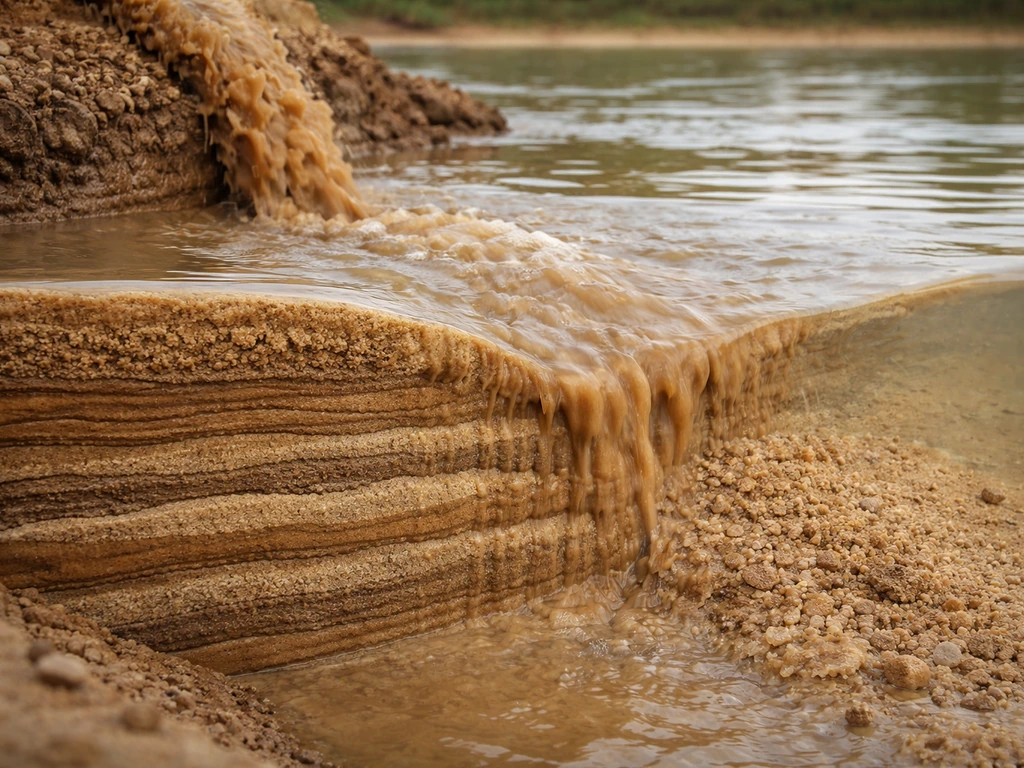
Rivers carry eroded material to deltas and ocean basins, building up thick sedimentary sequences over time. The Mississippi River delta, for example, has been prograding outward into the Gulf of Mexico for thousands of years, adding new land. Sediment layers accumulate in basins and on ocean floors, steadily raising the height of those surfaces.
Erosion and subduction: the balancing act
Here is the catch. Every process that adds material to the surface is balanced by one that removes it. Erosion strips mountains down, transporting material to low-lying areas. Geologists measure erosion speed using the Bubnoff unit (1 B = 1 m³ of rock removed per km² per year), and rates vary enormously from slow-eroding cratons to rapidly incising river gorges.
More fundamentally, subduction zones swallow oceanic crust back into the mantle. One review estimates a sediment subduction flux of about 1. 65 km³ per year, and additional crustal material is dragged down along with it. The system is essentially a giant conveyor belt: crust is made at spreading centers and destroyed at subduction zones, with the global budget staying roughly in balance.
Why Earth can't grow without limits (and why that sounds familiar)
The same principle that stops cells from growing forever applies here: you cannot expand indefinitely without a continuous supply of energy and raw materials, and even then, physical constraints intervene. A cell hits a surface-area-to-volume problem; Earth hits a gravitational binding energy problem. Adding more mass to Earth mostly compresses the interior rather than expanding the radius, because gravity pulls inward harder than the added material can push outward.
Think about it this way: the most energetically costly thing you could do is try to make Earth physically larger. The planet's own gravity fights against that expansion at every step. It is the same reason an atom can't simply grow big by accumulating more electrons; internal forces and quantum constraints set hard limits on size. In Earth's case, the constraint is gravitational, not quantum, but the logic is the same: structure imposes a ceiling on growth.
There is also the question of material recycling. Just as living cells recycle their molecular components through metabolism, Earth recycles its crustal material through the rock cycle. Crust is built, eroded, subducted, remelted, and erupted again. The system is remarkably conservative with its material budget. This kind of closed-loop recycling is a hallmark of constrained, self-regulating systems, whether you are talking about a cell, an ecosystem, or a planet.
If you are curious about whether similar growth-and-limit dynamics apply to other bodies in our solar system, it is worth asking whether the Sun grows in any meaningful sense. The Sun is actively fusing hydrogen into helium and losing mass as radiation and solar wind, making it a good contrast case to Earth's relatively inert mass budget.
The even larger-scale version of this question is whether the universe itself grows, which it does through metric expansion of space rather than mass addition, a completely different mechanism that highlights just how many distinct things the word "grow" can mean across different scales of reality.
How to estimate this yourself and what to check
You do not need a PhD to do a rough sanity check on whether Earth is gaining or losing mass. Here is a simple back-of-the-envelope approach:
- Start with incoming mass: cosmic dust and micrometeorites contribute roughly 40,000 tonnes per year (with uncertainty of ±20,000 tonnes). That is your gain column.
- Add atmospheric loss: hydrogen escaping to space is estimated at ~95,000 tonnes per year, helium at ~1,600 tonnes per year. That is your loss column.
- Rough net: ~40,000 in, ~96,600 out. Net change is roughly negative 56,000 tonnes per year, a tiny fraction of Earth's 5.97×10^24 kg total mass.
- To double-check the hydrogen number: multiply 4×10^10 mol/year by 1 g/mol (molar mass of H) to get 4×10^7 g/year, which is about 40,000 tonnes per year, consistent with the cited figure.
- Express the net loss as a fraction of Earth's mass: 56,000 tonnes is 5.6×10^7 kg per year, divided by 5.97×10^24 kg gives roughly 9×10^-18 per year. That is nine quintillionths of Earth's mass lost annually. Immeasurably small.
For reliable data to dig deeper, here are the best places to look. NASA's GRACE Tellus website publishes monthly gravity field data and has a clear FAQ explaining what the satellite measures and what it does not. The USGS and the Smithsonian Global Volcanism Program track volcanic eruption rates and can give you real-time data on how much material is being added to Earth's surface. For atmospheric escape, look for peer-reviewed papers in journals like Geophysical Research Letters or JGR: Planets, where escape rate estimates are regularly updated as models improve. For cosmic dust influx, look for studies based on stratospheric particle collection and Antarctic ice core micrometeorite sampling, both of which give direct physical evidence of incoming material.
Mass, radius, surface, or life: a quick comparison
| Type of growth | Is it happening? | Rate/scale | Key evidence |
|---|---|---|---|
| Mass increase (accretion) | Net no (slight loss) | ~−56,000 tonnes/year estimated net | Cosmic dust flux vs atmospheric escape rates |
| Radius/diameter expansion | No detectable expansion | Below measurement threshold | GRACE gravity field, SLR J2 monitoring |
| Surface buildup (volcanism) | Yes, locally and globally | ~4 km³/year magma output at ridges and volcanoes | Volcano databases, seafloor spreading records |
| Surface recycling (subduction/erosion) | Yes, offsetting buildup | ~1.65 km³/year sediment subducted plus crustal recycling | Subduction flux reviews, erosion datasets |
| Biological growth on Earth | Yes, dynamic and measurable | Varies by ecosystem and season | Remote sensing, land-cover change datasets |
The short recommendation: if someone asks whether Earth grows, the most accurate one-sentence answer is that Earth gains a tiny amount of mass from space dust but loses slightly more through atmospheric escape, its physical dimensions are stable, and its surface is constantly being built and destroyed in a balanced geological cycle. "Growth" in the everyday sense does not apply.
What about growth in unusual environments?
One place where Earth-related growth questions get genuinely strange is in the context of space itself. Astronauts actually do experience growth of a sort: without gravity compressing the spine, intervertebral discs expand and people can temporarily gain up to 2 inches in height. If you want to go deeper on how the absence of gravity changes biological and physical growth, growth in space environments is a fascinating direction to explore. It shows that "growth" in living systems depends heavily on the physical environment, which is exactly the kind of constraint-based thinking that applies to planets too.
And if you are wondering whether space itself is expanding in a way that might affect Earth's position or apparent size, the answer involves metric expansion rather than any physical growth of matter. You can think of how space expands as a completely separate phenomenon from anything happening to Earth's physical mass or dimensions, one that operates at cosmological scales far beyond what affects our planet's day-to-day geology.
There is also an interesting parallel in thinking about what it would take for something truly small, at the atomic scale, to "grow" in a meaningful sense. Just as Earth's growth is constrained by gravity and material availability, atomic growth is constrained by quantum mechanics and nuclear forces. Across every scale, from atoms to planets to the universe, growth has limits, and understanding those limits is exactly what makes the question worth asking.
FAQ
If Earth is losing mass overall, does that mean the planet is shrinking year by year?
In practice, no. Any net mass decrease from escape is far too small to produce a measurable radius trend on human timescales. You may see local changes (like ice loss or sea level shifts) in gravity and shape data, but that is mass redistribution, not a shrinking planet.
Does new land from volcanoes and lava islands mean Earth is getting bigger?
Not globally. Volcanic construction adds surface material locally, but erosion and especially subduction remove an equivalent amount elsewhere over longer timescales. Net surface area changes can be real in specific regions, yet the planet does not accumulate a growing “extra” shell overall.
Could Earth’s mass still increase if incoming space material is higher than the usual estimates?
Even if the dust influx is off by a factor of two, atmospheric escape would still likely dominate because hydrogen loss is large and persistent. Also, escape is sensitive to solar activity and upper-atmosphere conditions, so the balance needs continuous updating rather than one-time measurements.
Why can’t we just measure Earth’s radius directly and look for growth?
Because the expected signal is extremely tiny compared to natural variability and measurement noise. Also, most of what changes Earth’s “shape” at observable scales is redistribution of water, ice, and air, which affects gravity and geodesy without requiring the whole planet to expand.
What about earthquakes and plate movement, do they change Earth’s overall size?
They change surface geometry locally and temporarily (uplift, subsidence), but they mostly shuffle crustal blocks. The deeper system largely stays in balance because subduction and spreading continue to recycle material rather than adding net planetary volume.
Does biomass growth, like forests and coral reefs, count as Earth growing?
It counts as biological expansion in the narrow sense of living coverage. But the total mass of organisms is minuscule compared with Earth’s mass, and when organisms die their carbon and nutrients cycle back through sediments, soils, and the ocean rather than building a lasting planetary “mass increase.”
Is there any scenario where Earth would measurably grow in the radius sense?
Only under extreme, sustained changes that overwhelm gravitational compression and energy constraints, which is not expected for realistic natural processes. Even large impacts add mass and heat the planet, but Earth rapidly redistributes and re-radiates that energy, and the long-term radius does not show a steady expansion trend.
How do we know incoming and outgoing mass budgets are tracked correctly?
One good sanity check is consistency across methods: direct micrometeorite collections and dust proxies support the incoming flux, while atmospheric escape models are constrained by observations of the upper atmosphere. Gravity missions also help by confirming that the main signals are redistribution rather than an unexplained global expansion.
Do changes in sea level or ice mass affect the idea of Earth growing?
They affect measurements of Earth’s gravity field and surface height, but they are redistribution of existing mass (water moving between storage reservoirs, ice melting, oceans responding). That can mimic some “size change” locally, so it must be separated from true radius increase.
What’s the simplest one-sentence answer to “does Earth grow”?
Earth does gain a small amount of material from space dust, but it loses slightly more through atmospheric escape, its radius is effectively stable, and its surface is continually built and destroyed by geology in a long-term balance.
Next Article
Does the Sun Grow Over Time? Size, Mass, and Brightness
Explains whether the sun grows: how it gained mass forming stars, then slowly brightens, and why it cannot grow forever.