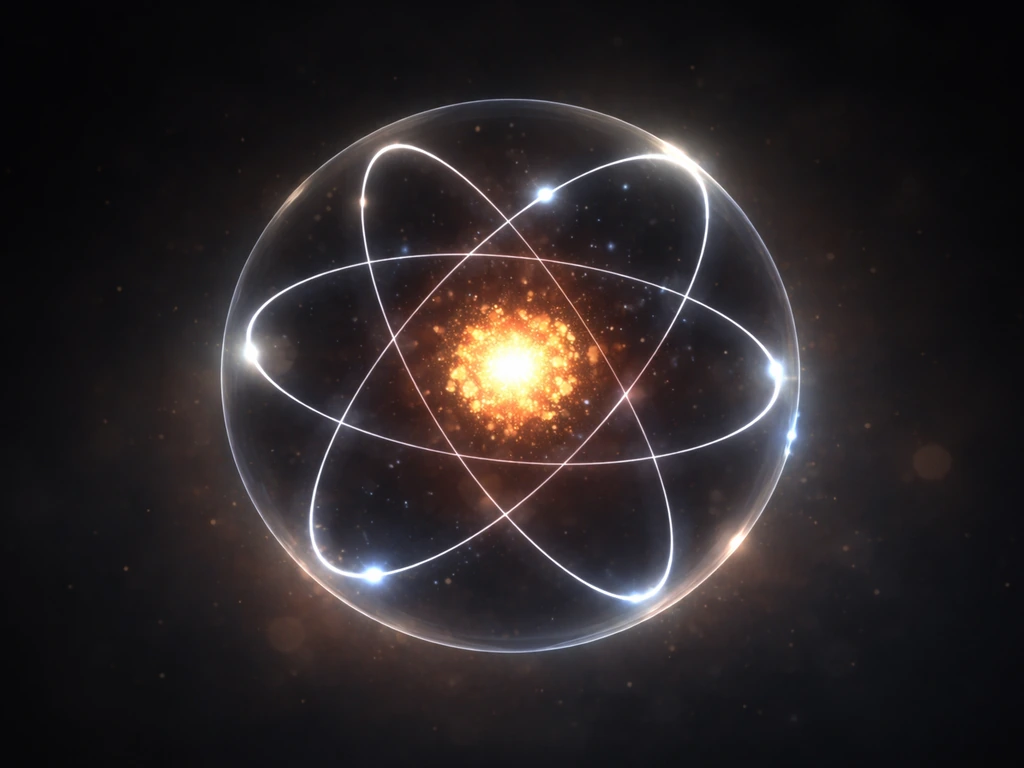
An atom cannot grow in the way a crystal, a cell, or an organism grows. A DC electric field (direct current) can excite electrons, strip them away through ionization, or drive atoms in solution to deposit onto a surface, but none of that makes a single atom physically larger.
Can the Atom Grow DC? Electrical Fields and Material Growth Explained

Marcus Whitmore
22 May 2026
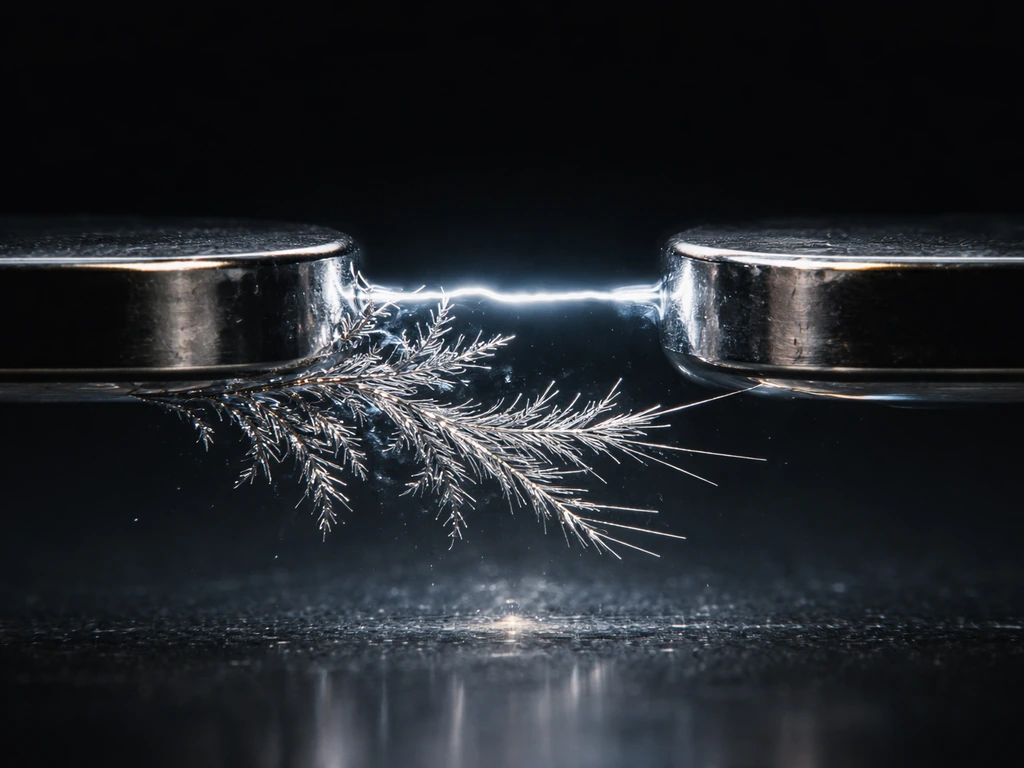
Wikipedia notes that electrons can change energy levels by emitting or absorbing photons and can be completely removed through ionization to form ions, which is distinct from any idea of “atomic size increasing. ” electrons can change energy levels by emitting or absorbing photons and can be completely removed (ionization) to form ions.
What DC current can do is drive macroscopic growth in materials, pulling ions out of solution and building up solid structures one atomic layer at a time. That process is real, measurable, and genuinely useful. The atom itself, though, stays the same size.
What does 'DC' actually mean here?
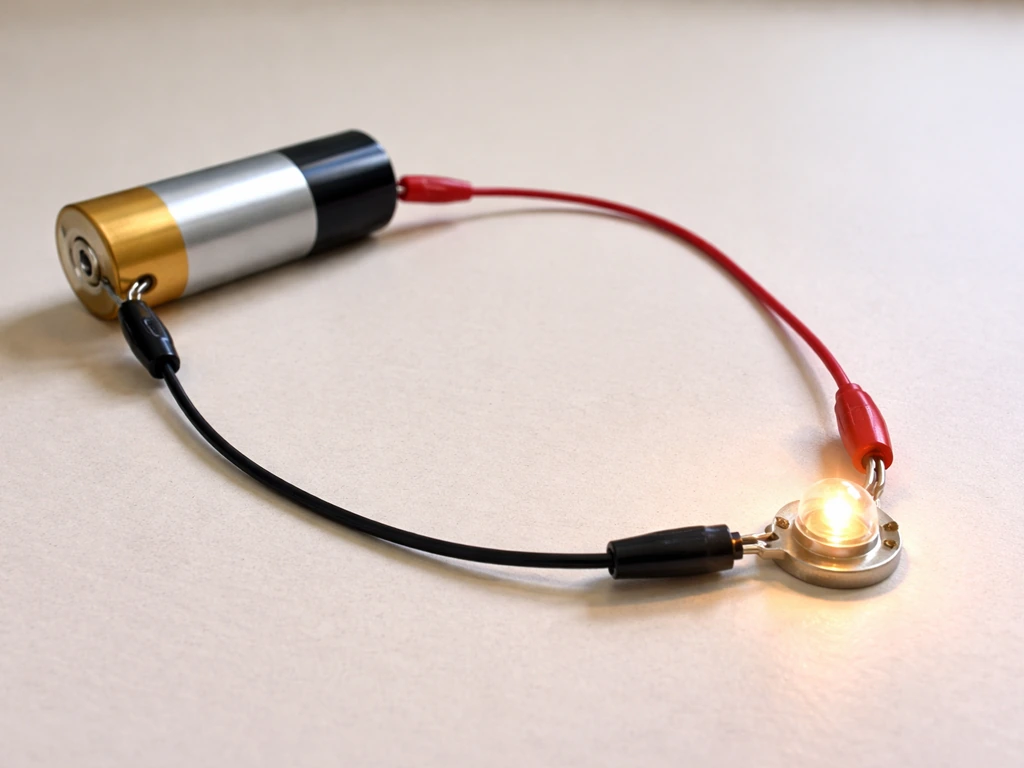
Before going further, it is worth being honest about the ambiguity in the search phrase. 'DC' has a few possible meanings depending on your background. The most common one, shared consistently across physics, engineering, and chemistry, is direct current: electrical current that flows steadily in one direction, the kind you get from a battery. That is almost certainly what most people mean when they type 'can the atom grow DC.'
There is one other possible reading worth acknowledging. 'DC' also refers to DC Comics, and 'The Atom' is a well-known DC superhero who famously shrinks and grows. If you arrived here from a curiosity about that character, the short answer is: comic book physics aside, real atoms do not work that way. The rest of this article is about actual physics and chemistry.
So from here on, 'DC' means direct current. The question becomes: what does a DC electric field or current actually do to atoms, and can any of that be called 'growth'?
Can an atom literally grow bigger?
Not really, and understanding why requires a quick look at what an atom actually is. An atom has a nucleus (protons and neutrons packed tightly together) surrounded by electrons arranged in shells or orbitals. The nucleus is extraordinarily dense and tiny, and the electrons occupy a cloud of space around it. The 'size' of an atom is really the size of that electron cloud, not something with a sharp edge like a marble.
When an electron absorbs energy (from a photon, a collision, or an electric field), it can jump to a higher energy level. This is called an excited state. In that excited state, the electron's orbital extends a bit further from the nucleus, so the effective radius of the atom does technically increase. You might also be wondering, in a more general sense, can the atom grow big instead of just its energy state changing? But this is not growth in any meaningful biological or structural sense. The atom has not gained mass. As soon as the electron releases that energy (usually by emitting a photon), it snaps back to its ground state. The change is temporary, quantized, and reversible.
Push the energy input even higher and you reach ionization: the electron is stripped away entirely. Now you no longer have a neutral atom; you have an ion. Again, no new mass, no structural growth. The identity of the atom is intact. Ionization is an electronic change, not a nuclear one.
The only process that actually changes what an atom fundamentally is involves the nucleus: nuclear reactions like fusion, fission, or radioactive decay. These transform one element into another. But these require enormous energy inputs (or radioactive instability) and are not triggered by ordinary DC currents. A DC field powerful enough to cause field ionization at a surface is well within the range of lab equipment, but it is still doing electron-level work, not nuclear work.
Chemical changes vs nuclear changes: knowing the difference

This distinction matters a lot when you are trying to understand what DC current can actually do. Chemical changes involve electrons being shared, transferred, or rearranged between atoms. blank" rel="noopener noreferrer">Electrochemical reactions, the kind that happen in a battery or an electroplating tank, are chemical changes driven by electron flow. Atoms of copper in a copper sulfate solution pick up electrons at an electrode and deposit as solid copper metal. The copper atoms are still copper. They have just changed location and bonding state.
Nuclear changes are a completely different category. Radioactive decay, for instance, involves a nucleus spontaneously transforming into a different isotope, emitting particles and energy in the process. That produces a genuinely different element or isotope. No DC current you could apply in a lab or classroom setting will trigger a nuclear transformation. The energy scales are orders of magnitude apart.
| Type of change | What moves or transforms | Does DC current cause it? | Does the atom 'grow'? |
|---|---|---|---|
| Excitation | Electrons jump to higher energy levels | Indirectly (via field effects) | Temporarily, slightly |
| Ionization | Electrons are removed completely | Yes, in very strong fields | No (loses electrons, becomes ion) |
| Chemical / electrochemical | Electrons transfer between atoms/molecules | Yes, this is core electrochemistry | No (atoms move/deposit, not enlarge) |
| Nuclear (decay/fusion/fission) | Protons/neutrons rearrange; element changes | No | No (element transforms entirely) |
What DC fields and currents actually do to atoms in materials
A DC electric field interacts with atoms primarily through their electrons. In a conductor, the field pushes free electrons along, creating current flow. In an ionic solution, it pushes charged ions toward oppositely charged electrodes. Neither of these processes grows atoms. But they do drive real, observable changes at surfaces and interfaces.
One well-documented effect is the blank" rel="noopener noreferrer">Stark effect: an external electric field shifts and splits the energy levels of an atom. This is measurable with spectroscopy and is used in atomic physics research. The atom's energy landscape changes, but its mass and nuclear identity do not. It is more like pressing on a spring than inflating a balloon.
In very high electric fields near surfaces, field ionization can occur: the field is strong enough to pull electrons away from atoms at the surface. This is used in field ion microscopy to image individual atoms on metal tips with extraordinary resolution. Still not growing atoms, but it does show that strong DC-like fields have real atomic-level consequences.
For most practical purposes (batteries, electroplating, electrochemical sensors, crystal growth setups), DC current drives ions through a solution and deposits them at an electrode. The current density, voltage, electrolyte concentration, pH, and temperature all control how fast and in what form that deposition happens. Those variables are the levers. The atoms themselves are just following where the field sends them.
Where growth actually happens: crystals, dendrites, and electrodeposition
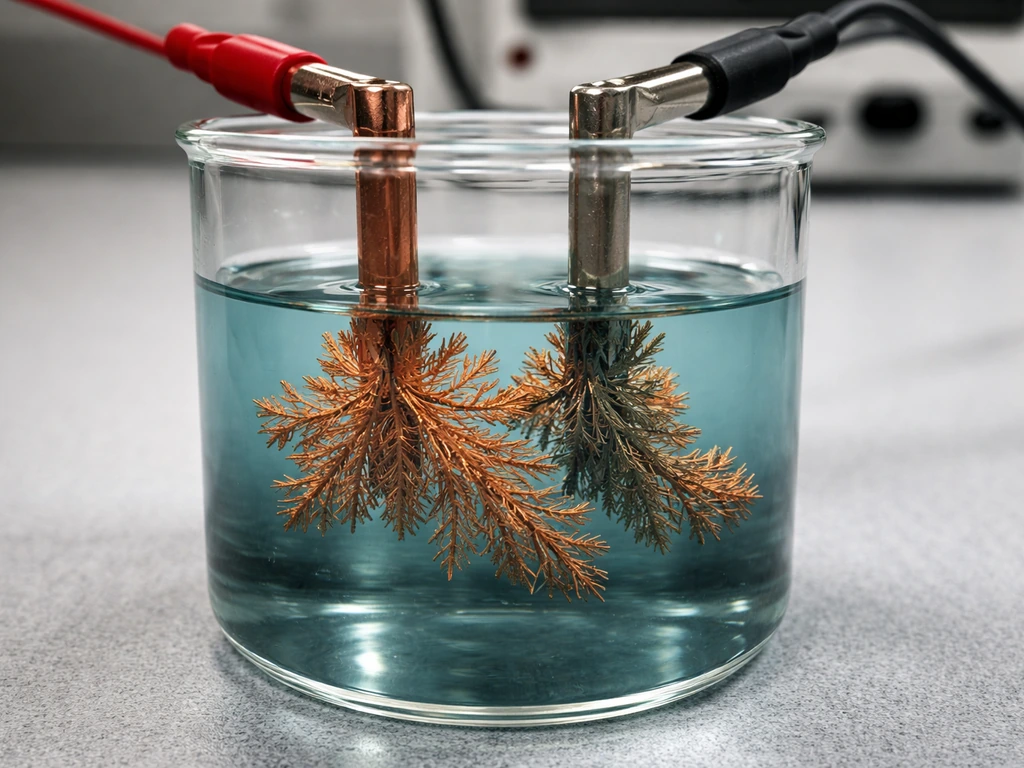
Here is where things get genuinely interesting. Even though a single atom cannot grow, DC-driven processes can produce spectacular macroscopic growth in solid materials. This is called electrocrystallization or electrodeposition, and it is one of the clearest examples of atoms collectively building something much larger than themselves.
The mechanism works like this: when you apply a DC voltage across two electrodes in an ionic solution (say, copper sulfate with copper electrodes), copper ions from the solution migrate to the negative electrode (cathode), gain electrons, and deposit as solid copper atoms. One atom, then another, then another, until you have a visible layer of solid metal. The process is governed by nucleation and growth: first a few atoms cluster together to form a stable nucleus, then more atoms attach to that nucleus and the crystal grows outward.
The shape and quality of that growth depends heavily on the DC conditions. Higher overpotential (more voltage than the minimum needed) tends to create more nucleation sites but smaller grains. Lower overpotential encourages fewer, larger crystals. Push the current density too high and you get dendritic growth, those fern-like metallic spikes that can short-circuit batteries and create safety problems. The DC field is essentially sculpting the morphology of the growing solid, even though each individual atom is just landing on a surface and bonding.
This is closely related to how crystals grow in geological and biological settings. Whether it is a copper crystal forming in an electroplating tank, a calcite crystal growing in a cave, or a snowflake forming around a dust particle, the principle is the same: individual atoms or ions add onto an existing structure one at a time, following energetic rules about where they fit best. The DC field is just one way to drive or steer that process. The atom itself never inflates.
It is worth briefly noting that similar field-driven assembly ideas come up in dielectrophoresis, where electric field gradients can push and position particles (including nanoscale ones) through space. This is more about moving objects than growing them, but it is another example of how electric fields manipulate matter at small scales without changing what the matter fundamentally is.
Why growth can't just keep going: the hard limits
This site covers why growth has limits across all scales, from cells that can only divide so many times to organisms that hit a size ceiling determined by physics and metabolism. The same principle applies here. Electrocrystallization under DC conditions runs into hard physical walls.
- Diffusion limits: ions in solution have to physically travel to the electrode. As deposition speeds up, a boundary layer depletes near the surface. Once the concentration of ions at the surface drops to near zero, you have hit the limiting current density. You cannot deposit faster than ions can arrive, no matter how much voltage you apply.
- Energy conservation: you cannot create matter from nothing. Every atom deposited on an electrode came from somewhere in the solution, and that solution depletes over time. The system needs a continuous supply of material and energy to sustain growth.
- Structural instability: push the current too hard and dendrites form. Dendrites are fragile, poorly bonded, and often break off or short-circuit the system. Fast growth is almost always lower-quality growth.
- Electrode and electrolyte degradation: high currents in aqueous solutions can trigger competing reactions like hydrogen gas evolution, which wastes energy and can damage the electrode surface.
- Thermodynamic equilibrium: at some point, the driving force (the applied potential) is balanced by the back-potential of the deposited material. The Nernst equation describes this equilibrium. Growth slows and stops unless you continue putting energy in.
These limits mirror what happens in biological growth: a cell cannot keep dividing without resources, signals, and space. A crystal cannot keep growing without a supply of dissolved material and a suitable energy gradient. The atom is just the building block. The constraints live at the system level.
How to explore this safely and what to look up next
If you want to see DC-driven atomic-scale growth with your own eyes, electroplating copper is one of the most accessible demonstrations in chemistry education. You need copper sulfate solution, two copper electrodes, and a low-voltage DC source (a 9-volt battery works). Connect them, wait a few minutes, and you will see copper depositing visibly on the negative electrode. Change the voltage and watch how the deposit texture changes. That rough or smooth surface reflects exactly the nucleation and growth dynamics described above.
For deeper reading, the key terms to search are: electrodeposition, electrocrystallization, nucleation overpotential, limiting current density, Stark effect (for field-atom interactions), and field ionization. If you are curious about whether atoms themselves change identity, search for nuclear transmutation or radioactive decay, and you will quickly see how different that domain is from anything a DC current can accomplish.
It is also worth comparing this question to related ones about growth at different scales. Whether space itself expands, whether the Earth accumulates mass, or whether you can grow in a microgravity environment all involve the same underlying question: what actually changes, what moves, and what stays conserved?
Whether space itself expands, whether the Earth accumulates mass, or whether you can grow in a microgravity environment all involve the same underlying question: what actually changes, what moves, and what stays conserved? That same question also shows up when you ask, does the universe grow whether space itself expands. Whether you can grow in space depends on the same conservation and energy limits discussed here, just in a different environment like microgravity microgravity environment.
Earth does not accumulate mass through DC processes in the way living things grow, though it can exchange material through other geological and space processes Earth accumulates mass. Atoms are the units that chemical and electrochemical growth is built from, but the atom itself is not what grows.
If you mean “does the sun grow” in the sense of changing size, the answer is also no in the way biology does, though the Sun’s output and internal structure evolve over time. The structure built from atoms is what grows, and that distinction is the whole game.
FAQ
If a DC field can’t make an atom physically bigger, can it still change the “size” I measure in spectroscopy experiments?
Yes, but it’s an electronic effect, not added mass. A strong DC field can shift and split energy levels (Stark effect), and in some conditions it can also change transition frequencies that experimentalists interpret as an effective change in orbital reach. The nucleus stays the same and the atom does not accumulate material.
Can very high-voltage DC cause atoms to grow through repeated excitation, like “stacking” bigger states?
No. Excited states are temporary and quantized, the electron returns to a lower energy state by emitting energy (often a photon or via collisions). If the field becomes strong enough for ionization, you remove electrons instead of making the atom larger. Either way, there is no cumulative, permanent size increase for a single atom.
Does DC current ever change the identity of an atom, for example turning one element into another?
Not via ordinary electrical fields or lab-scale DC currents. Changing element identity requires nuclear processes (transmutation). Those involve nuclear energy scales that DC setups for batteries, electroplating, and sensors do not reach.
In electroplating, are the “atoms on the surface” the same atoms that left the solution, or do new atoms form?
They are the same chemical species, just relocated and chemically reduced. For copper sulfate electroplating, copper ions move to the cathode, gain electrons, and become copper metal. The number of deposited atoms depends on charge passed, solution concentration, and efficiency losses like hydrogen evolution at the cathode.
Why does increasing the DC voltage sometimes produce rough deposits or dendrites instead of smoother layers?
Because higher voltage often increases overpotential and local current density, which changes nucleation and growth kinetics. Faster deposition can outpace surface diffusion of adatoms, leading to many small nuclei and irregular or branching growth (including dendrites). This is also where additives, agitation, and temperature become critical to control morphology.
What is “limiting current density,” and how is it related to growth under DC?
It’s the point where ion transport through the electrolyte cannot supply enough ions to the electrode surface to support the imposed current. Past that limit, the system compensates through side reactions or concentration polarization, often worsening deposit quality or causing gas evolution. Practical deposition quality depends strongly on staying near the right current range for the electrolyte and geometry.
If DC can deposit material one atomic layer at a time, why don’t I see individual atom “growth” events?
Because the visualization is macroscopic. Nucleation and layer formation happen at the scale of atoms, but the number of events needed for a visible change is huge. Typical experiments measure thickness, mass change, or surface texture after time-integrated deposition, not discrete single-atom steps.
Can DC-driven deposition happen in pure water, or does the electrolyte always need to conduct ions?
Electroplating requires ionic conductivity, so pure distilled water usually will not work well because it has too few ions. You generally need a soluble ionic compound (like copper sulfate) or another electrolyte that provides the ions to deposit. Without enough ions, most current either produces negligible deposition or goes into side reactions.
What happens if I reverse the polarity of the DC power supply in an electroplating setup?
Reversing polarity swaps which electrode is cathode versus anode. Deposition then occurs at the opposite electrode, and the original deposit may oxidize or dissolve depending on conditions. This can quickly degrade the intended surface finish or contaminate the electrolyte.
Is the Stark effect the only “DC field causes atomic-level changes” phenomenon, or are there others?
There are others, including field ionization near sharp tips and electric-field-induced alignment or polarization effects. For example, in some setups strong DC-like fields can polarize atoms and shift spectra, while extreme fields can lead to electron detachment at surfaces. These are still electron-level interactions, not atom growth.
Next Article
Can the Atom Grow Big? What Real Science Says
Can the atom grow big? Real science explains atomic structure, energy changes, and why size can only scale via combinati