
Yes, the universe is growing in a very real and measurable sense. Space itself is expanding, carrying galaxies apart from one another like raisins in a rising loaf of bread. But that is only one meaning of "grows," and the full answer depends on which kind of growth you are asking about. Is the universe getting bigger? Yes. Is it gaining new matter or energy? Almost certainly not. Is cosmic structure like galaxies and clusters still growing? That one is more complicated, and the answer is changing right now due to dark energy. Let's break all three apart.
Does the Universe Grow? Expansion, Structure, and Cosmic Futures

Marcus Whitmore
16 Apr 2026
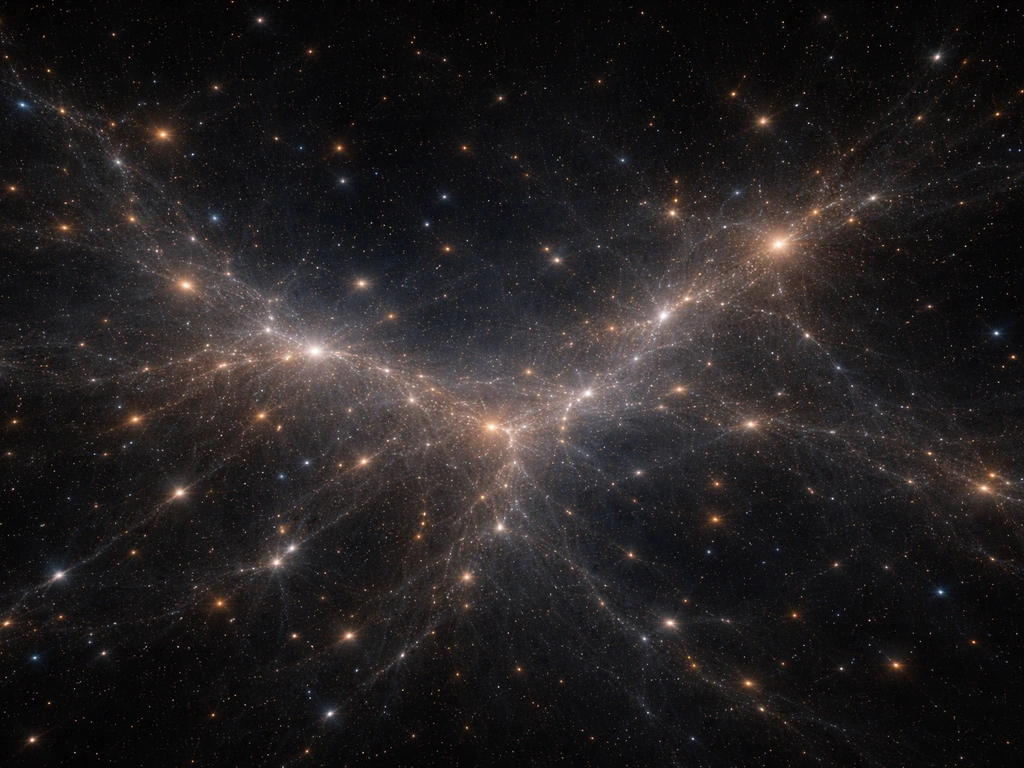
What "the universe grows" could actually mean
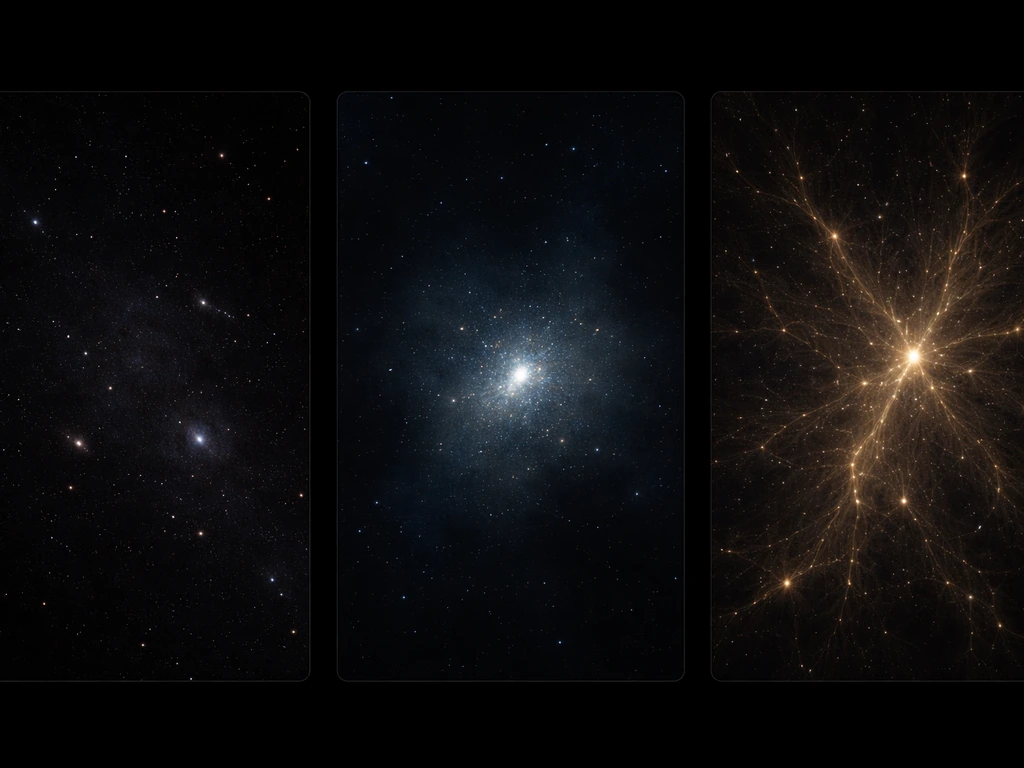
When people ask whether the universe grows, they usually mean one of three different things, and conflating them causes a lot of confusion. The first meaning is spatial expansion: is space itself getting larger? The second is matter creation: is the universe accumulating new mass or energy the way a living organism does when it eats and builds tissue? The third is structural growth: are the large-scale structures inside the universe (galaxies, clusters, superclusters) still forming and getting bigger over time?
These are genuinely separate questions with genuinely separate answers. The universe expanding is not the same as the universe gaining matter, just as a balloon inflating does not mean the rubber is getting thicker. And cosmic structure forming is almost the opposite of expansion, because gravity pulls matter together locally while the overall universe spreads out. Getting clear on which question you are asking is the most practical first step.
The core evidence: redshift, Hubble, and the scale factor
The evidence that space is expanding is solid and comes from multiple independent measurements. The key observable is redshift: light from distant galaxies is stretched to longer, redder wavelengths by the time it reaches us. This is not the same as a Doppler shift from a moving source, although it looks similar. What is actually happening is that the fabric of space expanded while the light was traveling, stretching the wavelength along with it.
Cosmologists describe this stretching with a single number called the scale factor, written as a(t). Think of it as the universe's "size dial" at any moment in time. By convention, the scale factor equals 1 today. In the past it was smaller, say 0.5 when the universe was roughly half its current linear size. The relationship between redshift and the scale factor is expressed as 1 + z = a₀ / a(t), where z is the observed redshift, a₀ is 1 (today), and a(t) is the scale factor at the time the light was emitted. Cosmological redshift arises from the universe’s expansion and is related to the time-dependent scale factor in FLRW models The relationship between redshift and the scale factor is expressed as 1 + z = a₀ / a(t). A galaxy with a redshift of z = 1 sent its light to us when the universe was half its current size.
The rate at which the scale factor changes is captured by the Hubble parameter, defined as H(t) = (da/dt) / a. Edwin Hubble's original observation in 1929 was that distant galaxies are receding from us at speeds roughly proportional to their distance, which is exactly what you expect from a uniformly expanding scale factor. Today's best measurements put the Hubble constant H₀ at roughly 67 to 73 kilometers per second per megaparsec, depending on the measurement method. That spread is actually one of the hottest debates in cosmology right now.
A powerful independent check on expansion comes from baryon acoustic oscillations (BAO), which are fossilized sound-wave imprints in the distribution of galaxies. Surveys like SDSS and eBOSS measure anisotropic clustering patterns to extract the comoving angular distance DM and the Hubble scale DH, along with the growth rate parameter combination fσ₈. These measurements slot into the H(z) = H₀ E(z) framework, where E(z) is set by the density of matter, radiation, and dark energy at each redshift. Together, redshift surveys, BAO, and the cosmic microwave background paint a remarkably consistent picture: the universe expanded from a hot, dense state and is still expanding today, faster than ever due to dark energy.
If you are curious how this kind of spatial expansion compares to the physical growth of objects within space, it is worth pausing on the distinction. Whether space itself grows is a fundamentally different question from whether the objects embedded in it grow, and the answer for space is yes, continuously, right now.
Is the universe actually gaining new matter or energy?

Here the answer is almost certainly no, at least in any sense comparable to biological growth. Living things grow by incorporating external matter and energy into their structure. A plant pulls in carbon dioxide, water, and sunlight and converts them into biomass. The universe has no external reservoir to pull from. In standard cosmology, matter and energy are conserved within the system (with a technically nuanced caveat about dark energy and total energy in an expanding universe, which is a genuine debate among cosmologists).
The total number of baryons (protons, neutrons, and the atoms they form) has been essentially fixed since about three minutes after the Big Bang, when Big Bang nucleosynthesis ended. Stars fuse lighter elements into heavier ones, but that is rearranging existing matter, not creating new matter from nothing. There is no widely accepted observational evidence that the universe is continuously generating net new matter the way a bacterial colony or a growing crystal does.
An older idea called the Steady State model, proposed in the 1940s and 1950s, did argue for continuous matter creation to keep the universe looking the same as it expanded. But the discovery of the cosmic microwave background in 1965 effectively ruled that model out. The CMB is exactly what you expect from a hot, dense early universe, not from a steady-state one. So while the universe is expanding in volume, its inventory of matter is not growing along with it. The average density of matter is actually falling over time.
This is an important contrast to how growth works at tiny scales. Whether an atom can grow big involves very different physics, governed by quantum mechanics and nuclear forces rather than spacetime geometry, but the underlying principle is the same: adding mass requires a source.
Growth at different scales: local structure vs global expansion
Even though the universe is not gaining matter and its overall volume is expanding, something very real is growing inside it: cosmic structure. Gravity is a relentless collector. Over billions of years, tiny density fluctuations in the early universe (seeded by quantum fluctuations during inflation) have been amplified by gravity into the web of filaments, voids, galaxy clusters, and superclusters we see today. This is called structure formation, and it is genuinely a growth process in the physical sense.
Think of it like condensation on a cold window. The total amount of water vapor in the room is not changing, but droplets are forming and growing by pulling in nearby molecules. Galaxy clusters work the same way: gravity pulls matter out of the surrounding voids and into denser regions. The voids get emptier; the clusters get richer. The cosmic web is still actively assembling.
This local growth is what happens even when the global universe is expanding. Gravitationally bound systems, like our own Milky Way galaxy and its local group neighbors, are decoupled from the expansion. They will not be pulled apart by the stretching of space because gravity wins at those scales. So when you hear that the universe is expanding, it does not mean galaxies themselves are getting bigger. It means the space between gravitationally unbound regions is growing. Whether Earth grows is a completely separate question from whether the universe expands, and the answer involves entirely different mechanisms.
One subtle but important point: the rate of structure growth (how fast density contrasts amplify over time) is directly linked to the expansion history. Cosmologists measure this with the growth rate parameter f = d ln D / d ln a, where D is the growth factor. The combination fσ₈ (growth rate times the amplitude of matter fluctuations on 8 Mpc/h scales) is precisely what BAO surveys like SDSS/eBOSS constrain from redshift-space distortions. If dark energy behaves unexpectedly, the growth rate deviates from predictions, which is why this measurement is so valuable.
How cosmic structure growth has changed over time
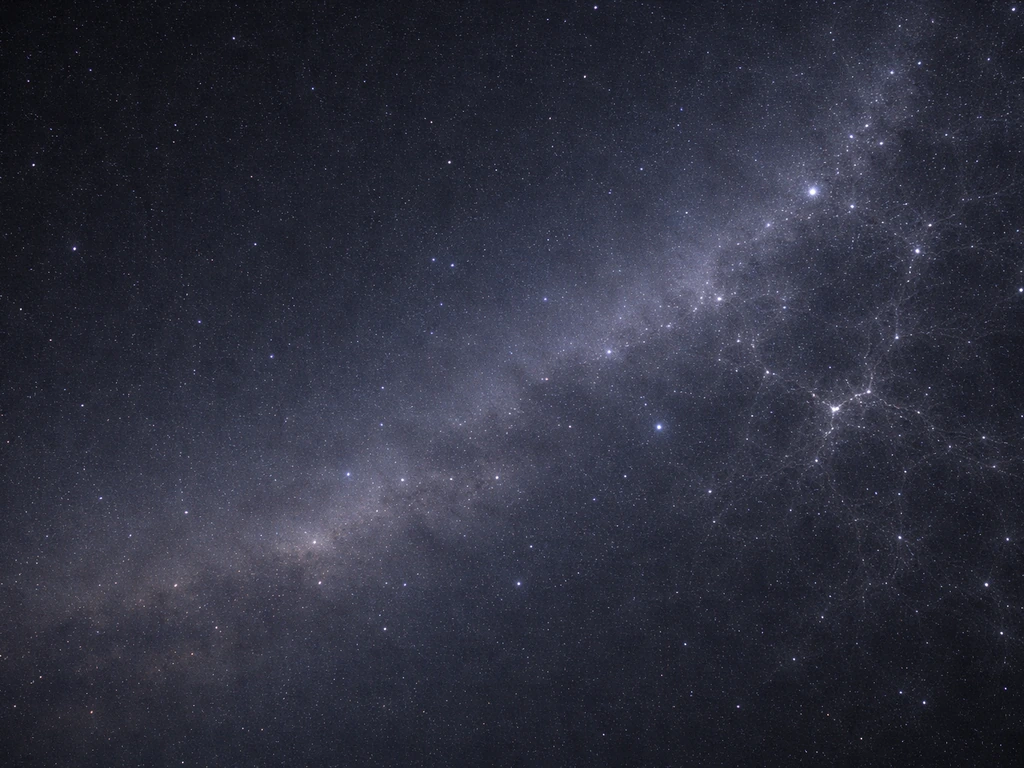
Structure formation has not proceeded at a constant rate. The history of cosmic growth has three rough phases, and understanding them gives you a much richer picture than just "the universe is expanding."
- Radiation-dominated era (first ~47,000 years): Expansion was fast and matter density was dominated by radiation. Gravity could not effectively collapse structures because radiation pressure kept matter spread out. Growth of structure was suppressed.
- Matter-dominated era (roughly 47,000 years to 9 billion years after the Big Bang): Matter density dominated expansion. Gravity had the upper hand, and structure formation kicked into high gear. This is when the cosmic web, galaxy clusters, and most large galaxies assembled.
- Dark energy-dominated era (roughly the last 5 billion years, continuing now): Dark energy began to dominate around redshift z ≈ 0.3. The expansion started accelerating, and the growth of structure began to slow. Dark energy acts like a repulsive force that counteracts gravity on the largest scales, making it harder for new matter to fall into existing overdensities.
We are currently in the third phase. The universe is still forming new stars (the Milky Way forms a few solar masses of stars per year), and galaxy clusters are still accreting matter. But the growth rate of structure is measurably slower than it was a few billion years ago. Future surveys like Euclid and the Vera Rubin Observatory's LSST are designed specifically to track this slowdown in fσ₈ across cosmic time and test whether dark energy is a true cosmological constant or something more dynamic.
The growth of stars and their host galaxies connects to a broader question about physical growth processes in extreme environments. For instance, how humans grow in space illustrates that even biological growth is affected by the same cosmic environment, though through very different mechanisms than dark energy.
The sun as a growth case study within the universe
It helps to ground this in a specific object. The Sun is a star embedded in an expanding universe, but it is gravitationally bound to the Milky Way and completely decoupled from cosmic expansion. How the Sun grows and changes over its lifecycle is governed entirely by nuclear physics, hydrostatic equilibrium, and stellar evolution, not by the Hubble parameter. The Sun is currently in the main sequence, slowly growing hotter and slightly larger. In about 5 billion years it will expand into a red giant. None of that is driven by cosmic expansion; it is all internal stellar physics.
This illustrates a general principle: for any gravitationally bound object (a star, a planet, a galaxy), local physics dominates. Cosmic expansion only matters for unbound objects separated by hundreds of megaparsecs or more. The "growth" of the universe and the "growth" of a star are essentially unrelated processes happening at wildly different scales.
Constraints and limits: what happens to growth in the long run?
Every growth process eventually hits a constraint. In biology, cells cannot grow indefinitely because of surface-area-to-volume limits, nutrient diffusion, and DNA replication fidelity. In cosmology, the ultimate constraints on cosmic growth come from the fate of the universe itself, which depends on the nature of dark energy.
| Fate scenario | Dark energy behavior | What happens to structure growth | End state |
|---|---|---|---|
| Heat death (most likely) | Cosmological constant (w = −1) | Structure growth slows and eventually halts; galaxies become isolated islands | Infinite expansion, maximum entropy, no usable energy gradients |
| Big Rip | Phantom dark energy (w < −1) | Dark energy eventually overcomes gravity at all scales; structures torn apart | All bound structures, including atoms, ripped apart in finite time |
| Big Crunch | Dark energy weakens or reverses | Expansion halts, then reverses; structures merge as universe collapses | All matter compressed back into a singularity |
| Big Bounce / cyclic | Speculative (various models) | Collapse followed by new expansion; structure growth resets | New cycle of expansion and structure formation |
The current best-fit model, the ΛCDM (Lambda Cold Dark Matter) model, points toward heat death as the most likely outcome. Dark energy appears to behave as a cosmological constant (w = −1), meaning its energy density stays fixed even as the universe expands. This causes the expansion to accelerate indefinitely. Over trillions of years, galaxies beyond our local group will recede past our cosmic horizon, becoming permanently unreachable and eventually invisible. Star formation will wind down as gas is consumed. The last stars will burn out. What remains will be black holes, cooling stellar remnants, and an ever-thinning sea of particles drifting apart in a cold, dark, nearly featureless universe.
That is the ultimate growth constraint: dark energy does not stop the universe from expanding, but it does choke off the local gravitational growth of structure by accelerating the expansion faster than gravity can collect matter. The universe's volume keeps growing; the richness of its contents does not.
The physics of how tiny-scale quantum structure connects to this cosmic picture is genuinely fascinating. How atomic growth figures into DC-scale physics might seem far removed from cosmology, but the same quantum vacuum energy that governs atomic behavior is thought to be related to the cosmological constant problem, one of the deepest unsolved puzzles in physics.
What to actually look up next
If you want to go deeper, here are the key concepts worth searching for, in roughly the order they build on each other:
- FLRW metric and scale factor: the mathematical framework that describes an expanding universe in general relativity
- Hubble tension: the disagreement between early-universe (CMB) and late-universe (Type Ia supernovae) measurements of H₀, and what it might mean
- Baryon acoustic oscillations: how sound waves from the early universe left imprints we can use as a standard ruler to measure expansion
- Dark energy equation of state: what w = −1 means, and what surveys like Euclid and DESI are trying to nail down
- Structure formation and the growth factor: how the growth rate fσ₈ is measured and why deviations would signal new physics
- Cosmological constant problem: why quantum field theory predicts a vacuum energy 10¹²⁰ times larger than what we observe
The bottom line is this: the universe is absolutely growing in the sense of spatial expansion, and that expansion is accelerating. It is not growing by adding matter or energy. And the rich internal structure of the universe, galaxies, clusters, filaments, is still growing but decelerating as dark energy tightens its grip. Those are three different answers to three different questions, all valid, all part of the same story.
FAQ
If the universe is expanding, does that mean the distance between all galaxies increases, even nearby ones like the Milky Way and Andromeda?
Not necessarily. Expansion effectively applies to regions that are not gravitationally bound. The Milky Way and Andromeda are bound (they are moving toward each other), so their separation is dominated by local gravity rather than the stretching of space. Farther, unbound galaxies will recede from us as the expansion continues.
Are galaxies “moving away” through space, or is space stretching between them?
In an expanding-universe description, the clean interpretation is that the space between distant, unbound regions increases, while galaxies are not simply flying through a static background. You can still describe it with redshifts that look like Doppler recession, but the underlying cause is different (light is stretched during propagation because the metric expands).
Does “the universe grows” imply its total energy increases, or that energy is not conserved?
Energy bookkeeping is subtle in general relativity. Locally, conservation laws still work, but defining a global “total energy” for an expanding spacetime is not straightforward, and different choices of definitions can yield different-looking statements. That is why the article avoids a simple “energy is created” picture.
Could the universe be gaining matter in some hidden way, like through decays or extra particles we cannot measure directly?
Standard cosmology and existing observations heavily constrain net creation of new baryonic matter. You can have particle interactions and energy transfers, including rare processes, but the idea of continuous production of net new mass comparable to biological growth is not supported by the dominant datasets (like the CMB, big bang nucleosynthesis, and large-scale structure).
When people ask whether structure is still growing, does that mean galaxies are getting larger over time?
Not in the straightforward way implied by “global growth.” The universe’s large-scale structures (clusters, filaments, and the web) are assembling, but individual galaxies can gain mass through mergers and accretion while also changing star-formation rates. The key point is that the overall assembly of mass into dense regions slows over time even while specific galaxies may still evolve.
Why does the growth of structure slow down if gravity is always attractive?
Dark energy changes the expansion history, which increases how quickly the background scale factor grows. When expansion accelerates, it becomes harder for gravity to pull matter into new dense regions fast enough, so the amplification of density contrasts (the growth rate) declines relative to earlier epochs.
What is the practical difference between the scale factor and redshift when interpreting observations?
Redshift is what you measure directly from spectra. The scale factor is a theoretical quantity that encodes the universe’s expansion relative to today at the time light was emitted. The mapping between them, 1 + z = a0/a(t), lets you convert observational data into constraints on the expansion and growth history.
If dark energy accelerates expansion indefinitely, does that mean star formation will completely stop everywhere?
Star formation will wind down dramatically, but “everywhere” matters. In practice, gas supplies become depleted, cooling and accretion slow, and the rate drops first in many regions while some systems can keep forming stars longer. The eventual fate described is about the large-scale decline and exhaustion of usable gas, not an instantaneous global cutoff.
What do we mean by “cosmic horizon,” and is it the same as a particle horizon or something else?
In everyday cosmology talk, it usually refers to regions beyond which light emitted now will never reach us because accelerated expansion stretches spacetime faster than light can traverse it. The exact horizon type depends on context (particle horizon versus event horizon), but the operational consequence is that more distant galaxies become unobservable over time.
How can we tell observationally whether dark energy is a true constant or something changing?
A common strategy is to compare the expansion history (from distances inferred using redshifts and BAO) with the growth of structure (from redshift-space distortions and the fσ8 combination). If dark energy changes with time, it tends to shift the relationship between how fast the universe expands and how fast density contrasts grow.
Next Article
Do You Grow in Space? How Microgravity Affects Height
Explains whether plants or humans really grow taller in space and how microgravity changes cells, hormones, fluids, and