
An atom cannot grow big the way a cell or a crystal grows. It has no metabolism, no membrane to expand, and no mechanism to accumulate mass the way living things do. But "grow big" can mean several real things in physics, and some of them actually do change an atom's effective size. The honest answer is: yes, an atom can temporarily get larger through specific quantum processes, and yes, atoms can become part of much bigger structures through bonding and assembly. What they cannot do is steadily expand on their own the way a living cell divides and grows. Here is what is actually going on.
Can the Atom Grow Big? What Real Science Says

Marcus Whitmore
21 Apr 2026
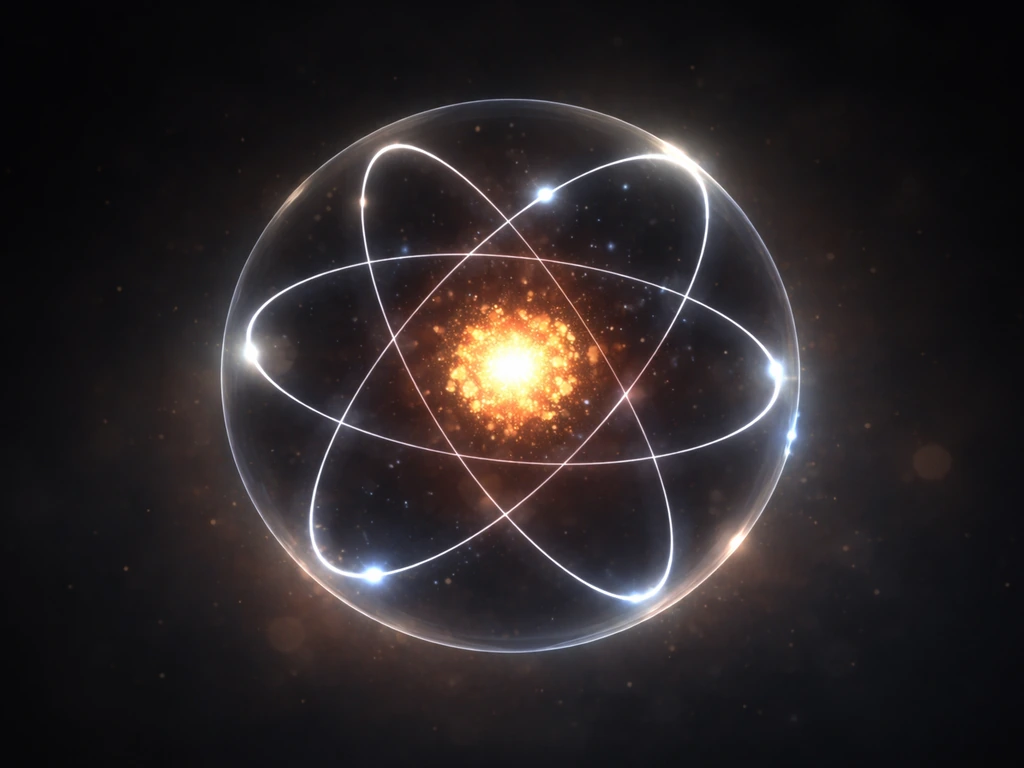
What "grow big" could actually mean for an atom

When someone asks whether an atom can grow big, they are usually imagining one of a few different things. Maybe they picture the atom inflating like a balloon. Maybe they are thinking about nuclear explosions or radiation and wondering whether atoms involved in those processes get physically larger. Or maybe they have heard of "large atoms" on the periodic table and are curious whether an individual atom can change its own size. All of these intuitions point at real science, but they need to be translated carefully.
An atom has two main parts: a tiny, dense nucleus in the center (made of protons and neutrons) and an electron cloud surrounding it. The nucleus is extraordinarily small, roughly 10^-15 meters (femtometers) across. Wikipedia’s overview of the atomic nucleus gives the typical rough scale comparison, noting that nuclear dimensions are tens of thousands of times smaller than the size of the surrounding atom blank" rel="noopener noreferrer">The nucleus is extraordinarily small, roughly 10^-15 meters (femtometers) across.. The electron cloud is about 100,000 times larger, on the order of 10^-10 meters (about 1 ångström). When physicists talk about "atomic size," they almost always mean the size of the electron cloud, not the nucleus. And the electron cloud's size is controlled by quantum rules that are not negotiable under normal conditions.
So "growing" an atom could mean: pumping energy into the electron cloud to push electrons to higher shells (excitation), ripping an electron off entirely (ionization), smashing or restructuring the nucleus (nuclear reactions), or assembling atoms together into molecules and solids. Each of these is a real process with measurable consequences for size. Only the last one leads to the kind of macroscopic growth this site explores.
How quantum structure locks in an atom's size
The size of an atom is not arbitrary. It is set by quantum mechanics, specifically by the relationship between the nucleus's positive charge and the energy levels available to electrons. In the Bohr model (a simplified but useful picture), electron orbits are only allowed at specific radii. For hydrogen, the smallest orbit has a radius called the Bohr radius: 5.292 × 10^-11 meters. Electrons cannot sit at any radius they like. They can only occupy discrete allowed levels labeled by a principal quantum number n = 1, 2, 3, and so on.
The radius of each allowed level scales with n squared: blank" rel="noopener noreferrer">rn = a0 × n^2. That means the second level is 4 times larger than the first, the third is 9 times larger, and so on. This is not a metaphor. These are the actual spatial extents of the electron's probable location. In a normal hydrogen atom sitting in its ground state, n = 1, and the electron cloud is pinned to that smallest, most stable size.
In multi-electron atoms, the picture gets more complex because inner electrons partially shield the nucleus from outer electrons. This shielding effect, described as the effective nuclear charge (Z_eff), means outer electrons feel a weaker pull than they would if the full nuclear charge were acting on them. That is partly why larger atoms on the periodic table have bigger electron clouds even though their nuclei are more positively charged. The interplay between nuclear charge and electron shielding determines the atom's equilibrium size under normal conditions.
Excitation and ionization: the two ways to stretch or shrink an electron cloud

If you want to temporarily make an atom larger, excitation is the mechanism. In many of the same ways that high-energy excitation can temporarily stretch an atom’s size, you can ask related questions like can the atom grow dc. When an atom absorbs a photon of the right energy, an electron jumps from a lower quantum level to a higher one. Because orbital radius scales with n^2, jumping from n = 1 to n = 2 roughly quadruples the effective radius of the electron cloud for that electron. The atom is genuinely physically larger for as long as the electron stays excited. Then it drops back down, emits a photon, and returns to its normal size.
Push this to an extreme and you get Rydberg atoms: atoms with electrons excited to very high principal quantum numbers (n can reach 28, 45, even 65 in laboratory conditions). A Rydberg atom can be as large as a bacterium compared to its ground-state self. Experiments measuring rubidium Rydberg states with 28 < n < 45 confirm that these enormous electron clouds are real and measurable, and that they persist long enough to study because lifetimes grow with n (roughly as n^3). But this size is unstable. Any external electric field, collision, or emission event collapses the atom back toward its ground state. There is no way to "lock in" a Rydberg state as a permanent size increase.
Ionization is the opposite extreme. When you supply enough energy (13.6 eV for hydrogen's ground state), the electron is removed entirely. The atom becomes an ion. Without its outermost electrons, the remaining electron cloud actually shrinks because the same nuclear charge is now acting on fewer electrons. Ionization energy increases with each successive electron removed, because the remaining electrons are held more firmly. A fully stripped nucleus has no electron cloud at all: it is essentially just a bare proton or group of protons and neutrons. That is "smaller," not larger, in any meaningful sense.
What nuclear changes actually do to an atom's size
Nuclear reactions change the nucleus itself, not just the electron cloud. In alpha decay, the nucleus loses 2 protons and 2 neutrons (mass number drops by 4, atomic number drops by 2). The atom becomes a different element entirely. In beta decay, a neutron converts to a proton, so the atomic number increases by 1 while the mass number stays the same. Again, the element identity changes. In either case, the daughter atom reorganizes its electron cloud to match its new nuclear charge, and it ends up being a different atom with its own characteristic size. You have not grown an atom. You have replaced it.
Nuclear radii themselves follow a simple scaling rule: r ≈ r0 × A^(1/3), where r0 is about 1.2 femtometers and A is the mass number. A large nucleus like uranium-238 has a nuclear radius of roughly 7.4 femtometers. Compared to the electron cloud (which is about 1 ångström, or 100,000 femtometers), the nucleus barely matters for the atom's overall size. Nuclear growth does not translate meaningfully into atomic size growth in any practical sense. The nucleus can also be changed through neutron capture or fusion, which again produces a new element or isotope rather than a larger version of the original atom.
After nuclear events, electron reorganization happens extremely fast. Following inner-shell ionization from decay, relaxation processes like Auger decay occur in roughly 10^-15 seconds (one femtosecond). After electron-capture-induced cascades, the ion charge stabilizes within about 10^-12 seconds. The atom reaches a new equilibrium almost instantly. There is no drawn-out process of growth.
| Process | Effect on electron cloud | Effect on nucleus | Does the atom get bigger? |
|---|---|---|---|
| Ground state (baseline) | Smallest stable size, set by quantum rules | Unchanged | No, this is baseline |
| Excitation (higher n) | Genuinely larger, scales with n^2 | Unchanged | Yes, temporarily |
| Rydberg excitation (very high n) | Extremely large, up to micron scale | Unchanged | Yes, but highly unstable |
| Ionization (electron removed) | Shrinks (fewer electrons, same nuclear charge) | Unchanged | No, it shrinks |
| Alpha decay | Reorganizes for new Z, new element | Loses 2p + 2n | Becomes a different atom |
| Beta decay | Reorganizes for new Z, new element | n converts to p | Becomes a different atom |
| Fusion / transmutation | Reorganizes for new element | Gains nucleons | Becomes a different atom |
Why atoms can't just keep expanding: binding energy and stability

The reason an atom does not expand indefinitely comes down to binding energy. Electrons in an atom are bound to the nucleus by electrostatic attraction. In quantum terms, the lowest available energy state (ground state) is where the system is most stable. Any excitation pushes energy into the atom, and physics naturally wants to release that energy and return to the ground state. There is no mechanism by which an atom can accumulate excess size without continuously absorbing energy to maintain it.
Think of it like holding a ball up a ramp. You can hold it at a higher position (excited state) if you keep putting energy in, but the moment you let go, it rolls back down. Rydberg atoms illustrate this perfectly. They are enormous, but they decay back toward ground state by emitting photons. External electric fields can ionize them before they even get that far. The bigger the Rydberg state, the more fragile it is to interference from neighboring atoms, fields, or collisions. Nature actively enforces a size ceiling.
This is the atomic version of the same constraint that limits cell size (surface-area-to-volume ratio problems) or organism size (structural load limits). At every scale, physics sets a ceiling. For atoms, that ceiling is the ionization limit: once you push the electron past the point where it is still bound (roughly 13.6 eV for hydrogen's ground state), you no longer have an atom at all. You have an ion and a free electron.
How atoms become part of bigger things: molecules, crystals, and macroscopic growth
Here is where the story connects to the kind of growth this site is really about. Earth does not grow by atoms inflating; instead, growth happens when matter accumulates into larger structures. Individual atoms do not grow big, but they do assemble into bigger structures through bonding, and that assembly is the foundation of all macroscopic growth.
When atoms share or transfer electrons, they form chemical bonds. Bond lengths (the distances between bonded atomic centers) are typically approximated as the sum of the covalent radii of the two atoms involved, and they fall in the range of roughly 1 to 3 ångströms. A molecule of water is about 2.75 ångströms across its oxygen atom. A protein can span hundreds of nanometers. The transition from atom to molecule is not the atom growing. It is atoms linking up into a larger architecture while each individual atom retains its own electron cloud structure.
In crystalline solids, atoms or molecules arrange themselves in repeating lattice structures. The characteristic spacing between atoms in a crystal lattice (the lattice constant) is typically a few ångströms, determined by the balance between attractive bonding forces and repulsive electron-cloud interactions. Van der Waals forces, which govern how closely non-bonded atoms can approach each other, keep atoms roughly 3.3 to 4.0 ångströms apart in molecular packing contexts. A grain of salt or a quartz crystal looks solid and continuous to you, but at the atomic level it is a precise, repeating arrangement of atoms each sitting at their fixed, quantum-defined sizes.
This is how you get to macroscopic growth. A crystal grows not because its constituent atoms enlarge, but because new atoms or molecules attach to its surface and extend the lattice. A biological cell grows because it synthesizes new molecules (proteins, lipids, DNA) and incorporates them into its structure. The atom is the building block, not the thing that grows. Growth, in the sense this site covers, is always about accumulating more building blocks and organizing them, not about inflating any single one.
A mental model that ties it all together
Here is a practical way to hold all of this in your head across different scales. At each level of organization, something specific sets the size limit, and growth works differently.
| Level | What sets the size | How growth happens | What limits expansion |
|---|---|---|---|
| Atom | Quantum structure: nuclear charge + electron energy levels | Excitation (temporary), assembly into molecules | Ionization energy, binding energy, return to ground state |
| Molecule | Bond lengths, molecular geometry, van der Waals packing (~1–4 Å) | Adding more atoms via chemical reactions | Bond stability, reaction kinetics, available atoms |
| Crystal / mineral | Lattice constants (few Å), crystal symmetry | Surface deposition of new unit cells | Temperature, solute availability, impurities, thermodynamics |
| Cell | Membrane tension, nucleus-to-cytoplasm ratio, surface-to-volume | Biosynthesis, then division (mitosis) | Diffusion limits, metabolic supply, genetic signals |
| Organism | Structural load, metabolic rate, oxygen/nutrient delivery | Cell proliferation and differentiation | Resource availability, gravity, genetic program |
Notice the pattern: at every level, the unit does not simply expand without constraint. The atom obeys quantum binding. The crystal obeys thermodynamic equilibrium. The cell obeys diffusion and surface-area limits. The organism obeys structural mechanics and metabolic supply. Growth, at every scale, is about assembling more units rather than inflating existing ones. Understanding this chain makes it much easier to think clearly about questions like why cells cannot grow indefinitely or why crystals stop forming when conditions change.
This same question of physical limits at different scales connects naturally to other size questions worth thinking about. Whether you are curious about how growth works in space environments, whether large-scale structures like planets grow, or how the universe itself expands, the underlying logic of constraints and mechanisms applies at every level. That question echoes the same theme: whether something can keep expanding indefinitely depends on the specific mechanisms and constraints involved does the universe grow. The atom is just the most fundamental place to start.
Practical takeaways for applying this in real science contexts
If you need to describe or measure atomic size correctly, be precise about which definition you are using. The van der Waals radius applies to non-bonded atoms in contact, covalent radius applies to bonded atoms, and ionic radius applies to charged atoms in crystal lattices. These values differ, sometimes significantly, so "atomic size" is always context-dependent. For hydrogen, the van der Waals radius is about 1.2 ångströms, while the covalent radius is about 0.31 ångströms.
If you encounter references to "large atoms" in chemistry, this almost always refers to heavier elements with more electrons and higher principal quantum numbers in their ground state. Cesium and francium have large ground-state atomic radii because their outermost electrons sit in high n shells. This is structural, not the result of any growth process.
If you are reading about radiation or nuclear medicine and wondering whether atoms involved in those processes get bigger, they do not. They change identity through decay, not size. The daughter atoms produced in alpha or beta decay are simply different elements, each with their own characteristic, quantum-fixed size.
And if someone asks you whether an atom can grow big, the best short answer is: not in the way living things grow. So if you are asking a bigger version of the same question, does space grow, it is driven by cosmology rather than atomic size changing through excitation or bonding. The same idea applies to stars: the Sun is held together by gravity and its internal fusion, not by atoms steadily growing larger over time does the sun grow. It can temporarily get much larger through Rydberg excitation, it can change identity through nuclear reactions, and it can become part of arbitrarily large structures by bonding with other atoms. For a similar question at a larger scale, you can ask whether space grows instead of whether individual atoms do does space grow. For a similar question at a larger scale, you can ask whether space grows instead of whether individual atoms do does space grow do you grow in space. But it cannot accumulate mass, expand its electron cloud permanently, or sustain growth over time the way a cell, a crystal, or an organism can. That distinction is the whole point.
FAQ
Can an atom’s electron cloud get permanently bigger if it is excited repeatedly?
Not in the sense of a lasting, larger ground-state atom. Excitation changes the electron to a higher energy level temporarily, then it relaxes and the size returns. In practice, you can keep an atom in excited states only while you continuously supply energy, and collisions or external fields tend to kick it into other states or ionize it.
What is the biggest size an atom can reach, and why does it fail at some point?
The largest common “bigger atom” case is a Rydberg atom, where the excited electron sits at very large radii. The limitation is that these states are fragile, with lifetimes that are longer than ordinary excited states but still finite, and they can be disrupted by stray electric fields, nearby atoms, or collisions that mix states or ionize the electron.
Does increasing temperature make atoms “expand” like solids do?
Temperature can change average spacing in solids and gases (lattice vibrations, thermal expansion, pressure changes), but it does not cause individual atoms to grow their electron clouds in a free, permanent way. Any apparent “size change” comes from motion and structure of many atoms, not from a single atom inflating its bound electron distribution.
If atoms do not grow, can the nucleus “grow” in size and make the whole atom bigger?
Even when nuclear size changes with different isotopes, the nuclear radius is so small compared with the electron cloud that it has essentially no practical effect on atomic size as measured by chemistry. The electron cloud still dominates the usual notion of atomic size and is set by quantum energy levels and shielding.
Can electron excitation lead to measurable changes in chemistry or bonding?
Yes, excited atoms can behave differently because their electron configurations are different, so reaction pathways and bond formation probabilities can change. However, bonding typically involves ground or near-equilibrium states, so if the excitation decays quickly, the effects are transient and often hard to exploit as stable “larger atom” behavior.
When people say “atomic radius,” which one should I use to avoid confusion?
Use the radius type that matches the context: covalent radius for bonded atoms, van der Waals radius for non-bonded contact, and ionic radius for charged atoms in crystals. The numeric values are not interchangeable, and mixing definitions is a common reason people think an atom “should” be bigger or smaller than it really is.
Does ionization make atoms bigger because the electron cloud is less dense?
No, ionization generally makes the remaining electron cloud effectively smaller because the remaining electrons are pulled in more strongly by the unchanged nuclear charge and reduced electron screening. The outside you can call “size” becomes smaller in most ionization steps, up to the point where the atom becomes a bare nucleus with no electron cloud.
Do alpha or beta decays produce an atom that is physically larger?
No. The products are different elements or different isotopes with different nuclear charge and different electronic structure. So the “new atom” has its own characteristic size, but you are not stretching the original atom into something bigger, you are replacing it with a different nuclear-electronic system.
Can an atom grow bigger by absorbing more than one photon or in a strong laser field?
You can drive multi-photon excitation and create Rydberg states, but you still do not get permanent growth. Strong fields usually increase the chance of ionization or state mixing, so instead of a stable larger configuration you get either rapid decay back to lower states or loss of the electron.
How can matter “grow” if atoms cannot grow big?
Growth in macroscopic systems happens by adding more atoms or molecules to an existing structure and reorganizing them (forming new bonds, building crystal lattices, extending networks). The individual building blocks remain quantum-defined, while the overall architecture changes because more units attach at surfaces or join into a larger repeating pattern.
Next Article
Does Space Grow? Cosmic Expansion, Evidence, and What’s Next
Yes: cosmological expansion grows space between galaxies, proven by redshift, CMB, and distances, with future fates.