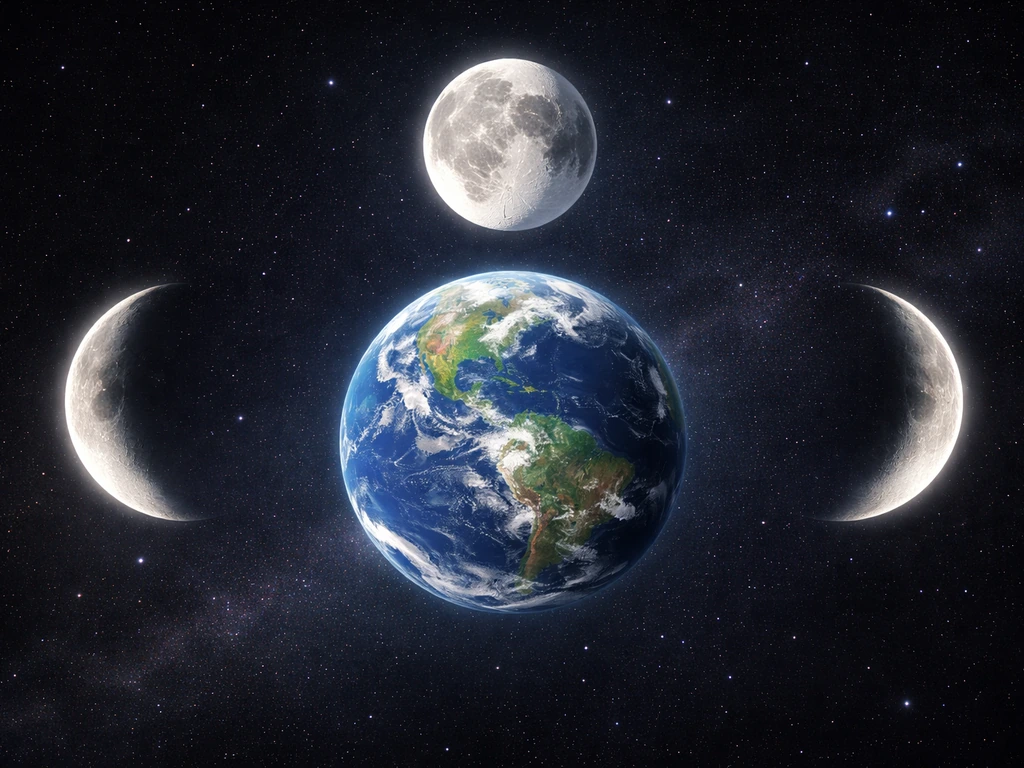
The short answer: no, the Sun does not grow every year in any meaningful sense of the word. In fact, it loses a tiny bit of mass each year. But the fuller answer depends entirely on what you mean by 'grow,' because the Sun is doing several competing things at once: losing mass through its solar wind, converting mass to energy through nuclear fusion, and picking up a negligible trickle of material from comet and dust impacts. Once you break those apart, the picture becomes surprisingly clear and genuinely fascinating.
Does the Sun Grow Every Year? What Changes and Why
Marcus Whitmore
20 Apr 2026
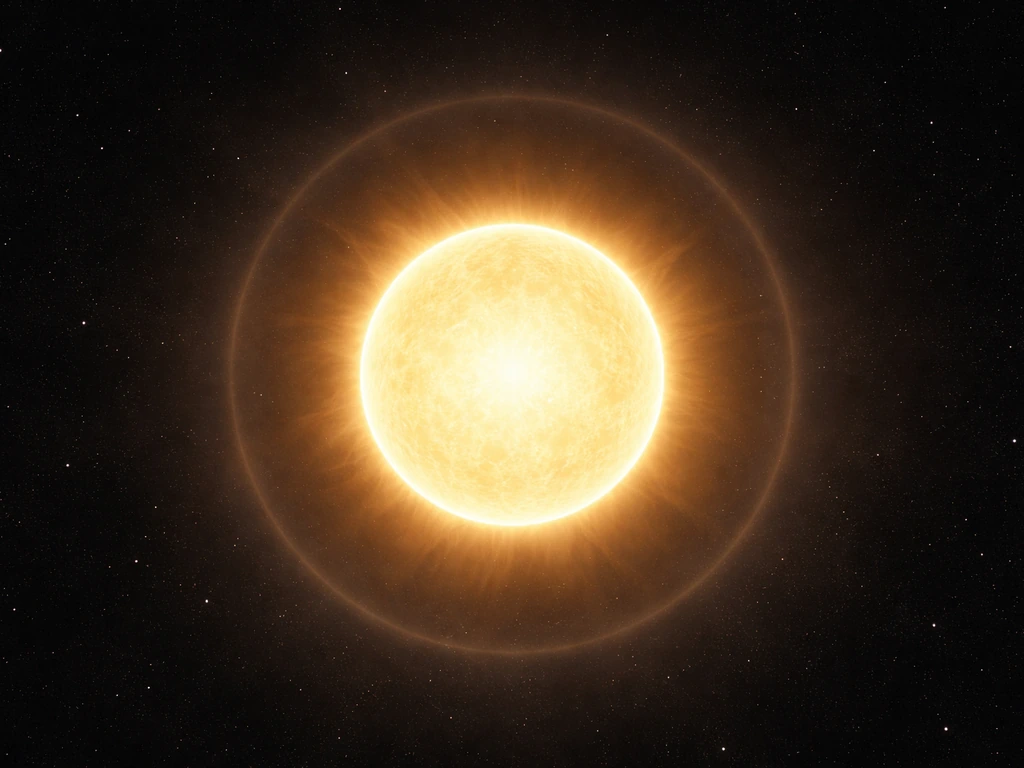
What does 'grow' even mean for a star?

When we talk about growth in living things, we usually mean one of two things: the organism is adding mass, or it is getting physically larger. For the Sun, those two things can come apart completely, so it is worth pinning down exactly which version of 'grow' you are asking about before diving into the numbers.
- Mass: Is the Sun getting heavier or lighter over time?
- Radius: Is the physical size of the Sun's disk expanding year over year?
- Luminosity (brightness): Is the total energy output increasing?
- Temperature: Is the surface getting hotter?
These four things are all connected through stellar physics, but they do not all move in the same direction at the same time. Right now, on a year-to-year basis, the Sun's mass is very slightly decreasing, its radius is essentially unchanged, its luminosity wiggles a tiny fraction of a percent with the solar cycle, and its surface temperature is similarly stable. None of that fits the everyday intuition of 'growing.' The more interesting story is what happens over millions and billions of years, which we will get to shortly.
Year to year, does the Sun's mass go up or down?
It goes down. Every year, the Sun sheds mass through two main channels: the solar wind and nuclear fusion. The solar wind alone carries away roughly 30 trillion tons of material per year, streaming charged particles outward through the entire solar system. On top of that, the Sun's fusion reactions convert mass directly into energy following Einstein's E=mc². That process drains an estimated 1.353×10^20 grams (about 135 quadrillion metric tons) of mass-to-energy per year. Research using the dynamics of NASA's MESSENGER spacecraft confirms a total fractional annual mass-loss rate on the order of about 0.9 to 1.1×10^−13 solar masses per year, with radiation alone accounting for roughly 6.76×10^−14 solar masses per year.
Now, the Sun does gain a little mass from impacts: comets, meteoroids, and interplanetary dust particles occasionally fall in. But this contribution is vastly smaller than what the solar wind and fusion carry away. Interplanetary dust accretion is also highly variable, influenced by orbital dynamics and even modeled to fluctuate on timescales of about 100,000 years. There is no realistic scenario where comet impacts and dust meaningfully offset the mass the Sun is constantly shedding. The net result is a Sun that gets ever so slightly lighter each year, not heavier.
The three things that change the Sun's mass: accretion, solar wind, and radiation
Think of the Sun's mass like a bathtub with the tap barely dripping (mass in) but the drain wide open (mass out). Let's look at each term properly.
Mass coming in: accretion
The Sun does accumulate some material. Comets that pass close enough get disrupted. Interplanetary dust drifts inward under a combination of gravity and radiation pressure effects. But astronomers who model the flow of interstellar and interplanetary dust into the inner solar system find that the rates are small, highly variable, and nowhere near enough to offset the outbound mass loss. Calling this 'accretion growth' would be like crediting a leaky garden hose with filling an Olympic swimming pool.
Mass going out: the solar wind
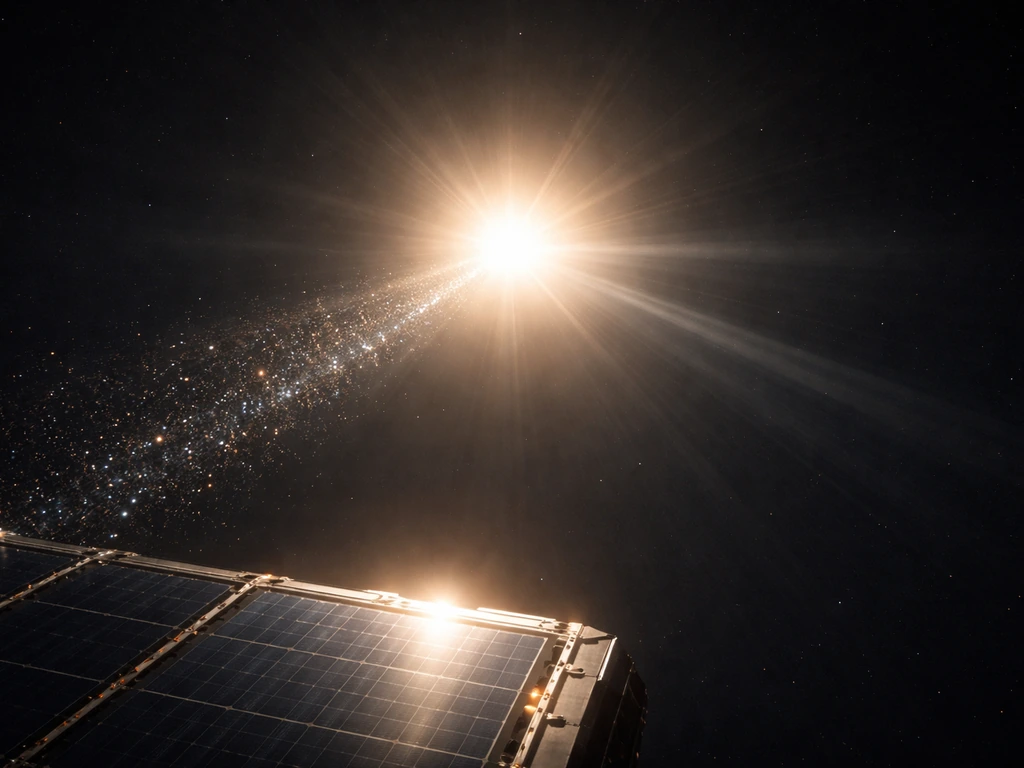
The solar wind is the Sun's most obvious mass-loss mechanism. It is a continuous stream of charged particles, mostly protons and electrons, flowing outward at hundreds of kilometers per second. The annual mass lost to the solar wind is around 2×10^−14 solar masses per year (or roughly 10^9 kg per second). Importantly, this rate is not perfectly constant. Coronal mass ejections (CMEs) add bursts of additional mass loss, and research comparing solar cycles 23 and 24 shows that solar-wind mass loss does not track sunspot numbers in a simple one-to-one way. Activity levels and mass-loss rates are related but not identical.
Mass going out: radiation (fusion converting mass to energy)
This is the one that surprises most people. Every photon that leaves the Sun carries away a tiny amount of mass-equivalent energy. Because E=mc² and the Sun produces an enormous amount of energy, this adds up to a significant annual mass loss: roughly 6.76×10^−14 solar masses per year just from luminosity alone. This is separate from the solar-wind loss and adds to it. So fusion does not make the Sun grow, it makes it shrink, very slowly.
Fusion is the engine of long-term change, just not the kind people expect
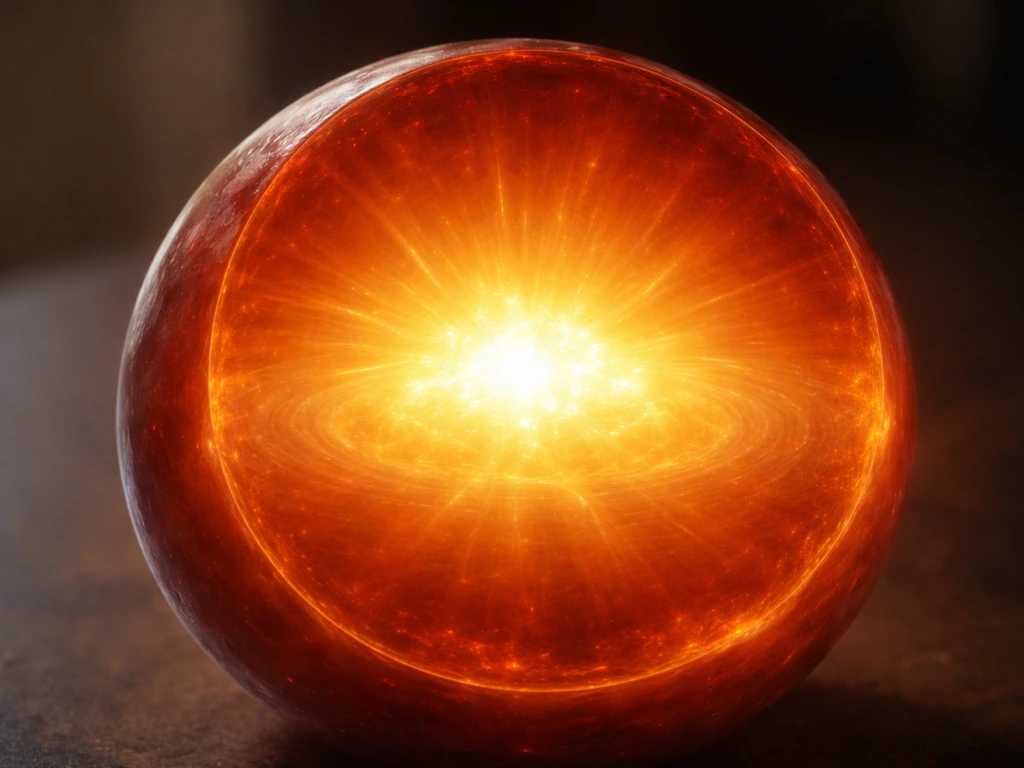
Nuclear fusion is happening in the Sun's core right now: hydrogen nuclei are fusing into helium, releasing energy in the process. Over time, this does two things. First, it very slowly depletes the Sun's hydrogen supply. Second, because helium is denser than hydrogen, the core gradually contracts and heats up, which over billions of years forces the outer layers to expand. This is the real long-term 'growth' story for the Sun, but it plays out on a timescale of billions of years.
The secular increase in luminosity driven by this evolutionary process is estimated at about 0.009% per million years. Put that in perspective: the ~0.1% luminosity swing that happens over a single 11-year solar cycle is roughly ten times larger than what evolutionary brightening produces in a million years. The Sun will not become noticeably brighter or significantly larger for a very long time. Eventually, in about 5 billion years, it will expand into a red giant and envelope the inner planets, but that is a story for deep time, not anything observable on human or even geological timescales.
What actually changes from year to year: solar cycles, not growth
If you look at graphs of solar output over decades, you will see a clear up-and-down rhythm. That is the 11-year solar cycle, driven by the Sun's magnetic field flipping polarity roughly every 11 years. Solar Cycle 25, for reference, began in December 2019 at solar minimum. Over one cycle, the Sun's total irradiance (the energy reaching Earth per square meter) varies by about 0.1%, hovering around a solar constant of approximately 1,361 W/m². That 0.1% works out to roughly 1.4 W/m², which is genuinely small.
Helioseismology data from missions like SOHO show that even the Sun's inferred subsurface radius changes slightly in phase with this 11-year activity cycle, between about 0.975 and 0.99 solar radii depth. Eclipse analysis has also found that the Sun's apparent radius was about 0.5 arcseconds (roughly 375 km) larger in 1925 than in 1979, a difference that reflects measurement challenges and activity-linked structural changes rather than steady evolutionary growth. None of this is 'growing' in the biological sense. It is the Sun breathing in and out on a magnetic rhythm.
A quick size-check: would the Sun even expand if luminosity stayed the same?
Here is a fun thought experiment from solar physics. If you held the Sun's luminosity constant and only looked at how gravity and internal pressure balance each other, stellar structure models suggest the Sun would actually shrink by about 74 cm per year, not expand. This is a theoretical 'Kelvin contraction' style estimate, not a directly measured annual shrinkage, but it illustrates the point: the natural tendency of stellar gravity, absent internal energy sources, is to compress a star, not inflate it. Fusion is what holds the Sun at its current size by pushing outward. And as fusion slowly depletes hydrogen over billions of years, the balance shifts, eventually driving the red giant phase.
How to actually check this yourself
If you want to sanity-check any claim that the Sun is 'growing every year,' here are the numbers to reach for and the places to find them.
| What to look up | What the data shows | Where to find it |
|---|---|---|
| Solar irradiance (total solar irradiance, or TSI) | Cycles between ~1,360 and ~1,362 W/m² over the 11-year solar cycle; no long-term upward trend on human timescales | NASA / LASP SORCE and TSIS instrument data archives |
| Solar radius measurements | No measurable steady annual expansion; decade-scale variations tied to activity cycle | NASA NTRS eclipse analyses; SOHO helioseismology data |
| Solar mass-loss rate | Net loss of roughly 0.9–1.1×10^−13 solar masses per year (radiation + solar wind) | Published planetary dynamics studies, MESSENGER mission analyses |
| Solar wind mass-loss rate | About 2×10^−14 solar masses per year (~10^9 kg/s) | NOAA / NASA solar wind monitoring; Parker Solar Probe mission data |
| Long-term luminosity evolution | ~0.009% brighter per million years; negligible on any human timescale | Peer-reviewed stellar evolution models; solar irradiance variability literature |
One practical approach: pull up NOAA's or NASA's Space Weather Prediction Center pages and look at Total Solar Irradiance (TSI) data spanning a few decades. You will see the 11-year cycle clearly and no upward trend. That alone is a powerful visual sanity check. For mass-loss numbers, NASA's mission pages for Parker Solar Probe and published analyses of planetary orbital dynamics (like the MESSENGER-based study) give explicit estimates that researchers use to model the solar system's long-term evolution.
The verdict, by what 'grow' means
Here is the clean summary. By every common definition of 'grow,' the Sun is not growing year over year.
| Definition of 'grow' | Is the Sun doing it annually? | What is actually happening |
|---|---|---|
| Mass increasing | No | Net mass loss of ~0.9–1.1×10^−13 M☉/year via solar wind and fusion radiation |
| Radius expanding | No | Radius is essentially stable; small cycle-linked fluctuations exist, no steady expansion |
| Luminosity increasing | No (cycling) | Varies ~0.1% over the 11-year solar cycle; secular increase is ~0.009% per million years |
| Temperature rising | No | Surface temperature (~5,500°C) is stable on human timescales |
| Long-term evolutionary growth | Eventually yes, but slowly | Will expand into a red giant in ~5 billion years driven by core hydrogen depletion |
The Sun is not growing, it is slowly burning through its fuel and losing mass in the process. The changes that do happen year to year are driven by its magnetic cycle, not by any accumulation of material or energy. Volcano growth, by contrast, is shaped by how magma rises, erupts, and builds new layers of rock over time volcanoes grow. If you are curious about how other bodies in our solar system change over time, the questions of whether the Earth, the Moon, or even stars in general grow follow similar logic: inputs versus outputs, timescales, and what 'growth' actually means physically for a non-living system. In space, attraction between objects can also change over time, depending on how their masses and distances evolve. You can apply the same inputs-versus-outputs logic when asking, does the moon grow? The same input versus output idea also applies to the question <a data-article-id="1179823B-923F-4E69-8933-923DE9F51C27"><a data-article-id="1179823B-923F-4E69-8933-923DE9F51C27">does the earth grow in size</a></a>. For the giant planets, the same inputs-versus-outputs idea helps explain how they grew to be so large over long timescales how other bodies in our solar system change over time. Stars also change over time, but whether they grow depends on inputs versus outputs and the relevant timescales stars in general grow. Galaxies grow in much the same way, but on far longer timescales driven by gravity, gas supply, mergers, and feedback from stars and black holes how do galaxies grow.
The practical takeaway: if someone tells you the Sun is growing every year, ask them which measurement they are looking at. Odds are they are seeing the solar cycle's natural brightness variation, which is real but temporary, and not evidence of the Sun accumulating mass or expanding its radius in any lasting way.
FAQ
If the Sun is losing mass, can its radius still appear to increase slightly during the solar cycle?
Yes. The 11-year magnetic cycle can cause small, activity-linked structural shifts that affect surface layers and helioseismic inferences, without meaning the Sun is truly expanding in a long-term, cumulative way. Any “bigger” effect is temporary and tied to magnetic activity rather than net growth.
Does the Sun’s brightness trend upward over decades because it is “growing”?
Not in the way people mean by growth. Over human timescales, the dominant pattern is the solar cycle’s up-and-down variation, with no clear long-term upward trend that would match ongoing accumulation. The slow evolutionary brightening occurs on million- to billion-year scales, far beyond observational timescales.
Could mass gained from impacts or dust ever balance the Sun’s mass loss?
In practice, no. The inflow from interplanetary dust and occasional comet disruption is far smaller than the mass leaving via solar wind and the mass-to-energy conversion in fusion. Even though impact rates can vary, they do not come close to offsetting the dominant losses.
What is the most common misunderstanding about “the Sun growing,” and how do I correct it?
Mixing up “growing” with “changing.” The Sun’s energy output and surface properties change noticeably with the magnetic cycle, but those are fluctuations. Net physical growth like adding mass or permanently increasing size does not happen year to year; the net trend is slightly toward lower mass.
Does the Sun shrink every year, or only its mass changes?
Mass decreases continuously, but radius changes are much smaller and not monotonic year to year. Stellar-structure reasoning suggests a tendency to contract without internal energy support (and fusion provides the counterpressure), but the measurable radius variation over a cycle is mainly linked to magnetic activity and modeling uncertainties rather than a steady annual shrink.
If fusion converts mass to energy, why doesn’t the Sun burn out quickly?
Because the fusion rate is tuned to maintain hydrostatic equilibrium for a very long time. The Sun’s output corresponds to consuming hydrogen extremely slowly on a human timescale, so the visible changes are dominated by the solar cycle, while fuel depletion and structural evolution unfold over billions of years.
When people point to changes in Earth’s climate and blame Sun growth, is that valid?
Usually no. Climate variations over centuries are not explained by the Sun expanding or gaining mass year to year. The Sun’s cycle can contribute to small irradiance changes, but the magnitude and timing do not match a “growth” mechanism.
How can I tell whether a claim about Sun growth is mixing timescales?
Ask what timeframe the claim is using. If it’s referencing short-term observations like sunspots, irradiance, or apparent size changes over decades, it’s almost certainly the 11-year magnetic cycle or measurement effects. True structural “growth” in a stellar sense would require comparisons over millions to billions of years.
Next Article
Does the Moon Grow? Phases, Mass Changes, and Timescales
No, the Moon does not grow noticeably; explain phase illusion and only tiny, slow changes over geologic timescales.