
A line segment can grow (get longer) only by extending from one of its endpoints, moving outward along the same line in that endpoint's direction. It cannot grow from the middle, from a random interior point, or by shooting off at an angle. If a multiple-choice question asks 'from which of the following can a line segment grow,' the correct answer will always be the option that describes an endpoint or an extension anchored at an endpoint along the collinear direction.
A Line Segment Can Grow From Which of the Following

Marcus Whitmore
30 May 2026
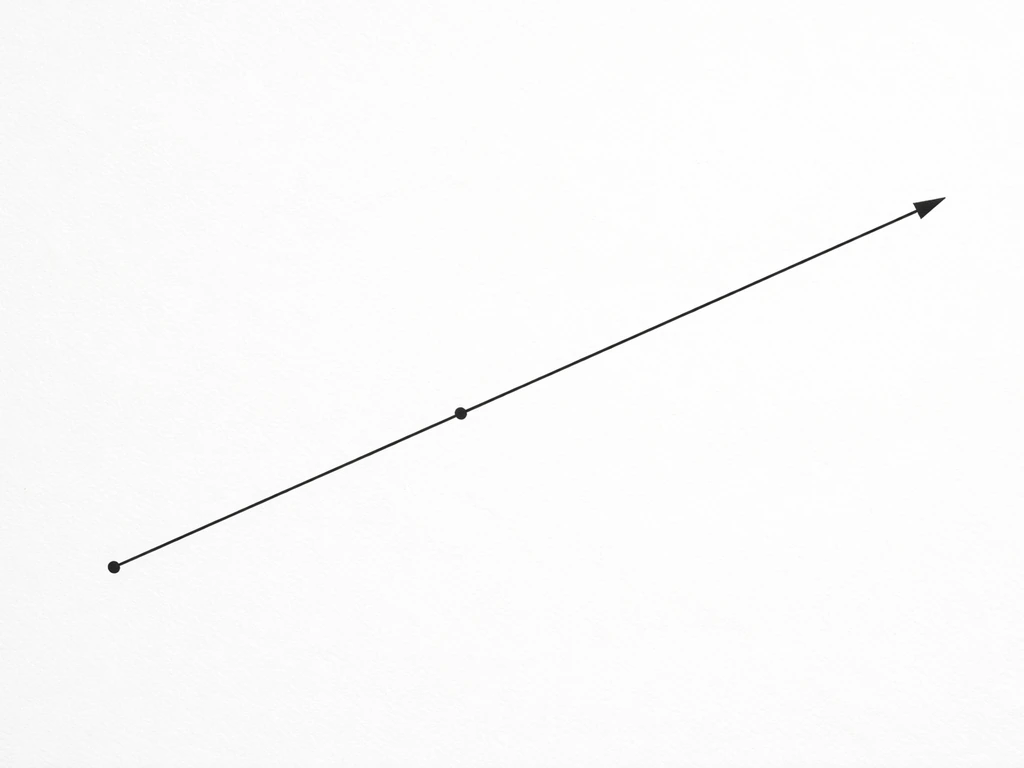
What 'grow' actually means for a line segment
On this site we usually talk about biological growth: cells dividing, roots pushing through soil, organisms reaching their size limits. But a line segment 'growing' is purely geometric. There is no cell division here. Growth just means an increase in length, achieved by extending the segment so it covers more distance between two points. Think of it like stretching a rubber band anchored at one end: the anchor point stays fixed, and the band gets longer in one direction.
The biological parallel is actually kind of useful here. Just as a root can only grow from its tip (the meristem at the end), not from some random spot along its length, a line segment can only be extended from its tips: its endpoints. In plants, root cells can grow out from shoot cells only after the right signals reprogram the cells and allow root growth to initiate root cells grow from shoot cells. Growth has directionality and a starting point in both cases. That constraint is the whole point of this question type.
The core definitions you need locked in
Before you can answer any 'which of the following' question about a segment growing, you need four definitions absolutely clear in your head.
| Term | Definition | Key feature |
|---|---|---|
| Point | An exact location in space with no length, width, or depth | No extent at all |
| Line segment | A portion of a straight line bounded by two distinct endpoints; includes every point between them | Finite length; two endpoints |
| Ray | Starts at one endpoint and continues forever in one direction | One endpoint; infinite in one direction |
| Line | Extends infinitely in both directions with no endpoints | No endpoints; infinite both ways |
The endpoint is the load-bearing concept here. A segment has exactly two of them. A ray has exactly one. A line has none. When you 'extend' a segment beyond one endpoint, you have technically created a ray (or a longer segment if you stop at a new point). Either way, the operation starts at an endpoint and moves outward along the same line, never detouring off to the side.
The rules for extending (growing) a segment

Extending segment AB means picking either endpoint A or endpoint B and continuing the line beyond it. The University of Kentucky geometry notes put it plainly: the extension of segment AB in the direction of B produces ray AB, and the extension in the direction of A produces ray BA. Those are the only two legal extensions of a given segment.
Three rules govern every valid extension:
- Start at an endpoint (A or B, never an interior point like the midpoint).
- Move outward in the direction away from the segment's interior (not back through the segment).
- Stay collinear: the extension must lie on the exact same line as the original segment, not veer off at any angle.
Break any one of those three rules and you are no longer extending the segment. You might be constructing a completely new segment, a broken line, or something else entirely, but the original segment has not 'grown.'
How to check each answer option quickly
Most multiple-choice questions on this topic give you four or five options describing where or how a segment could grow. Here is a fast elimination checklist you can run through for every single option.
- Is the proposed starting point an endpoint of the segment? If no, eliminate immediately.
- Is the proposed direction outward (away from the segment's interior)? If the option describes going inward or through the other endpoint, eliminate it.
- Is the proposed extension collinear with the original segment? If the option describes any angle or turn, eliminate it.
- Does the option describe adding length to both ends simultaneously without specifying endpoints? That is vague and almost certainly wrong; look for the option that names a specific endpoint.
- If an option describes the midpoint or 'center' as the growth origin, eliminate it: the midpoint is an interior point, not an endpoint.
Run this checklist in order. Most wrong options are eliminated at step one or step three. The correct option will pass all five checks.
Common traps that trip students up

Growing from the middle
This is the most common wrong answer students pick. An option might say something like 'from the midpoint of the segment' or 'from any point along the segment.' That sounds reasonable if you are thinking biologically (plants do grow from internal nodes sometimes), but geometrically an interior point is not an endpoint. Extending from an interior point would split the segment, not lengthen it. Eliminate any option that mentions the midpoint or 'any interior point' as the growth origin.
Confusing a ray with a segment
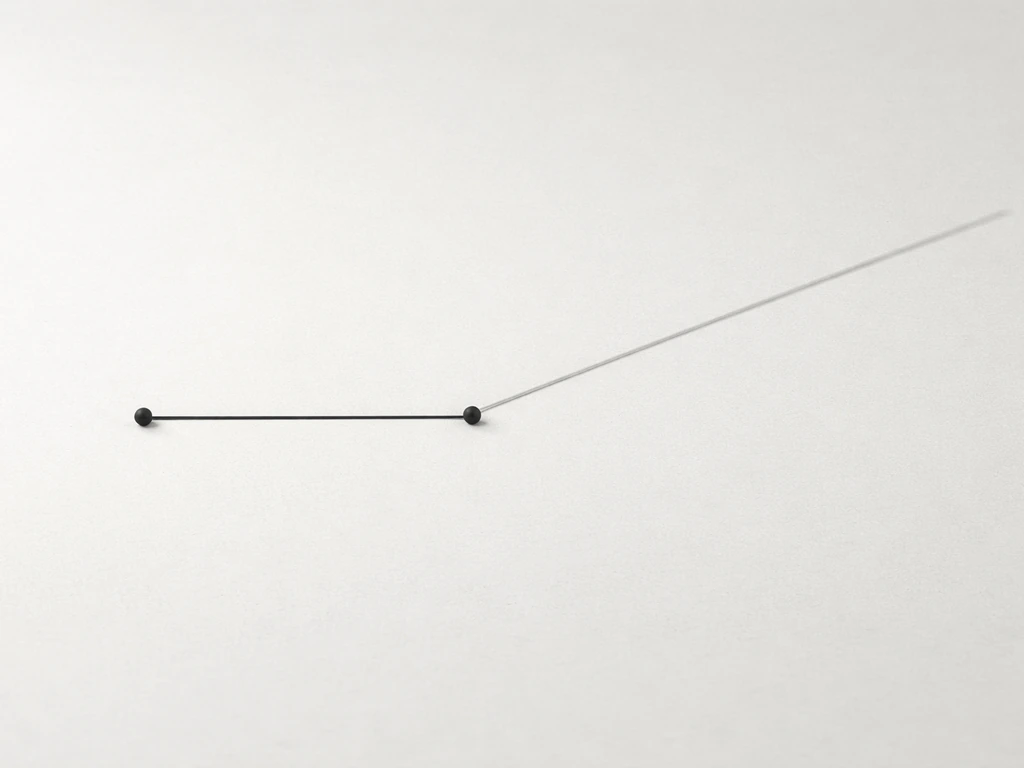
When you extend a segment beyond one endpoint, the resulting figure is technically a ray, not a longer segment (unless you define a new endpoint on the extension). In geometry, a Wikipedia definition describes a ray as points on a line that proceed indefinitely starting at its endpoint in one direction, which matches what happens when a segment is extended beyond one endpoint blank" rel="noopener noreferrer">extend a segment beyond one endpoint. Some questions try to trick you by asking whether the original segment 'becomes a ray' or 'stays a segment' after growth. The honest answer: extending beyond one endpoint without stopping produces a ray. Extending to a new defined point produces a longer segment. Both operations start at an endpoint, so the growth origin rule is the same either way.
Wrong direction
For segment AB, extending from endpoint B in the direction back toward A (that is, inward) does not grow the segment; it just retraces it. A valid extension from B goes outward, away from A. Some answer choices describe an endpoint correctly but flip the direction. Visualize an arrow pointing away from the segment's interior: that is the valid direction.
Off-angle extensions
An option might describe drawing a new line from endpoint B at a 45-degree angle, or perpendicular to the segment. That creates a brand-new segment at an angle, not an extension of the original. The original segment has not grown. The extension must be collinear, meaning it continues along the very same straight line the segment already occupies.
Step-by-step example: solving the multiple-choice question

Let's say the question gives you segment CD with endpoints C and D, and asks: 'From which of the following can segment CD grow? In other words, the key question is where do branches grow from, which always means an endpoint or node rather than the middle. ' with these four options:
- A) The midpoint of CD
- B) Any point on CD
- C) Endpoint D, in the direction away from C
- D) A point perpendicular to CD at endpoint C
Here is how to work through it step by step.
- Identify the endpoints: C and D. These are the only legal starting points for extension.
- Check option A (midpoint of CD): The midpoint is interior, not an endpoint. Eliminate.
- Check option B (any point on CD): 'Any point' includes interior points. This cannot be universally correct. Eliminate.
- Check option C (endpoint D, direction away from C): Endpoint D is a valid starting point. Direction away from C means outward, not back through the segment. This is collinear with CD. This passes all three rules. Keep it.
- Check option D (perpendicular point at C): Even though endpoint C is valid, the perpendicular direction is not collinear with CD. Extending at 90 degrees creates a new segment, not a longer CD. Eliminate.
- Select option C. It is the only option that starts at an endpoint and moves outward along the original line.
That six-step process works for any variation of this question type. The structure never changes: find the endpoints, confirm the direction is outward, confirm the direction is collinear, and you have your answer.
The bigger idea: growth always needs a starting point and a direction
Whether you are thinking about a root tip pushing deeper into soil (gravitropism governs direction, just as context governs why roots grow downward and shoots grow upward) or a line segment being extended on a geometry worksheet, the principle is the same: growth is not random. It has a defined origin and a defined direction. This is the same direction rule as a force pointing one way: the segment effectively shoots in the opposite direction defined origin and a defined direction. For a line segment, the origin is always an endpoint, and the direction is always outward and collinear. So if you are wondering why a stem grows upwards, the key idea is that growth follows a defined direction from its growth point, not from random places along the stem. No exceptions. Once you internalize that constraint, this whole family of multiple-choice questions becomes straightforward to crack.
The same logic applies when you think about where branches grow from on a plant: not from the middle of an existing stem at random angles, but from defined nodes in specific directions. This same idea helps explain why roots grow downward and shoots grow upwards instead of coming from random places on the stem why do roots grow downward and shoots grow upwards. Geometry formalizes that same intuition into exact rules. Knowing those rules is what lets you move through answer choices confidently instead of guessing.
FAQ
If an option says the segment grows from its midpoint, could it still be correct in some special case?
No. Any midpoint is an interior point, extending from it would split the original segment rather than add length in a single outward direction from an endpoint. The only legal growth origins are the two endpoints.
What if the answer choice says the segment grows “in both directions” (left and right) from an endpoint?
A single extension grows outward from one chosen endpoint along the collinear line. If the choice implies you are extending on both sides at once, that is not one endpoint extension, it effectively describes a different operation (like rebuilding a longer segment with new endpoints).
Is it valid to extend a segment until it hits another point, like a specific intersection point?
Yes, as long as the extension starts at an endpoint and continues along the same straight line. Stopping at a new defined point makes a longer segment, but the growth origin is still that original endpoint.
If an option describes extending from endpoint A but toward A itself, is that growth?
No. Extending from A must go outward away from the interior of the segment. If the direction is inward, the “extension” just retraces what was already there.
How can I tell whether an option describes a true collinear extension or a new angled segment?
Check whether the new figure continues the exact same straight line as the original segment (same line, no turn). Any perpendicular, 45-degree, or angled direction indicates a new segment, not an extension of the original.
When a question talks about a segment “becoming a ray,” what does it mean for the choice?
Extending beyond one endpoint without stopping produces a ray. If an option correctly states “from one endpoint outward” but uses ray language, it can still be correct. If it specifies the wrong endpoint or the wrong outward direction, it is wrong.
If an option mentions “from any point along the segment,” could they be using a looser everyday meaning?
For this geometry question type, “grow” is literal and must use endpoint-based extension. Everyday phrases might sound loose, but the rule for the geometry model does not allow interior starting points.
What if the segment is labeled with letters like CD, but the option uses a different order, like “DC” or “from D toward C”?
Order matters only for direction. Extending from endpoint D toward C means going inward, so it is not growth. Extending from D away from C is the correct direction for D-based extension.
Next Article
Where Do Branches Grow From Nodes, Buds, and Apical Dominance
Learn where branches grow from nodes, buds and axillary buds, and how auxin and apical dominance control branching.