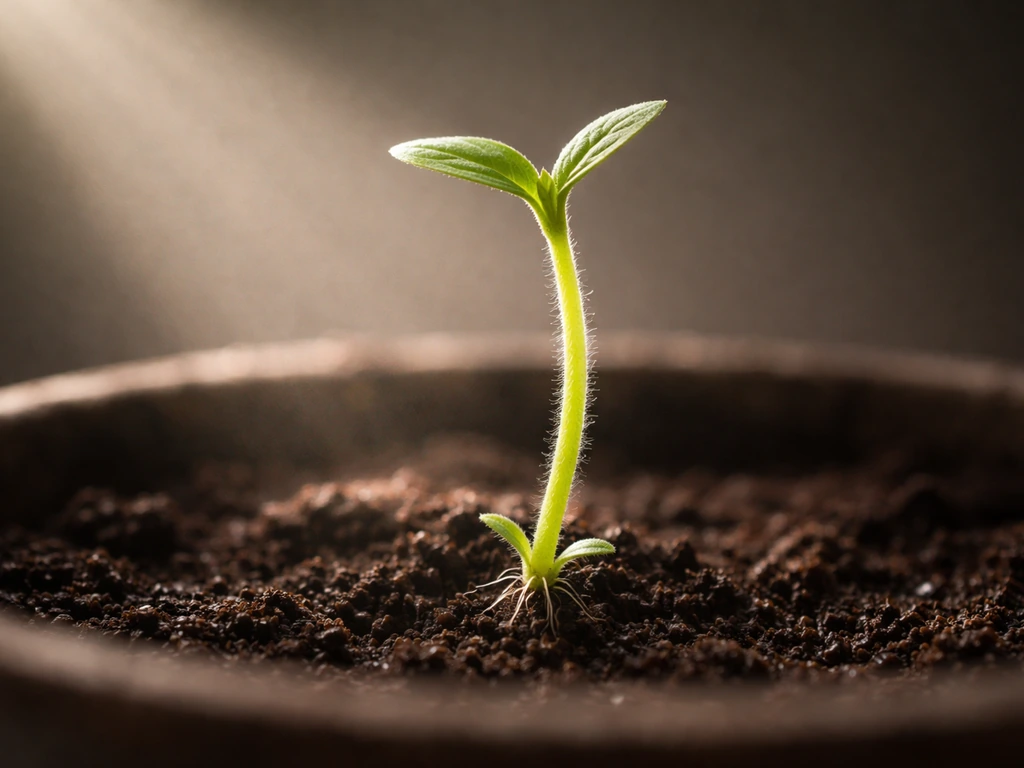
Roots grow downward and shoots grow upward because each organ detects gravity (and in shoots, light) and then redistributes a hormone called auxin to make cells on one side grow faster than the other. It's not random, and it's not magic. It's a tightly controlled response to directional environmental signals, a process called tropism, and once you understand the mechanism you can predict exactly what a plant will do when you flip it sideways, block its light, or deprive it of water.
Why Do Roots Grow Downward and Shoots Grow Upward?

Marcus Whitmore
12 May 2026
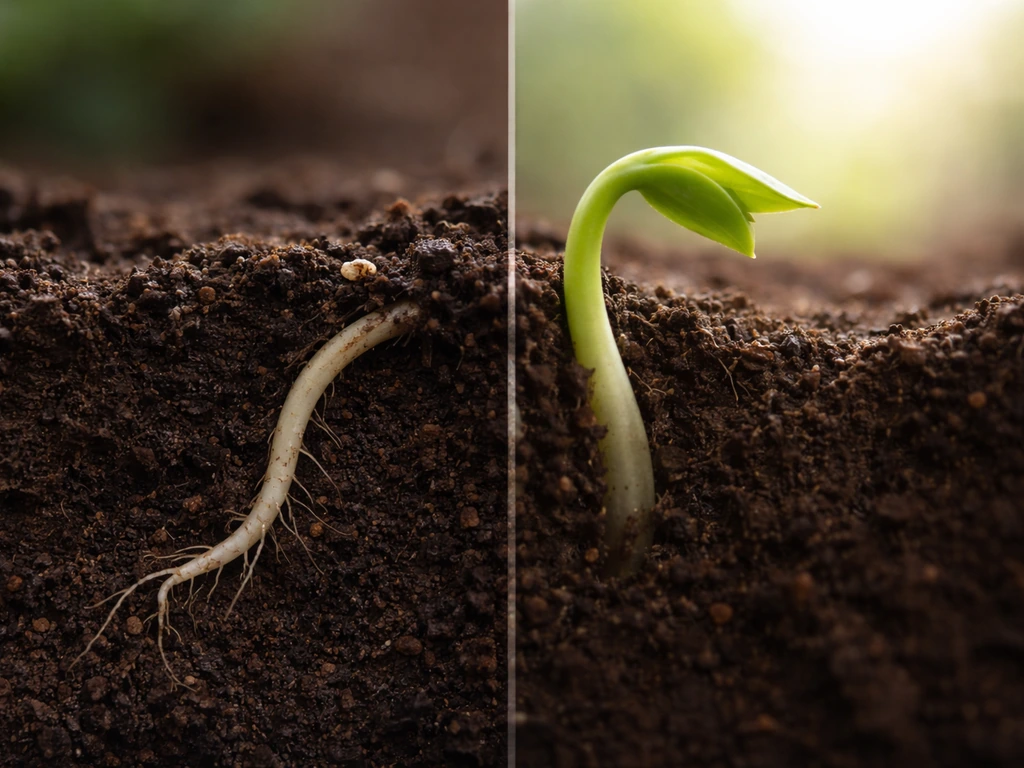
Growth direction comes from directional signals, full stop
The one-sentence answer: roots and shoots don't have a built-in compass, they read environmental cues (gravity, light, water, chemicals, touch) and grow toward or away from them based on which signals are strongest. That's it. Every nuance in this article is just an expansion of that idea.
Botanists call these directional growth responses tropisms. Gravitropism is the response to gravity, phototropism is the response to light, hydrotropism is the response to water, and so on. A plant uses all of these simultaneously, and the growth direction you see at any moment is the sum of all those competing signals. Under normal garden conditions, gravity and light pull in the same direction (down and up, respectively), so roots and shoots behave predictably. Change those conditions and the plant adjusts. In microgravity experiments with the moss Ceratodon purpureus, amyloplast sedimentation and positioning were found to be nonrandomly distributed, consistent with statolith behavior shaping gravitropic sensing under altered gravity.
How plants sense gravity: the statolith story
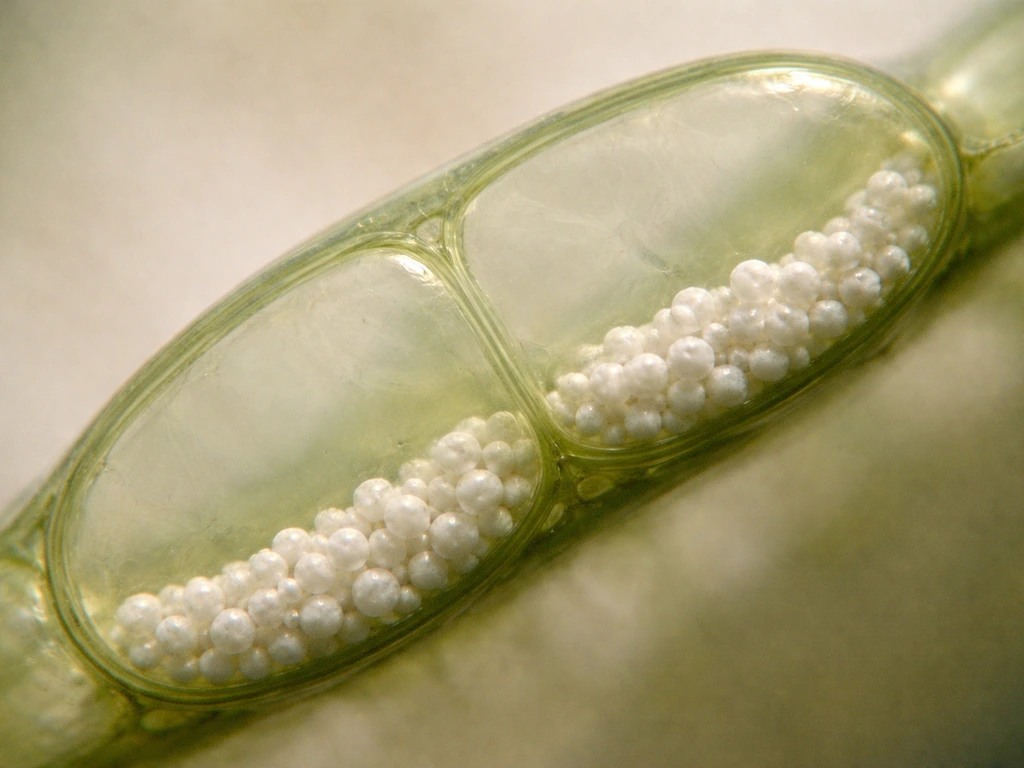
Gravity sensing in plants relies on specialized cells called statocytes. Inside these cells sit dense, starch-packed organelles called amyloplasts (sometimes called statoliths or starch grains). Because they're denser than the surrounding fluid, amyloplasts sink toward whatever is currently the lowest point of the cell, like a small stone settling to the bottom of a jar of water.
When a root is growing perfectly downward, the amyloplasts rest at the very bottom of the statocytes. Tip the plant sideways and within minutes the amyloplasts roll to the new lowest point. That movement is the trigger. It kicks off a signaling cascade that eventually tells the root, 'you're off course, correct.' Researchers have spent decades refining exactly how amyloplast movement (including interactions with actin networks and vacuoles inside the cell) gets converted into that downstream signal, and it remains an active area of research.
In roots, the statocytes are clustered in the root cap, a protective tissue at the very tip of every root. In shoots, equivalent gravity-sensing cells sit in a region called the endodermis, just inside the stem's outer layers near the shoot apical meristem. Same basic mechanism, but located in different tissues, and (critically) wired to produce opposite growth responses.
Why roots go down but shoots go up (same signal, opposite result)
This is the part that confuses most people. Both roots and shoots sense gravity using the same statolith mechanism, so why do they grow in opposite directions? The answer is in how each organ is wired to respond to auxin. Roots are hypersensitive to auxin: a small extra dose on one side slows elongation.
Shoots are less sensitive: the same extra dose speeds up elongation. So when auxin accumulates on the lower side of a tilted organ (which it does in both cases), the root curves up away from that side while the shoot curves down toward it. Nature Cell Research describes how auxin maxima on the lower side repress root growth, while continued elongation on the upper side bends the root downward [auxin accumulates on the lower side](https://www. nature.
com/articles/s41422-019-0254-4). This wiring is why shoots grow in the opposite direction to the force of gravity shoots grow in the opposite direction to gravity. Same hormone, same redistribution, opposite outcomes.
Light sensing and phototropism in shoots
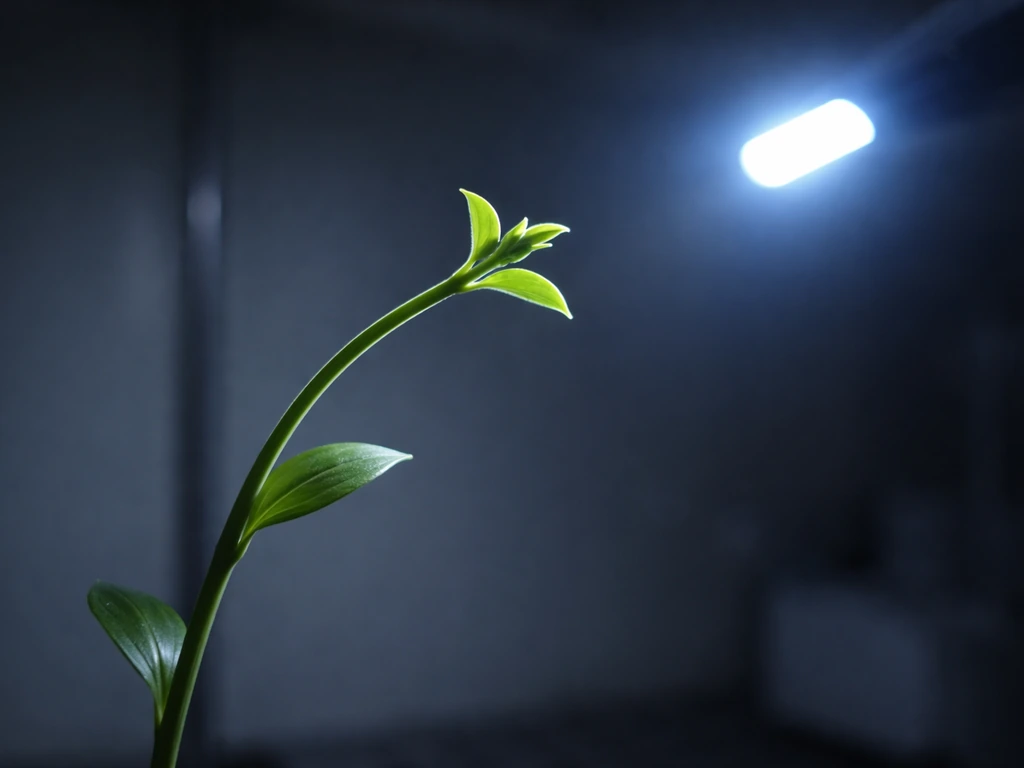
Shoots have a second, overlapping directional system: phototropism. Blue light hitting the shoot tip is detected by photoreceptor proteins called phototropins. When light comes from one side, phototropins on that side get activated and trigger a lateral shift of auxin toward the shaded side. The shaded side now has more auxin, those cells elongate faster, and the shoot bends toward the light source.
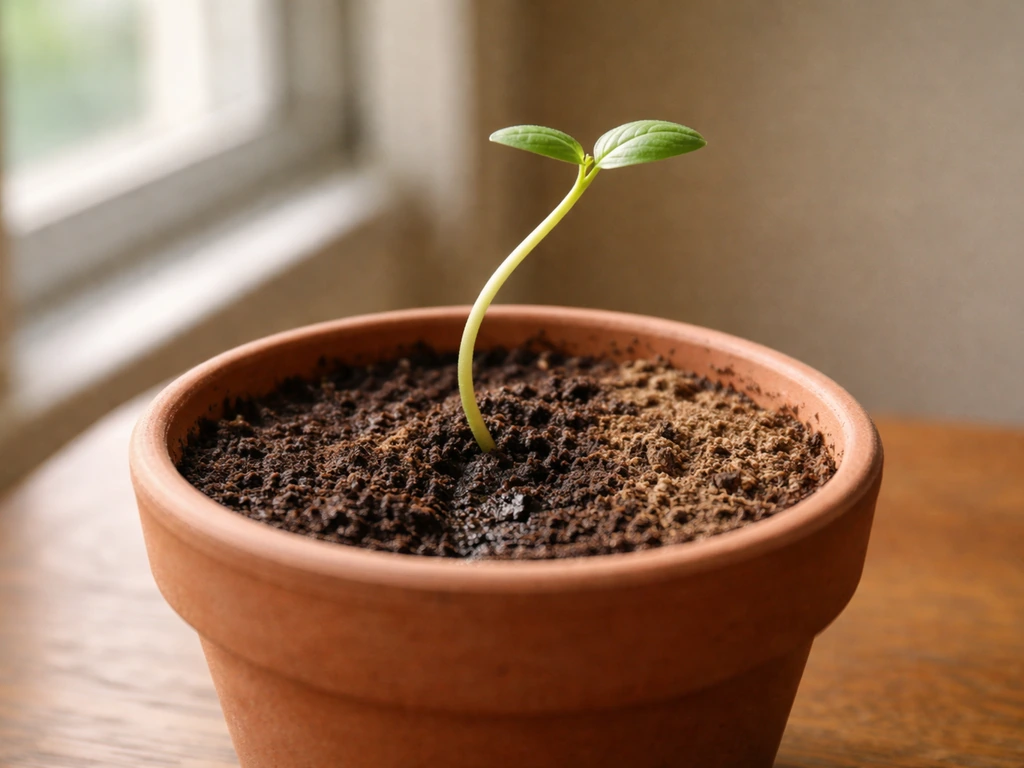
Under normal outdoor conditions, light and gravity cooperate. Shoots grow up because the sky is both bright (phototropism pulling upward) and the 'away from gravity' direction (gravitropism pushing upward). To see why the stem grows upward, you can follow the same auxin redistribution and gravitropism wiring that makes shoots respond opposite to roots shoots grow up. In a windowsill pot, though, gravity still points straight down while light comes in at an angle. The shoot compromises, leaning toward the window rather than growing perfectly vertical. That's not the plant being unhealthy, it's just phototropism temporarily outweighing gravitropism. Rotating the pot every few days keeps the lean even.
Roots, interestingly, are generally not phototropic in the same direct way. They're typically buried in darkness and don't need a light-tracking system. Some roots do show a mild negative phototropism (they grow away from light), which reinforces their downward direction when they're exposed at the soil surface.
Auxin: the hormone doing all the heavy lifting
Auxin (mainly indole-3-acetic acid, or IAA) is the central player in every tropism we've discussed. It's produced primarily at the shoot tip and root tip, then moved through the plant by a transport system involving specialized carrier proteins (PIN proteins) that can be repositioned within cells to redirect the flow of auxin depending on environmental signals.
Think of it like traffic routing software. The plant detects a directional cue (gravity, light), repositions the 'exit ramps' (PIN proteins) on the relevant cells, and auxin flows to whichever side needs more growth stimulation or inhibition. This is why a seedling laid on its side doesn't just stay horizontal. Within 30 to 90 minutes you can watch the shoot tip starting to curve upward and the root tip starting to curve downward, because the hormone redistribution happens that quickly.
Differential cell elongation is the physical outcome. Cells on the fast-growing side expand more in length (not by dividing more, just by taking in water and expanding their vacuoles), making that side longer and curving the organ in the opposite direction. It's the same principle behind why a balloon tied tighter on one end curves instead of inflating symmetrically.
Other cues that guide growth direction
Gravity and light are the dominant signals, but roots especially are sensitive to other directional cues that can override or modify the gravitropic response.
- Hydrotropism: Roots actively grow toward moisture gradients. In dry soil with one moist patch, roots will curve toward that patch even if it means growing slightly sideways rather than straight down. This is practically relevant if you water unevenly or have a leaky pipe in the garden.
- Chemotropism (nutrient seeking): Roots curve toward higher concentrations of nutrients like phosphate and nitrate. Fertilizer placement matters, roots will explore toward the fertilizer zone.
- Thigmotropism (touch response): When roots or shoots encounter a physical obstacle, they curve around it. Roots hitting a rock or compacted layer will follow the path of least resistance, which is often sideways. This is a common reason roots appear to grow horizontally in compacted soils.
- Oxytropism (oxygen gradient): Roots in waterlogged, low-oxygen soil often grow upward toward the surface (a phenomenon seen in swamp-adapted plants). Oxygen availability can temporarily override the downward gravitropic signal.
These aren't rare edge cases. In any real garden soil, roots are integrating all of these signals at once. The nice clean 'roots grow down, shoots grow up' rule is a summary of the dominant signals under ideal conditions, not a description of what every cell does every second.
When the rules break: conditions that flip or reduce directional growth
Several real-world conditions produce growth patterns that look 'wrong' but actually make perfect biological sense once you know the mechanism.
| Condition | What you see | Why it happens |
|---|---|---|
| Seedling on its side | Shoot curves upward, root curves downward within hours | Amyloplasts settle to new 'down' side, auxin redistributes, differential elongation bends both organs back toward their preferred direction |
| Complete darkness (no light) | Shoot grows straight up, possibly etiolated (pale, stretched) | Gravitropism still works without light; phototropism adds nothing but the stem elongates more than usual seeking light |
| Rotating clinostat (lab) | Shoot and root grow in random or horizontal directions | Continuous rotation prevents amyloplasts from settling, eliminating the gravity signal; without gravitropism the organ loses its preferred direction |
| Microgravity (space) | Roots and shoots grow in all directions | No gravity vector means no gravitropic signal; phototropism keeps shoots oriented toward light but roots wander |
| Waterlogged soil | Roots may grow upward or laterally toward soil surface | Low oxygen triggers oxytropism and stress responses that override gravitropism |
| Circling roots in a pot | Roots grow in circles or even upward | Pot wall acts as obstacle (thigmotropism); roots follow the container shape rather than gravity |
| Etiolation / shade avoidance | Shoot bends sharply toward any light source | Phototropism intensifies when light is scarce; auxin gradient steepens in low-light conditions |
| Root cap removed (lab) | Root loses directional growth, grows randomly | Statocytes in the cap are gone, so the gravity-sensing mechanism is disrupted |
One nuance worth knowing: not all roots grow straight down. Lateral roots emerge at angles determined partly by gravity, partly by the angle at which they branch from the primary root, and partly by local soil conditions. This is related to a concept called the gravitropic set-point angle (GSA), where different root or shoot branches maintain different angles relative to gravity rather than aiming purely vertical. The same principle is why branches on a tree grow outward rather than straight up, even though shoots are supposed to be negatively gravitropic.
Troubleshooting weird growth direction in your plants
If a plant in your home or garden is growing in an unexpected direction, work through these checks before assuming something is seriously wrong.
- Shoot leaning toward window: Normal phototropism. Rotate the pot 180 degrees every 3 to 5 days to keep the plant growing straight. If you want it perfectly vertical, provide even light from above (a grow light centered over the plant works well).
- Roots growing out of drainage holes or circling inside the pot: The plant is root-bound. Roots hit the container wall (thigmotropism) and have nowhere to go but sideways or upward. Repot into a container 2 to 5 cm larger in diameter.
- Roots growing upward out of soil surface: Usually means waterlogging or poor drainage creating a low-oxygen zone. Check drainage, reduce watering frequency, and consider adding perlite or grit to the mix to improve aeration.
- Seedlings flopping sideways instead of standing upright: Often a sign of etiolation combined with weak stems. Move the plant to brighter, more even light immediately. The gravitropic response is working (the shoot is trying to go up) but the stem can't support the weight. Gently staking while the plant strengthens helps.
- Plant not straightening after being tilted: If a healthy plant doesn't correct its growth direction within a few days of being repositioned upright, check for root damage, stem rot at the base, or severe nutrient deficiency, all of which can impair hormone transport and disrupt gravitropism.
- Garden tree or shrub with branches growing downward: Strongly downward-drooping branches may indicate a weeping variety (genetically modified gravitropic set-point angle), heavy fruit load, or structural damage. If it's not a weeping cultivar, check for pest or disease damage at the branch junction.
Simple at-home experiments to see tropisms for yourself
The best way to really understand this is to watch it happen. These experiments use common household items and produce visible results within 24 to 72 hours.
Experiment 1: Sideways seedling (gravitropism in action)
- Germinate a bean or radish seed in a damp paper towel inside a zip-lock bag until you can see a root and a small shoot (about 2 to 4 cm each).
- Pin the bag to a vertical surface (like a clipboard) with the root pointing sideways, not down.
- Check every 12 hours. The root will curve downward and the shoot will curve upward, typically within 24 to 48 hours.
- For a control, set up an identical seedling with the root pointing straight down. It should grow straight with no curve.
Experiment 2: Light maze (phototropism)
- Take a shoebox and cut a small hole (about 2 cm wide) in one end.
- Place a small potted seedling (bean or sunflower works well) at the opposite end of the box from the hole.
- Close the lid and place the box with the hole facing a bright window.
- Check after 3 to 5 days. The shoot will have bent significantly toward the hole, following the single light source.
- Optional: add cardboard baffles inside the box to create a maze. The shoot will find its way around them toward the light, demonstrating both phototropism and thigmotropism working together.
Experiment 3: Water chasing (hydrotropism)
- Fill a long, narrow tray with dry sand or vermiculite.
- Plant a fast-growing seedling (radish or grass) in the center.
- Water only one end of the tray consistently for one week, keeping the other end completely dry.
- At the end of the week, gently unearth the roots and observe their direction. You should see roots preferentially growing toward the watered end, even if it means deviating from straight down.
These experiments aren't just fun demonstrations. They're the same kinds of observations that led scientists to identify auxin in the first place, and they give you genuine intuition for how flexible plant growth direction really is. Once you've watched a seedling correct itself after being tipped sideways, the whole mechanism clicks in a way that no diagram quite achieves.
The bigger picture: architecture supports function
It's worth stepping back and noticing how the plant's physical structure reinforces these growth directions. The root cap isn't just a protective layer, it's the location of the gravity-sensing statocytes, positioned precisely at the growing tip where directional decisions matter most. The shoot apical meristem sits at the top of the stem, exposed to light and sky, making it perfectly placed to receive both gravitropic and phototropic signals. This isn't coincidence. These structural arrangements are the product of hundreds of millions of years of selection for efficient directional growth.
The question of how root cells and shoot cells can develop such different properties from the same genetic blueprint is a fascinating separate story, closely tied to how cell identity is established during development. Root cells and shoot cells can grow from each other through plant developmental pathways, where cells in meristems and other tissues dedifferentiate and then re-differentiate based on hormones and positional cues from shoot cells to root cells. Similarly, the specific mechanics of why shoots grow in the opposite direction to gravity connects directly to how shoots handle the gravitropic signal differently from roots. And if you've ever watched a climbing vine, you'll know that touch and support structures add another whole layer to the directional growth story.
But at the core, the answer is always the same: the plant reads a directional signal, moves its hormone to one side, and the side with more (or less) auxin grows faster. Roots down, shoots up, with all the interesting exceptions that come from a world that doesn't always cooperate with those simple directions. For a line segment to grow, you can think of the way it expands from one end based on which option matches the direction of growth a line segment can grow from which of the following.
FAQ
If I tip a seedling sideways, will it always correct in 30 to 90 minutes?
Because the key variable is auxin sensitivity and where auxin ends up after the tilt. If a plant is under poor light, drought stress, or has been recently repotted, the auxin response can be slower or weaker, so the “correction” may take days instead of hours, and the direction may look less clean than the textbook pattern.
What should I do if my plant keeps leaning the “wrong” way even after rotating the pot?
No. Growth direction is a balance of multiple tropisms, and some environments make one signal strongly outweigh the others. For example, in very low light, phototropism can be too weak to compete with gravitropism, while in brighter angled light, phototropism can dominate and produce a persistent lean.
Do roots ever grow toward or away from light?
Roots primarily behave like positive gravitropes in typical soil darkness, so they often do not need a light-tracking system. However, at the soil surface or in clear containers, light can trigger mild negative phototropism (and other stress responses), causing roots to turn or slow rather than forming a perfectly straight “down only” path.
Can a plant fail to respond to gravity after it is moved or damaged?
Yes. Statocytes sense gravity, but the plant’s response depends on how auxin carriers are set up in the relevant tissues. If the root tip or shoot tip is physically damaged, or if the transport system is disrupted by poor conditions, the organ can fail to curve properly even though gravity is still detected.
Why do I see auxin-based tropism “signals” but not much bending in my stressed plants?
Auxin redistribution happens quickly, but visible curvature can be delayed because cell expansion depends on water availability, temperature, and energy status. If the plant is dry, cold, or otherwise stressed, cells may not elongate efficiently, so tropism signaling is present but the shape change is slower.
Does root and shoot gravitropism work the same way at all ages of the plant?
The “opposite directions” idea assumes similar wiring at equivalent developmental stages. Young tissues in active growth respond most strongly, and older tissues can become less flexible as cell walls stiffen and the growth zone shifts, so gravitropic correction may be weaker over time.
Why does my plant curve in 2D or 3D in a way that seems unpredictable?
Slight inconsistencies usually come from the fact that light and gravity are not the only directional cues. Touch, uneven moisture, nearby roots, and chemical gradients can nudge the auxin distribution, so the plant may not bend in exactly the plane you expect.
How can I quickly tell which tropism is dominating in my setup?
For many purposes, you can use the “dominant signal” rule. If the organism is exposed to strong angled light, phototropism can overpower gravitropism, causing upward or outward leaning. If light is weak and gravity dominates, you should see classic upward for shoots and downward for roots.
Why do branches on trees or side roots not grow perfectly straight up or straight down?
Yes, because branches often follow a maintained angle relative to gravity rather than always aiming straight up or down. Different branches can have different gravitropic set-point angles, and local geometry of branching plus soil or support contact can lock in those angles.
What is the best practical way to test gravitropism at home without confusing it with stress?
Repositioning works best when you change the cue directions while keeping the plant healthy. Rotate the pot gradually and consistently (not all at once), ensure adequate water, and avoid touching the root tip region. Sudden disturbance can trigger additional responses that mask the gravitropic correction you are trying to observe.
Next Article
Why Does the Stem Grow Upwards? Causes and Experiments
Explore why stems grow upward: hormones, gravity sensing, light cues, constraints, and simple at-home experiments.