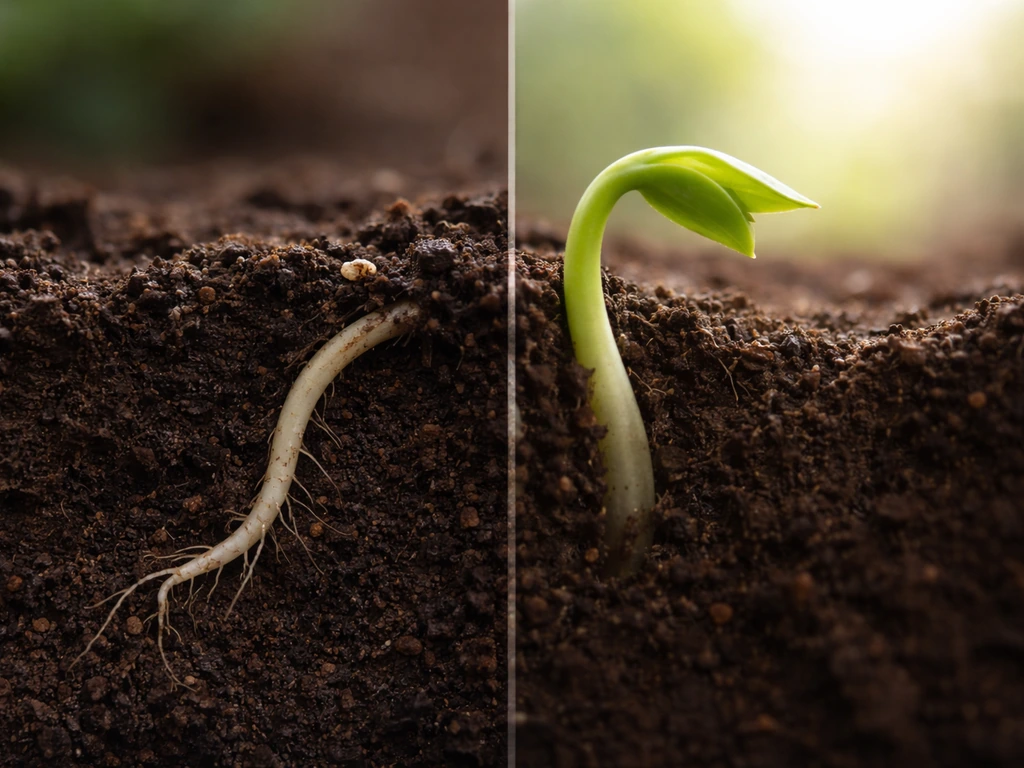
Shoots grow opposite to gravity because they are negatively gravitropic: when gravity pulls down, shoots bend and grow upward. Shoots grow opposite to gravity due to negative gravitropism, which is the key to why do roots grow downward and shoots grow upwards. This is not a reflex or a mechanical push-back.
Shoots Grow Opposite the Applied Force: Why and How to Test

Marcus Whitmore
15 May 2026
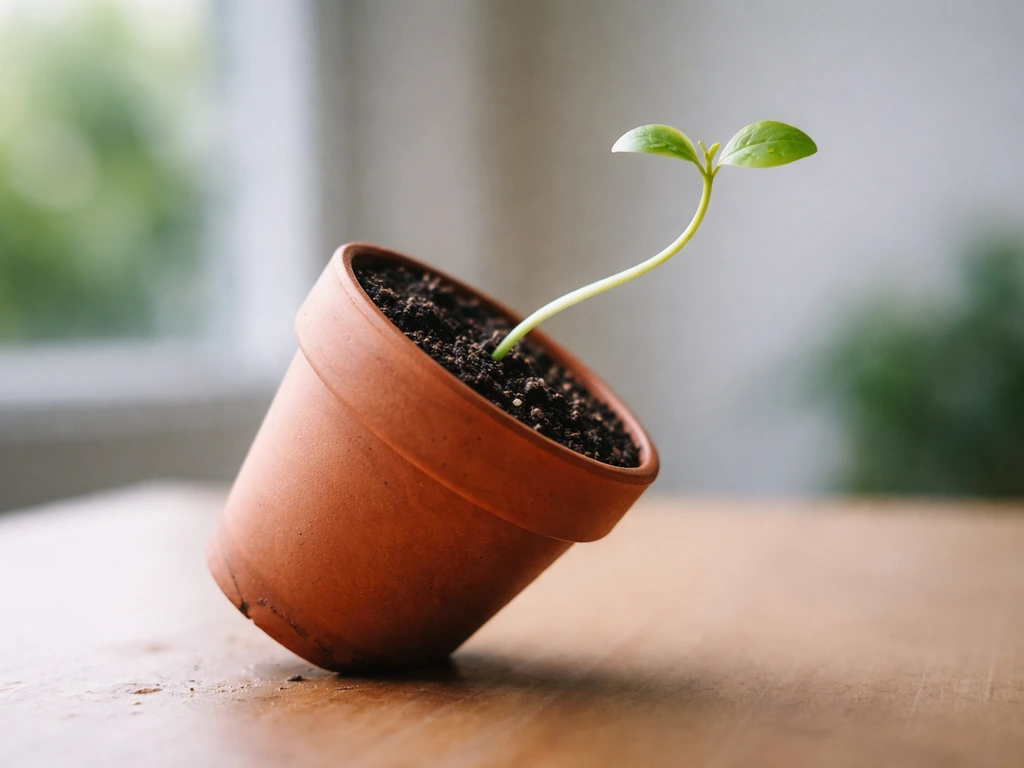
It is a carefully regulated biological process where the plant senses which way is down, moves the hormone auxin toward the lower side of the shoot, and the unequal auxin concentration causes faster cell elongation on that lower side, physically curving the stem upward. If the force involved is touch rather than gravity, the same hormone gets redistributed differently, and the direction of curvature changes.
Knowing which force is at play, and how the plant is reading it, tells you exactly what growth response to expect.
What 'opposite to force' actually means in plant growth
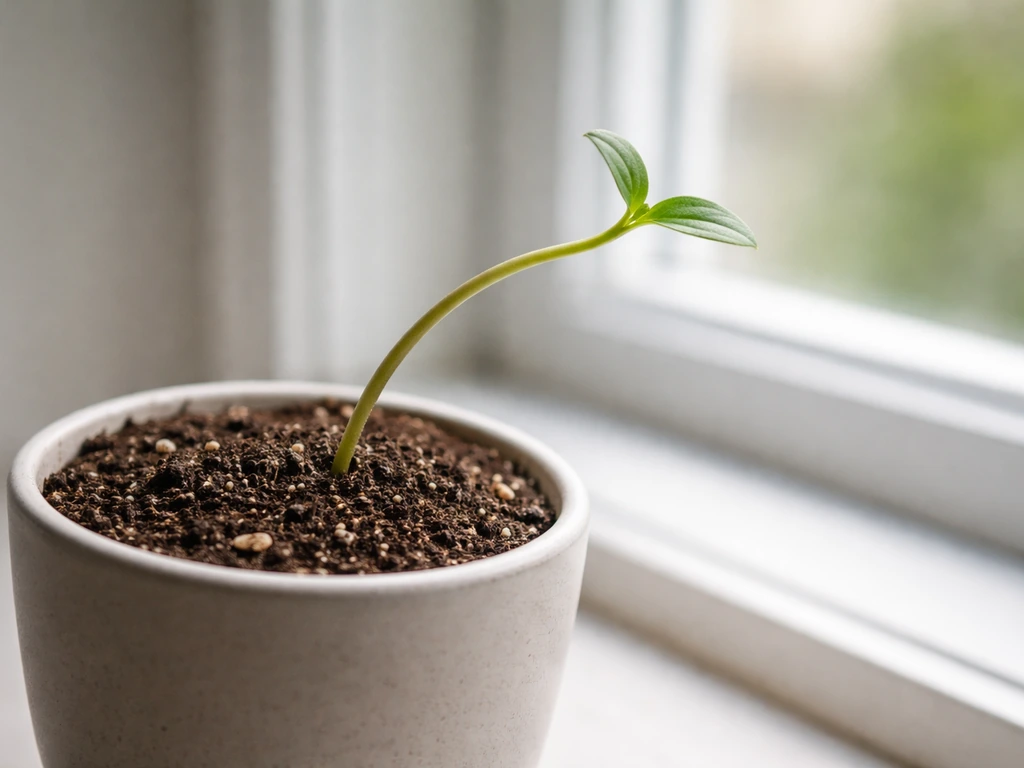
When biologists say shoots grow 'opposite to a force,' they almost always mean negative gravitropism: the shoot reorients away from the direction gravity is pulling. Roots do the opposite, growing toward gravity (positive gravitropism). K12 LibreTexts explains that shoot gravitropism is negative, meaning shoots reorient away from gravity while roots show positive gravitropism and grow toward it blank" rel="noopener noreferrer">Roots do the opposite. Because roots respond to gravity differently, their growth patterns also depend on how root cells develop from cells in the shoot roots do the opposite, growing toward gravity. This sign convention is classical and consistent across plant species.
Here is the important nuance: the plant is not sensing the magnitude of the gravitational pull like a scale measures weight. Research has shown that plants encode inclination, meaning the angle of the organ relative to vertical, not the raw force being applied. Tip a seedling 45 degrees and it responds to that angle, not to how hard gravity is pulling on it. This is why simply pressing down on a shoot does not trigger the same response as tilting it.
Touch-based forces follow a different rule entirely. In thigmotropism (from the Greek thigma, meaning touch), the directional cue is the point of contact itself. Cells at the contact site grow more slowly or contract, while cells on the opposite side elongate faster, bending the shoot toward or around the object. That is directionally specific, but it is not 'opposite to gravity.' Mixing these two up is one of the most common sources of confusion when people observe a shoot curving and wonder what is causing it.
How shoots sense forces: gravity versus touch
Sensing gravity: statoliths and statocytes
Inside shoots, specialized cells called statocytes contain dense starch-filled organelles called amyloplasts, or statoliths. These settle under gravity toward the lowest point of the cell, much like a marble rolling to the bottom of a bowl. In shoots, the statocytes form a cylindrical sheath surrounding the stem (called the endodermis or starch sheath), which is a different location from the root cap where root statocytes sit. This structural difference helps explain why roots and shoots respond to the same gravitational signal in opposite directions.
When a shoot is tilted, the statoliths reposition within the statocytes. That repositioning physically relocates PIN auxin transporter proteins on the cell membrane, shifting where auxin flows. The result is a lateral auxin gradient, with more auxin accumulating on one side of the shoot. That is the Cholodny-Went mechanism in action, and it is the engine behind gravitropic curvature.
Sensing touch: mechanosensitive channels and calcium
Touch or mechanical pressure activates a completely different front-end sensing system. Mechanosensitive ion channels in the plasma membrane open in response to membrane deformation. This triggers an almost immediate spike in cytosolic calcium (Ca2+), which then activates kinase cascades (including CDPKs and MAPKs) and reactive oxygen species (ROS) signaling. The whole cascade happens at the interface between the cell wall, plasma membrane, and cytoskeleton.
So while both gravity and touch eventually feed into auxin redistribution and differential growth, they enter the system through different sensors, at different speeds, and with different spatial geometries. Touch responses can happen in seconds to minutes (think of a tendril beginning to coil after contact). Gravitropic reorientation typically unfolds over hours, with bending termination mediated by auxin feedback on PIN3 polarity occurring around 24 hours after stimulation. Gravitropic reorientation ends through auxin feedback that terminates the response by altering PIN3 polarity, with PIN3-mediated lateral auxin transport central to producing the asymmetric growth that drives bending bending termination mediated by auxin feedback on PIN3 polarity.
Mechanisms behind curvature: differential growth and auxin transport
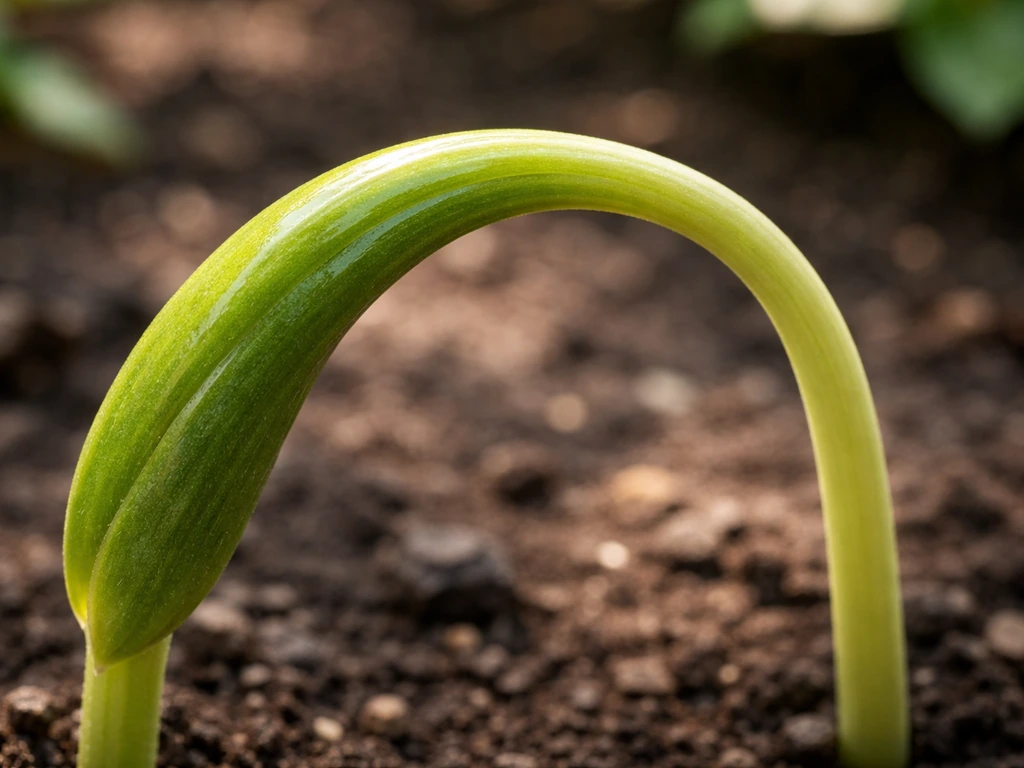
Regardless of whether the cue is gravity or touch, the actual bending is always produced the same way: differential growth. A line segment can grow from a point by expanding in the direction set by its growth rules differential growth. One side of the shoot elongates faster than the other, and the organ curves toward the slower-growing side. The mechanism is elegant in its simplicity but precise in its execution.
In gravitropism, when a shoot is inclined, statoliths settle toward the lower side. PIN3 auxin carriers relocalize and pump auxin laterally toward that lower flank. Auxin promotes cell elongation, so the lower side grows faster, and the shoot curves upward. As the shoot approaches vertical again, a feedback loop involving TIR1/AFB auxin receptors repolarizes PIN3 and redistributes auxin more evenly, terminating the bend. The system self-corrects once the job is done.
In thigmotropism, the geometry is reversed in a sense. Cells on the contact side grow more slowly, while cells on the opposite, untouched side elongate faster. The shoot bends toward the object it is touching. In tendrils, this auxin-driven asymmetry can happen remarkably fast after contact, driving the coiling behavior you can watch in real time with climbing plants.
Both processes share the same downstream output (a hormone gradient causing asymmetric elongation), but the direction and the trigger differ. Understanding this shared mechanism is what lets you predict and control growth direction once you identify which force is acting.
How to identify which tropism is happening
Before you can fix or redirect a shoot, you need to know what is bending it. Run through these diagnostic checks in order:
- Check orientation relative to vertical. If the shoot is bending upward regardless of where the light is, gravity is almost certainly the primary driver. Negative gravitropism is the default for shoots.
- Check for a light source. If the shoot is bending toward a single light direction, phototropism is confounding the picture. Move the plant to even, diffuse light (or a dark room for a few hours) and see if the bending direction changes.
- Check for a contact point. Is any part of the shoot touching a stake, wall, trellis wire, or another stem? Touch-driven thigmotropism causes bending toward the contact side, not away from it. Look for a compression point.
- Check the timing. Touch responses begin within minutes to hours. Gravitropic reorientation is visible within 1 to 6 hours and mostly complete within 24 hours in seedlings. A very slow, gradual bend over multiple days with no contact or light change points strongly to gravity.
- Check for any pulling or tethering. If you have manually attached the shoot to something or weighted it, you are imposing a mechanical force that is not the same as gravitropism. The shoot may respond to the imposed inclination, not the pulling force itself.
| Force type | Direction of curvature | Speed of response | Key diagnostic clue |
|---|---|---|---|
| Gravity (negative gravitropism) | Away from gravity, toward vertical | 1 to 24 hours | Happens even in darkness with no contact |
| Touch/contact (thigmotropism) | Toward contact point | Minutes to hours | A physical object at the bending site |
| Light (phototropism) | Toward light source | 1 to 12 hours | Bending tracks with light direction |
| Imposed mechanical load/tether | Follows angle of inclination | Gradual, over days | External attachment or weight present |
Simple at-home tests you can run today
You do not need a lab for this. A small seedling (bean, sunflower, or radish work well because they are fast and visible), a pot, a window, and a phone camera are enough to run a clean observation. If you are tracing where growth happens, another useful related question is where do branches grow from, since branching points determine how stems and shoots develop.
Test 1: Isolating gravity (negative gravitropism)
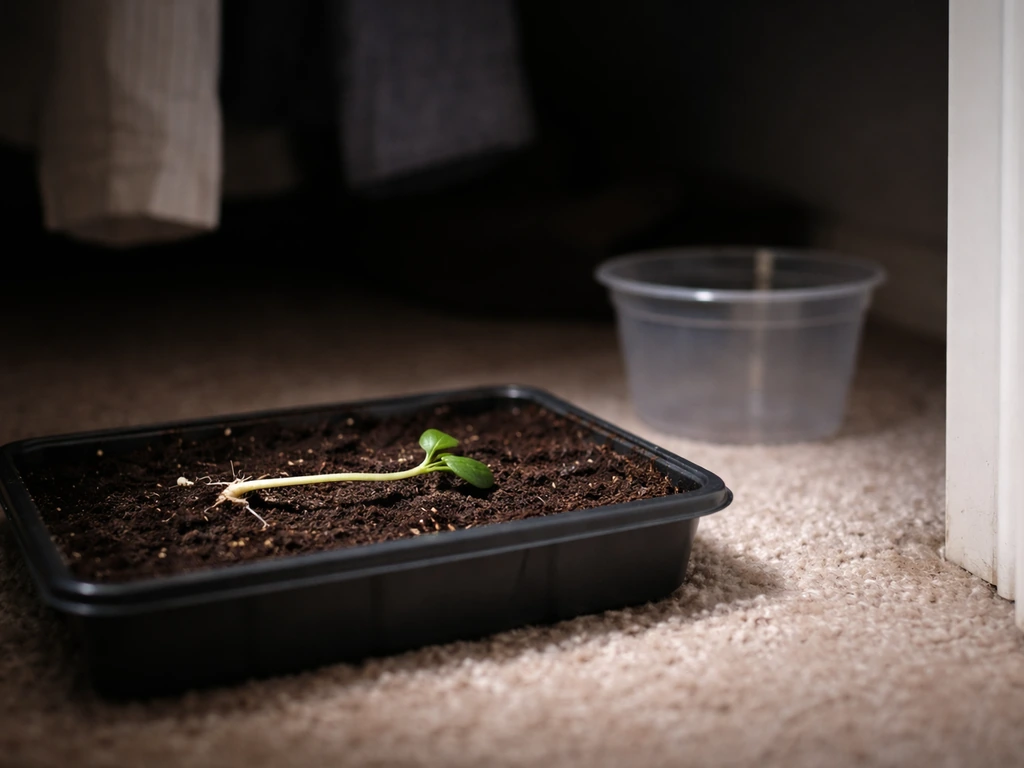
- Germinate a seedling until the shoot is 3 to 5 cm tall and growing straight.
- Rotate the pot 90 degrees so the shoot is now horizontal. Place it in a dark closet to remove light as a confound.
- Photograph the shoot every 2 hours for 12 hours. Use a protractor or draw a reference line on the photo to measure the angle of the tip relative to horizontal.
- Expected result: the shoot tip should begin curving upward within 1 to 4 hours and approach vertical within 12 to 24 hours. This is negative gravitropism in action.
Test 2: Isolating touch (thigmotropism)
- Use a tendril-forming plant (cucumber, pea, or passionflower). Let a tendril extend freely.
- Gently press a thin stick or pencil against one side of the tendril and hold it for 60 seconds. Remove the stick.
- Photograph every 15 to 30 minutes for 2 hours.
- Expected result: the tendril should begin curling toward the contact side within 30 to 90 minutes. The coiling direction maps directly to where you applied pressure.
Test 3: Separating phototropism from gravitropism
- Place a seedling near a single-sided light source (a lamp, not a window with diffuse sky light).
- Observe which way it bends. Then rotate the pot 180 degrees so the shoot now leans away from the light.
- If the shoot reverses its bend toward the light again, phototropism dominates. If it keeps bending upward regardless of light direction, gravitropism is dominant.
- Record tip angle every 2 hours. Competing signals often produce a compromise angle between the two cues.
How to control or redirect shoot growth safely
Once you know what force is driving the bending, redirecting growth is straightforward. The key is working with the plant's sensing system, not against it.
Changing orientation
Rotating the pot is the simplest gravitropic intervention. Nurseries do this routinely to keep potted trees growing straight: a quarter-turn every week prevents the shoot from settling into a permanent lean. If you want a shoot to grow at an angle deliberately, fix the pot at that angle and the shoot will gradually reorient to grow 'upward' relative to its new gravitational frame. Give it at least 24 to 48 hours per adjustment to let the gravitropic response complete.
Using supports to guide without forcing
Staking and tying work with thigmotropism and mechanical support simultaneously. A loose tie guides the shoot direction without creating a strong contact stimulus. A tight tie creates a thigmotropic contact point that can curve the shoot toward the stake. Use soft ties and check weekly. Climbing plants, as explained further in topics about why climbers need support to grow, actively use contact cues to anchor themselves, so a trellis is not just a scaffold but an active growth signal. Climbing plants like these grow by repeatedly sensing contact and adjusting their direction to reach better light and space why climbers need support to grow.
Managing light to remove phototropic confounds
If you want to observe or control pure gravitropism, even lighting is essential. Rotate the plant a quarter-turn each day, or use a grow light positioned directly overhead. This neutralizes phototropic pull and lets gravitropism do its work unimpeded. For experiments, a dark room is even cleaner.
Practical control checklist
- Rotate pots weekly to prevent permanent gravitropic lean.
- Use even, overhead lighting to eliminate phototropic bias.
- Apply stakes and ties loosely to guide without triggering strong thigmotropic contact responses.
- Maintain consistent watering: water stress affects turgor and auxin transport, which can unpredictably alter tropism outcomes.
- When running growth experiments, always include an unmanipulated control pot grown under identical conditions.
Common mistakes and misconceptions
Misconception 1: The shoot is 'pushing back' against the force
This is probably the most widespread misunderstanding. People see a shoot growing upward against gravity and assume the plant is somehow resisting or counteracting the physical force, like a compressed spring. It is not. The shoot is not exerting a force in the opposite direction to gravity. It is simply growing asymmetrically because an internal hormone gradient told one side of the stem to elongate faster. The force does not push the plant up; the plant builds itself upward in response to sensing which way is down.
Misconception 2: Plants respond to force magnitude
Research using clinostats and centrifuges has confirmed that shoots respond to the angle of inclination, not the strength of gravitational pull. A shoot on a slowly rotating clinostat (which averages out the directional gravity signal) loses its gravitropic sense and grows in random directions, even though the full force of gravity is still present. What matters to the plant is orientation, not how hard it is being pulled.
Misconception 3: Touch bending is passive or elastic
When you press on a shoot and it bends away, it looks like a passive mechanical deflection. But if the plant is showing thigmotropism, that curvature is being actively built through mechanotransduction: ion channels open, calcium floods in, kinase cascades fire, and new differential growth is programmed. Remove the contact, and the curvature can persist and even increase for a period before the plant remodels itself. This is biology, not physics.
Misconception 4: One simple auxin rule explains everything
The Cholodny-Went hypothesis (auxin moves to the lower side, lower side grows faster) is useful and broadly correct, but it is a simplification. Sensitivity to auxin changes over time, PIN transporter polarities shift as bending progresses, and stochastic noise in statolith settling means the response is not instantaneous or perfectly linear. If your seedling is not bending as cleanly as a textbook diagram, that is normal. The underlying mechanism is probabilistic and dynamic, not mechanical and instant.
Misconception 5: Gravity and touch signals are completely separate systems
Both gravitropism and thigmotropism involve calcium signaling and downstream hormonal responses, and they share some transduction components. This is exactly why isolating which cue is driving observed curvature requires deliberate experimental control (dark rooms, rotation, contact removal) rather than assumption. Do not assume a bending shoot is gravitropic just because it is growing upward, especially if there is also a light source or a contact point in the environment.
FAQ
If shoots respond to the angle of inclination, how do I tell whether my plant is reacting to angle or to magnitude of gravity?
Use a clinostat or slow rotation. If the direction cue is averaged out, the shoot loses a consistent gravitropic set point and grows more randomly even though gravity is unchanged. Also try two tilts with the same angle but different “resting” posture, for example different degrees of rocking, to confirm that orientation, not how forceful the pull feels, tracks the response.
Does gravity always produce gravitropic bending, or can other cues override it?
Other cues can dominate if they create a stronger or more immediate asymmetry, especially phototropism from an off-center light source or thigmotropism from contact. That is why the article recommends even lighting and neutral overhead illumination, because light gradients can mask gravitropic reorientation.
How quickly should I expect a shoot to bend if it is gravitropism versus touch?
Touch-based curvature can begin in seconds to minutes because mechanosensitive signaling ramps fast. Gravitropic reorientation typically takes hours, and the bend commonly progresses toward termination around the 24-hour range as feedback repolarizes auxin transport.
When I tie a plant loosely to a stake, can it still be thigmotropism if there is only occasional contact?
Yes. Even intermittent contact can create a directional cue at the contact side, depending on how often and how firmly it touches. If you want less thigmotropic influence, use slack guidance so the shoot is allowed to move without a sustained contact point, and compare to a “no-touch” control.
What does it mean if my shoot keeps bending even after I remove the contact?
Contact removal can be followed by persistence because the initial asymmetry has already set up signaling and differential growth. Curvature can continue or even increase for a period while the plant remodels, then the growth program gradually rebalances once the cue is gone.
If my shoot bends upward, does that always mean it is negative gravitropism?
Not necessarily. Upward growth is consistent with negative gravitropism, but upward curvature can also occur when light direction, partial contact, or a spatial growth constraint shifts elongation to the “wrong” side relative to gravity. The practical check is to repeat under neutral lighting and without contact, then rotate the pot to see whether curvature tracks inclination.
Why do some seedlings bend “messier” than others when I tilt or press them?
Biological responses are probabilistic and dynamic, so statolith settling, auxin gradients, and PIN polarity adjustments may not produce a perfect mirror-image curvature. Using fast, visually clear species helps, but individual seedlings can still show variable timing and curvature smoothness.
How can I separate gravitropism from phototropism without specialized equipment?
Rotate the pot a quarter-turn each day or use overhead lighting so the light vector is effectively symmetric. If you still see a systematic reorientation relative to the vertical, that points to gravitropism; if changes track the light direction instead, phototropism is likely contributing.
Does the plant ever “overshoot” and then correct its bend?
Yes. As the shoot approaches vertical, feedback mechanisms involving auxin sensing and transporter repolarization redistribute auxin more evenly, which reduces the growth asymmetry that was driving curvature. The result is a self-correction trend rather than a single irreversible bend.
How do I document the growth response so I can trust my interpretation?
Mark a reference point on the pot and take photos from the same position at consistent intervals (for example, every few hours for touch and daily for gravitropism). Include controls, one with no tilt and one with neutral orientation, so you can distinguish stimulus-driven curvature from normal random waviness.
Next Article
Why Do Roots Grow Downward and Shoots Grow Upward?
Discover how gravity, light, water and auxin drive roots down and shoots up, plus home tests to troubleshoot odd growth.