Sugar crystals grow because dissolved sugar molecules in a supersaturated solution are constantly looking for a more stable place to land, and a solid crystal surface gives them exactly that. Once a tiny starting point forms (called a nucleus), molecules attach themselves one by one to the crystal's edges and kinks, stacking up in the same repeating pattern over and over until you get a visible, well-formed crystal. The driving force is thermodynamics: the crystal state is lower energy than staying dissolved, so given the right conditions, sugar will always prefer to become solid.
Why Do Sugar Crystals Grow? Supersaturation to Big Crystals
Marcus Whitmore
17 May 2026
What sugar crystals actually are (and what 'growth' really means here)
Sugar crystals are made of sucrose molecules arranged in an extremely precise, repeating three-dimensional lattice. Sucrose crystallizes in what chemists call the monoclinic crystal system, meaning the molecules pack together at specific angles and distances (the lattice parameters are precisely known down to fractions of a nanometer). Every crystal of table sugar you've ever seen shares that same internal geometry. This is very different from biological growth, which involves cells dividing and consuming energy. Crystal growth is purely a physical and chemical process: no metabolism, no DNA, no energy input from the crystal itself. It's all about molecules in solution finding their lowest-energy arrangement and snapping into place.
When we say a sugar crystal 'grows,' we mean it adds more sucrose molecules to its outer surface, extending the lattice outward in three dimensions. The crystal doesn't generate new material. It recruits dissolved molecules from the surrounding liquid and locks them into its structure. Sugar molecules help yeast grow by providing an available energy source that yeast cells can break down as they multiply recruits dissolved molecules. Think of it like building with LEGO bricks: each new brick has to click into exactly the right position, or it doesn't fit.
The physics behind it: supersaturation and nucleation
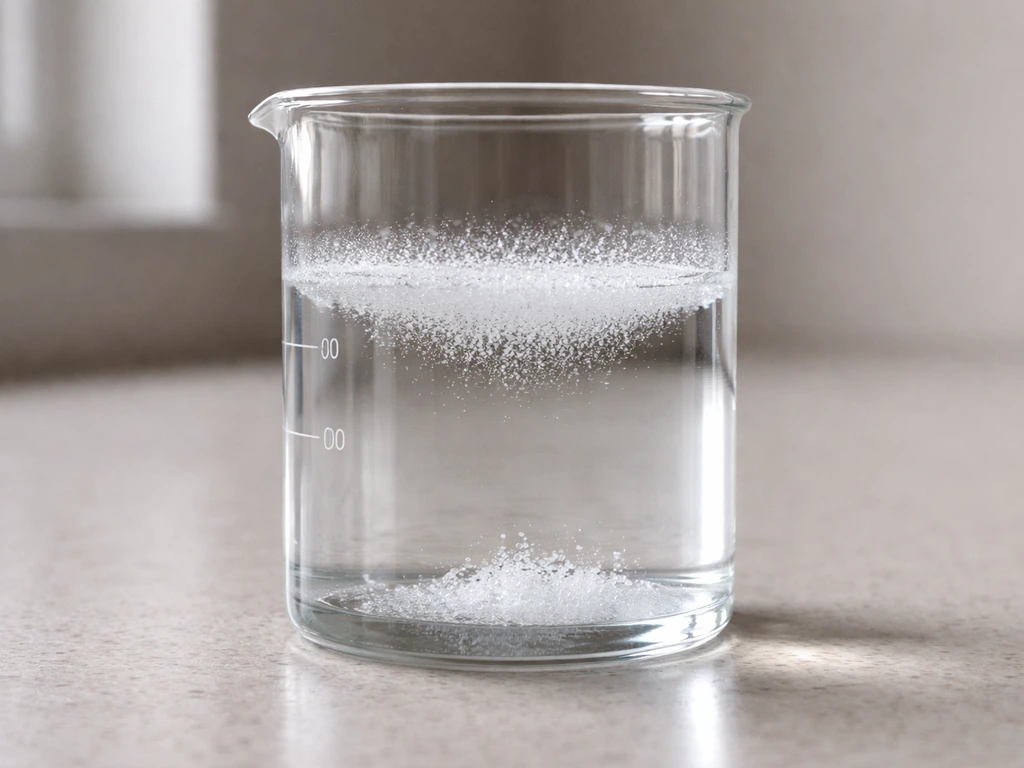
Before any crystal can grow, two things have to happen: the solution has to become supersaturated, and a nucleus has to form. These are the two non-negotiable steps, and understanding them explains almost every crystal-growing success or failure you'll ever encounter.
Supersaturation: more sugar than the water wants to hold
Water can only hold so much dissolved sugar at a given temperature. At 20°C, you can dissolve about 204 grams of sucrose in 100 grams of water before the solution is fully saturated. Engineering ToolBox reports sucrose solubility in water as grams of sucrose per given mass of water and notes that solubility increases with temperature, which is why heating can be used to dissolve more sugar before cooling to induce supersaturation [grams of sucrose in 100 grams of water](https://www.
engineeringtoolbox. com/sugar-solubility-water-d_2193. html). At higher temperatures, water holds significantly more.
When you heat water to near boiling, dissolve a large excess of sugar, and then let it cool, you end up with a supersaturated solution: the water is now holding more sugar than it 'wants' to at that lower temperature. That excess sugar is thermodynamically unstable. It's like a ball balanced on top of a hill. It wants to roll down.
Crystallization is the hill it rolls down.
Supersaturation is often expressed simply as how far the actual concentration exceeds the equilibrium (saturation) concentration. The larger that gap, the stronger the driving force to crystallize. If you don't get the solution supersaturated enough, crystals won't form or won't grow. If you get it too supersaturated too quickly, you get a blizzard of tiny crystals instead of a few large ones.
Nucleation: the first tiny cluster
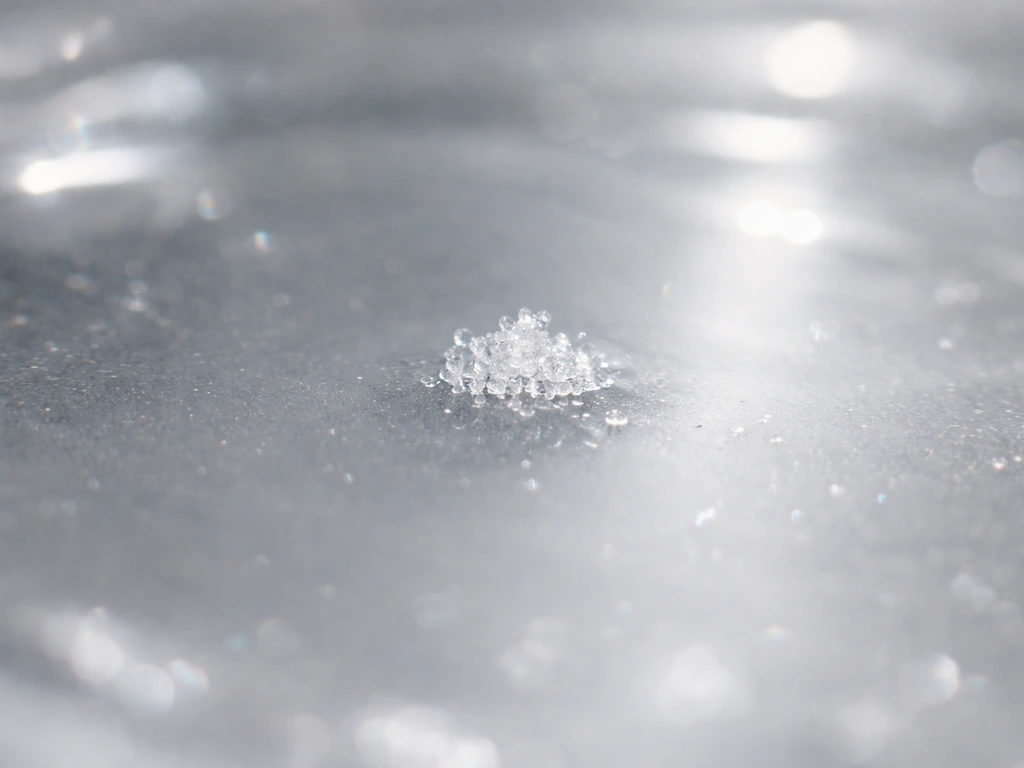
Even in a supersaturated solution, crystals don't always start forming immediately. Nucleation is the process of assembling the very first stable cluster of molecules, and it requires overcoming an energy barrier. Think of it like condensation: water vapor in the air can stay as vapor even when it's technically supersaturated, until it hits a dust particle or a cold surface and suddenly droplets appear. The same logic applies here.
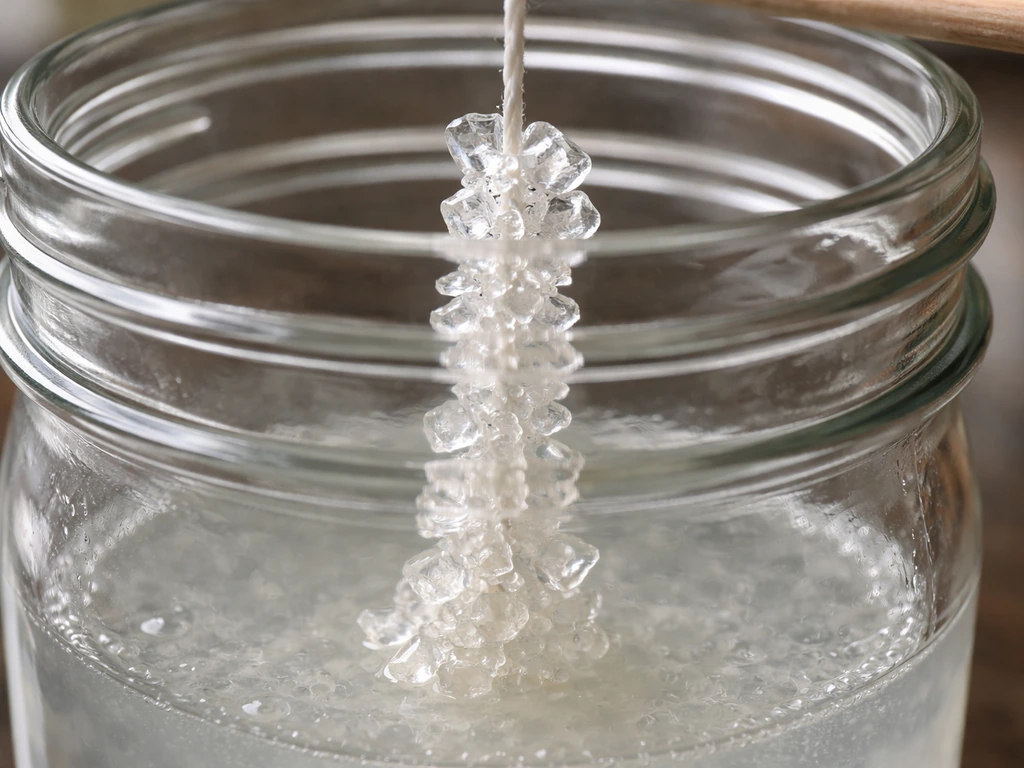
There are two types of nucleation. Homogeneous nucleation happens spontaneously in the bulk liquid with no help from surfaces, and it requires a very high degree of supersaturation because the energy barrier is large. Heterogeneous nucleation happens on a surface, a dust particle, a scratch in a container, or a seed crystal, and it's far more common and practical because the surface lowers the energy barrier. That's why a clean string coated with sugar crystals dropped into your syrup works so well: you're forcing heterogeneous nucleation right where you want it.
Why crystals keep growing: molecule-by-molecule attachment at crystal faces
Once a stable nucleus exists, growth is surprisingly orderly. Sucrose molecules from the surrounding solution don't just pile onto the crystal randomly. They attach at specific sites, particularly at steps and kinks along the crystal's edges. Imagine a half-built brick wall: the easiest place to add a new brick is at an inside corner (a kink), because it can bond to two existing bricks instead of just one. Molecules at kink sites form more bonds, which releases more energy, making attachment at those spots thermodynamically favored.
This process is described by what scientists call the terrace-ledge-kink (TLK) model, and it's been studied in detail through Burton-Cabrera-Frank (BCF) theory. The result is that crystals grow layer by layer, with each new molecular layer spreading across an existing face before the next one starts. This is why well-grown crystals have flat, smooth faces rather than rough, lumpy surfaces: growth happens in an organized sequence, not all at once. The overall driving force for all of this is still supersaturation. The moment supersaturation drops to zero (the solution reaches equilibrium), growth stops.
One detail worth noticing: crystallization releases heat. As each molecule locks into the lattice, a small amount of energy is given off. In a home experiment this is usually imperceptible, but in industrial sugar processing it's a real engineering consideration. It also confirms that the crystal state is genuinely lower in energy than the dissolved state, which is exactly why the process happens spontaneously.
The conditions that control how fast (and how big) crystals grow
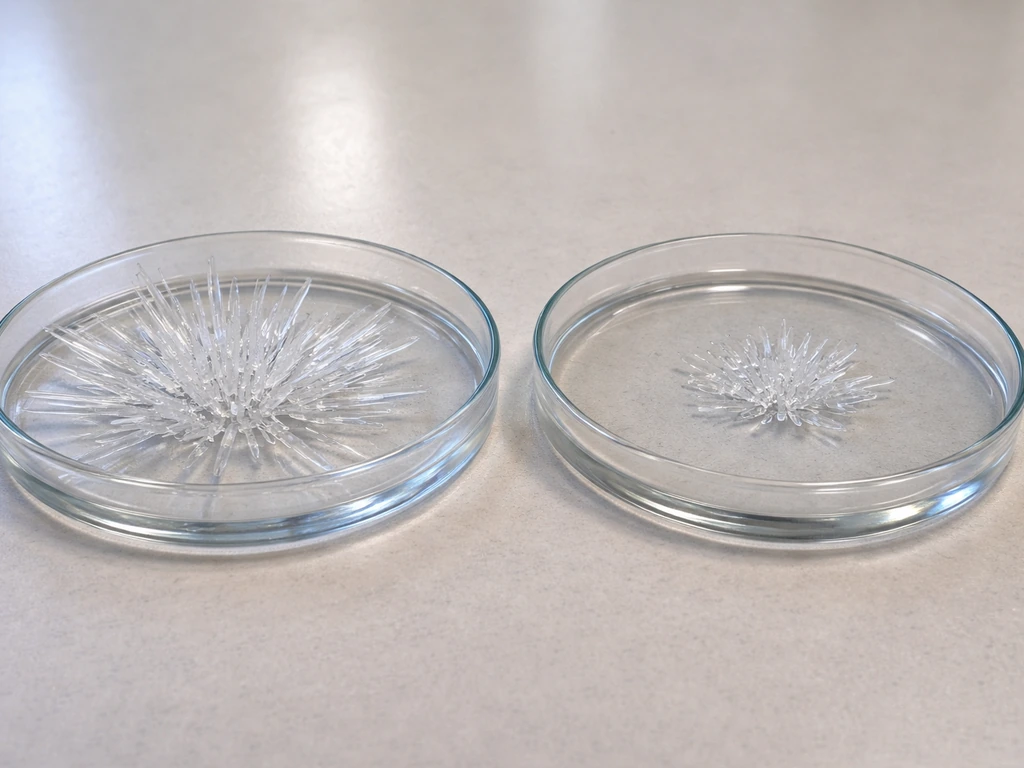
Knowing the mechanism is useful, but what most people actually want to know is: what do I change to get bigger, better crystals? Here's what moves the needle most.
| Variable | Effect on growth | Practical tip |
|---|---|---|
| Temperature | Higher temperature = more dissolved sugar possible; slow cooling = larger crystals | Dissolve at near-boiling, then cool slowly and steadily |
| Concentration (supersaturation) | More excess sugar = stronger driving force, but too much = many tiny crystals | Aim for a moderately supersaturated solution, not a syrup so thick it sets instantly |
| Evaporation rate | Slow evaporation concentrates solution gradually, feeding steady growth | Use a loose cover (cloth or paper towel) to allow slow, controlled evaporation |
| Purity of sugar and water | Impurities can block growth sites or trigger unwanted nucleation | Use refined white granulated sugar and filtered or distilled water where possible |
| Solvent (water) | Sucrose crystallizes well from water; other solvents shift solubility curves dramatically | Stick with water for reliable, predictable results |
Temperature matters in two ways. Hot water can change how much sugar dissolves and how fast supersaturation forms, which is what affects crystal growth speed Temperature matters. First, it determines how much sugar you can get into solution in the first place. Second, the rate at which you cool the solution controls how gradually supersaturation builds up.
A slow, gentle cooling lets crystals grow large and well-formed. If you are comparing this with other gelatin-like or chewable “growth” behaviors, a related question is why does vinegar make gummy bears grow, since acid changes how quickly things swell and soften growing larger crystals.
A fast drop in temperature (say, putting your syrup in the fridge right away) causes supersaturation to spike suddenly, triggering a burst of nucleation that gives you many tiny crystals instead of a few big ones.
Variables that can make or stop growth entirely
Seeding: the most reliable tool you have
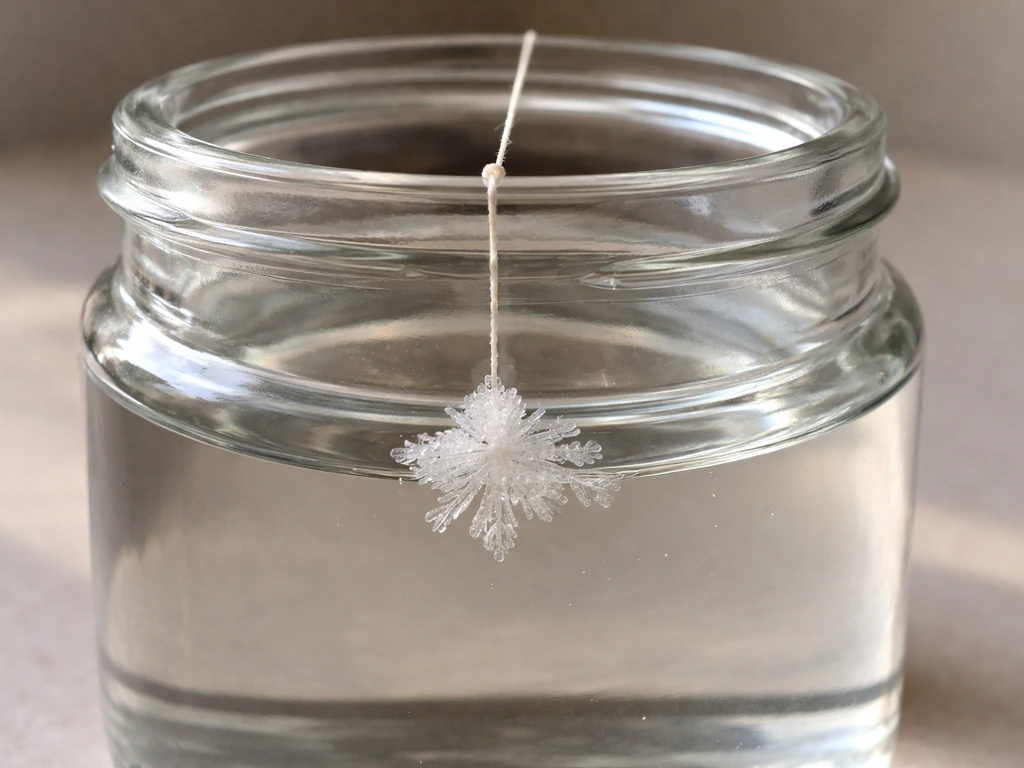
Adding a seed crystal is the single most reliable way to control where and how growth starts. A seed crystal (a small existing sugar crystal, or a string coated with dried sugar) provides an immediate heterogeneous nucleation site. Instead of waiting for spontaneous nucleation to occur randomly (which might happen on the jar walls, on floating dust, or not at all), you direct the growth exactly where you want it. The key is that the seed must be introduced into a solution that is supersaturated but not so extremely supersaturated that it crystallizes everywhere at once before the seed can take over.
Agitation and mixing
Stirring or shaking your solution can help or hurt, depending on timing. During the initial dissolution step, mixing is great because it speeds up how fast sugar goes into solution. Once you want crystals to grow, agitation becomes a problem. Stirring disrupts the thin boundary layer of solution right next to the crystal surface, where molecular attachment is happening.
It can also knock off small crystals that haven't fully adhered, spreading nucleation sites throughout the solution and producing many small crystals rather than a few large ones. Once your seed is in place, leave the solution undisturbed. For example, crystallization that produces too much solid too fast can be restarted by adding a seed crystal or adjusting stirring or crystal relocation [restart crystallization with a seed crystal or by changing stirring/crystal handling](https://chem. libretexts.
org/Bookshelves/OrganicChemistry/OrganicChemistryLabTechniques%28Nichols%29/03%253ACrystallization/3. 06%253AStep-by-StepProcedures/3. 6F%253A_Troubleshooting).
Evaporation rate
Even after cooling, a sugar solution continues to become more supersaturated as water evaporates. This is actually what keeps crystal growth going over days or weeks in a home experiment. The slower the evaporation, the more gradually supersaturation rebuilds, and the more time each molecular layer has to spread neatly across a crystal face before the next layer starts. Very fast evaporation creates the same problem as rapid cooling: supersaturation spikes and you get rough, small, or numerous crystals instead of large, well-formed ones.
Impurities
This one surprises people. Impurities in your sugar or water don't just add 'noise.' Specific chemical impurities can block the kink and step sites on a crystal's surface where new molecules are supposed to attach, dramatically slowing or halting growth. Research on sucrose crystallization shows that ionic impurities (like chloride or sulfate salts) can either inhibit or promote crystallization depending on their chemistry, and certain additives can increase nucleation while producing many small, porous crystals rather than large ones. In a home experiment, this is why using pure granulated sugar and clean water matters more than people think.
Running a simple crystal-growing experiment at home (and fixing it when it goes wrong)
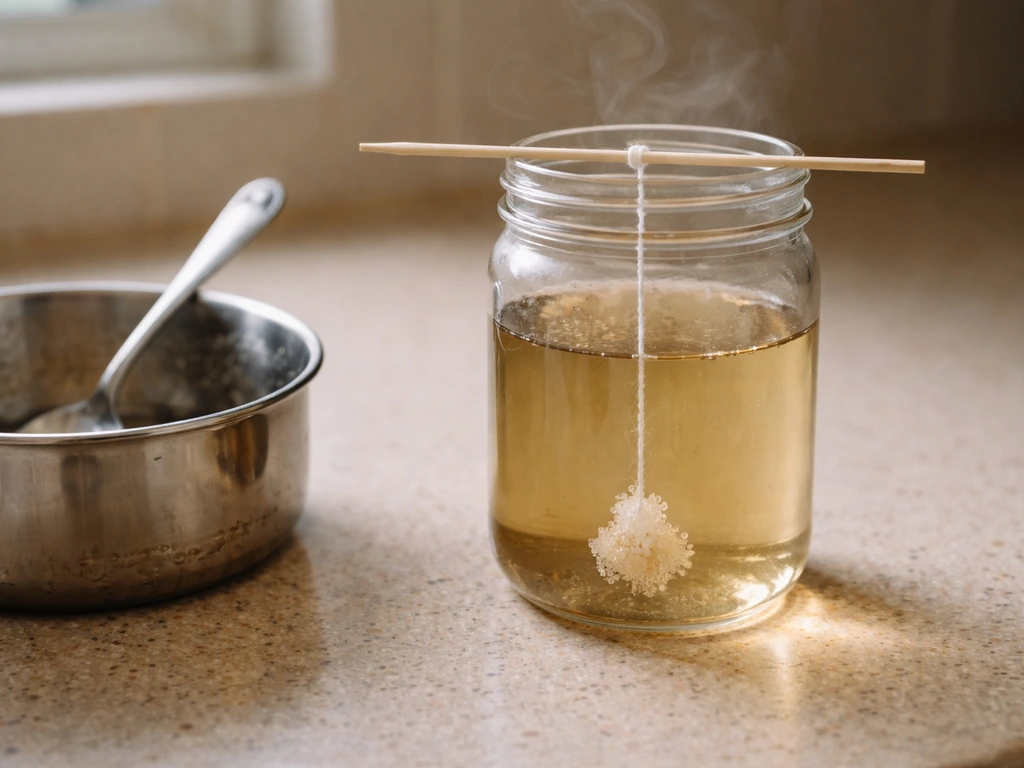
Here's a practical setup that connects each step directly to the science above. This is the classic rock candy approach, stripped down to what actually matters mechanically.
- Make a supersaturated solution: Heat 1 cup of water to near boiling, then slowly stir in 2 to 3 cups of granulated white sugar until fully dissolved. The high temperature lets you dissolve far more sugar than the water can hold at room temperature, which is exactly what you need.
- Prepare a seed string: Wet a wooden skewer or cotton string, roll it in granulated sugar, and let it dry completely. This coats it with sugar crystals that will act as ready-made nucleation sites.
- Cool the syrup slightly: Let the syrup cool to about 60-70°C before adding your seed. If it's too hot, it may dissolve your seed coating rather than grow on it.
- Suspend the seed string: Pour the syrup into a clean glass jar and suspend the seeded string so it hangs in the middle without touching the sides or bottom. Cover loosely with a paper towel or cloth (not an airtight lid) to allow slow evaporation.
- Leave it completely undisturbed: Place it somewhere with a stable, room-temperature environment. No refrigerator, no sunny windowsill with temperature swings, no moving it around. Check once a day visually.
- Wait 5-7 days minimum: Crystal growth is slow and steady. You should see visible growth within 24-48 hours. Larger crystals take a full week or more.
Troubleshooting when things go wrong
- Crystals formed all over the jar walls but not on the string: Your solution was too supersaturated when you added the string, or the string had no seed crystals on it. The jar wall provided heterogeneous nucleation sites that beat you to it. Start over with a freshly cleaned jar and a properly seeded string, and let the syrup cool a bit more before adding the string.
- No crystals formed at all after several days: The solution may not be supersaturated enough, or the seed crystals dissolved. Try gently reheating the syrup, adding a bit more sugar, letting it cool, and reintroducing a fresh seeded string.
- Crystals are tiny and numerous instead of large: Supersaturation was too high when nucleation started, triggering many nucleation events at once. Slow down the process: less extreme concentration ratios, slower cooling, and less agitation.
- Growth started and then stopped: The solution has likely reached equilibrium. Supersaturation is depleted. Gently add a small amount of freshly made concentrated syrup to the jar to restore the driving force.
- Crystals look rough or cloudy: Fast growth or impurities. Rough surfaces happen when supersaturation is high and molecules attach faster than they can find proper kink sites. Try reducing concentration slightly and ensuring you're using clean, pure ingredients.
- String of tiny crystals ('stringy' growth) rather than one big crystal: Too many nucleation sites on the string, or agitation caused fragments to seed multiple spots. Use a cleaner string with fewer, more widely spaced seed crystals next time.
One thing worth keeping in mind: the rate of sugar crystal growth is genuinely slower than salt crystals under equivalent conditions. Sugar molecules (sucrose) are large and complex compared to simple salt ions like sodium chloride, which means they take longer to find and lock into kink sites on the crystal surface. If you want to explore that comparison directly, it's a fascinating experiment in its own right, since it highlights how molecular size and shape affect crystallization kinetics.
Similarly, if you've ever wondered whether tap water versus distilled water affects growth speed, the answer ties back to the impurity discussion above: dissolved minerals in tap water can interfere with growth sites, which is why distilled or filtered water tends to produce cleaner, more consistent crystals.
The bottom line: what you're really controlling
Every variable in crystal growing, temperature, concentration, evaporation rate, seeding, mixing, and purity, connects back to two things: how much thermodynamic driving force (supersaturation) you have, and how well you control where and when nucleation happens. Get the solution supersaturated enough to grow but not so much that it explodes into tiny crystals, give it one clear nucleation site to focus on, and then let slow evaporation steadily feed more sugar molecules to the growing faces. That's the whole game. The physics does the rest.
FAQ
I made a sugary syrup, but nothing crystallized. What went wrong?
If your solution is supersaturated but no crystal appears, it usually means nucleation never started. Common causes are too little supersaturation, very clean glass (few nucleation-promoting surfaces), or no seed present, so the energy barrier to form a stable nucleus was not overcome.
How can I get fewer, larger sugar crystals instead of lots of tiny ones?
For larger crystals, you want fewer nucleation events, not faster growth. Practically, that means avoiding sudden temperature drops, minimizing stirring after seeding, and using slower evaporation so supersaturation rises and falls gradually instead of spiking.
Should I stir my sugar solution while crystals are forming?
Stirring is most useful during the dissolution step, once the goal is to form a stable supersaturated solution. After you add a seed, agitation can knock off micro-crystals that re-seed the liquid and create many growth centers.
What seed and concentration are best if I want the seed to dominate crystal growth?
A seed helps because it forces heterogeneous nucleation at a known site. If the solution is only mildly supersaturated, the seed may grow slowly or stop; if it is extremely supersaturated, spontaneous nucleation can occur everywhere, outcompeting the seed.
Why does my experiment sometimes produce rough, powdery crystals?
Too much supersaturation at once leads to “bursty” nucleation, creating many tiny crystals. Too little supersaturation means the thermodynamic driving force never becomes strong enough for sustained attachment at kink and step sites.
Why do my sugar crystals stop growing after a while?
Growth stops when supersaturation falls to zero, meaning the solution reaches equilibrium concentration at that temperature. Continued evaporation can restart growth, but if you cover the container or keep humidity high, evaporation slows and crystals stop earlier.
Can small amounts of table salt or other ingredients affect sugar crystal growth?
Yes, some additives can change crystallization behavior by altering effective solubility, ion strength, and surface attachment. Even small amounts of certain salts can shift nucleation from “few crystals” to “many crystals” by changing how easily sucrose units attach to kink sites.
Why do my crystals look uneven or cloudy instead of smooth and clear?
Crystal appearance depends on how your solution conditions favor different growth directions. Rough or misshapen crystals often come from uncontrolled nucleation (many competing sites) or from surface disturbance that disrupts orderly layer-by-layer growth.
What causes sugar crystals to turn cloudy or opaque?
Cloudiness often comes from microscopic inclusions or trapped solution during rapid growth, and from too many nucleation events that create internal disorder. Slower cooling and evaporation typically reduce trapped liquid and produce clearer, more uniform crystals.
Could dust or container scratches be why I get lots of crystals everywhere?
If your container has scratches, dust, or residues, those act as heterogeneous nucleation sites and can multiply crystal counts. Using clean, smooth glass and filtering or letting the hot syrup settle briefly can reduce unintended seeds.
Is distilled water really better than tap water for making consistent sugar crystals?
Tap water can carry dissolved minerals and dissolved organics that influence impurity effects. Using filtered or distilled water tends to improve reproducibility because it reduces variability in ionic content that can inhibit or alter attachment at step and kink sites.
Does the way I cool the syrup matter more than how much sugar I dissolve?
Supersaturation is not set only by “how much sugar I put in,” it also depends on temperature history. If you dissolve at high temperature and then cool quickly, you can create a large supersaturation jump that triggers many nucleation events.
Can I speed up crystal growth and still get big crystals?
You can’t always “force” rapid large-crystal growth by making everything faster. If you want bigger crystals, prioritize controlled supersaturation buildup (gentle cooling, slow evaporation) and one nucleation site (seeding), because crystal size is largely determined by how often new nuclei form.
Next Article
Why Does Vinegar Make Gummy Bears Grow? Chemistry Explained
See how vinegar acid dissolves and swells gummy bear gel, boosting water uptake to mimic growth without real cell growth