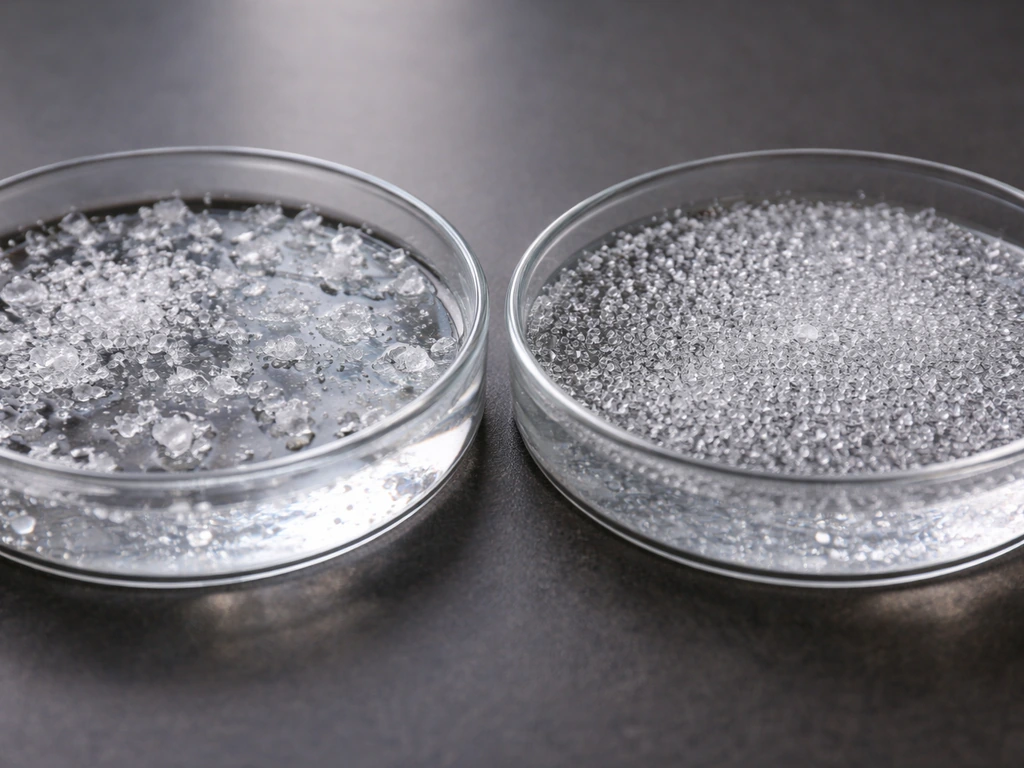
Yes, sugar crystals grow faster when you increase supersaturation and temperature, and they grow bigger (rather than just more numerous) when you use a seed crystal and keep stirring gentle. The single most reliable way to get large, fast-growing sugar crystals is to start with a small seed crystal suspended in a freshly supersaturated solution at around 50–60°C, then let it cool slowly without disturbing it. Everything else is a refinement of those two moves.
Do Sugar Crystals Grow Faster? Test Stirring and Seeds
Marcus Whitmore
12 May 2026
What 'faster growth' actually means in a sugar crystal experiment
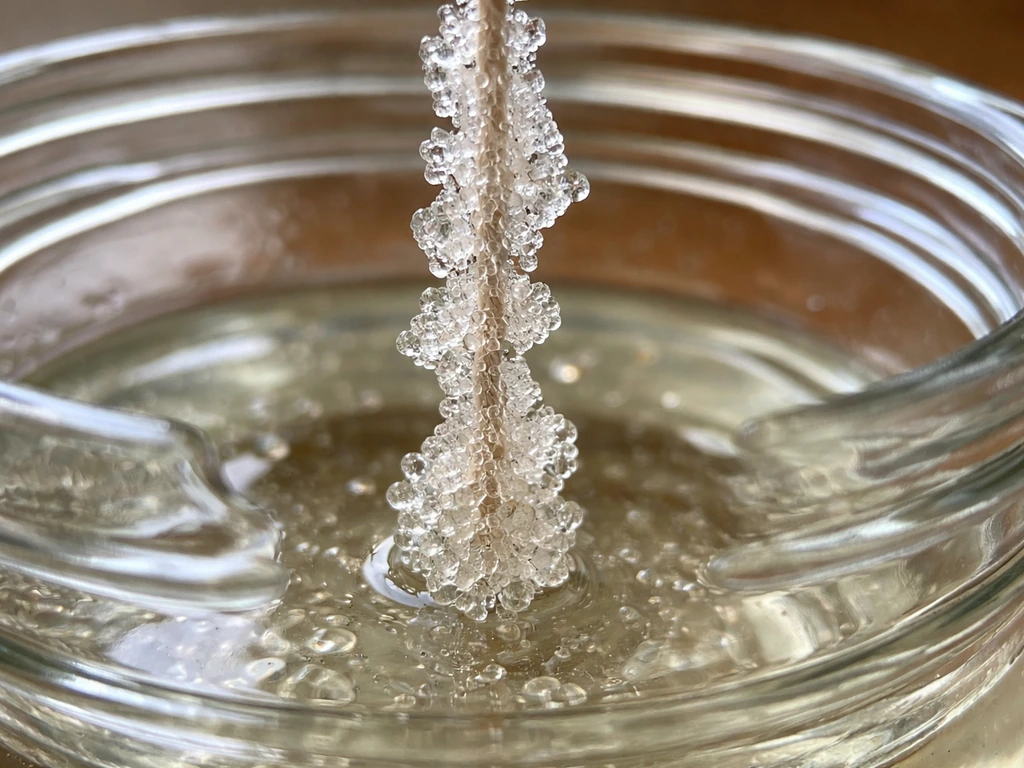
Before adjusting anything, it helps to be clear about what you're trying to measure. 'Faster growth' can mean two very different things: crystals that appear sooner (faster nucleation) or crystals that get bigger faster (faster crystal growth rate). These two outcomes are almost opposites in practice. Conditions that speed up nucleation tend to produce lots of tiny crystals, while conditions that favour growth on existing crystals tend to produce fewer, larger ones. If your goal is to grow one impressive rock candy crystal, you want to maximise growth rate on a single seed while suppressing new nucleation events. If you just want to see something happen quickly, then faster nucleation is fine. Knowing which outcome you're after shapes every decision you make in the experiment.
The core science: supersaturation, nucleation, and diffusion-limited growth
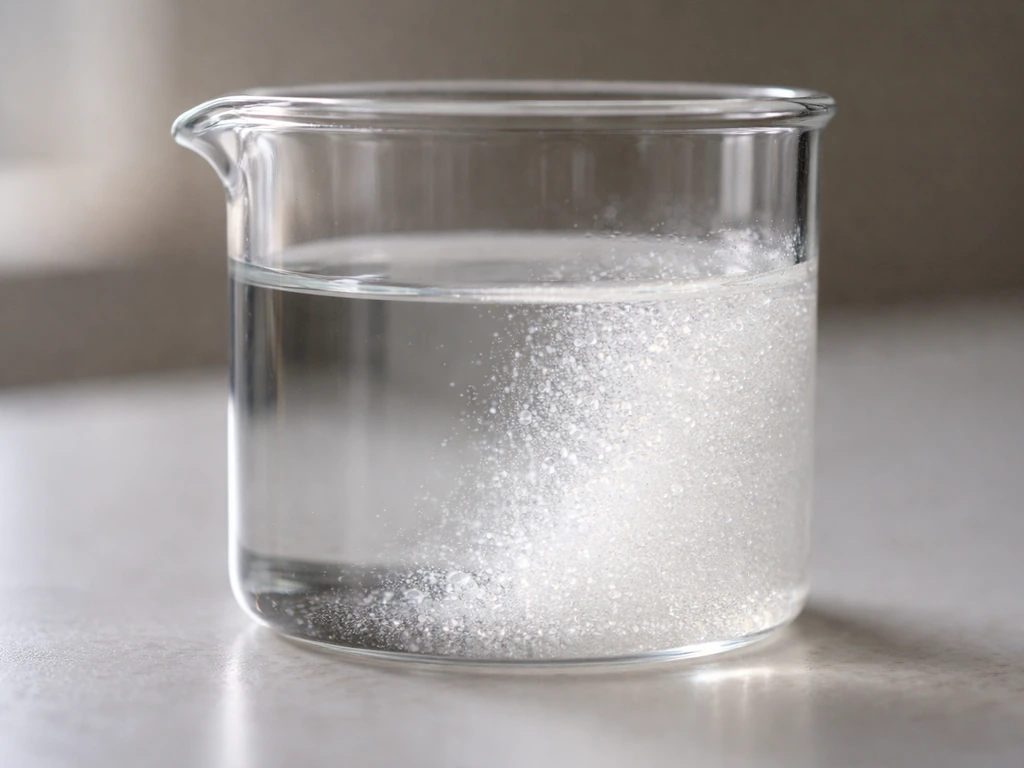
Sugar crystals grow from a supersaturated solution, meaning a solution that contains more dissolved sugar than the equilibrium amount at that temperature. Supersaturation is the engine behind everything. Without it, crystals don't grow at all. With too much of it, you trigger an avalanche of nucleation events that give you a cloudy mess of micro-crystals instead of one beautiful large crystal.
Once supersaturation exists, two things can happen: nucleation (new crystals form from scratch) or growth (existing crystal surfaces accumulate more sugar molecules). Nucleation requires a much higher energy barrier than growth does, which is why a supersaturated solution can sit undisturbed for a surprisingly long time without crystallising. This delay window is called the metastable zone, and it's your friend. Inside the metastable zone there's enough driving force to grow existing crystals but not enough spontaneous disorder to trigger new ones constantly.
Growth itself is a two-step process. First, dissolved sugar molecules diffuse from the bulk solution through a thin boundary layer of liquid sitting right against the crystal surface. Second, those molecules integrate into the crystal lattice. If diffusion is slow relative to the integration step, growth is 'diffusion-limited' and the crystal sits waiting for molecules to arrive. This is exactly why stirring, temperature, and concentration all matter: they all affect how fast sugar molecules move through that boundary layer and how many are available to land on the crystal face.
Temperature and concentration: the two biggest levers
Sucrose solubility climbs steeply with temperature. At 20°C, about 204 g of sugar dissolves in 100 g of water. At 60°C that jumps to roughly 287 g per 100 g of water. When you make a saturated solution at 60°C and let it cool to 30°C, the sugar that can no longer stay dissolved becomes your supersaturation, the driving force for crystal growth. The bigger the temperature drop, the higher the supersaturation, the faster the growth. But there's a ceiling: push supersaturation too high and you overshoot the metastable zone, triggering a blizzard of nucleation events instead of controlled growth on your seed.
A practical sweet spot for DIY sugar crystal experiments is to dissolve 2 parts sugar in 1 part water by weight (or slightly more) at 60–70°C, then let the solution cool to 25–30°C before introducing your seed crystal. This gives you genuine supersaturation without blowing past the metastable zone. If the solution has already been sitting for a while without forming crystals on its own, that's actually a good sign: it means you're inside the metastable zone and ready for controlled seed growth.
| Temperature (°C) | Max sucrose solubility (g per 100 g water) | Practical notes |
|---|---|---|
| 20 | ~204 | Good holding temperature for slow growth |
| 30 | ~219 | Comfortable room-temperature working range |
| 40 | ~238 | Start of rapid solubility increase |
| 50 | ~260 | Prepare seed solutions here |
| 60 | ~287 | Good dissolution temperature for supersaturated stock |
| 70 | ~320 | High heat; evaporation loss becomes significant |
Seed crystals, stirring, and what they each actually do
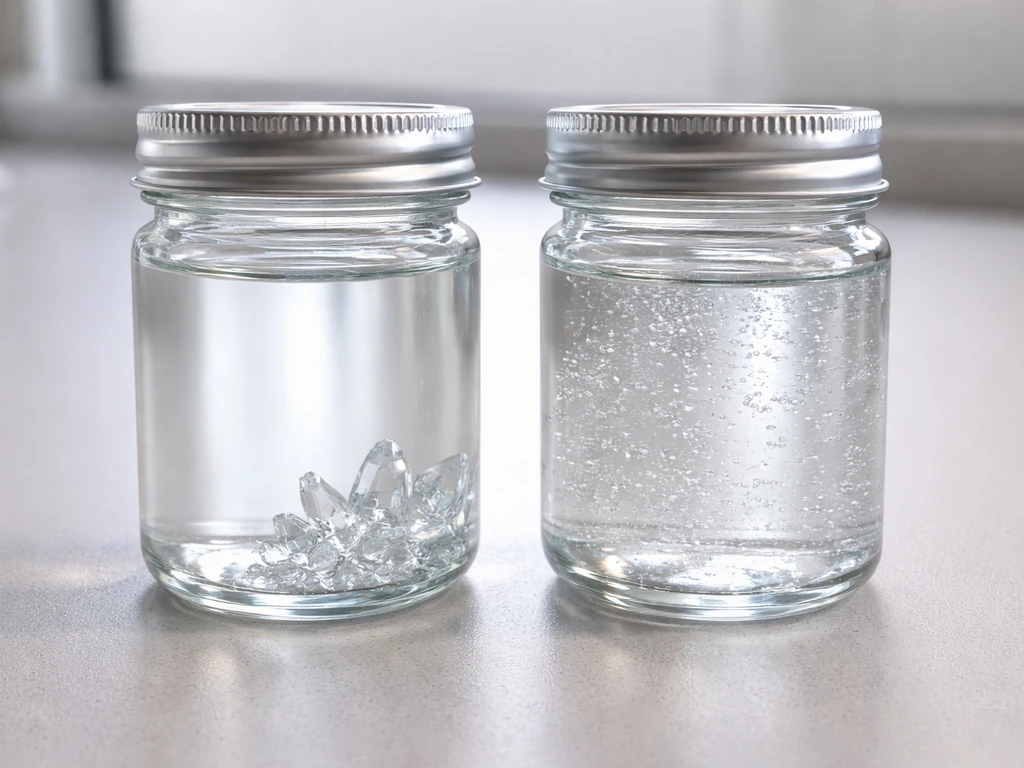
Adding a seed crystal is the most reliable single change you can make to shift from 'lots of tiny crystals' to 'one large crystal.' Here's why: when you drop a seed into a supersaturated solution, the excess dissolved sugar starts depositing onto the existing crystal surface immediately. This consumes supersaturation in a controlled, directed way. As supersaturation drops, the solution moves further into the metastable zone where spontaneous new nucleation is less likely. The seed effectively monopolises the available driving force.
Seed mass and surface area matter here. More seed surface area means faster initial consumption of supersaturation and fewer unwanted new nuclei. In controlled crystallization experiments, higher seed surface area consistently shifts the crystal size distribution toward fewer, larger product crystals. For a home experiment, a single sugar crystal about 5–10 mm across tied to a string works well. Suspend it in the middle of the solution so it doesn't touch the container walls, which would act as unintended nucleation sites.
Stirring is more nuanced. Gentle, low-speed stirring helps by reducing the thickness of the diffusion boundary layer around the crystal, getting sugar molecules to the surface faster and speeding up growth. But aggressive stirring creates problems: it fragments growing crystals, throws tiny crystal chips into the solution, and those chips act as secondary seeds, triggering new nucleation events all over the place. Studies show that below about 300 rpm there's a useful range where increasing agitation reduces supersaturation at the nucleation moment, resulting in fewer nuclei and larger crystals. Above that, fragmentation takes over and you end up with more small crystals again. For home experiments, 'gentle occasional swirling' rather than continuous stirring is usually the right call.
Design a quick test: how to set up a controlled comparison
The cleanest way to answer 'does this change make crystals grow faster?' is to run two setups side by side where only one variable differs. Here's a simple protocol you can run at home or in a classroom.
- Make a stock solution: dissolve 400 g of plain white granulated sugar in 200 mL of hot water (around 65°C). Stir until fully clear, then let it cool to your target experiment temperature (e.g., 30°C) without disturbing it.
- Set up two identical clear glass jars. Pour equal volumes of your cooled stock solution into each.
- In jar A (seed condition): suspend a single sugar crystal (about 5–8 mm) from a wooden skewer or string so it hangs in the middle of the solution.
- In jar B (no-seed condition): leave the solution alone, or add a pinch of powdered sugar to trigger uncontrolled nucleation.
- Cover both jars loosely with a paper towel to allow slow evaporation but block dust.
- Measure crystal size every 24 hours by removing the seed crystal (or the largest crystal in jar B), blotting dry, and weighing or measuring its longest dimension with a ruler.
- Record: mass or length vs. time for each jar. Plot the results. The growth rate is the slope of the mass or size vs. time curve.
- To test temperature as a variable, repeat the whole experiment at 20°C and 35°C using the same seed size and starting concentration.
The key variables to keep constant across jars are: sugar brand and purity, volume of solution, jar size and shape, ambient temperature, and evaporation conditions. Change only one variable at a time. If you want to test stirring, use a magnetic stir plate set to a consistent low speed in one jar and leave the other undisturbed.
Practical setup tips: container choice, purity, and avoiding defects
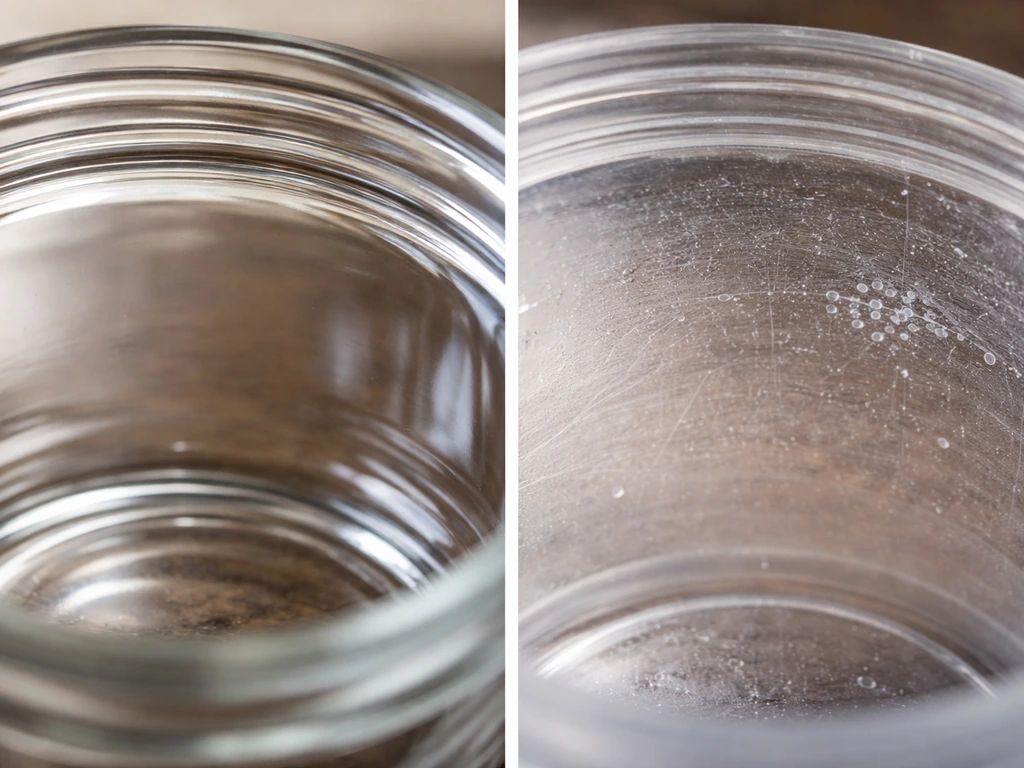
Container choice matters more than people expect. Rough surfaces and scratches on the inside of a container are nucleation sites. Use smooth glass jars rather than plastic, which can have microscopic surface texture that seeds unwanted crystals along the walls. If you see a crust of tiny crystals forming around the waterline or on the jar walls, that's the container stealing supersaturation that should be going to your seed.
Purity is the other big practical lever. A 2021 Springer paper on rock sugar crystallization reports that mineral impurities such as salts like KCl and CaCl2 can inhibit sucrose crystallization by decreasing sucrose solubility and/or slowing crystal growth rate Purity is the other big practical lever.. Tap water contains dissolved minerals, chlorine, and organic compounds that can disrupt crystal lattice formation and change the metastable zone behaviour. Distilled or filtered water consistently produces clearer, more uniform crystals. For the sugar itself, plain white granulated sugar (refined sucrose) works better than raw or brown sugar for controlled experiments because impurities in less-refined sugars change how easily nucleation occurs and can alter crystal shape.
- Use smooth glass jars, not scratched plastic containers
- Use distilled or filtered water rather than tap water
- Use refined white granulated sugar, not raw, brown, or flavoured varieties
- Filter your hot solution through a coffee filter before cooling to remove undissolved particles
- Keep the seed crystal suspended in the middle of the solution, not touching walls or bottom
- Cover loosely to allow slow evaporation but block dust and airborne particles, which act as nucleation sites
- Keep temperature stable: fluctuations drive repeated dissolution and re-nucleation cycles that produce size irregularities
When crystals stall or you end up with hundreds of tiny ones
Stalled growth almost always means supersaturation has dropped too low. Once the solution reaches equilibrium concentration, there's no driving force left and the crystal simply stops growing. The fix is to add more sugar: dissolve a small additional amount in a little hot water, let that cool slightly, then add it to the jar. You can also let evaporation do the work passively by leaving the jar uncovered for a few hours to raise concentration before covering again.
If you end up with a jar full of tiny crystals instead of one large one, the most likely causes are too-high initial supersaturation, accidental disturbance of the solution (jarring, vibration, temperature spike), or contamination that seeded uncontrolled nucleation. The solution is to dissolve everything by gently heating the jar until all crystals disappear, then cool more slowly and introduce a single, clean seed crystal before the solution has a chance to nucleate on its own.
High stirring speed is another common culprit for tiny-crystal outcomes. If you've been stirring continuously, try switching to no stirring at all and see if the remaining crystals grow larger over the next 24 hours. As noted in stirring research, the relationship between agitation and crystal size is non-monotonic: a little agitation helps, a lot hurts. The same principle applies to why people avoid stirring pulled sugar in candy-making contexts: once you have the seed you want, mechanical disturbance becomes your enemy.
It's also worth checking for 'induction time' confusion. A supersaturated solution can look like nothing is happening for hours before any crystals appear. This long induction time is normal and doesn't mean your experiment failed. Lower supersaturation levels have longer induction times. If you've been waiting and nothing is happening, resist the urge to add more sugar or stir more vigorously. Instead, drop in your seed crystal and let it do the work of consuming supersaturation gradually.
Why crystal growth fits into the bigger picture of growth constraints
Crystal growth faces the same fundamental constraint that limits growth across all physical and biological systems: the problem of supply and transport. A growing crystal can only add new material as fast as molecules can diffuse through the surrounding solution to reach its surface. This diffusion-limited growth ceiling is the crystal equivalent of why large cells can't survive without circulatory systems, why tree rings narrow in drought years, or why gel balls grow faster in hot water than cold. In every case, growth is ultimately limited by how efficiently the system can move building materials from a reservoir to the growing surface. Controlling that transport, through temperature, concentration, and gentle fluid motion, is exactly what you're doing when you set up a well-designed crystal growth experiment.
Understanding that sugar crystal growth is driven by supersaturation connects naturally to related questions in solution chemistry, like why salt crystals behave differently from sugar crystals under the same conditions, or how yeast uses sugar for its own growth processes. Yeast can use dissolved sugars as a food source, which supports fermentation and increases yeast activity how yeast uses sugar for its own growth processes. But for the sugar crystal experiment specifically, the takeaway is clean: higher supersaturation plus a seed crystal plus gentle handling equals faster, larger crystal growth. If you want the quick answer to why sugar crystals start and get bigger, that comes down to how supersaturation drives nucleation versus growth faster, larger crystal growth. If you're curious why acidity can also change growth behavior, see why does vinegar make gummy bears grow for a related example of how a reagent affects expanding soft materials. Everything else is a variable worth testing.
FAQ
Does stirring make sugar crystals grow faster, or does it just cause more crystals?
It can do both depending on how you stir. Gentle motion can thin the boundary layer and speed up growth on your seed, but continuous or vigorous stirring often fragments crystals, creating many secondary nuclei that compete for supersaturation. The practical tell is whether you end up with one dominant crystal (good for growth) or lots of small ones (sign of secondary nucleation).
If I use tap water, will crystals definitely grow slower or just look worse?
Tap water can change results by introducing dissolved minerals and organics that affect lattice formation and the metastable zone behavior. You might still get crystals, but they can be less uniform or they may nucleate sooner on container surfaces. If you want a cleaner test of “growth speed,” use filtered or distilled water and keep everything else identical.
Why do my crystals not start growing for a long time, even though the solution should be supersaturated?
That delay is often normal induction time, especially when supersaturation is not extremely high. If nothing appears after a while, resist stirring harder or adding more sugar immediately. Drop in a pre-made seed crystal and let it consume supersaturation gradually.
How can I tell whether my setup is suffering from too much supersaturation versus too little?
Too much supersaturation usually gives lots of tiny crystals and cloudiness (nucleation runaway), while too little gives a single seed that stalls because the driving force has dropped to near equilibrium. If your seed stops growing, the fix is typically to add a small measured amount of extra sugar in hot water, then cool slightly before adding.
What is the best way to add more sugar when growth stalls without triggering new tiny crystals?
Dissolve a small extra amount of sugar in a little hot water, cool it until it is near the jar’s temperature, then add it slowly. The goal is to restore supersaturation modestly without shocking the system. Also avoid splashing on the jar walls, since that can seed uncontrolled nucleation.
Should I place the seed crystal in the middle, or is touching the glass okay?
Avoid letting the seed touch the container walls. Wall contact and surface roughness can act as unintended nucleation sites, pulling supersaturation away from your intended seed. Suspending the seed in the center (and using smooth glass) improves the chance you get one large crystal.
Can I use a sugar cube, multiple seeds, or a larger seed to speed things up?
A larger seed can reduce the time to see a single visible crystal because there is more surface area to consume supersaturation, but it can also reduce control if it encourages additional nucleation sites. Multiple seeds almost always lead to competition, so you get several crystals rather than one. For the “fast, one crystal” goal, use one clean seed around 5 to 10 mm across.
Is it better to cool slowly, or can I just cool quickly to make crystals grow faster?
Faster cooling can increase supersaturation, but it also increases the risk of overshooting into the nucleation-heavy region. The more reliable approach is controlled cooling to a target range, then introducing the seed once you are in the metastable zone. For DIY experiments, that often means cooling to about 25 to 30°C before seeding.
If my jar turns cloudy with many micro-crystals, what should I do next time?
Start by identifying the most likely trigger: overshoot (too high initial supersaturation), disturbance (jarring, vibration, temperature spikes), or contamination (including tiny crystal chips). Next time, dissolve everything completely by gentle heating, then cool more slowly and add exactly one clean seed before spontaneous nucleation can dominate.
Does agitation have an optimal range, or is “more stirring” always worse?
Agitation effects are non-monotonic. A small amount can help transport to the crystal surface, but more agitation eventually causes fragmentation and secondary nucleation, leading to more small crystals. A useful practice is to compare “undisturbed” versus “gentle occasional swirling,” not “low speed continuous stirring” versus “high speed,” if your goal is size on one seed.
Can I run a reliable test for “does this variable make growth faster?” at home?
Yes, but you need to control non-tested factors. Keep constant sugar type and amount, total solution volume, jar geometry, ambient temperature, and evaporation exposure. Then change only one variable between jars. Also measure the same crystal (same seed location) at set times, since nucleation timing can mislead you if you only judge by “first crystals seen.”
Next Article
Why Do Salt Crystals Grow Faster Than Sugar Crystals?
Discover why salt crystals grow faster than sugar: ions form, diffusion and surface growth speed change, plus a test you