Salt crystals typically grow faster than sugar crystals because sodium chloride breaks apart into individual ions in water, and those tiny ions move through solution and attach to a crystal face much more quickly than the large, intact sucrose molecules that sugar relies on. If you are wondering why do sugar crystals grow more slowly, the key is how sucrose diffuses and attaches at the crystal surface compared with salt. Add in the fact that salt's solubility changes very little with temperature (making supersaturation easier to maintain) while sugar's solubility swings wildly, and you get a consistent speed advantage for salt under most kitchen-lab or classroom conditions.
Why Do Salt Crystals Grow Faster Than Sugar Crystals?

Marcus Whitmore
4 May 2026
Crystal growth basics: supersaturation and nucleation
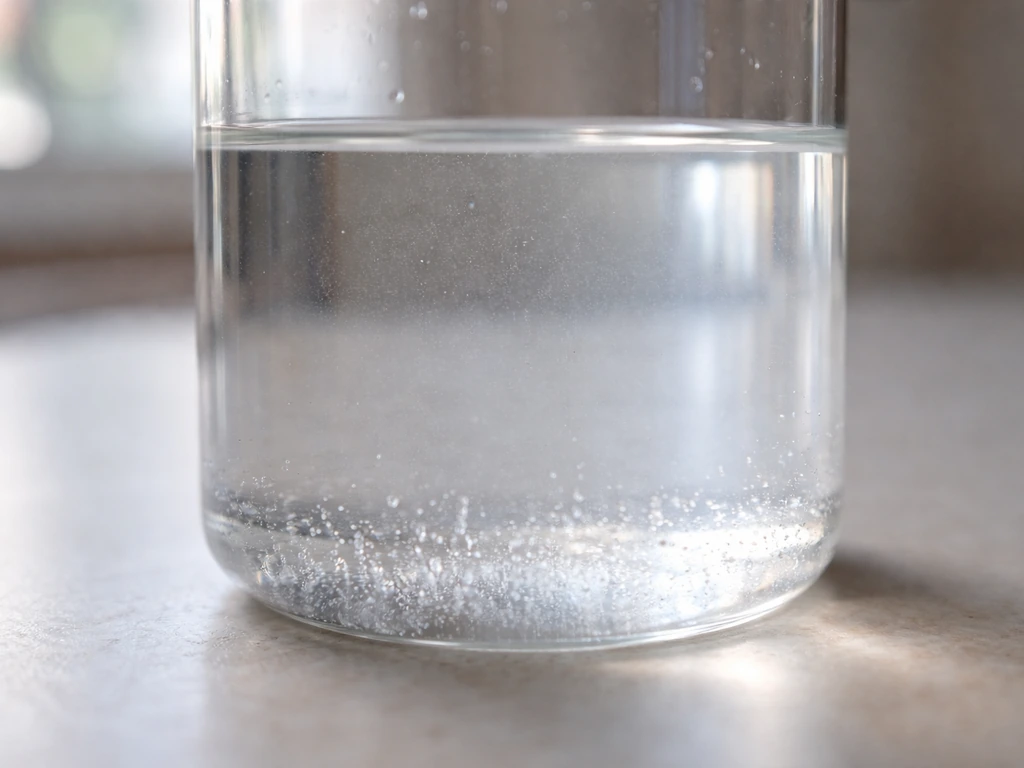
Before you can compare salt and sugar, you need to understand what actually drives any crystal to form in the first place. The key concept is supersaturation: when a solution holds more dissolved material than it can comfortably keep at a given temperature, it becomes unstable and wants to kick some of that solute out as a solid. The bigger the gap between what's dissolved and what the solvent can hold at equilibrium, the stronger the driving force.
Nucleation is the moment a tiny cluster of molecules or ions decides to stay together long enough to become a permanent seed. It comes in two flavors. Primary nucleation is spontaneous: molecules collide in solution and form a stable embryo from scratch. Secondary nucleation happens when existing crystals or container surfaces give those clusters somewhere to land. At very high supersaturation, nucleation dominates and you get a swarm of tiny crystals. At moderate supersaturation, nucleation slows and growth takes over, producing fewer but larger crystals. Crucially, nucleation rate changes over many orders of magnitude with supersaturation, while growth rate increases much more gently, so controlling how supersaturated you make your solution is the single most powerful lever you have.
Salt vs sugar chemistry: solubility, ionization, and particle transport
Here is where the two substances really diverge. NaCl dissolves in water at roughly 36 g per 100 g of water at 20°C, and that number barely budges as you heat the water up to 100°C. Sucrose, on the other hand, dissolves at about 204 g per 100 g water at 20°C and shoots up to around 476 g per 100 g water at 100°C. Sucrose solubility increases strongly with temperature, which is summarized in the sucrose solubility table on Wikipedia Sucrose, on the other hand, dissolves at about 204 g per 100 g water at 20°C and shoots up to around 476 g per 100 g water at 100°C.. That enormous temperature sensitivity is relevant when you are trying to compare growth speeds, because it changes how you create supersaturation in the first place.
The chemical difference that matters most, though, is what happens the moment each substance hits water. NaCl dissociates completely into Na+ and Cl- ions. These are small, carry an electric charge, and move independently through solution. Sucrose is a covalent molecule (molecular weight 342 g/mol) that stays intact as one large, neutral particle. That distinction controls everything downstream: how fast the solute travels to a growing crystal face, and how easily it attaches once it gets there.
| Property | NaCl (salt) | Sucrose (sugar) |
|---|---|---|
| Solubility at 20°C | ~36 g/100 g water | ~204 g/100 g water |
| Solubility at 80°C | ~38 g/100 g water | ~362 g/100 g water |
| Particle in solution | Na+ and Cl- ions (2 particles per formula unit) | One intact sucrose molecule |
| Particle size | Very small ions | Large molecular complex (~342 g/mol) |
| Charge | Yes (ionic) | No (neutral, polar) |
| Temperature sensitivity of solubility | Low | Very high |
How diffusion and evaporation affect growth rates
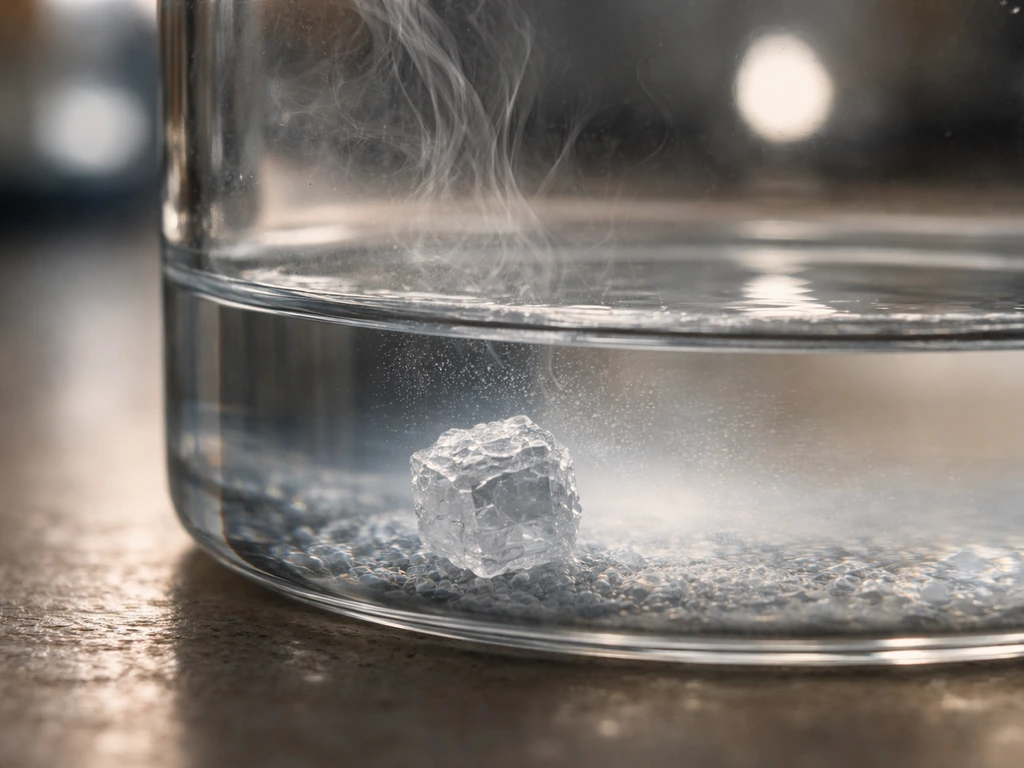
Think of the zone immediately around a growing crystal as a depleted neighborhood: the crystal keeps pulling solute in, so the concentration right at the surface is lower than in the bulk solution further away. Solute has to diffuse across this boundary layer to feed the crystal. The thinner the boundary layer and the faster the solute diffuses, the faster the crystal can grow.
Diffusion coefficients tell you exactly how quickly a particle wanders through water on its own. At 25°C, Na+ ions diffuse at about 1.334 x 10^-9 m²/s and Cl- ions at about 2.032 x 10^-9 m²/s. Sucrose diffuses at roughly 0.52 x 10^-9 m²/s. That means the ions feeding a salt crystal move through water roughly two to four times faster than sucrose molecules approaching a sugar crystal. The sucrose molecule's bulk and neutral charge make it a slower, clumsier traveler.
Evaporation adds another layer. When water evaporates from the surface of a salt or sugar solution, the local concentration near the evaporating surface rises, increasing supersaturation and accelerating crystallization. Research into NaCl evaporation-crystallization confirms that evaporation rate and crystal growth rate are tightly coupled, and that convective air flow above the solution can dramatically speed up evaporation, which in turn spikes supersaturation and growth rate. Because NaCl solutions evaporate faster than the thick, syrupy sucrose solutions (which are far more viscous at similar saturation levels), salt benefits more from this evaporation-driven boost.
Stirring or any flow in the solution shrinks the boundary layer around the crystal. Studies show the boundary layer thickness scales roughly with the inverse of flow rate, so even gentle convection matters a lot. Ions, being smaller and faster, take better advantage of this thinned boundary layer than sucrose molecules do.
Surface processes: why ions and molecules attach differently
Getting to the crystal face is only half the job. Once a solute particle arrives at the surface, it has to shed its water molecules (desolvation) and lock into the crystal lattice. For NaCl, electrostatic attraction does a lot of the heavy lifting. Na+ is pulled strongly toward negatively charged surface sites, and Cl- toward positive ones. Studies of the NaCl crystal-solution interface show that approaching ions develop highly ordered hydration shells near the surface, and that electrostatic charging at early-stage NaCl surfaces actively facilitates growth of subsequent layers. The charged surface essentially recruits the next ion.
For sucrose, there is no such electrostatic assist. The molecule has to find the right orientation, shed its hydration shell from a large contact area, and slot into a complex hydrogen-bonding network at the crystal face. This orientation requirement and the size of the molecule slow the surface attachment step considerably. It is a bit like parallel parking a bus compared to slipping a bicycle into a narrow space: the smaller, guided object wins every time.
Water structuring at the interface matters here too. At an NaCl surface, water dipoles orient themselves perpendicular to the surface because of the electrostatic pull from Na+. This organized water layer actually eases ion desolvation and attachment. At a sucrose crystal face, water interacts through hydrogen bonds with the molecule's many hydroxyl groups, making desolvation slower and more energy-intensive.
Role of temperature and concentration
Temperature controls growth rate through two linked effects: it changes how much solute can dissolve (solubility), and it changes how fast particles move (diffusivity and viscosity). Hot water can also change how quickly you reach the supersaturation conditions that drive crystal growth, which is why temperature matters for crystal speed Temperature controls growth rate. Higher temperature means faster-moving particles, thinner boundary layers, and easier desolvation, all of which speed up crystal growth.
For salt, you can reliably create a supersaturated solution by dissolving as much NaCl as possible in hot water and then letting it cool slowly or evaporate. Because NaCl solubility changes so little with temperature (from about 35.7 g/100 g at 0°C to about 39.2 g/100 g at 100°C), even a small drop in temperature or slight evaporation pushes the solution over the edge into supersaturation. This makes supersaturation easy to establish and maintain in a consistent band, which in turn produces steady, controllable growth.
For sugar, the story is more complicated. Sucrose solubility spans from roughly 179 g/100 g water at 0°C to about 487 g/100 g water at 100°C. That huge range means a hot, saturated sucrose solution that cools down becomes massively supersaturated, which can trigger a burst of nucleation (giving many tiny crystals) rather than steady growth on a single seed. Getting large, fast-growing sugar crystals requires much more careful temperature management. This is one practical reason why, under casual or classroom conditions, salt often wins the growth-speed race: its narrow solubility window makes the sweet spot of moderate supersaturation far easier to hit.
Starting concentration matters just as much as temperature change. A solution that is only slightly supersaturated will grow crystals slowly. A solution that is strongly supersaturated will grow them fast, but may also nucleate many competing crystals, which actually starves each individual crystal of solute and can slow down individual crystal enlargement. The ideal is moderate, sustained supersaturation, which salt solutions provide almost automatically under evaporation conditions.
Impurities and additives: how they speed or slow crystals
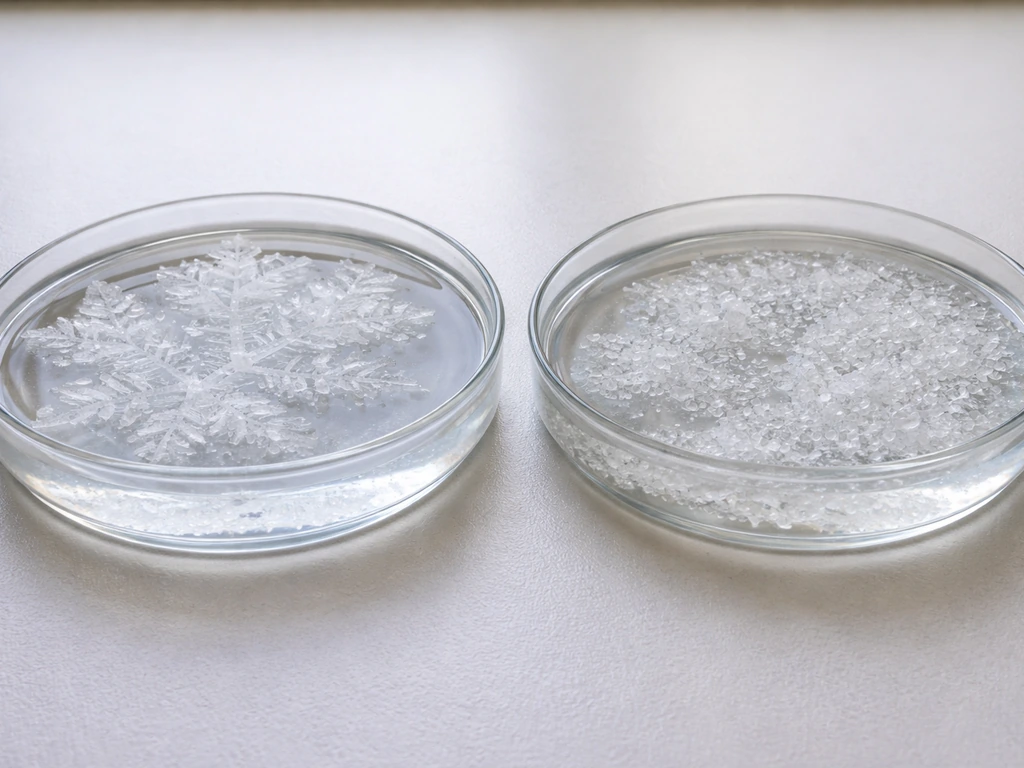
Pure solutions grow crystals the fastest, but real-world conditions are never perfectly pure. Impurities in a salt or sugar solution can either block growth or accidentally accelerate it, depending on what they are and how much is present.
For salt, a well-known example is ferrocyanide, commonly used as an anti-caking agent in table salt. Even tiny amounts adsorb onto specific crystal faces and block the steps where new ions would attach, slowing growth and changing crystal shape. Surfactants work similarly, adsorbing onto faces and modifying both nucleation rate and crystal habit. The presence of other ions (like Mg2+ from tap water minerals) can compete for surface sites or disrupt the NaCl lattice. If you are trying to grow the fastest salt crystals, using distilled or filtered water and pure NaCl with no additives makes a measurable difference.
For sugar, glucose and fructose (the breakdown products of sucrose itself) are the most relevant impurities. Research shows that glucose and fructose selectively slow growth on certain sucrose crystal faces at concentrations above roughly 50 g/100 g water, and their effects differ between the left and right poles of the crystal. Industrial sucrose crystallization from impure syrups is notably slower than from pure sucrose solutions for exactly this reason. In a home experiment using table sugar, trace impurities in the sugar itself can slightly suppress growth. Using caster or pharmaceutical-grade sugar reduces this effect.
One practical takeaway: if you are comparing salt and sugar crystal growth, use the same water source and the cleanest versions of each you can find. Impurity differences between samples will otherwise muddy the comparison and make it hard to isolate the chemistry that actually causes the speed difference.
Try it today: a simple comparison experiment
You do not need a lab to test this. Here is a straightforward setup that takes about 15 minutes to prepare and produces visible results within 24 to 48 hours.
What you need
- Table salt (plain, non-iodized if possible, no anti-caking agent listed on the label)
- White granulated sugar
- Distilled or filtered water
- Two identical shallow dishes or petri dishes
- A kitchen scale accurate to 1 g
- A ruler and a phone camera for daily photos
- A warm, undisturbed spot (a sunny windowsill or a warm shelf works well)
Setup
- Heat 100 g of distilled water to near-boiling (around 90°C). Dissolve 38 g of salt in one portion. This is just above saturation at room temperature, giving you a reliably supersaturated solution as it cools.
- In a separate 100 g of hot water, dissolve 230 g of sugar. This gives you a similarly supersaturated sucrose solution relative to its room-temperature solubility of about 204 g/100 g water.
- Pour each solution into its labeled dish to a depth of about 5 mm. Place both in the same warm location so temperature is not a variable.
- Optional but useful: drop one small seed crystal of each type into the corresponding dish to encourage secondary nucleation and directed growth rather than a random spray of tiny crystals.
- Photograph both dishes from directly above at the same time each day. Use the ruler in frame for scale.
What to measure and what to expect
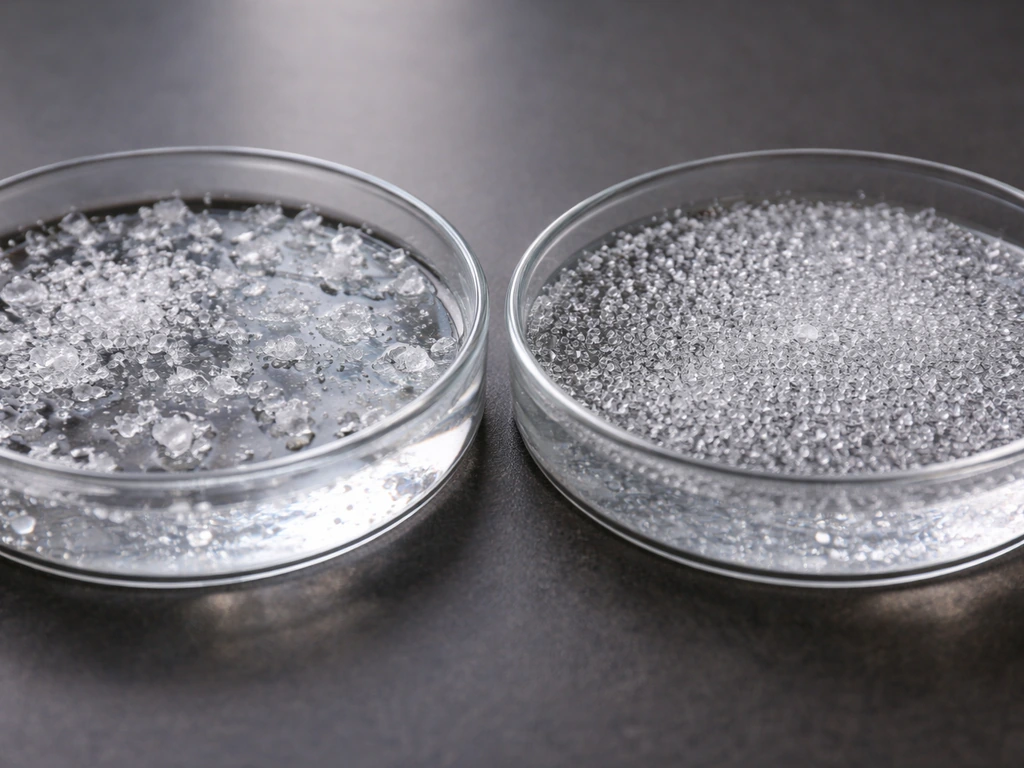
Measure the longest dimension of a visible crystal in each dish every 24 hours. You should see the first recognizable salt crystals within 12 to 24 hours, typically as the classic cubic shapes NaCl is known for. Sugar crystals may take 24 to 48 hours to become clearly visible, and will tend to be more irregular at first. By day three, the size difference between your salt and sugar crystals should be obvious.
If you want to go further, run a second trial using evaporation as the only driver: make saturated (not supersaturated) solutions at room temperature, pour thin layers, and let them evaporate without heating. Salt will still pull ahead, demonstrating that the ion transport and surface attachment advantages hold even when you remove the temperature variable entirely.
Watch for one common trap: if your sugar solution produces a huge burst of tiny crystals all at once, you have hit the high-supersaturation nucleation zone rather than the growth zone. Dilute the solution slightly and start again. Salt is much more forgiving here, which is itself part of the answer to why it grows faster under everyday conditions. The same curiosity about how concentration and solvent type influence crystal speed applies if you explore related questions, such as whether tap water minerals change sugar crystal growth rates or how other dissolved substances interact with the growth process. To control how fast sugar crystals grow when you are using tap water, focus on supersaturation, evaporation rate, and how ions and impurities influence attachment tap water minerals change sugar crystal growth rates. This general crystal-growth logic also helps explain why vinegar can speed up gummy bear growth by changing the solution chemistry and supersaturation behavior why it grows faster under everyday conditions.
The bottom line, confirmed by your own dish: salt crystals grow faster because the ions are smaller, charge-guided, and diffuse faster through water, the surface attachment step is electrostatically assisted, and the narrow solubility window keeps supersaturation in the productive growth range almost automatically. Sugar molecules are larger, neutral, slower to diffuse, and harder to orient onto a crystal face. Every step in the chain favors salt. If you are wondering how this same kind of chemistry applies outside crystals, it is also why sugar can be important for yeast growth in fermentation how does sugar help yeast grow.
FAQ
Does salt always grow faster than sugar, or are there conditions where sugar can catch up?
Salt usually wins, but sugar can close the gap if you force sugar into the same “growth zone” conditions and avoid strong nucleation. Practically, that means using a well-controlled, moderately supersaturated sugar solution, a clean seed crystal, and minimizing stirring once crystals form so you do not create a swarm of new nuclei that steals solute.
Why do sugar experiments sometimes produce lots of tiny crystals instead of a few large ones?
That usually means the sugar solution became too supersaturated at once, so nucleation dominated before growth could take over. The fix is to reduce the temperature drop (for example, start closer to room temperature), use gentler evaporation, and consider starting with a seed crystal so attachment on existing surfaces competes with spontaneous nucleation.
Which part matters more for the speed difference, diffusion or surface attachment?
Both matter, but for salt the attachment step is often the bigger advantage because ion electrostatics guide desolvation and recruitment at the crystal face. For sugar, even if diffusion brings sucrose to the surface, the molecule must orient correctly and reorganize hydrogen bonding, which slows the final “lock-in” step.
How does stirring change the outcome between salt and sugar?
Stirring thins the depleted boundary layer and increases the solute flux to the crystal surface. Because Na+ and Cl- move faster and are guided by charge, they typically benefit more from the thinned boundary layer than a neutral, larger sucrose molecule, so salt growth speed is more sensitive to convection than sugar growth is.
Is evaporation always a reason salt crystals appear faster?
Evaporation can strongly boost growth for both, but salt often shows a larger effect in typical setups because salt solutions reach supersaturation with less sensitivity to temperature and are less viscous at comparable saturation levels. If you reduce evaporation (covered container, humid air, slower air flow), the gap usually narrows.
What role do impurities play, and how can I tell if my result is chemistry or contamination?
Impurities can block crystal face growth, or change which faces grow, by adsorbing onto surfaces. A quick diagnostic is to repeat with the cleanest materials you can (distilled water, no additives, pure sugar) and ensure your containers and stirring tools are clean, since residues and anti-caking agents can noticeably alter rates and shapes.
Do tap water minerals speed up or slow down sugar and salt crystallization?
It can go either way, but commonly minerals introduce extra ions that compete for surface sites or disrupt normal crystal growth. For a fair test, use the same water for both solutions, or run a control with distilled water so you can separate “ion competition” effects from the intrinsic ion versus molecule diffusion and attachment differences.
If I want the biggest salt crystals, how should I set concentration and supersaturation?
Target moderate, sustained supersaturation rather than a sudden jump. That usually means dissolving fully at warm temperature, then cooling slowly or using gentle evaporation, and avoiding rapid temperature changes that trigger lots of nucleation and produce many small crystals.
How can I prevent sugar crystals from becoming too small?
Use a seed crystal and avoid high supersaturation spikes. Keeping the solution closer to saturation, using slower evaporation, and limiting agitation after seeding helps direct solute to existing crystals instead of generating a burst of new nuclei.
Why do sugar crystals sometimes look irregular compared with the classic salt cube shapes?
Salt often forms well-defined cubic habits due to the orderly alignment of ions in its lattice. Sugar is a large neutral molecule that must orient and attach through complex hydrogen-bonding, so variations in local attachment routes and growth kinetics can yield less symmetric, more irregular morphologies.
Next Article
How Does Sugar Help Yeast Grow and How to Optimize It
Learn how sugar feeds yeast for fast growth, CO2 and ethanol, plus how to test and optimize sugar, temp, and yeast.