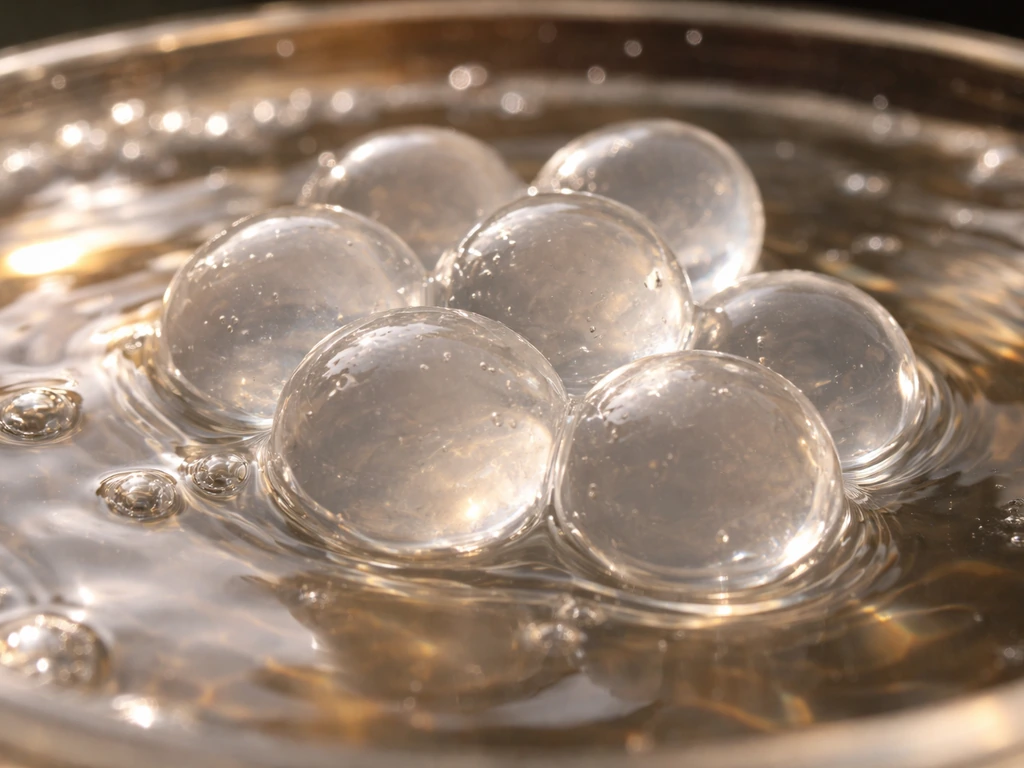
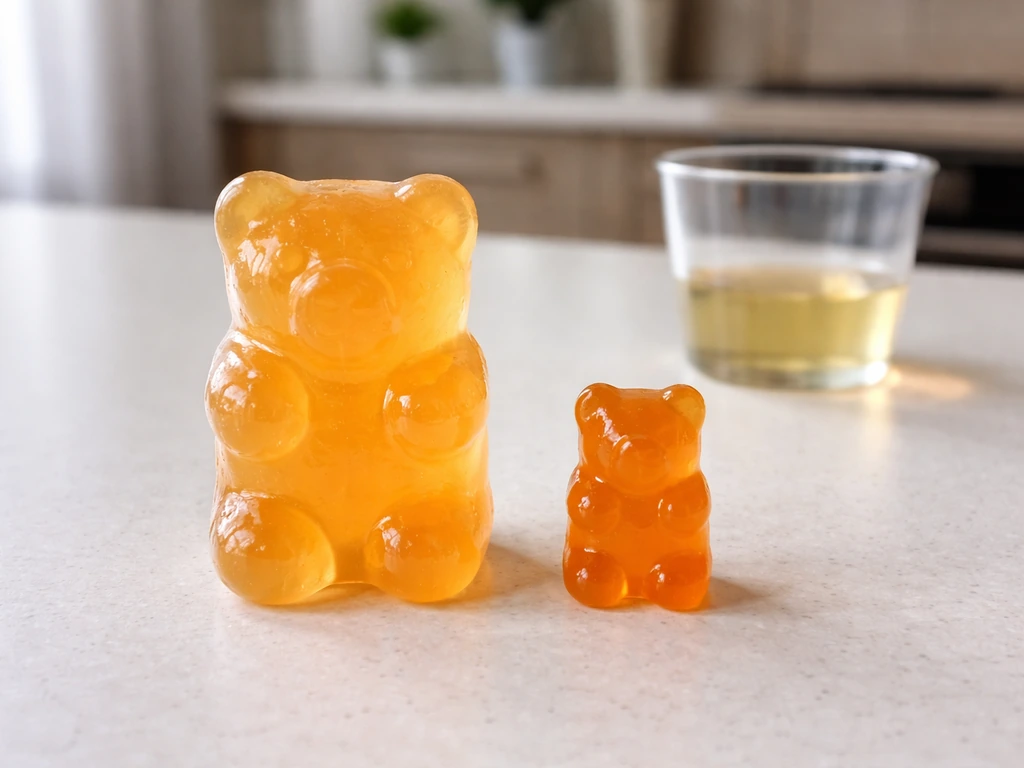
Gummy bears appear to grow in vinegar because two things happen at once: water moves into the candy through osmosis, and the acid in vinegar partially disrupts the gelatin matrix holding the bear together. The result is a bear that swells in size, softens in texture, and gains measurable mass. It looks like growth, but nothing is alive or reproducing here. It's a physical and chemical expansion, not biological growth.
Why Does Vinegar Make Gummy Bears Grow? Chemistry Explained

Marcus Whitmore
13 May 2026
What 'growth' really means here (and what it doesn't)
When biologists talk about growth, they mean cell division, mitosis, tissue expansion driven by living processes. A gummy bear has none of that. It's not a cell, it's not alive, and it can't reproduce. So when it gets bigger in vinegar, that isn't growth in any biological sense. It's swelling, the same way a dry sponge expands when you drop it in water, or the way a gel implant swells when it absorbs fluid. The bear's polymer network takes on liquid and physically expands its volume.
This matters because the mechanism is completely different from how living things grow. A growing yeast cell builds new cellular machinery and divides. Sugar matters because it gives yeast an energy source, helping it multiply when conditions are right A growing yeast cell builds new cellular machinery and divides.. A growing crystal adds molecules to its lattice. A gummy bear in vinegar just soaks up liquid and puffs out. Understanding that distinction helps you interpret what you're actually seeing in the experiment, and why the result has a hard ceiling that biological growth doesn't.
What gummy bears are made of (and why it matters)
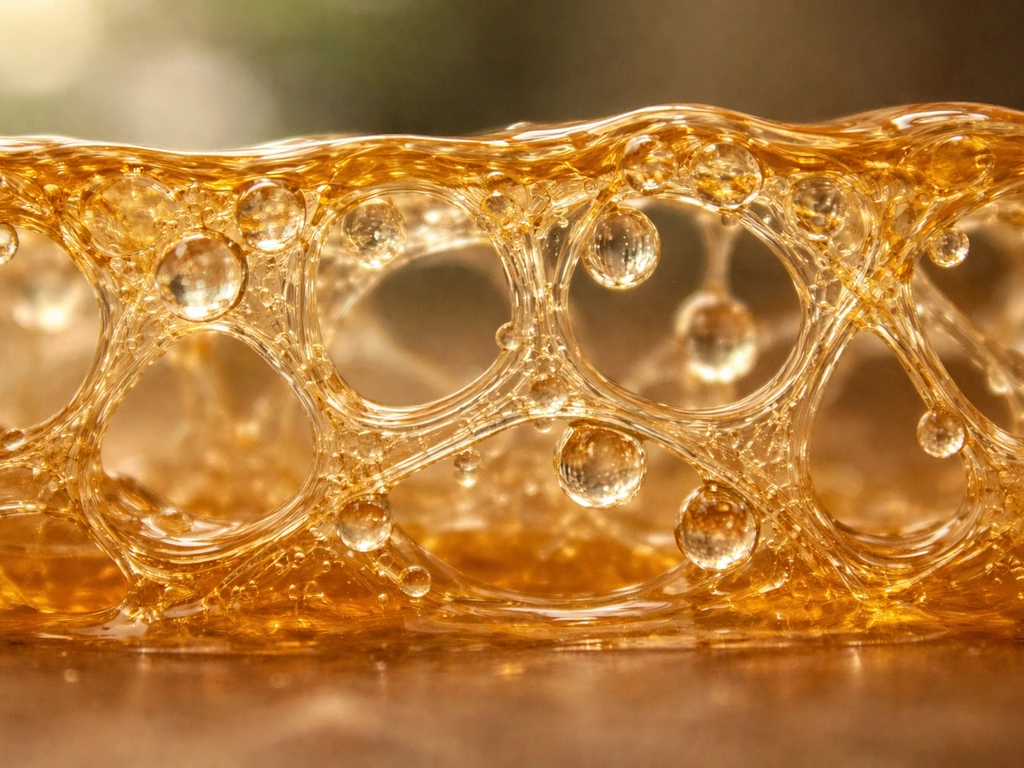
Traditional gummy bears are built from blank" rel="noopener noreferrer">gelatin, sugar (usually glucose syrup or sucrose), starch, water, flavoring, and food acids like citric acid. Some brands swap gelatin for pectin, which is plant-derived and vegan-friendly. The structural backbone in both cases is a three-dimensional polymer network. In gelatin-based bears, that network forms through hydrogen bonds and hydrophobic interactions between protein chains, creating a hydrogel. Think of it like a microscopic scaffolding full of tiny pockets that can hold water.
That scaffolding is the key to everything. Because the polymer chains are cross-linked into a network rather than a solid block, the gummy bear can absorb liquid into those spaces. It's not dissolving, it's inflating, at least at first. The denser the cross-linking, the less room there is to expand. The looser the network, the more liquid can move in. When you drop the bear into vinegar, both the osmotic pull of the sugar inside the bear and the acid in the vinegar start working on that network immediately.
Osmosis is the engine driving the size increase
Osmosis is the movement of water from a region of lower solute concentration to a region of higher solute concentration across a selectively permeable barrier. The gummy bear is loaded with dissolved sugar. Plain vinegar has far less dissolved solute than the inside of the bear. That concentration difference creates an osmotic gradient, and water molecules move from the vinegar into the bear to try to equalize it.
The gelatin or pectin network acts as that permeable barrier. Water can move through the gel matrix, but the large sugar molecules and polymer chains can't escape easily. So water keeps streaming in, the network swells to accommodate it, and the bear gets physically larger. You're watching osmosis happen in slow motion, in candy form. This is the same driving force you'd see in a plant cell pulling water from soil or a red blood cell swelling in a hypotonic solution.
Vinegar is mostly water (around 94 to 96 percent), so there's plenty of liquid available to move. The acetic acid dissolved in it doesn't stop osmosis from happening. But the acid does add a second layer of chemistry that makes the vinegar result noticeably different from plain water.
What the acid in vinegar actually does to the gel
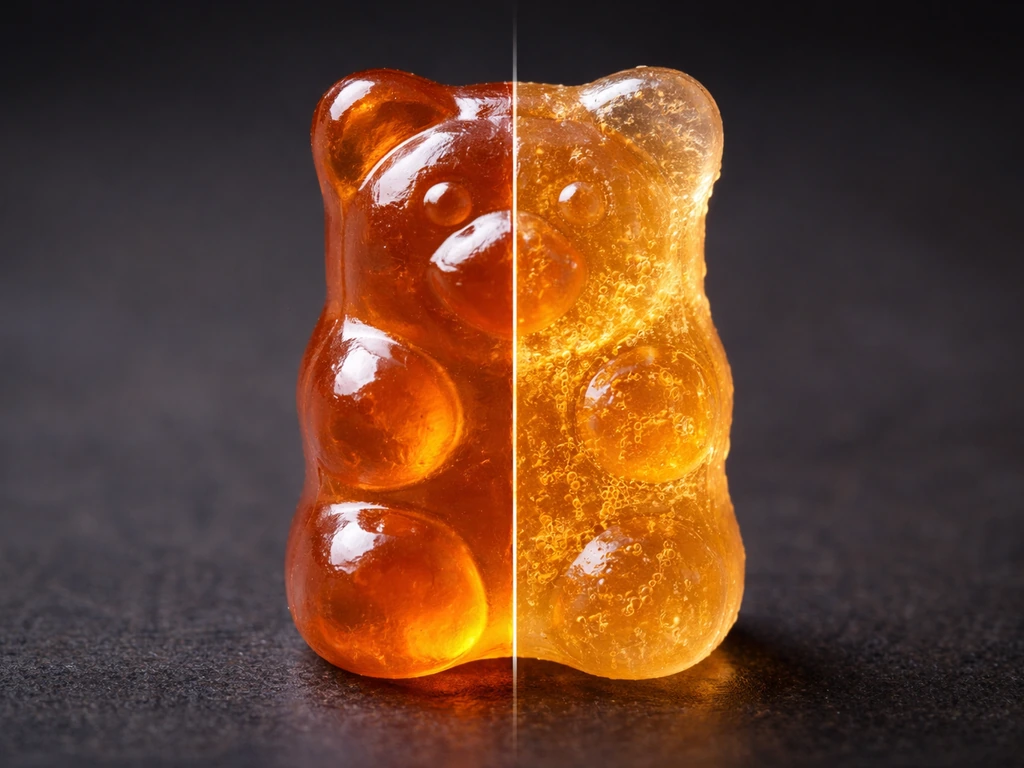
Acetic acid, the active ingredient in vinegar, lowers the pH of the soaking solution down to roughly 2 to 3. That acidic environment changes the gelatin or pectin matrix in ways that plain water doesn't. Research on acetic acid and gelatin hydrogels shows that the acid modifies the microstructure of the gel, changing how water is absorbed and how permeable the network becomes. Essentially, the acid loosens the bonds that hold the polymer scaffold together, making it easier for water to enter but also making the structure weaker over time.
In pectin-based gummy bears, the effect is even more pronounced. Pectin's carboxyl groups change their charge state depending on pH. At low pH, those groups become protonated and the gel behaves differently, sometimes swelling more, sometimes becoming disorganized and weak. The practical outcome in both gelatin and pectin bears is the same: the acid softens the bear, changes its texture, and can eventually begin to break down the polymer network itself if you leave the bear long enough.
So vinegar drives two processes simultaneously. Osmosis pulls water in and expands the volume. Acid chemically modifies the structural matrix, which changes how that expansion plays out and, over longer periods, starts dissolving the bear rather than just inflating it.
Swelling first, then dissolution: how the bear changes over time
In the first 6 to 12 hours, the dominant process is swelling. The bear absorbs water, its mass increases, its dimensions grow measurably, and it holds its shape roughly. After 12 to 24 hours, you start to see the acid's structural damage accumulate. The bear gets gooey, loses its crisp edges, and may start to fall apart if you handle it. By 48 hours in strong vinegar, many bears disintegrate or become an amorphous blob.
This is the difference between osmotic swelling and acid-driven dissolution. In plain water, a gummy bear can swell to roughly double its original size and still hold together reasonably well because water alone doesn't attack the polymer bonds. In vinegar, you get initial swelling followed by structural breakdown. The bear appears to grow, then it appears to melt. Both outcomes are caused by the same chemistry, just at different stages.
Interestingly, this means gummy bears often show less apparent size increase in vinegar than in plain water, even though the vinegar process sounds more dramatic. The acid-driven softening can cause the bear to lose shape as it grows, so the dimensional measurements don't increase as cleanly. The bear in water swells in a more organized way; the bear in vinegar swells and simultaneously weakens.
How conditions change the result
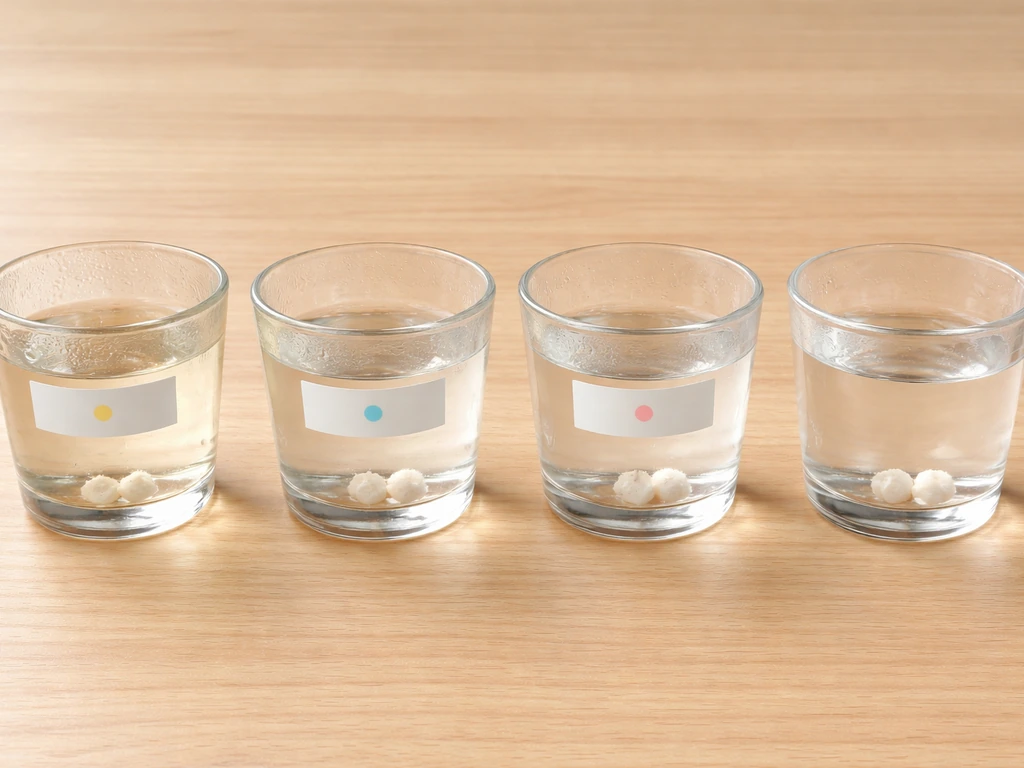
Not all vinegar experiments look the same, and that's because several variables shift the outcome significantly.
| Variable | Effect on Swelling | Practical Note |
|---|---|---|
| Vinegar concentration (acidity) | Higher acidity speeds up matrix breakdown and softening; lower acidity allows more clean swelling | Standard white vinegar (5% acetic acid) is a good baseline; avoid cooking vinegars with additives |
| Temperature | Warmer liquid increases osmotic and diffusion rates; bear absorbs faster but may dissolve faster too | Room temperature (~20°C) is standard; refrigerating slows both swelling and breakdown |
| Soaking time | 6–12 hrs: mostly swelling; 12–24 hrs: swelling + softening; 24–48+ hrs: dissolution and structural loss | Measure at multiple timepoints to see the full curve |
| Gummy bear brand/type | Gelatin-based vs pectin-based bears respond differently; pectin is more pH-sensitive | Haribo uses gelatin; many vegan brands use pectin — compare them directly for a richer experiment |
| Bear size | Larger bears take longer to fully absorb; smaller surface-to-volume ratio slows uptake | Use identical bears from the same bag for fair comparisons |
| Bear freshness | Older, drier bears may absorb more liquid than fresh bears already containing more moisture | Use bears from the same package to control this |
Temperature is one of the most underappreciated variables. If your classroom is cold or you run the experiment in a refrigerator, diffusion slows down noticeably. Hot water speeds up osmosis, so gel beads or gummy gels generally swell faster than in colder water, though acid can change the outcome too Osmotic movement of water is a physical process governed by concentration gradients. Osmotic movement of water is a physical process governed by concentration gradients, but it's also faster at higher temperatures because molecules move more energetically. A bear left at 25°C will absorb more liquid in 12 hours than one left at 10°C.
How to run this experiment today and get real numbers
You don't need a lab. You need a kitchen scale, a ruler, a few small cups, gummy bears, vinegar, and plain water for comparison. Here's a clean protocol that gives you quantitative data you can actually graph. The Carleton College SERC osmosis activity uses gummy bears to have students calculate percent change in height, width, and mass as key quantitative “growth” measures compute percent change in height/width/mass.
- Pick gummy bears from the same bag so they start at roughly the same size and moisture level. Use at least two bears per condition for reliability.
- Measure each bear before soaking: mass in grams (to 0.1 g precision), height, width, and length in millimeters. Record everything.
- Set up at least two conditions: a cup with plain tap water and a cup with white vinegar. Add a salt water or corn syrup condition if you want to see osmosis go in reverse.
- Submerge one or two bears fully in each cup. Make sure there's enough liquid to cover the bears, as they'll absorb quite a bit.
- Measure again at 6 hours, 12 hours, 24 hours, and optionally 48 hours. Pat each bear gently dry before weighing to remove surface liquid.
- Calculate percent change in mass: (final mass minus initial mass) divided by initial mass, multiplied by 100. Do the same for at least one linear dimension.
- Observe and record texture changes at each timepoint (firm, soft, gooey, disintegrating). This qualitative data is as important as the numbers.
- Graph your percent mass change over time for each solution to visualize the swelling curve and where it plateaus or reverses.
What to expect: bears in plain water typically show the most dramatic size increase, often near 100 to 200 percent mass gain over 24 hours while staying relatively intact. Bears in vinegar usually show meaningful swelling (often 50 to 150 percent mass increase by 12 to 24 hours) but develop a noticeably softer, stickier texture. Bears in salt water or corn syrup lose mass as water moves out of the bear into the hypertonic solution, and they shrink and harden instead.
Troubleshooting: why your gummy bears aren't growing
If your bears aren't swelling much, or they're swelling unevenly, one of a few things is probably going on. Work through these before redoing the whole experiment.
- Not enough time: 1 to 2 hours is often too short to see dramatic changes. Give it at least 6 hours, ideally overnight.
- Not enough liquid: if the bears absorb all the liquid in the cup, they stop growing because there's nothing left to pull in. Use at least 200 to 300 mL per bear.
- Wrong type of vinegar: flavored, seasoned, or thickened vinegars (like balsamic) contain sugars or other solutes that change the osmotic gradient and can actually slow or reverse swelling.
- Very fresh, moist gummy bears: bears that are already moisture-rich have less osmotic pull and may swell less than drier, older bears.
- Cold environment: if the room or liquid is cold, diffusion and osmotic movement are significantly slower. Move to a warmer spot.
- Pectin-based bears behaving differently than expected: pectin is more sensitive to pH than gelatin and may swell or disintegrate at a different rate. Note the brand and check the ingredient list.
- Bears dissolving instead of swelling: this usually means too much time has passed, or the vinegar is very concentrated. The acid has broken down the matrix faster than osmosis swelled it. Measure earlier next time.
- Uneven swelling: this can happen if the bear isn't fully submerged. Make sure all surfaces are in contact with the liquid, or gently rotate the bear midway through.
The bigger picture: physical vs biological growth
This experiment is a useful reminder that not all expansion is growth. Gummy bears in vinegar grow in the everyday sense of getting bigger, but they do it through purely physical and chemical mechanisms: osmotic water uptake driven by concentration gradients, and acid-driven modification of a polymer gel. That same kind of solute-and-dissolution effect is behind why salt crystals can grow faster than sugar crystals why salt crystals grow faster than sugar crystals. No cells divide. No energy is consumed by a living system. No new material is synthesized. The bear just fills with liquid until equilibrium is reached or the structure fails.
Compare this to how sugar crystals grow by adding molecules to a lattice, or how yeast expands a dough by consuming sugar and producing gas. Each of those involves a distinct mechanism. The gummy bear experiment sits at the intersection of osmosis, polymer chemistry, and acid-base interactions, which is exactly why it's such a useful teaching tool. It makes an invisible process (water moving down a concentration gradient) literally visible and measurable in your hand.
If you want to push the experiment further, try comparing gelatin-based and pectin-based bears in the same vinegar solution and watch how differently each polymer responds to low pH. Or try varying vinegar concentration by diluting with water in steps (25%, 50%, 75%, 100% vinegar) and plot swelling against acid strength. You'll quickly see that there's a sweet spot where the acid opens up the matrix enough to help water enter, but beyond that point it just destroys the structure instead of expanding it. That tradeoff is the heart of what this experiment is really showing you.
FAQ
Why do gummy bears sometimes grow less in vinegar than in plain water?
If the acid softens the polymer network while swelling is still happening, the bear can lose shape (edges blur or it turns gooey), so your ruler measurements look smaller even when the mass is still increasing. Measuring both mass (kitchen scale) and dimensions helps separate “more water uptake” from “better shape retention.”
What concentration of vinegar gives the biggest size increase?
There is usually a tradeoff, a moderate acid level can loosen the gel enough to allow strong swelling, but very strong acid can start breaking down the network before the bear reaches maximum inflation. A practical method is to test diluted vinegar (25%, 50%, 75%, 100%) and pick the concentration where mass gain peaks before disintegration begins.
Does temperature change the “growth” effect in vinegar?
Yes. Warmer conditions speed up water movement and gel swelling, so bears absorb liquid faster. If you compare two trials, keep the solution temperature similar (for example, both at room temperature), otherwise the faster trial may look like it “works better” due to kinetics, not chemistry.
How long should I leave gummy bears in vinegar for the best results?
For most classroom-style observations, 6 to 12 hours shows mostly swelling, 12 to 24 hours often shows both swelling and noticeable softening, beyond about 48 hours the structure can fail and the bear can disintegrate. If your goal is “growth,” record measurements early; if your goal is “melting,” record later.
Why do some bears start to fall apart instead of staying intact?
Acid can weaken and disrupt the polymer network, especially if the solution is concentrated, the bear is thinner, or it is left longer. Handling stress matters too, once the outer layer softens it tears more easily, so gently blot and lift instead of pinching and pulling.
Will the experiment still work with pectin-based gummy bears versus gelatin-based?
Yes, but the timeline and texture differ. Pectin’s charge behavior at low pH can cause the gel to swell differently and lose structural order sooner or later depending on the formulation, so comparing the same vinegar cup side by side usually shows different softening and failure patterns.
Should I rinse the bear before measuring it?
Rinsing can remove vinegar stuck on the surface and delay continued acid damage, which changes what you are measuring. If you rinse, do it consistently for every sample, and note that surface liquid removal affects the apparent mass and stickiness.
Why does sugar solution behave differently than salt water or vinegar?
Sugar solutions tend to be less effective at pulling water out or attacking the gel chemically compared with vinegar. Salt water is typically hypertonic and can cause water to move out (shrinking), vinegar has both water-driven swelling and acid-driven matrix damage, so the outcome is a combination rather than a single “osmosis only” result.
Can I use this to estimate how much water entered the gummy bear?
Yes. Weigh the bear before and after soaking. Mass increase is a good proxy for water uptake, because most of the incoming liquid is water from the surrounding solution. For better accuracy, record final mass after a consistent draining time (for example, 10 seconds on a rack).
What’s the most common mistake when students do this experiment?
Comparing only visual size without controlling variables like time, temperature, and vinegar strength, or not measuring mass. Since vinegar can soften and distort the bear, relying on appearance alone can lead to incorrect conclusions about “how much growth” happened.
Next Article
Does Hot Water Make Gel Balls Grow Faster? What to Expect
Hot or warm water speeds gel bead swelling by faster diffusion, but final size is limited by hydration equilibrium.