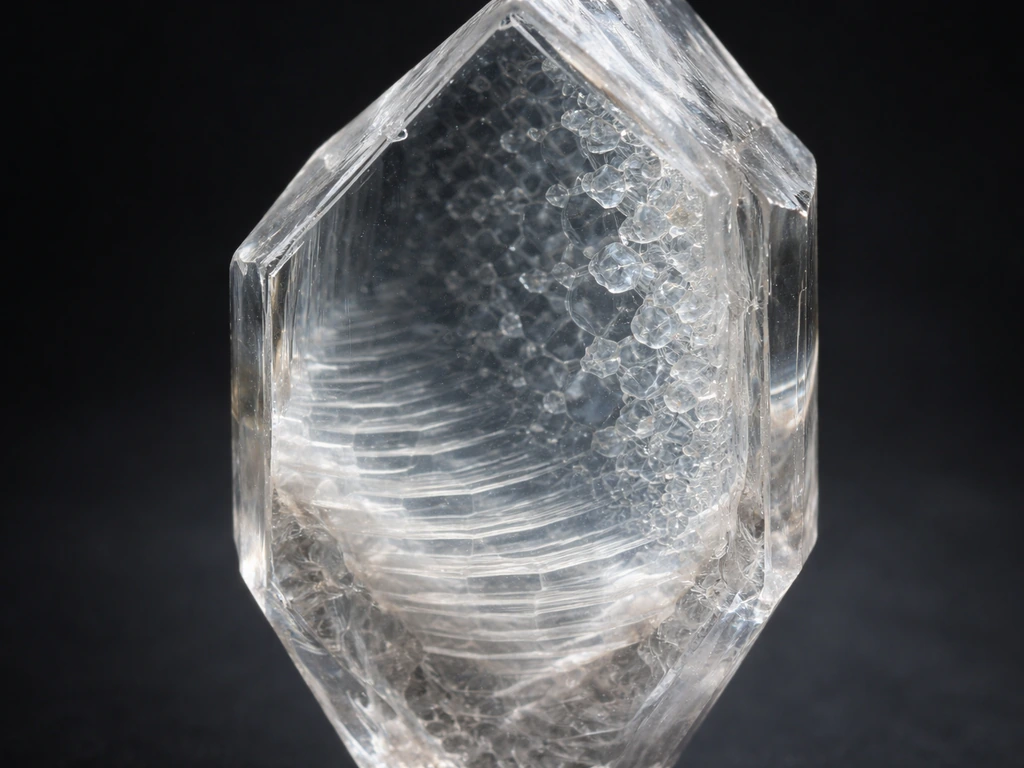
New minerals can absolutely grow inside rocks that are already solid, and it happens all the time in the crust beneath our feet. The key is that 'solid' doesn't mean 'sealed.' Rocks have grain boundaries, micro-fractures, and pore spaces that fluids can infiltrate, carrying dissolved ions that reprecipitate as brand-new crystals. Minerals also grow through solid-state reactions driven by heat and pressure, where atoms diffuse along grain boundaries and reorganize without any melting at all. So the short version is: get fluid (or enough heat and pressure) into a rock, create chemical disequilibrium, and mineral growth follows.
How New Minerals Grow Inside Existing Rocks
Marcus Whitmore
29 May 2026
What 'growing inside rock' actually means
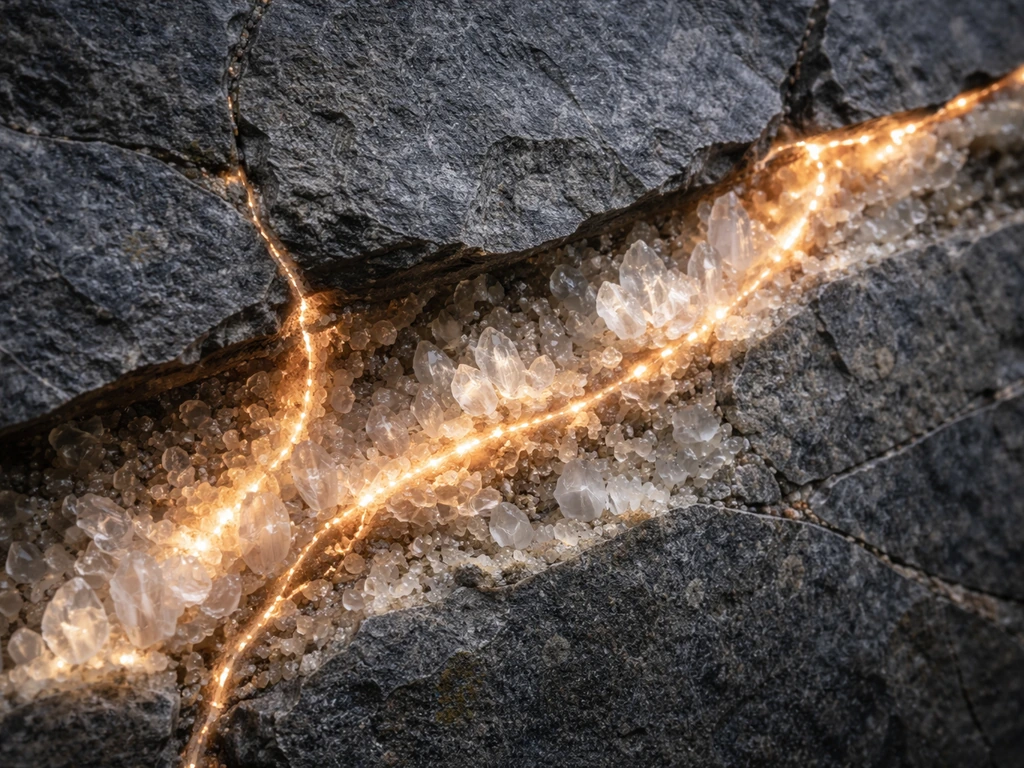
When people picture rocks, they imagine something inert and unchanging. But a rock is really a packed aggregate of mineral grains, each with its own chemical composition, and those grains are never perfectly in equilibrium with their surroundings forever. Change the temperature, pressure, or chemistry of the fluids moving through the rock, and suddenly the existing minerals are out of step with the new conditions. New minerals then nucleate and grow to bring the system back toward equilibrium. This isn't biology, but the logic rhymes closely with how living cells respond to resource changes: the system senses disequilibrium and reorganizes to compensate.
Growth inside rock happens through three broad pathways, and real rocks often show evidence of more than one at a time. First, fluids carry dissolved material into open spaces and precipitate new crystals. Second, existing minerals dissolve and the freed ions reprecipitate as different minerals right at the reaction interface, a process called dissolution-reprecipitation.
Fluid, rock interactions can drive dissolution and coupled replacement/precipitation reactions that reorganize minerals after the host rock has already solidified, with the pathway depending on fluid and solid compositions and disequilibrium at the mineral, fluid interface dissolution-reprecipitation reactions at the moving interface.
Third, under high temperature and pressure, atoms migrate along grain boundaries and rearrange into new mineral structures without any fluid involvement beyond a thin grain-boundary 'phase. ' Each pathway leaves distinct fingerprints in the rock, which is exactly what lets us tell them apart.
Where the building blocks come from: fluids, melts, and transport
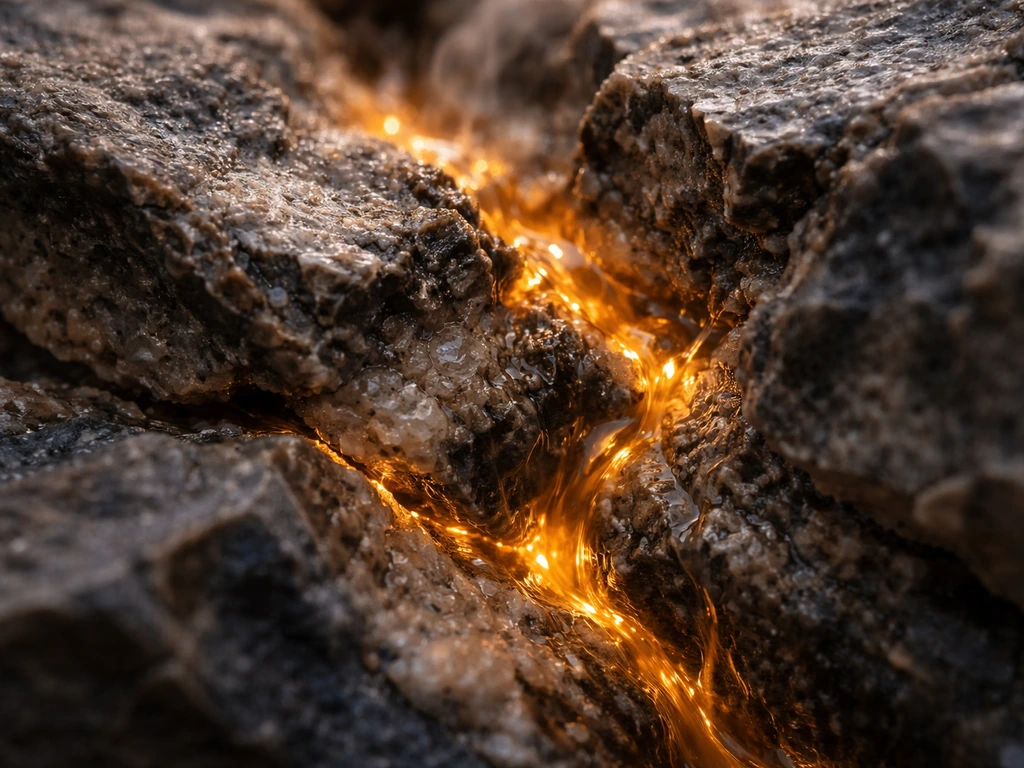
Every mineral needs a supply of the right ions, and in rocks those ions travel in fluids. Hydrothermal fluids are hot, chemically active water solutions that circulate through fracture networks, picking up elements like silica, calcium, iron, and sulfur from the surrounding rock as they go. Groundwater does the same thing at lower temperatures and slower rates. Magmatic fluids exsolved from cooling magma carry volatiles and metals under tremendous pressure. Even pore fluids trapped in sedimentary rocks can slowly transport enough material to precipitate new cement minerals over millions of years.
Transport is the rate-limiting step, much like nutrient delivery limits how fast a cell can grow. If fluid can't reach a reactive site, no new mineral forms there regardless of how far out of equilibrium the local chemistry is. Permeability, which is how easily fluid moves through the rock, controls everything downstream. Fractures are the express highways. Grain boundaries and lattice defects act more like dirt roads: slow, but they can still carry enough material to drive reactions over geological time. As minerals dissolve and reprecipitate, they can actually generate new porosity in the product, which opens up fresh pathways and accelerates the whole process.
Dissolution-reprecipitation: the rock's own material becomes the feedstock
One of the most elegant mineral growth mechanisms doesn't require any external supply of ions at all. In interface-coupled dissolution-reprecipitation (CDR), a fluid contacts an existing mineral, dissolves a thin layer at the surface, and then immediately reprecipitates a new mineral from that dissolved material, all at the same moving interface. The fluid acts as a catalyst and a transport medium but doesn't need to import anything from far away. The reaction front literally eats the old mineral and builds the new one in the same motion.
What makes CDR especially striking is that it can preserve the original grain's shape almost perfectly, producing what geologists call a pseudomorph. You end up with a crystal that looks exactly like the original mineral on the outside but is made of completely different chemistry on the inside. Think of it like replacing the bricks in a wall one at a time while keeping the wall standing: the structure is preserved even as the material changes entirely. For CDR to keep going, the product phase has to generate enough porosity to let fluid reach the retreating interface. If the product is too dense and seals itself off, the reaction stalls.
Nucleation and crystal growth: why minerals don't form everywhere at once
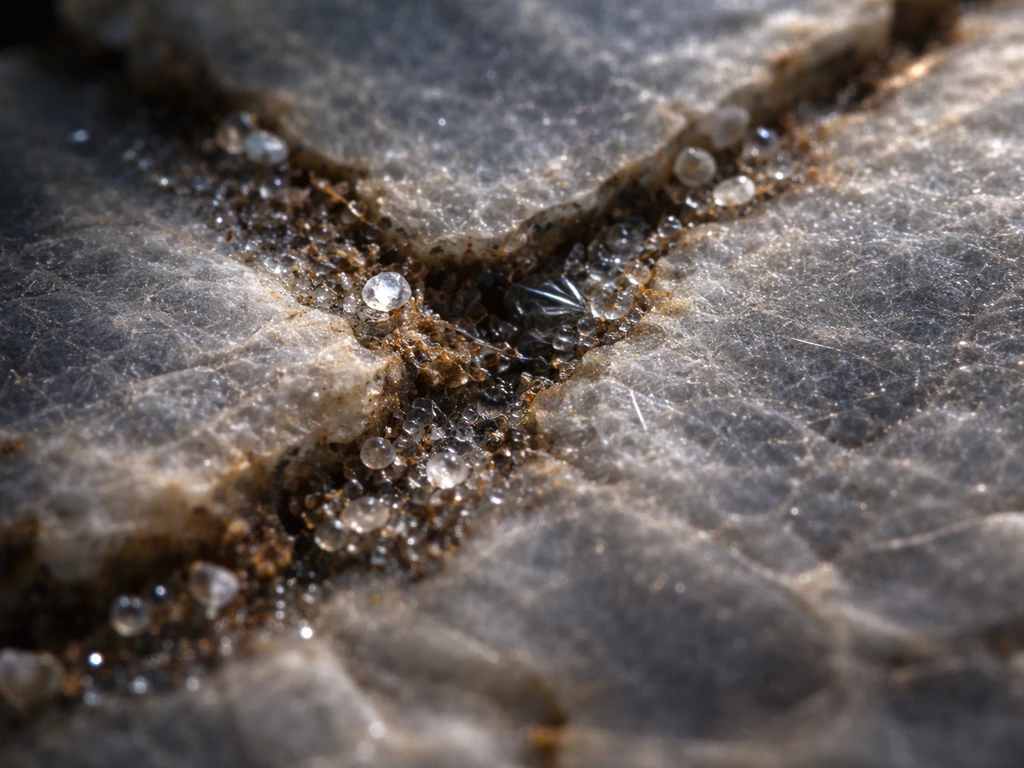
Just because the chemistry is right for a new mineral doesn't mean crystals immediately sprout everywhere. These same principles apply to gemstones, too, including how do diamonds grow inside Earth. Nucleation, the formation of a stable embryonic crystal, requires overcoming a surface energy barrier. A tiny cluster of atoms arranged in the new crystal structure is energetically unfavorable until it reaches a critical size, because the surface energy cost of creating new crystal faces outweighs the volume energy gained by forming the stable mineral. This is why supersaturation has to build up before crystallization actually starts, and why once it does start, growth tends to concentrate on the first few nuclei rather than spreading uniformly.
Supersaturation is the driving force: the fluid has to carry more dissolved material than the equilibrium concentration for that mineral at those conditions. Temperature matters hugely because solubility changes with temperature, so a cooling hydrothermal fluid that was transporting silica in solution at 300°C may hit saturation and precipitate quartz at 200°C.
Pre-existing surfaces lower the barrier through heterogeneous nucleation, which is why new minerals often nucleate on grain boundaries, fracture walls, or impurities rather than in the middle of a pore space. This kind of crystal-driven growth and nucleation behavior is also the same core idea behind weathering that occurs when crystals grow, where minerals expand in tiny pores or fractures.
Once a crystal is growing, its rate depends on how fast ions can diffuse to the surface and attach in the right crystallographic orientation.
Replacement and metamorphic growth: no fluid required
Not all mineral growth needs a circulating fluid phase. At the elevated temperatures and pressures of metamorphism, atoms become mobile enough to diffuse along grain boundaries and lattice defects. A grain-boundary model of metamorphic reaction proposes that these nanoscale zones between adjacent mineral grains act as local reaction sites, where minerals that are out of equilibrium with each other exchange atoms and reorganize into new phases. The driving force is local disequilibrium between touching grains, not a bulk fluid infiltrating from outside.
This is how garnet porphyroblasts, those large red-brown crystals you sometimes see in metamorphic rocks like schist, grow to centimeter scale. Minerals do grow in size when the processes described here add new material to existing grains over time. As the rock is buried and heats up, the surrounding minerals become unstable relative to garnet chemistry, and atoms of iron, magnesium, aluminum, and silicon slowly migrate through grain boundaries to feed garnet growth. The garnet expands outward, consuming the surrounding matrix. The process is slow but powerful, and the mineral assemblage that forms tells geologists exactly what temperature and pressure conditions the rock experienced, like a thermometer and barometer preserved in stone.
Replacement reactions in lower-temperature settings also occur without full melting. Feldspar converting to muscovite or kaolinite during hydrothermal alteration, for example, involves a combination of fluid-assisted ion exchange and local solid-state reorganization. The fluid doesn't dissolve the feldspar grain completely; instead it facilitates a coupled exchange at the interface, swapping potassium and aluminum arrangements for new ones. These reactions are the basis of much ore deposit formation and hydrothermal alteration zones.
What rocks actually show you: textures and evidence
Reading these processes out of a real rock sample comes down to recognizing textures. Each growth mechanism leaves a different signature, and once you know what to look for, the rock tells its own story.
Veins vs. replacement textures
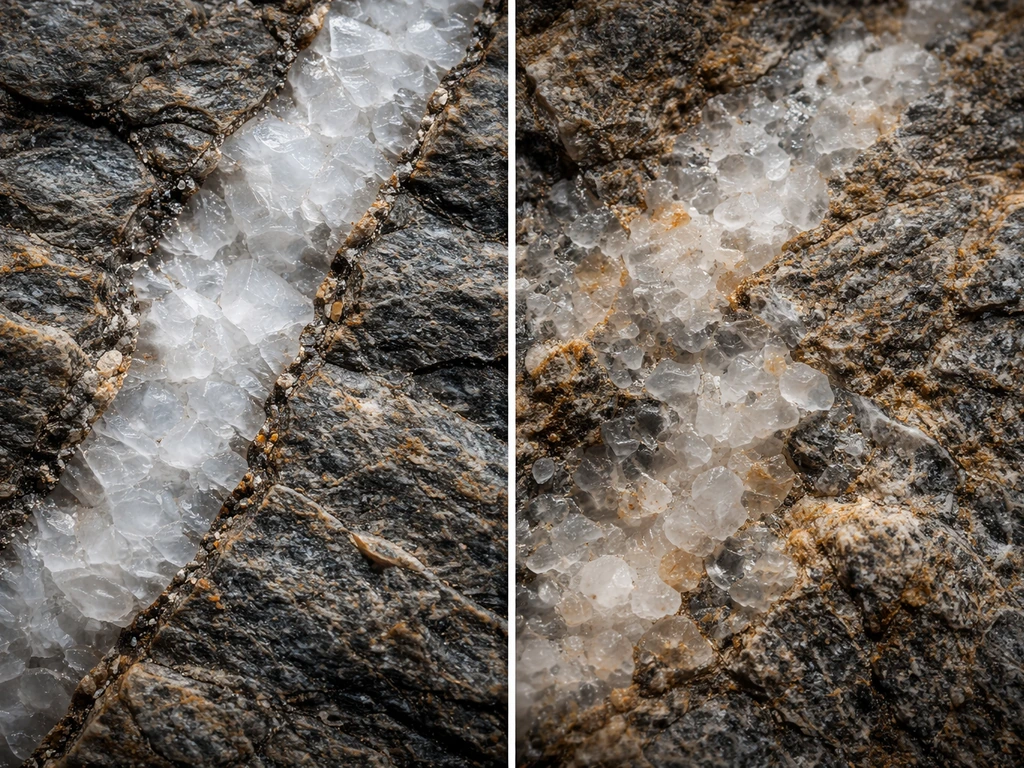
Veins are the clearest evidence of fluid-driven precipitation into open space. They cut across pre-existing structures, have sharp walls, and are filled with minerals like quartz, calcite, or sulfides that crystallized from passing fluids. The crystals often grow perpendicular to the vein walls, pointing toward the center, which is a textbook sign of open-space filling. Replacement textures look different: the original grain shape is retained (that pseudomorphism again), but the mineral composition has changed. You might see perfectly cubic outlines filled with a different mineral than what you'd expect for that crystal habit.
Crystal zoning
Many growing crystals record changing conditions in their chemistry as they grow, like tree rings recording wet and dry years. Compositional zoning shows up under a microscope or microprobe as concentric shells of slightly different chemistry. A garnet might have an iron-rich core (grown early at lower temperature) and a magnesium-rich rim (grown later as temperature increased). Oscillatory zoning in plagioclase feldspar records fluctuations in the magma's composition as it cooled. These zoning patterns are direct evidence that the crystal was growing incrementally through changing conditions.
Alteration halos and porosity patterns
Fluid flow leaves traces beyond just the minerals it deposits. Alteration halos, zones of chemically changed rock radiating outward from fractures or veins, mark where fluids interacted with the host rock. The halo is often bleached, discolored, or enriched in secondary minerals like chlorite, epidote, or carbonates. Porosity textures in thin section, especially the spongy or wormy patterns created when CDR generates new pore space in a reacting grain, are another strong indicator of fluid-mediated dissolution-reprecipitation rather than solid-state metamorphic growth.
Comparing the three main growth pathways
| Growth pathway | Driving force | Fluid required? | Key texture evidence | Typical minerals |
|---|---|---|---|---|
| Open-space fluid precipitation | Supersaturation from circulating fluid | Yes, circulating fluid essential | Veins, drusy cavities, perpendicular crystal growth | Quartz, calcite, sulfides, zeolites |
| Dissolution-reprecipitation (CDR) | Disequilibrium at mineral-fluid interface | Yes, but can be very localized | Pseudomorphs, reaction-front porosity, alteration halos | Muscovite after feldspar, oxides after sulfides |
| Metamorphic solid-state growth | Heat and pressure driving grain-boundary diffusion | Minimal (grain-boundary 'phase') | Porphyroblasts, foliation wrapping, crystal zoning | Garnet, staurolite, kyanite, sillimanite |
If you're trying to decide which mechanism operated in your sample, start with the table above as a quick filter. Then confirm with the textures described earlier. Open-space veins are almost always unmistakable. Pseudomorphs point to CDR. Large crystals wrapped by a foliation in a metamorphic rock point to solid-state growth under pressure.
What stops mineral growth, and what controls which mineral forms
Mineral growth stops when the driving force disappears. If the fluid runs out of dissolved material, precipitation stops. If the temperature or pressure changes to a regime where the growing mineral is no longer stable, growth stops and might even reverse into dissolution. If the reaction front seals itself with an impermeable product layer, cutting off fluid access, CDR halts. These are feedback limits almost identical in logic to the limits on biological growth: a cell stops dividing when it runs out of nutrients or when signaling tells it conditions aren't right anymore.
Competing mineral phases also matter. When multiple minerals could potentially nucleate from the same fluid, the one with the lowest nucleation barrier tends to form first, even if it isn't the thermodynamically most stable phase. This is Ostwald's rule of stages, and it's why you sometimes see unstable precursor minerals in rocks that later transform to more stable ones. The kinetics of nucleation and growth can override thermodynamic predictions on short timescales, especially at low temperatures where reaction rates are slow.
Predicting which mineral forms next requires knowing the bulk composition of the fluid and rock, the temperature and pressure, and the activity of key components like water, carbon dioxide, or oxygen. Geochemists use thermodynamic phase diagrams and mineral stability diagrams to map out which mineral assemblage is stable under any given set of conditions. In the field, you can use the existing mineral assemblage as a guide: the presence of specific index minerals like kyanite, andalusite, or sillimanite tells you the pressure-temperature range the rock experienced, which in turn tells you what other minerals should be stable alongside them.
Growth limits and the universal principle
It's worth pausing on why mineral growth in rocks and growth in living things follow such similar rules. In both cases, growth requires a supply of raw materials, a transport system to deliver them, a trigger that initiates construction, and a set of conditions that must be maintained.
In both cases, growth stops when resources run out, when transport is blocked, or when feedback signals (chemical equilibrium in rocks, hormonal or nutrient signaling in organisms) indicate that further growth isn't favorable. The physics of diffusion, surface energy, and chemical potential apply equally to a garnet growing in a metamorphic schist and to a cell expanding in a growing tissue.
That's not a coincidence; it reflects deep physical constraints on how any ordered structure builds itself in a changing environment.
How to actually investigate a sample: your practical next steps
If you have a rock sample and want to identify which mineral growth process is recorded in it, here's a straightforward workflow.
- Start with hand sample examination. Look for veins (fluid pathway evidence), altered zones or discoloration (alteration halos), unusually large crystals standing out from the surrounding matrix (porphyroblasts), or grains with unfamiliar colors that still have a recognizable crystal form (possible pseudomorphs).
- Use a hand lens or loupe to check grain boundaries and crystal surfaces. Spongy, porous, or corroded grain surfaces suggest dissolution-reprecipitation. Clean, euhedral (well-formed) crystal faces in open cavities suggest free growth from a fluid.
- Identify the mineral assemblage. Which minerals are present? Cross-reference with known stability fields: garnet plus kyanite suggests high pressure metamorphism; calcite plus quartz veins suggest low-temperature hydrothermal fluid; chlorite and epidote suggest moderate-temperature hydrothermal alteration.
- Map the spatial relationships. Do the new minerals cut across older structures (fluid veins) or are they wrapped by a foliation (metamorphic growth)? Are replacement minerals confined to the margins of old grains (interface-controlled CDR) or distributed throughout (pervasive fluid flow)?
- If you have access to thin sections, look for crystal zoning under plane-polarized and cross-polarized light. Oscillatory or compositional zoning confirms incremental growth through changing conditions.
- If you can access a scanning electron microscope or electron microprobe, look for compositional gradients across grain boundaries and check for micro-porosity in altered grains. These are the definitive signatures of CDR vs. solid-state processes.
- Consider the geological context. What type of rock is it (igneous, sedimentary, metamorphic)? What tectonic setting? A vein in a granite batholith points toward late-stage magmatic or hydrothermal fluids. Large garnet crystals in a pelitic schist point toward prograde metamorphism during burial.
You don't need a full laboratory to make a reasonable diagnosis. Hand sample observation plus knowledge of which minerals are present will get you most of the way there. The textures almost always tell the story if you know what each growth mechanism looks like.
And if you want to go deeper into any one of these pathways, the topics of how crystals grow in general, how quartz crystals specifically form, and how weathering interacts with crystal growth in surface environments are all closely related threads worth following. If you specifically want to understand how do quartz crystals grow, the same principles of nucleation, supersaturation, and ion transport apply.
Small-scale crystal growth in materials like Play-Doh follows the same basic idea: a supersaturated mixture, a suitable surface for nucleation, and conditions that let ions or particles arrange into a crystal crystals grow in general. Those surface processes include weathering that occurs when crystals grow, which can reshape rock textures over time. If you are specifically curious about gemstones, learning how do diamonds grow is a great next step because the same crystallization logic applies under extreme conditions.
These same ideas help explain how does rock grow in terms of nucleation, fluid flow, and solid-state reactions. How do crystals grow is the broader question that these rock processes illustrate how crystals grow. If you want the bigger picture of the steps involved, see how crystals grow beyond just the cases found inside rocks.
FAQ
Can minerals grow inside “sealed” igneous rocks with no visible fractures or pores?
Yes, but only if there are effective pathways at grain scale, such as grain boundaries, microcracks, or connected pore networks too small to see in a hand sample. If a rock truly lacks connected pathways and the only interfaces are isolated, ion transport becomes too slow and growth is limited to very thin reaction rims.
What’s the difference between crystals growing in open space versus inside a pre-existing grain?
Open-space growth forms vein-like crystals with sharp, bounded walls and crystals oriented from the walls toward the center. Inside-grain growth typically preserves an outline of the original mineral (often a pseudomorph) and may show spongy, wormy porosity if the mechanism generates new pore space while the reaction interface advances.
How can I tell if a new mineral formed from dissolution-reprecipitation rather than direct solid-state diffusion during metamorphism?
Look for fluid-related micro-features. Dissolution-reprecipitation commonly produces replacement textures, reaction fronts, and porosity that can enhance subsequent flow. Pure solid-state grain-boundary metamorphism tends to show evidence of atom exchange between adjacent minerals with less dramatic evidence of newly created pore networks.
Why do some minerals preserve the exact external shape of the original grain?
That usually points to an interface-coupled dissolution-reprecipitation style process. The key requirement is that the reacting product phase generates enough permeability or porosity to keep fluid access to the retreating interface; otherwise the reaction stalls before shape preservation can occur.
What controls whether nucleation starts quickly or only after long buildup of supersaturation?
Nucleation depends on overcoming a surface energy barrier, which varies with crystal chemistry and the availability of favorable surfaces. Impurities, grain boundaries, and fracture walls lower the barrier through heterogeneous nucleation, so growth often begins there rather than uniformly in pore centers.
If multiple minerals are possible from the same fluid, why do I sometimes see an “early” mineral that later disappears?
Kinetics can dominate on early timescales. A mineral with the lowest nucleation barrier can precipitate first even if it is not the most stable phase, and later reactions can transform it into a more stable assemblage (often described as stages).
Does cooling always make precipitation happen?
Not always. Cooling often increases supersaturation for minerals whose solubility decreases with temperature, but the outcome depends on fluid composition and which components control solubility. If the fluid chemistry or redox state shifts, precipitation may not occur until a specific threshold is crossed, or it may trigger different phases instead of one expected mineral.
How fast can mineral growth occur inside rocks?
It ranges from microscopic rims during rapid hydrothermal events to large crystals over millions of years. Transport is usually rate-limiting, so even when thermodynamics favor growth, slow diffusion or low permeability can keep growth extremely sluggish until pathways improve.
What’s the role of oxygen, carbon dioxide, or sulfur in changing which mineral grows?
These components control redox and complexing, which changes the effective activities of reactive ions in the fluid. Even when temperature and total “metal content” look similar, different oxygen or CO2 conditions can shift which minerals nucleate first and which remain stable, especially for sulfides, carbonates, and iron-bearing phases.
Can mineral growth create or destroy porosity, and why does that matter?
Yes. Some reactions generate porosity as material dissolves and new phases form, which can open new fluid pathways and accelerate later growth. Other reactions can seal pores and reduce permeability, shutting down transport and stopping growth even if chemical disequilibrium still exists.
Why do crystals sometimes show concentric zoning like tree rings?
Zoning forms when conditions fluctuate while a single crystal continues to grow. Changes in fluid chemistry, temperature, or pressure during growth can alter the relative uptake of elements, leaving shells of slightly different composition that later appear as zoning under a microscope or microprobe.
How can I use mineral assemblages in a metamorphic rock to estimate the conditions of growth?
Presence of pressure-temperature index minerals narrows the stability field of an assemblage. Once you identify index phases and observe whether they overgrow others, you can infer not only the approximate temperature and pressure range, but also the order of major growth stages.
In a sample, what’s a practical “first pass” workflow to choose the likely growth mechanism?
Start with the most obvious texture category: open-space veins (sharp walls, crystallization toward a center), replacement with preserved outlines (pseudomorph-like behavior), or metamorphic overgrowths aligned with foliation and grain-boundary features. Then refine using subtler clues like reaction porosity (for interface-coupled processes) and compositional zoning (for changing growth conditions).
Next Article
How Do Quartz Crystals Grow: Conditions, Processes, and Locations
How quartz crystals form, from nucleation and layer growth to required silica fluid, temperature, pressure, pH, and loca