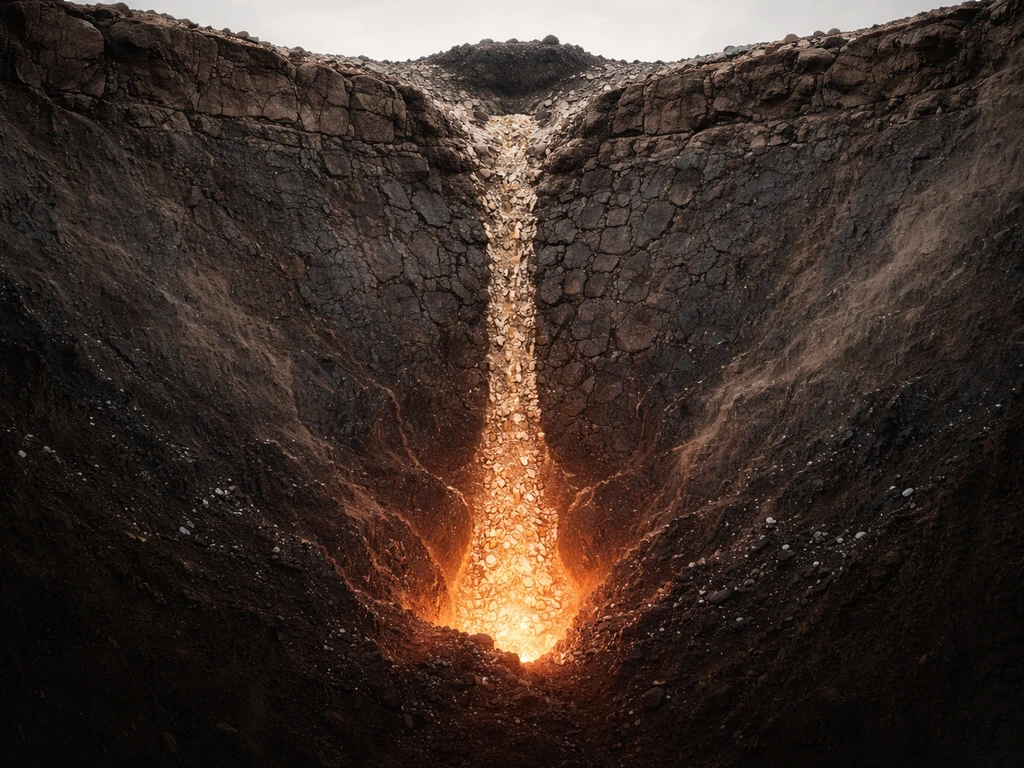
Weathering that occurs when crystals grow is called crystal-growth weathering, and it works exactly the way it sounds: crystals form inside tiny pores and cracks in rock or other materials, expand as they grow, and push outward with enough force to split the surrounding material apart. The two most common versions of this process are salt crystallization weathering and frost wedging (ice crystallization). Both are driven by the same basic physics: crystal growth in a confined space generates pressure, and if that pressure exceeds the tensile strength of the surrounding material, the material fractures.
Weathering That Occurs When Crystals Grow: How It Works

Marcus Whitmore
11 Apr 2026
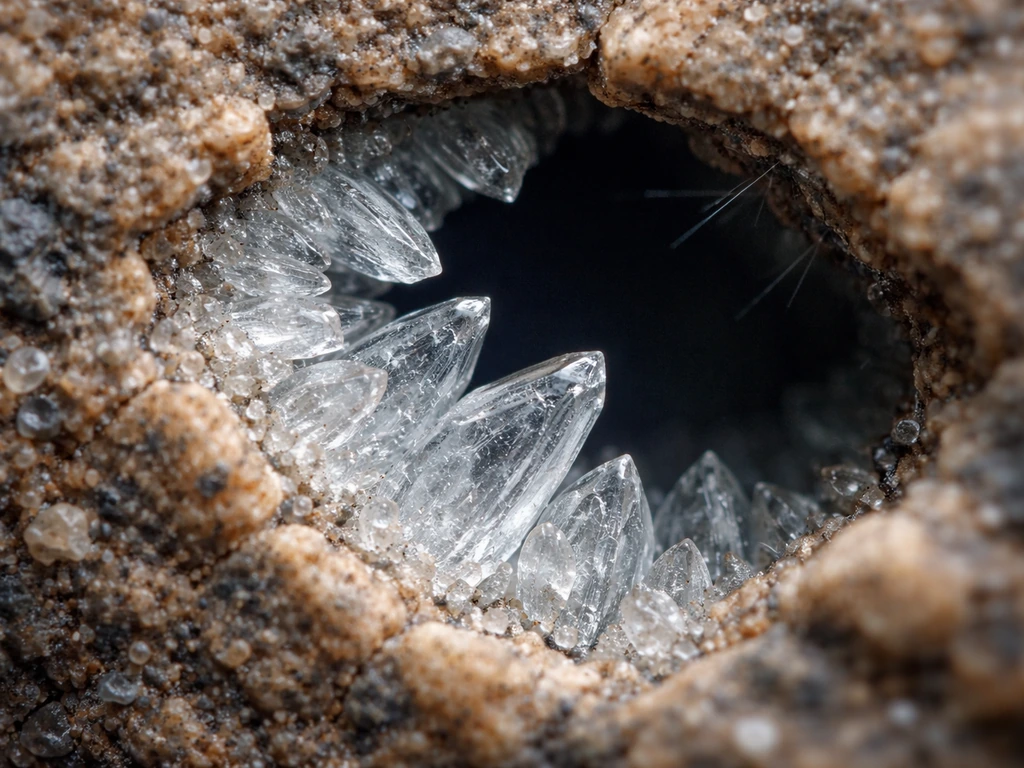
What crystal-growth weathering actually is
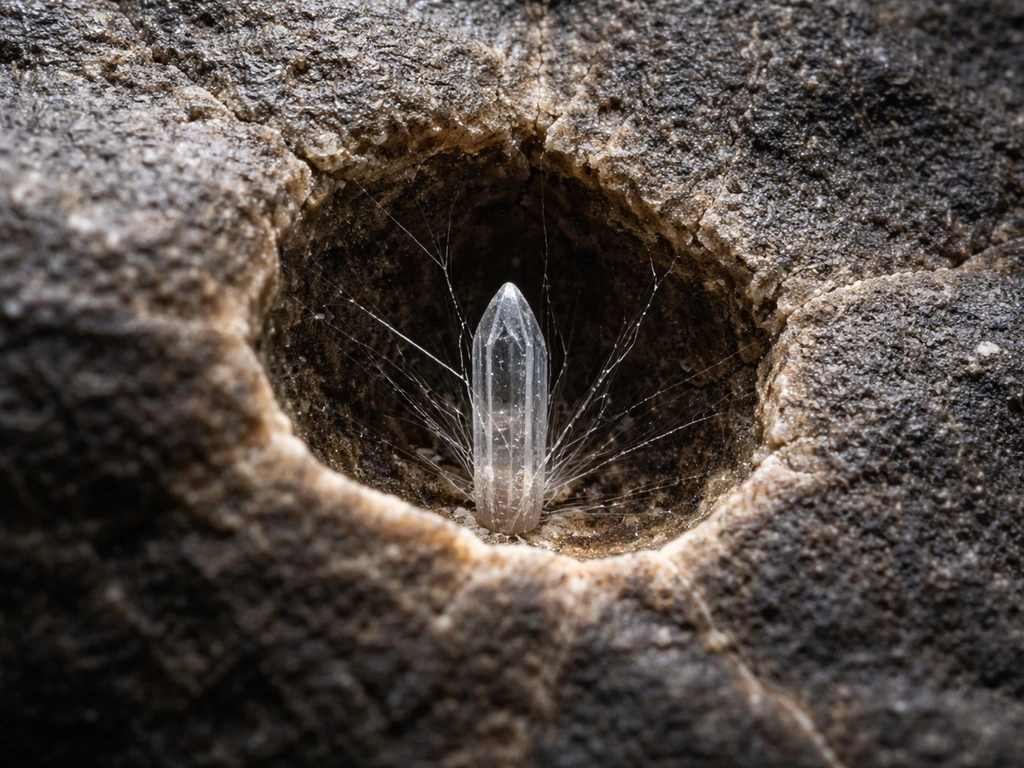
Think of a pore inside a rock as a tiny room. If you force something to grow inside that room without letting it expand outward, the walls eventually crack. That's the core mechanism. When a crystal nucleates inside a pore and continues to grow, it doesn't just sit there passively. It pushes against the pore walls, generating what materials scientists call crystallization pressure. This isn't gentle pushing either. Salt crystals under the right conditions of supersaturation can generate crystallization pressures approaching 135 MPa, which is far more than the tensile strength of most natural stone or concrete.
There's a subtlety here worth understanding: the crystal doesn't always push the wall outward. Experiments on model pores show that salt-crystal growth in confined, dead-end pores can actually generate tensile stress in the pore wall, pulling it inward and causing pore-wall collapse. So the damage pathway isn't always a clean wedge-split. It can be a more complex internal failure that only becomes visible later as surface scaling or crumbling. Understanding how crystals grow from a nucleation point outward is key to visualizing why confinement changes everything: when there's nowhere for the crystal to go, all that growth energy becomes mechanical stress on the surrounding solid.
One more concept to pin down before going further: the distinction between efflorescence and subflorescence. Efflorescence is salt that crystallizes at the surface, forming the white powdery or crusty deposits you've probably seen on brick walls or concrete sidewalks. Subflorescence is the more damaging version, where crystallization happens below the surface inside the pore network. Surface efflorescence is mostly cosmetic. Subflorescence is what actually damages materials because the crystallization pressure has nowhere to escape.
Salt crystallization weathering: where the salts come from and how they break things
Salt has to get into the rock or material from somewhere. In natural settings, the most common sources are seawater spray in coastal environments, groundwater carrying dissolved minerals, and rainwater that dissolves soluble minerals from the rock itself. In built environments, road deicers are a major source. Sodium chloride (rock salt) has historically been the dominant deicer, but the use of calcium chloride and magnesium chloride has increased significantly, and these alternatives bring their own damage pathways. Magnesium ions, for example, can react with hydrated portland cement to produce brucite and magnesium oxychloride, which is a chemical deterioration mechanism layered on top of the physical crystallization damage.
Once dissolved ions are inside the pore network, evaporation is the trigger. As water evaporates from the surface, the solution left behind becomes increasingly concentrated. When it reaches supersaturation, crystals begin to nucleate. If evaporation continues and the solution keeps flowing inward from below (replenished by capillary action or groundwater), crystallization shifts deeper into the material, creating subflorescence rather than surface efflorescence. Whether the damage ends up at the surface or inside depends on the balance between evaporation rate, fluid supply, and pore structure. For anyone curious about how new minerals grow within existing rocks, this is exactly that process playing out in real time.
Pore size matters enormously. Studies on limestone show that pores smaller than roughly 0.05 to 0.1 micrometers are particularly critical for salt-crystallization susceptibility. Micropores smaller than about 0.05 µm, and also considering ~0.1 µm, are reported as a critical influence on salt crystallization damage and susceptibility Pore size matters enormously. In these very fine pores, the crystal can't grow freely, confinement is high, and pressure builds faster. Repeated wetting-and-drying cycles make things worse because each cycle can precipitate new crystals or cause existing ones to recrystallize into larger forms that push even harder against pore walls. Over time, this shifts the pore-size distribution, decreases porosity in some zones, and eventually alters the permeability of the whole material.
Frost wedging: the ice version of the same story
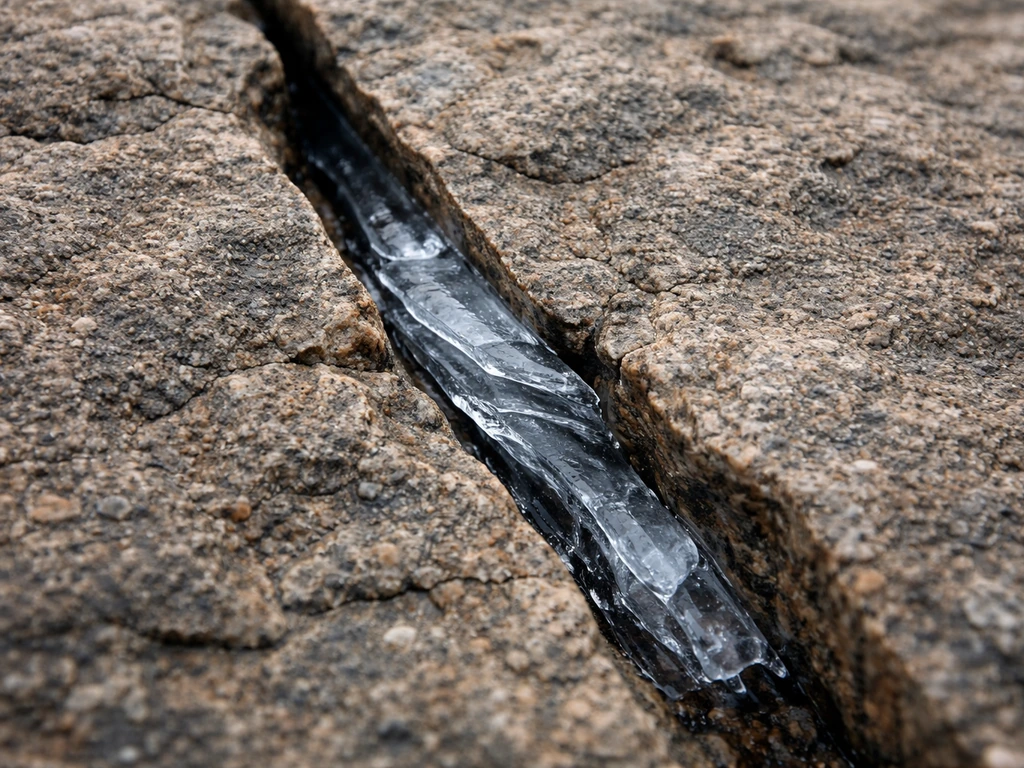
Frost wedging is crystal-growth weathering with ice as the crystal. When water in a rock's pores freezes, it expands by about 9.05% in volume. That expansion is the growth event. If the pore is already mostly full of water, that 9% has nowhere to go and it pushes outward against the pore walls. The critical threshold here is roughly 91% water saturation of capillary pores. Below that level, the expansion can be partially absorbed by the remaining air space. Above it, pressure spikes sharply and cracking becomes likely.
Ice doesn't just expand in place, either. Ice segregation and ice lensing can actively pull water toward the freezing front through a process similar to what happens in frost heave in soils. The growing ice lens pries the rock apart progressively, especially along pre-existing joints or grain boundaries. Frost wedging is most active in shallow near-surface zones where water can accumulate and freeze repeatedly, and it's especially effective in rocks with large, interconnected pores or in joints where water pools.
This is also why it's a process that builds up over many freeze-thaw cycles rather than one dramatic event, with microcracks accumulating a little more damage each time. It's worth comparing this to how rock grows over geological time, which makes clear just how different destructive versus constructive mineral processes can be.
Frost-induced stress values applied to rock matrices in experimental studies range from around 10 to 100 MPa, which covers or exceeds the tensile strength of most common rock types. For concrete and infrastructure materials, the same physics applies. The Powers critical saturation theory formalizes this: when capillary pores exceed about 91.7% water saturation, freezing expansion cannot be absorbed and damage becomes likely. This is a measurable, actionable number, not just a conceptual threshold.
Salt vs. ice: a quick side-by-side
| Feature | Salt Crystallization Weathering | Frost Wedging (Ice Crystallization) |
|---|---|---|
| Crystal material | Dissolved salts (NaCl, CaSO4, MgCl2, etc.) | Ice (frozen pore water) |
| Primary trigger | Evaporation driving supersaturation | Temperature drop below 0°C with high pore saturation |
| Key threshold | Supersaturation ratio of solution | ~91% capillary water saturation (Powers theory) |
| Pressure range | Up to ~135 MPa under high supersaturation | ~10–100 MPa applied to rock matrix |
| Ion supply needed? | Yes, dissolved ions required | No, pure water can cause damage |
| Most damaging location | Subflorescence (below surface) | Near-surface pores and existing joints |
| Typical settings | Coastal, arid, or road-salt environments | Freeze-thaw zones, alpine, seasonal climates |
| Damage pattern | Scaling, crumbling, granular disaggregation | Cracking, spalling, joint widening |
The recommendation here is simple: don't try to treat frost wedging with the same approach as salt weathering. Salt damage needs ion management and moisture control. Frost damage needs water-saturation management and sometimes air entrainment in cementitious materials. They share the same crystal-growth mechanism but require different prevention strategies.
What conditions make crystal-growth weathering worse
Not all rocks or materials are equally vulnerable. Four factors interact to determine how much damage crystal growth causes: water availability, ion supply, temperature cycling frequency, and pore structure.
- Water availability: Both salt and ice weathering require liquid water. More water, more damage. Wetting-and-drying cycles are especially destructive because each drying phase concentrates the solution and drives crystallization deeper into the material.
- Ion supply: For salt weathering specifically, a continuous supply of dissolved ions keeps the crystallization process going cycle after cycle. Coastal spray, groundwater seepage, or road deicers all provide this supply.
- Temperature cycling: Repeated freeze-thaw cycles accumulate microcrack damage even when individual events cause no visible fracture. Similarly, repeated heating and cooling drives repeated evaporation and rehydration cycles for salt crystallization.
- Pore structure and permeability: Fine pores generate higher confinement and higher crystallization pressure. High connectivity allows fluid to replenish crystallization zones. Materials with abundant fine pores and good capillary connectivity are the most vulnerable.
The combination of all four factors at once is what produces rapid, visible deterioration. A coastal seawall in a seasonal climate, exposed to saltwater spray and regular freeze-thaw cycles, is essentially experiencing both forms of crystal-growth weathering simultaneously. It's no coincidence that some of the most dramatic examples of this weathering are found in environments where moisture, dissolved minerals, and temperature swings all overlap. If you've ever wondered whether rocks grow in size over time, the answer to this connects directly to crystal growth processes that can both build and destroy rock structure depending on conditions.
How to recognize it in the field
Crystal-growth weathering leaves distinctive signatures if you know what to look for. The trick is distinguishing between surface-only deposits (mostly harmless efflorescence) and subsurface damage (subflorescence or frost cracking) that signals ongoing structural deterioration.
Salt crystallization signs
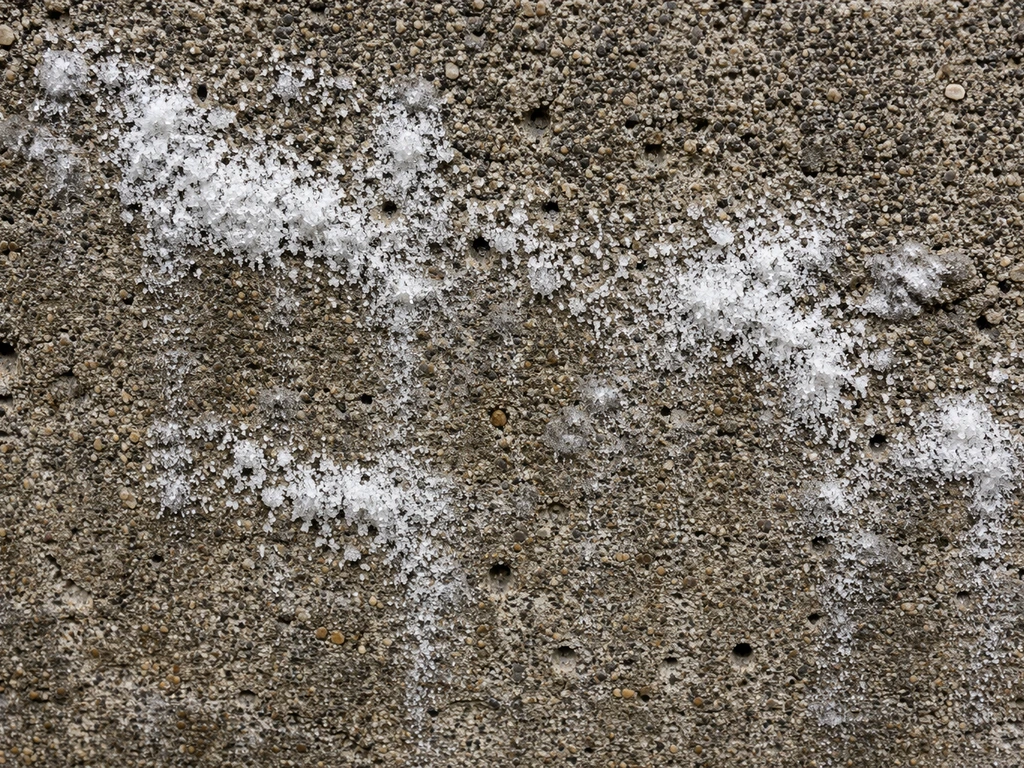
- White, powdery, or fluffy crusts on brick, stone, or concrete surfaces: classic efflorescence, mostly cosmetic but signals ion-rich water is moving through the material.
- Granular disaggregation or sandy texture on stone surfaces: grains have been pushed apart by subflorescence crystallization; the stone surface crumbles when rubbed.
- Contour scaling: thin parallel layers of stone surface spalling off like onion skin, typical of salt crystallization near the surface.
- Blistering or flaking just below the surface: the crystallization front has moved inward, pushing off the outer skin of the material.
- Recurring deposits after rain or humidity events: salt is cycling in and out of solution repeatedly, a sign of active ongoing damage.
Frost wedging signs
- Angular fragments and blocks of rock with fresh, sharp fracture surfaces: characteristic of frost splitting along joints.
- Talus piles and scree slopes at the base of cliff faces in alpine or seasonal-climate zones: accumulated frost-split debris.
- Widened joints or cracks in rock outcrops that follow pre-existing planes of weakness (bedding, foliation, existing fractures).
- Spalling or surface pitting on concrete or masonry after winter, especially in zones that hold water (step edges, horizontal surfaces, low points).
- Progressive cracking across multiple winters rather than sudden failure: microcrack accumulation is the pattern, not single-event fracture.
The setting gives you a lot of context. Salt weathering dominates in coastal cliffs, arid evaporative environments, and along roads treated with deicers. Frost wedging is the main player in alpine zones, seasonally cold climates, and in freeze-thaw transition zones. Overlap zones, like a northern coastal city that salts its roads in winter, show both simultaneously. The fact that quartz crystals grow through similar pore-filling mechanisms in hydrothermal settings is a useful reminder that crystal growth in confined spaces is a universal geological process, constructive in some contexts and destructive in others.
Simple demos and safe observation ideas
You don't need a lab to observe crystal-growth weathering at work. Here are a few low-risk setups that make the mechanism visible and tangible, whether you're a student, educator, or just curious.
Salt crystallization demo
- Dissolve table salt (NaCl) in warm water to make a saturated solution (roughly 36 g per 100 mL of water at room temperature).
- Soak a small piece of porous material, like a broken brick, terracotta pot fragment, or soft sandstone, in the solution for 30 minutes.
- Remove the piece and let it dry slowly at room temperature. Watch for white crystalline deposits forming at the surface (efflorescence).
- Repeat the soak-and-dry cycle 5 to 10 times. After multiple cycles, look for surface granular disaggregation, flaking, or pitting. This mirrors what repeated wet-dry cycles do to stone over seasons.
- For comparison, keep one soaked piece in a humid environment so it dries more slowly. The slower-drying piece often shows more subflorescence damage because crystallization migrates deeper into the pore network.
This setup directly illustrates the key finding from crystallization pressure research: damage is tied to cycling that precipitates crystals within pores rather than only at the surface. The visual difference between the two drying conditions is usually striking after 5 to 8 cycles. It's essentially the same chemistry behind why Play-Doh grows crystals when left to dry, just applied to stone instead of modeling clay.
Frost wedging demo
- Saturate a small piece of porous brick or soft sandstone by submerging it in water for 1 to 2 hours. Record its weight to track water uptake.
- Aim for saturation above the critical threshold by ensuring the pore spaces are as full as possible. Target saturation above 90% of the pore volume if you can estimate porosity from the weight difference.
- Seal the saturated sample loosely in a plastic bag (to prevent freezer-drying) and place it in a home freezer overnight.
- Thaw at room temperature for several hours, then re-freeze. Repeat for 10 to 20 cycles.
- After multiple cycles, inspect the surface for new cracking, spalling, or disaggregation. Compare to a control sample that was only partially saturated (below 80%) before freezing.
The comparison between high-saturation and low-saturation samples is the key variable here. The 91% threshold means a half-saturated sample may show almost no damage while a nearly full sample cracks visibly. That's the Powers critical saturation theory made tangible.
How to prevent or reduce the damage
Prevention comes down to breaking the conditions that enable crystal growth in the first place. Depending on your situation, that means managing water, managing ions, or managing both.
For natural stone and masonry structures
- Reduce water ingress with water-repellent treatments or consolidants, but choose materials carefully. A treatment that blocks surface pores without addressing subsurface moisture can trap ions inside and worsen subflorescence damage.
- Improve drainage so water doesn't pool against stone surfaces. Horizontal surfaces and joints that hold standing water are the highest-risk zones.
- Avoid repeated application of salt-based deicers directly onto stone steps, pavements, or masonry walls. Even a few seasons of heavy sodium chloride application can load a stone's pore network with enough ions to drive ongoing crystallization damage.
- If deicers must be used, consider alternatives to magnesium chloride, which can react chemically with cement-based materials beyond just physical crystallization effects.
- For heritage or historic stone, consult a conservator before applying any consolidant or water repellent. The interaction between treatment and pore structure is material-specific.
For concrete and infrastructure
- Use air-entrained concrete in freeze-thaw environments. Entrained air voids give ice the space it needs to expand without cracking the paste matrix.
- Keep concrete pores below the critical 91.7% water saturation threshold during freezing events. This means good drainage design and avoiding conditions where water ponds on or against concrete.
- Limit chloride loading from deicers. Chloride ions don't just cause crystallization pressure; they also diffuse into reinforced concrete and initiate steel corrosion, creating a compound damage pathway.
- Recognize that different deicers have different damage profiles. Calcium chloride and magnesium chloride can cause measurable concrete damage at lower concentrations than sodium chloride, and magnesium chloride poses additional chemical attack risks to cement paste.
- For existing structures showing scaling or cracking, address the moisture source first. Resurfacing without fixing drainage just delays the next damage cycle.
The underlying logic in all of these recommendations is the same: crystal growth needs both a growth medium (water or supersaturated solution) and confinement (pores). Remove either ingredient and you break the damage cycle. The question of how diamonds grow under extreme pressure and temperature is a reminder that crystal growth under confinement is among the most powerful mechanical forces in nature. The same physics that builds the hardest material on Earth also dismantles bridges and cliff faces when the conditions are right.
Putting it all together
Crystal-growth weathering is one of those mechanisms that seems almost too simple on the surface but turns out to have remarkable depth once you start asking where the pressure actually comes from and why some materials fail while others in the same environment don't. The short version: crystals growing in confined pores push harder than most natural materials can resist, especially under repeated cycling. Salt and ice are the two main culprits, they operate through the same basic physics, but they respond to different triggers and call for different solutions.
If you're a student trying to understand the mechanism, the key terms to remember are crystallization pressure, efflorescence versus subflorescence, critical saturation, and supersaturation. If you're an educator designing a demo, the salt-cycling brick experiment is reliable, safe, and visually convincing. If you're a homeowner or engineer dealing with real damage, start with water: where is it getting in, where is it evaporating, and what ions is it carrying? Answering those three questions will point you toward the right mitigation every time.
FAQ
How can I tell whether I am seeing harmless efflorescence or active subflorescence damage?
Look for where the cracking and material loss are. Surface efflorescence often wipes off with little underlying damage, while subflorescence usually comes with internal scaling, spalling, or a loss of cohesion beneath the surface (often after repeated wet-dry or freeze-thaw cycles).
Why do salt-crystallization problems sometimes worsen even if I clean the white powder from the surface?
Cleaning removes the deposit, not the dissolved ions trapped inside the pore network. As water re-enters and evaporates again, supersaturation is reached anew and crystals can re-form deeper, continuing the internal pressure cycle.
Is the 91% or 91.7% water saturation threshold a hard rule for frost wedging?
It is a practical tipping point for many capillary pore systems, but real rocks and concretes vary in pore size distribution, connectivity, and thermal history. If pores are poorly connected or air is present, damage can shift or require more freeze-thaw cycles to become obvious.
Does frost wedging require freezing air temperatures only, or can it happen when the air stays above freezing?
It can happen with freezing at the pore scale. Capillary water can cool below 0 C in shaded or ventilated areas, and freezing can occur where heat is lost faster than the bulk air warms, especially in joints, cracks, and near-surface zones.
What’s the main practical difference in prevention between salt weathering and frost wedging?
Salt damage prevention focuses on limiting ion ingress and controlling moisture so supersaturation does not occur in pores. Frost damage prevention focuses on limiting water saturation during cold periods and, for cementitious materials, using measures like air entrainment to provide pressure-relief pathways.
Can deicer choice affect damage beyond just “more or less salt”?
Yes. Chlorides and other salts vary in how readily they dissolve, how they transport through pores, and whether they contribute to additional chemical deterioration (for example, magnesium-related reactions with hydrated cement). So two sidewalks in the same climate can deteriorate differently.
Why do repeated wetting-and-drying cycles cause more harm than a single event?
Each cycle can dissolve ions or move them deeper, then recrystallize during drying. That can create new crystals, change crystal habit, and progressively alter pore-size distribution and permeability, making future cycles more damaging than the first.
Do smaller pores always mean faster weathering?
Not always faster in every case, but very fine pores (on the order of 0.05 to 0.1 micrometers) are often critical because confinement increases crystallization pressure. The outcome also depends on whether there is sufficient fluid supply and whether pores can redistribute stress or allow pressure relief.
What field measurements are most useful if I’m troubleshooting crystal-growth damage on a structure?
Start by mapping moisture sources and flow paths (leaks, capillary rise, condensation zones), then check for salt sources (road splash, seawater spray, soil contamination). Moisture content timing, such as whether pores stay near high saturation during cold nights, is often more informative than a one-time observation.
Will sealing a surface stop crystal-growth weathering?
Sometimes, but not reliably. If a seal reduces evaporation but still allows moisture to enter and cannot release trapped salts, pressure can build behind the barrier. The best approach is usually targeted moisture management (prevent ingress and provide a path for drying), not a generic impermeable coating.
Why can salt crystallization damage show up as delayed surface failure?
Internal cracking and pore-wall collapse can occur before there is much visible exterior change. Surface scaling or crumbling often appears after repeated cycles, when enough internal damage has reduced cohesion and the outer layer can no longer hold together.
Next Article
How Do Diamonds Grow: Conditions, Processes, and Limits
Explains how diamonds form and evolve: depth and P–T conditions, carbon sources, growth limits, and where they reach the