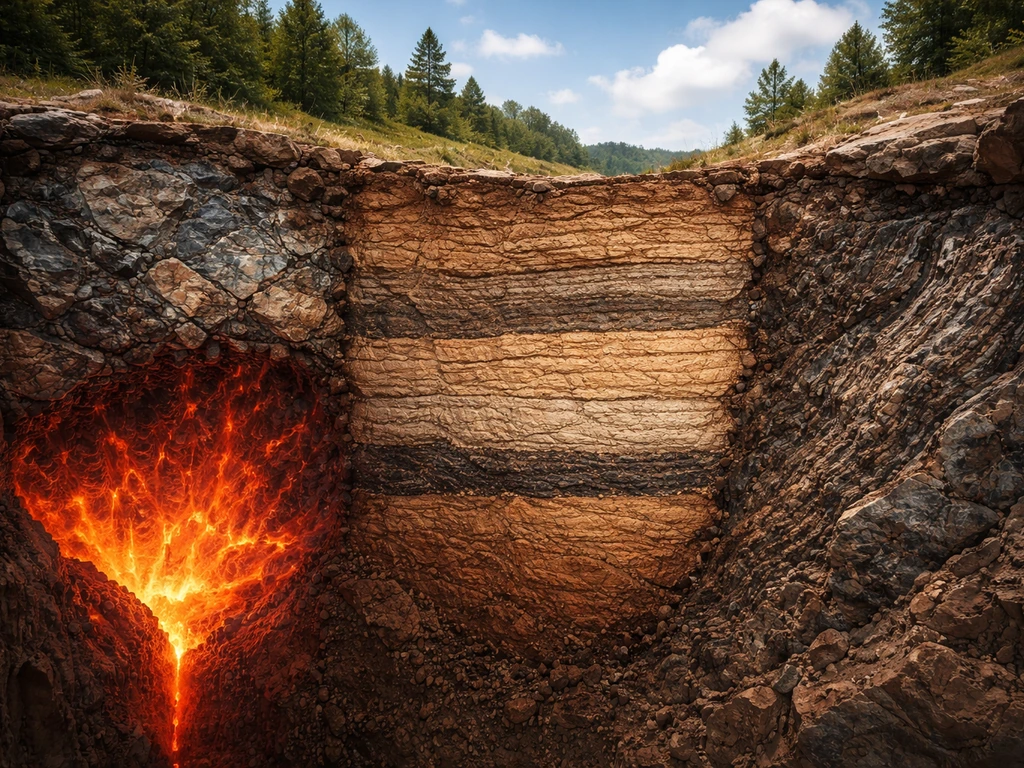
Diamonds don't grow like plants or animals do. There's no metabolism, no cell division, no biological clock ticking away. But they do form, and that formation process is so structured and sequential that geologists absolutely use the word "growth" to describe it. Understanding how diamonds grow means understanding how individual carbon atoms stack themselves into one of the hardest, most stable crystal structures on Earth, under conditions so extreme that most of us will never experience anything remotely close to them.
How Do Diamonds Grow: Conditions, Processes, and Limits

Marcus Whitmore
6 Apr 2026
Do diamonds actually grow (or only form)?
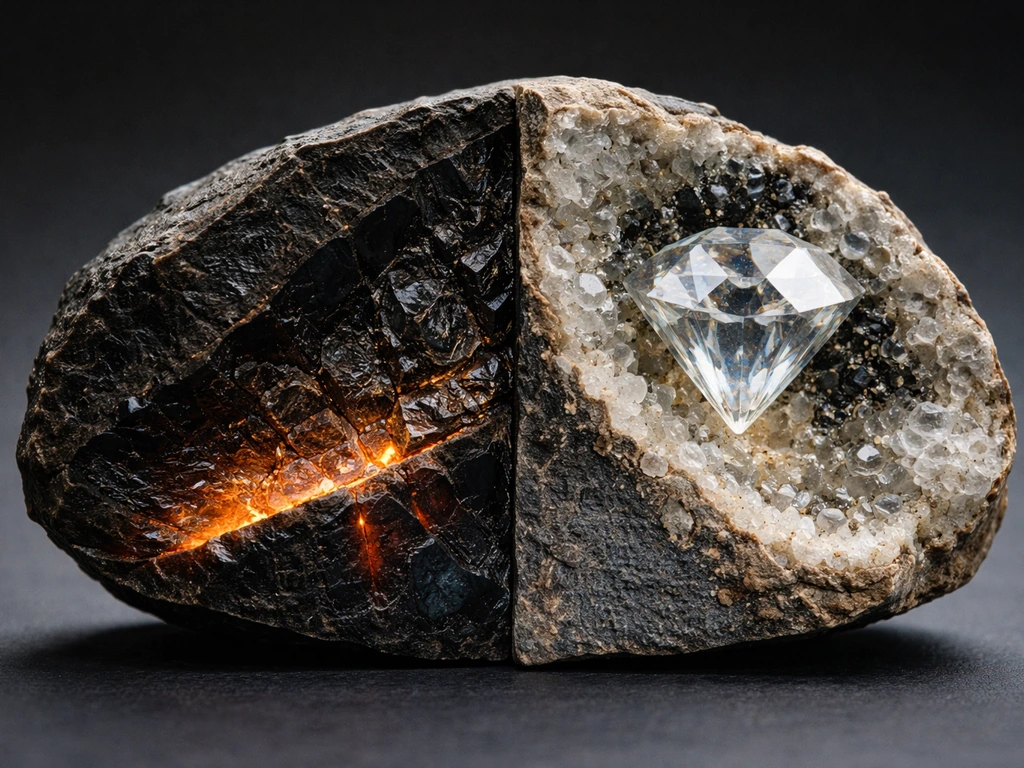
This is a fair question to ask, and the honest answer is: both, depending on how you use the word. Diamonds don't grow in the biological sense. Nothing alive is doing the work. But in mineralogy and geology, "diamond growth" is a precise technical term describing how carbon atoms attach to an existing crystal face over time, building up layers in a measurable, directional way. Geologists can actually read growth records preserved inside diamonds, including zones of different nitrogen content that reveal how the crystal built itself in stages over millions, sometimes billions, of years.
That's a key point worth sitting with. A single diamond can record multiple growth episodes. The core might have formed under one set of mantle conditions, then sat dormant, then added an outer rim when conditions changed again. Scientists reconstruct this history using FTIR spectroscopy to measure nitrogen aggregation states, essentially using the crystal's own chemistry as a thermometer-clock. So while diamonds aren't alive, they do have a growth history that's just as layered and complex as tree rings.
Where diamonds grow
Diamonds form in the Earth's mantle, not in the crust where we live, mine, and do most things. The specific zone is roughly 150 to 230 kilometers below the surface, deep beneath ancient, thick continental cores called cratons. These cratons matter enormously: their thick lithospheric roots, sometimes extending down to around 230 km as documented at Siberia's Udachnaya kimberlite, keep the pressure and temperature in just the right range for diamond to be the stable form of carbon rather than graphite.
If the lithospheric root is too thin, the geothermal gradient pushes temperatures too high relative to pressure, and graphite wins instead of diamond. Research on African cratons confirms that a lithospheric thickness of at least roughly 150 km is the minimum threshold for diamond stability. This is why diamonds aren't found just anywhere. They're tied to the world's oldest, most stable continental platforms, places like the Kaapvaal Craton in southern Africa, the Siberian Craton, and the Slave Craton in Canada.
For a broader look at how mineral structures form inside existing rock formations, how new minerals grow within existing rocks covers the pressure and chemistry involved in mineral crystallization within the lithosphere, which shares a lot of conceptual ground with what happens during diamond formation.
How diamond formation works
Carbon sources
Carbon has to come from somewhere, and it turns out there are at least two major sources feeding diamond formation. Some diamonds grow from carbon that has always been in the mantle, primordial stuff that never saw the surface of the Earth. Others form from recycled carbon: organic material and carbonate rocks that were dragged down into the mantle via subduction, the process where one tectonic plate slides under another.
Stable isotope analysis, specifically measurements of carbon-13 to carbon-12 ratios (written as δ13C), can distinguish between these two carbon pools, which is how geologists know both pathways exist. Diamonds from the Juina-5 locality in Brazil, for example, carry isotope signatures and mineral inclusions that point clearly to recycled crustal material being involved in their formation.
The pressure-temperature recipe

Once carbon is in the right part of the mantle, it needs the right pressure and temperature to crystallize as diamond rather than graphite. Experimental work gives us a concrete sense of what that means: conditions around 7.7 GPa and 1600°C have been shown to drive diamond formation from supercritical C-O-H fluids in the lab. Temperatures above roughly 1300°C appear to be required for the process to work efficiently. To put 7.7 GPa in perspective, that's about 76,000 times normal atmospheric pressure. You're not recreating this in a kitchen.
The chemical mechanism often involves a redox reaction: oxidized carbon (like CO2 or carbonate) reacts with reduced species (like methane or hydrogen) under these extreme conditions, and diamond crystallizes out of the resulting fluid or melt. C-O-H fluids act almost like a delivery system, carrying dissolved carbon to sites where it can precipitate as diamond. This is similar in principle to how dissolved minerals precipitate from water to form other crystal types, which you can see explained in detail when looking at how crystals grow more generally.
Crystal growth at the atomic level
Here's where "growth" becomes the exactly right word. Once a tiny diamond nucleus forms, it grows by a process called facet-controlled step-flow growth. Think of it like laying bricks on a wall, but at the atomic scale. Carbon atoms attach to specific crystal faces, mainly the {111} and {100} faces in diamond's cubic structure. These faces don't grow by randomly accepting atoms from all directions. Instead, growth steps advance across the face, layer by layer, controlled by surface energy and the kinetics of how quickly atoms arrive and lock in.
The transition from graphite to diamond isn't automatic even when conditions are right. It requires nucleation, a starting point where the first small cluster of diamond-bonded carbon atoms forms. Both the nucleation and the subsequent growth stages have energy barriers that must be overcome, which is part of why diamond formation takes geological time scales rather than happening instantly whenever the pressure and temperature are correct. This is very much the same nucleation-and-growth framework described when explaining how quartz crystals grow, even though quartz forms under very different conditions.
Nitrogen plays a fascinating supporting role here. Most natural diamonds contain nitrogen as their dominant impurity, incorporated during growth. As a diamond sits in the hot mantle over time, nitrogen atoms rearrange from simpler configurations (A-centers) into more complex ones (B-centers). The ratio of these states tells scientists how long the diamond spent at what temperature, essentially a built-in growth and residence log. Studies of nitrogen aggregation and the formation of A centers in diamonds show that growth and formation temperature changes the kinetics by which A centers convert to more aggregated states, supporting this temperature-and-time indicator role how long the diamond spent at what temperature. This is the geo-thermometer behavior that makes diamond nitrogen chemistry so scientifically valuable.
What stops diamonds from growing forever
This connects directly to one of the recurring themes on this site: growth always has limits. For diamonds, several constraints work together to cap how large any individual crystal can get.
- Carbon supply: Diamond growth depends on a steady supply of dissolved carbon in the surrounding fluid or melt. Once local carbon is used up or conditions shift, growth stalls.
- Time in the stability field: A diamond only grows while it sits inside the pressure-temperature window where diamond is stable. Any shift in geothermal conditions can end growth or trigger the reverse process.
- Resorption: Diamonds don't just grow, they can also dissolve. When volatile-rich fluids pass through the mantle (a process called metasomatism), they can partially dissolve existing diamond crystals. Experimental modeling shows measurable weight loss can occur over relatively short geological timescales under the right conditions. A diamond might grow a rim, then lose part of it, then grow again.
- Episodic vs. continuous growth: Most natural diamonds show evidence of growth in stages, not as one uninterrupted process. Core and rim regions often record completely different temperature-time histories, implying growth pauses that could last millions of years.
This stop-and-start, grow-and-dissolve pattern is actually common in geological systems. If you're curious how similar constraints apply to rocks more broadly, the question of whether rocks grow in size covers the physical and chemical limits that cap mineral and rock expansion in ways that parallel what happens to diamonds.
How diamonds reach the surface
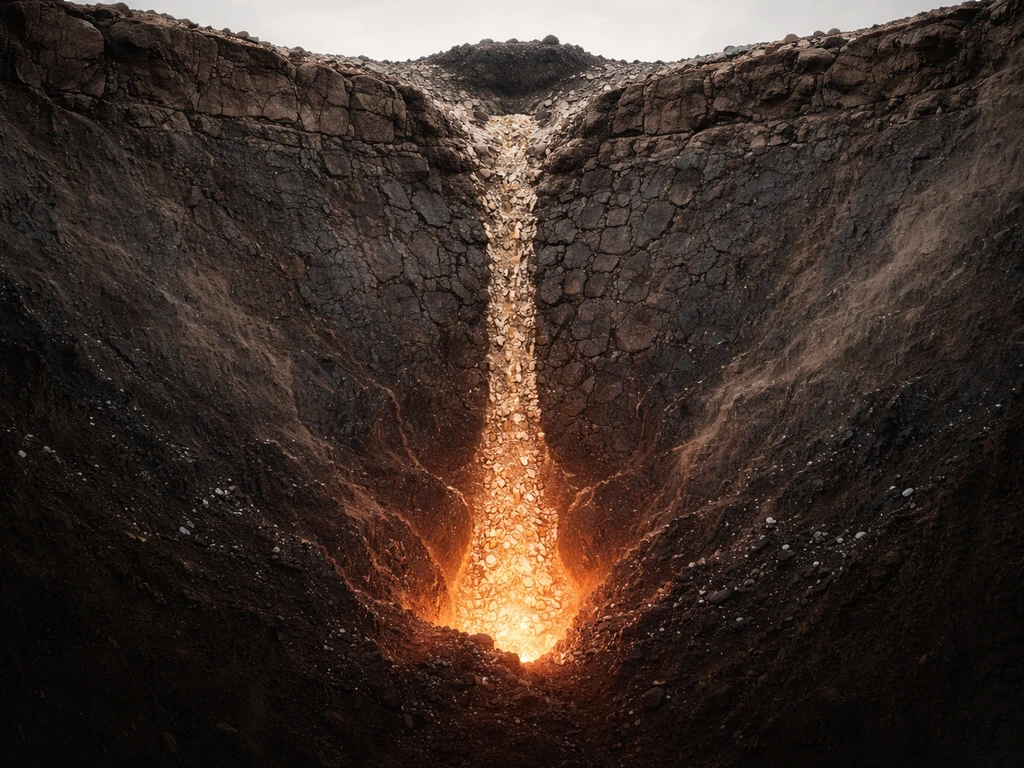
Diamonds can't walk themselves up 200 kilometers of mantle rock. They need a ride, and that ride comes in the form of kimberlite or lamproite eruptions. These are unusual volcanic events where magma originates at depths within or below the diamond stability field, picks up rock fragments (xenoliths) along the way, and races toward the surface. The key word is races: kimberlite magmas are thought to ascend extraordinarily quickly, possibly at meters per second in the final stages, because slow ascent would allow the diamonds to convert to graphite as pressure dropped.
The resulting structures are called diatremes, carrot-shaped pipes that taper from a broad surface crater down to a narrow root at depth. The rapid ascent and the volatile content of kimberlitic magma both help preserve the diamonds by limiting the time they spend at conditions where graphite would be more stable. Research on ascent rate modeling confirms that both speed and volatile content are critical variables for diamond survival. Diamonds that don't make it, or that experience slower or more oxidizing conditions, can partially or fully convert to graphite before reaching the surface.
The broader concept of how crystals are affected by changing physical conditions during transport connects naturally to weathering that occurs when crystals grow, which looks at how environmental changes alter crystal integrity over time.
Diamond vs. graphite: same element, very different outcomes
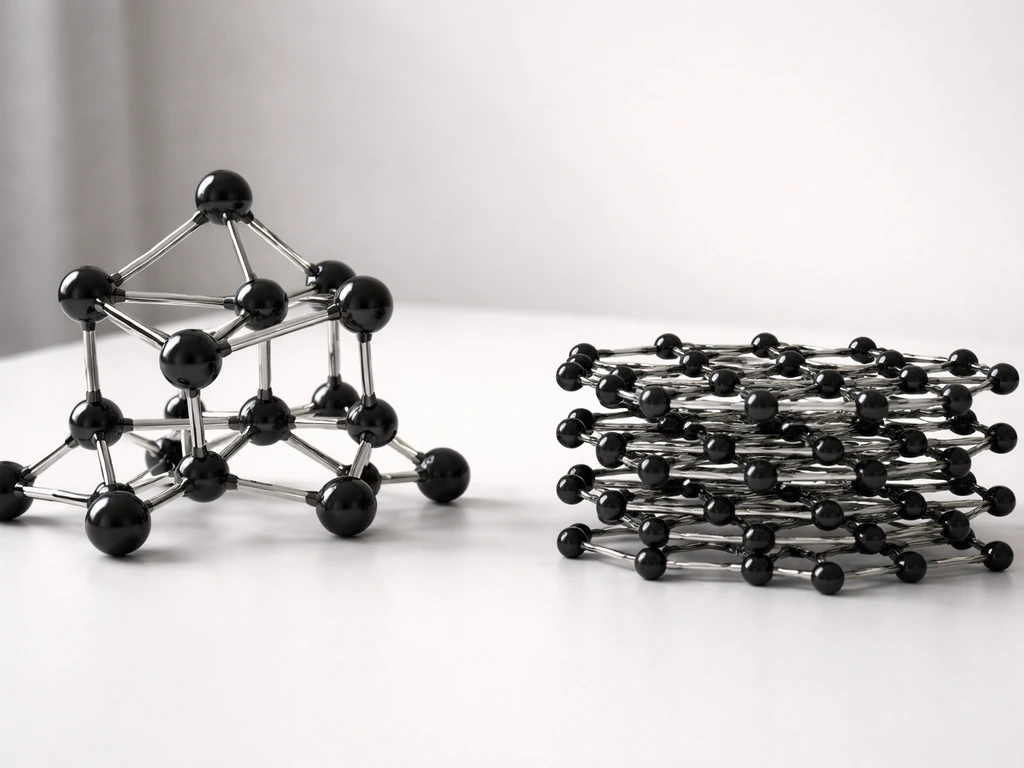
It's worth pausing to appreciate just how much conditions matter. Diamond and graphite are both pure carbon. The only difference is how the atoms are arranged, and that arrangement is entirely controlled by pressure and temperature. Under the extreme conditions of the deep lithospheric mantle, carbon atoms bond into a rigid three-dimensional tetrahedral lattice: diamond. At surface conditions, carbon relaxes into flat sheets with weaker bonds between them: graphite. The same element, completely different properties, entirely because of where and how it formed.
| Property | Diamond | Graphite |
|---|---|---|
| Carbon bonding | 3D tetrahedral (sp3) | 2D layered sheets (sp2) |
| Formation depth | ~150–230 km | Surface to shallow crust |
| Pressure required | ~4.5–7+ GPa | Stable at surface pressure |
| Hardness | Hardest natural mineral (10 on Mohs) | Very soft (1–2 on Mohs) |
| Stability at surface | Metastable (very slowly converts) | Thermodynamically stable |
| Color/appearance | Transparent, brilliant | Opaque, gray-black, greasy |
What to look for if you want to find diamonds geologically
You're unlikely to stumble across a diamond kimberlite pipe on a weekend hike, but geologists do have practical tools for finding them. The most reliable approach is tracking indicator minerals: specific minerals that form in the same deep mantle environment as diamonds and get carried up in kimberlite pipes alongside them. The key ones are blank" rel="noopener noreferrer">pyrope garnet (often with a distinctive orange-red color called "G10" compositions), chrome diopside (a bright green pyroxene), chromite, and ilmenite. When you find these minerals scattered in stream sediments or glacial tills, you follow them upstream to their source. That source is often a kimberlite pipe.
This indicator mineral approach is the standard first step in diamond exploration globally, and it works because these minerals are chemically and physically durable enough to survive long transport from the pipe to wherever they're eventually sampled. Understanding the geological context also means knowing how kimberlites relate to ancient craton cores, which connects back to the deep question of how rock grows and evolves over geological time.
Where to go next if you want to learn more
If the crystal growth mechanics here sparked your curiosity, the most natural next step is building a stronger foundation in how crystallization works across different minerals. The principles of nucleation, step-flow growth, and the role of dissolved species in feeding crystal expansion apply far beyond diamonds.
For a more approachable entry point, consider looking at systems where you can actually watch crystal growth happen at accessible scales. For instance, why Play-Doh grows crystals might sound unexpected, but it illustrates the same nucleation and precipitation principles operating at room temperature, making the abstract mechanics much easier to picture before scaling up to mantle pressures.
For deeper reading, the Reviews in Mineralogy and Geochemistry volume on diamonds (RiMG 088) is the most thorough scientific synthesis available, covering growth zoning, nitrogen aggregation geo-thermometry, carbon isotope systematics, and mantle geodynamics in detail. The GIA's geological research publications are more accessible and cover indicator mineral exploration and modern diamond geology at a level that doesn't require a graduate degree. Mineralogy education resources from organizations like the Minerals Education Coalition provide solid foundational context for how diamonds fit into the broader picture of Earth's carbon cycle and volcanic systems.
The core takeaway is this: diamonds grow in the true crystal-growth sense of the word, building atom by atom under conditions that are almost impossible to imagine at the surface, preserved by geological luck, and delivered to us by some of the most violent volcanic events the Earth produces. There's no biology involved, but the growth story is just as intricate, just as constrained by environment, and just as dependent on the right conditions being maintained over time. That's a theme that runs through growth at every scale, from a single cell dividing to a diamond forming 200 kilometers underground.
FAQ
Do diamonds “grow” continuously in the mantle, or do they form in bursts?
They usually grow in stages. Many diamonds show growth zoning, which indicates periods of active carbon addition followed by changes in conditions, then more overgrowth later. A single crystal can record multiple episodes with different nitrogen chemistry, so the process is not steady-state for the entire lifetime of the diamond.
What stops a diamond from growing forever once conditions are right?
Several things can end or slow growth even if pressure and temperature stay within the diamond stability field: carbon supply may run low at the growth site, growth can be kinetically limited by how fast atoms and step-advancing steps can be supplied, and later transport or chemical changes can cause dissolution or graphite conversion at the margins.
Is graphite always present when diamond forms, or can diamond form without any graphite?
Graphite can appear when conditions shift, but diamond formation does not require bulk graphite to be present as a starting material. Instead, what matters is whether the local redox environment and fluid chemistry drive carbon toward diamond stability. If oxygen or temperature-pressure conditions drift the wrong way during transport, graphite can form from the same carbon system.
How do nitrogen and its A-centers to B-centers transformation affect what geologists can learn?
Nitrogen aggregation acts like a time and temperature recorder because the conversion rate depends on how hot the diamond was during its residence. By combining nitrogen aggregation state data with other constraints, scientists can estimate the diamond’s thermal history, not just where it formed.
Why are some diamonds larger than others even if they share similar formation settings?
Size depends on how long a diamond nucleus remains in a growth-friendly environment and how much carbon-rich fluid or melt is available to feed step-flow growth. Differences in ascent and residence times, fluid chemistry, and local kinetics of attachment to the {111} and {100} faces can all produce major size variation.
Can a diamond lose growth, for example shrinking or converting back into graphite?
Yes. If a diamond spends too long during pressure drop or if the surrounding fluids become more oxidizing, carbon can re-equilibrate toward graphite, at least partially. This can produce surface resorption features or partial conversion before the diamond reaches the surface.
Does rapid ascent always preserve diamonds, or can diamonds survive even with slower transport?
Rapid ascent greatly improves survival, but survival is not solely about speed. Volatile content and oxidation state of the magma also matter because they affect how quickly and in what chemical conditions the diamond experiences decreasing pressure and changing redox conditions. Faster transport helps, but composition can partially compensate, or exacerbate, outcomes.
What “indicator minerals” actually tell you about diamond potential?
They signal that a sampled rock history included deep-mantle processes capable of producing or carrying diamond-forming material. For example, certain garnet compositions (like G10 pyrope), chrome diopside, chromite, and ilmenite are durable enough to travel in kimberlites and help narrow the search upstream. They do not guarantee diamonds, but they make the source environment far more relevant.
Why do indicator minerals appear in stream sediments even though diamonds might be deeper?
Kimberlite and related volcanic material can break apart during erosion, releasing indicator minerals and other dense grains that resist weathering. These minerals travel as sediments and accumulate in stream beds or glacial tills, acting as a practical “trail” back to the pipe.
Is it possible to grow diamonds in a lab by replicating mantle conditions, and how does that relate to “growth”?
Lab synthesis focuses on creating the thermodynamic and kinetic environment for nucleation and step-like growth, but it typically uses high-pressure and high-temperature techniques and controlled carbon feedstocks rather than “growing” from an existing diamond in the same natural way. The key connection to natural growth is that nucleation barriers and carbon delivery rates still govern how diamonds form.
Next Article
How Does Rock Grow? Mechanisms, Limits, and Evidence
Explains how rocks gain mass via mineral crystallization, sediment buildup, and metamorphism, plus weathering limits and