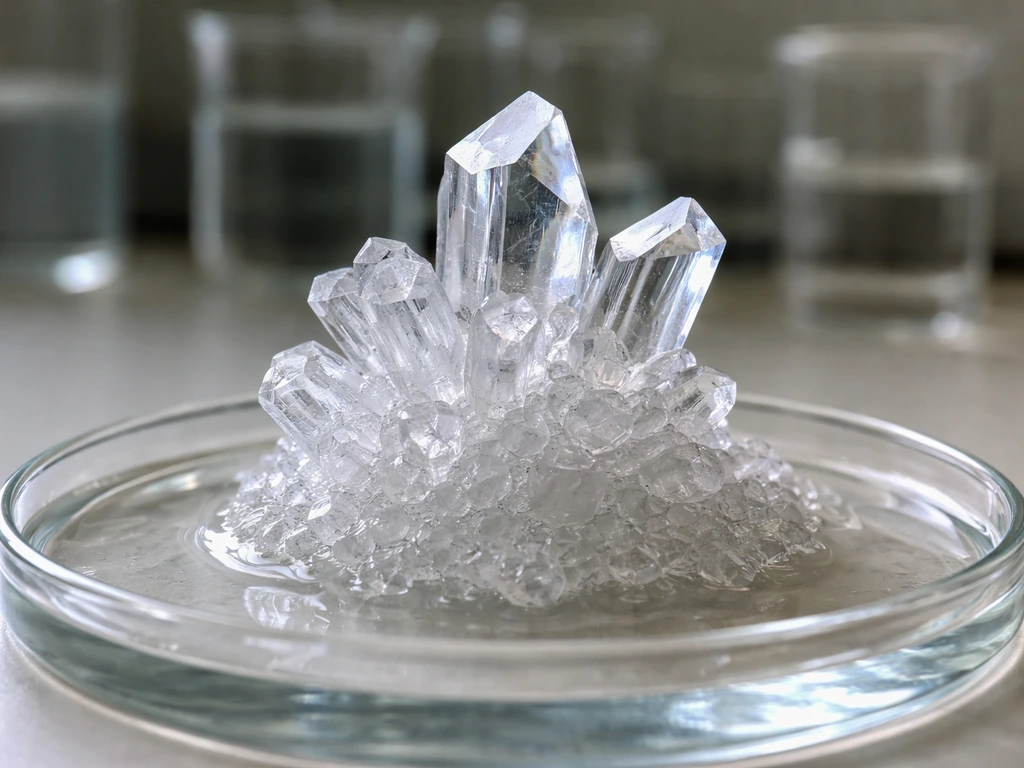
Crystals don't have a single fixed maximum size. How big they get depends almost entirely on conditions: how much dissolved material is available, how long those conditions stay favorable, how well you control nucleation, and how efficiently dissolved solute can reach the growing surface. At home, a well-managed alum or sugar crystal can reach several centimeters in a few weeks. In a dedicated lab, single crystals can grow to decimeters. In geological settings with millions of years and the right chemistry, crystals have reached over 18 meters long. The real question isn't "what's the maximum?" but "what's limiting mine?"
How Big Can Crystals Grow? Limits, Methods, and Tips

Marcus Whitmore
3 Jun 2026
Crystal growth basics: what "size" depends on
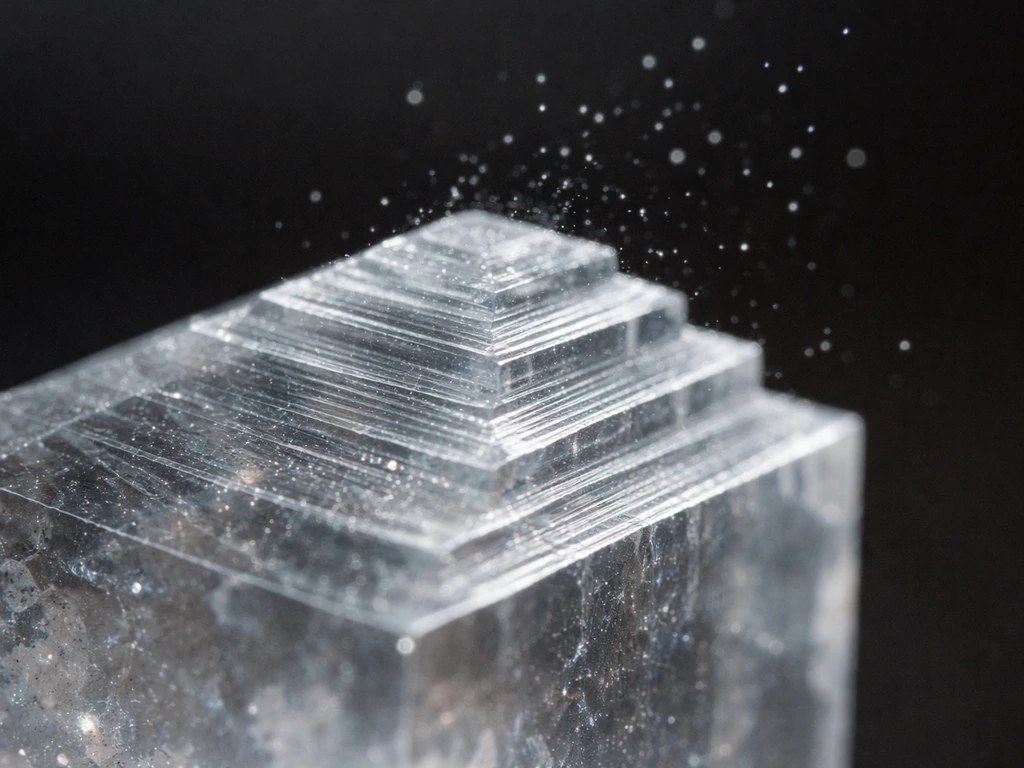
A crystal grows by adding dissolved molecules or ions from solution onto an ordered lattice surface. Every new layer that forms has to match the existing structure exactly, which is why crystals grow so slowly compared to, say, a bacterial colony. The driving force behind all of this is supersaturation: the solution has more dissolved material than it can stably hold at current conditions, so solute "wants" to come out of solution and deposit onto a solid surface.
Supersaturation is usually expressed as a ratio S = C/C, where C is the actual concentration of dissolved solute and C is the equilibrium solubility at that temperature. When S is greater than 1, you have a driving force for crystallization. When S equals 1, growth stops. It's that simple in principle. The tricky part is that as your crystal grows, it consumes solute, which pulls C down toward C* and slows growth. If you don't replenish the driving force (by further cooling, evaporating more solvent, or topping up the solution), the crystal effectively starves itself.
Size is therefore set by three interacting things: how much total dissolved material you started with, how efficiently that material reaches the growing crystal surface (transport), and how long favorable conditions last before the system hits equilibrium or something goes wrong.
Real-world factors that limit crystal size
Even with unlimited time and solution, crystals don't grow forever. Several hard physical limits kick in as size increases.
Diffusion becomes the bottleneck
As a crystal gets larger, solute near the surface gets depleted faster than it can be replenished from the bulk solution. The time it takes a molecule to diffuse across a depletion zone scales with the square of the distance (proportional to R², where R is the crystal radius). So a crystal twice the size takes four times as long to receive fresh solute. Growth slows dramatically as size increases under diffusion-limited conditions, essentially putting a soft speed limit on how fast a large crystal can grow. This is sometimes called the "diffusion-to-capture" limit.
Available solute runs out
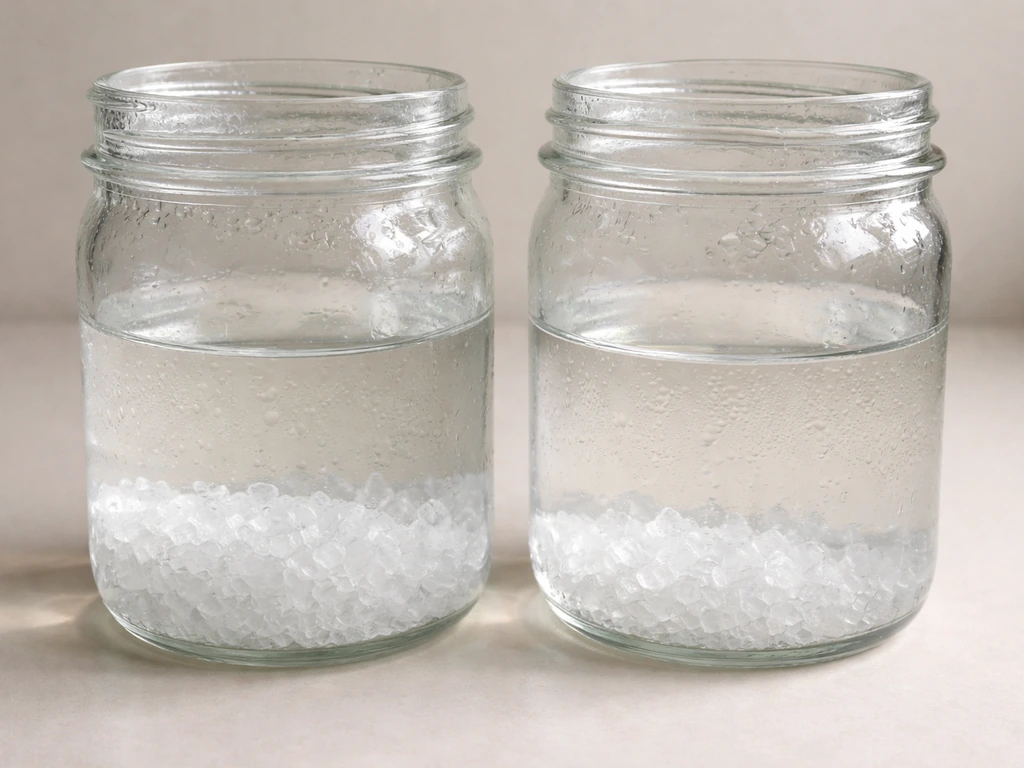
Every gram of crystal came from dissolved solute. If you start with 100 mL of saturated alum solution, there's a finite ceiling on total crystal mass. Once the solution approaches equilibrium solubility, growth stops regardless of how perfect your setup is. This is why industrial crystallizers are designed to continuously replenish solute, and why your home experiment plateaus after a week or two.
Impurities and defects
Real solutions contain trace contaminants. Impurities can adsorb onto crystal faces and block further growth on that face, sometimes completely. If you’re curious why do crystals grow on charcoal in particular, the same ideas about supersaturation, nucleation, and available surface area explain why a porous carbon surface can kickstart deposition. They can also incorporate into the lattice, creating defects that cause the crystal to crack or develop irregular surfaces. This is one reason lab-grade crystals (grown from purified reagents) can reach sizes that tap-water experiments never achieve.
Too many nucleation events
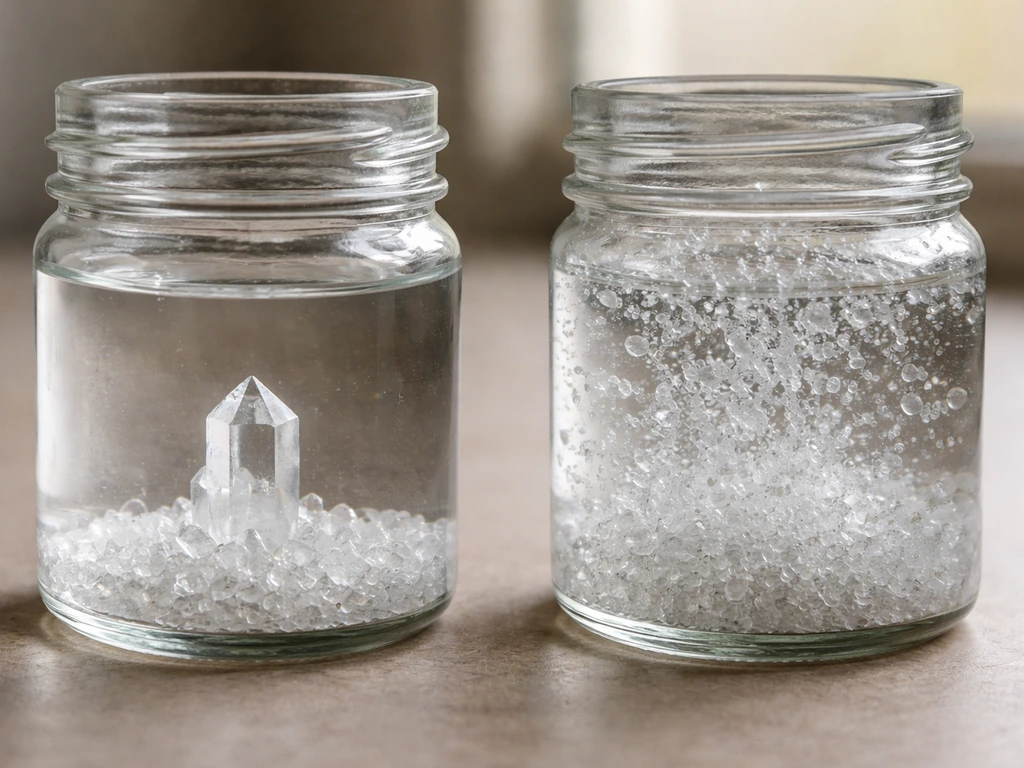
If dozens of tiny crystals nucleate at once, they all compete for the same finite pool of solute. Instead of one large crystal, you get a cluster of small ones. Managing nucleation, getting fewer crystals to start with, is probably the single most important thing you can do to grow a bigger specimen. If you want to know whether is your cermet going to grow, the same idea applies: manage nucleation so solute goes into fewer, larger crystals.
Supersaturation and growth rate control
Supersaturation controls two competing processes simultaneously: nucleation (the birth of new crystals) and growth (the enlargement of existing ones). High supersaturation drives both, but it drives nucleation especially hard, producing a shower of tiny crystals. Lower, controlled supersaturation favors growth of existing crystals over the birth of new ones. The sweet spot for growing one large crystal is maintaining moderate, sustained supersaturation rather than spiking it.
You can express the driving force in a few equivalent ways. Absolute supersaturation is simply ΔC = C − C. Relative supersaturation is S = C/C. Degree of supersaturation is σ = S − 1. For practical home use, you don't need to calculate these precisely. What matters is the intuition: cool your solution slowly and gently, don't let it drop temperature too fast, because rapid cooling spikes supersaturation and triggers a nucleation storm.
Growth rate also depends on how quickly fresh solute can reach the crystal surface through its boundary layer. Carbon nanotube growth is often explained using similar ideas of supersaturation and transport limits, which influence how fast tubes extend and what form they take. Researchers studying boundary-layer-controlled growth have shown that increasing supersaturation effectively shrinks the characteristic distance over which concentration gradients develop, meaning growth accelerates. But there's a tradeoff: pushing supersaturation too high nucleates new crystals. Convective transport (gentle flow or stirring) helps replenish the boundary layer and keeps growth rates higher without requiring extreme supersaturation.
Nucleation vs existing crystals: how to scale up
The most reliable way to grow one big crystal rather than many small ones is to start from a single seed crystal and suppress all other nucleation. Here's the logic: if you drop a pre-made seed into a slightly supersaturated solution, you give solute a preferred place to deposit. As long as the solution stays below the nucleation threshold (a moderate S rather than a sky-high one), new nuclei won't spontaneously form, and all growth goes to your seed.
Seed selection matters. Grow a batch of small crystals first, pick the clearest and most geometrically regular one, and use that as your starting point. Tie it to a string or suspend it so it hangs freely in the solution, not touching the container walls. Then prepare a fresh slightly supersaturated solution and move your seed into it.
Watch out for secondary nucleation: as your seed crystal grows, small fragments can break off (especially if stirring is too vigorous or the crystal bumps the container) and those fragments act as new seeds. This is called attrition-driven secondary nucleation, and it's a major source of crop failure in both home experiments and industrial crystallizers. Research on potassium alum specifically shows that even seed fragments in the 250 to 350 micrometer range can propagate into separate crystals and redistribute your solute across many individuals instead of one.
Environment setup: temperature, solvent, cooling/evaporation, stirring
Getting the environment right is where most home experiments fail. Each variable pulls on the system differently, and they interact.
Temperature
Temperature controls solubility (C*). For most common crystallization candidates like alum, potassium nitrate, or sugar, solubility rises significantly with temperature. You dissolve more solute at high temperature, then cool slowly so solubility drops and the solution becomes supersaturated. The slower and more controlled the cooling, the more gently supersaturation rises, and the more growth concentrates on existing crystals rather than triggering new ones. Putting your container in an insulated box or cooling it in a water bath gives you much more control than just setting it on a shelf.
Evaporation
Evaporation is an alternative or complementary driver. As water leaves the solution, C rises while C* stays fixed (assuming temperature is constant), so supersaturation increases. Slow, steady evaporation keeps supersaturation in the growth-friendly zone. Too fast and you spike supersaturation and nucleate dozens of small crystals. Covering your container loosely (a coffee filter or loose plastic wrap) restricts evaporation rate and gives you much better results than leaving the solution open to room air. The evaporation rate also affects where crystals form: faster evaporation tends to concentrate crystallization at the liquid-air interface, which can shift which crystals dominate or cause surface crusts that seal off the solution.
Stirring and convection
Gentle stirring or convection helps deliver fresh solute to the crystal surface and prevents local depletion zones. Without any flow, a growing crystal depletes its immediate neighborhood and growth slows, even if the bulk solution is still supersaturated. But aggressive stirring creates mechanical shear that can chip the crystal surface and produce secondary nuclei. The practical rule is: no stirring for sensitive single-crystal experiments, but occasional very gentle rocking of the container can help if the solution is large compared to the crystal.
Practical targets: typical sizes by method
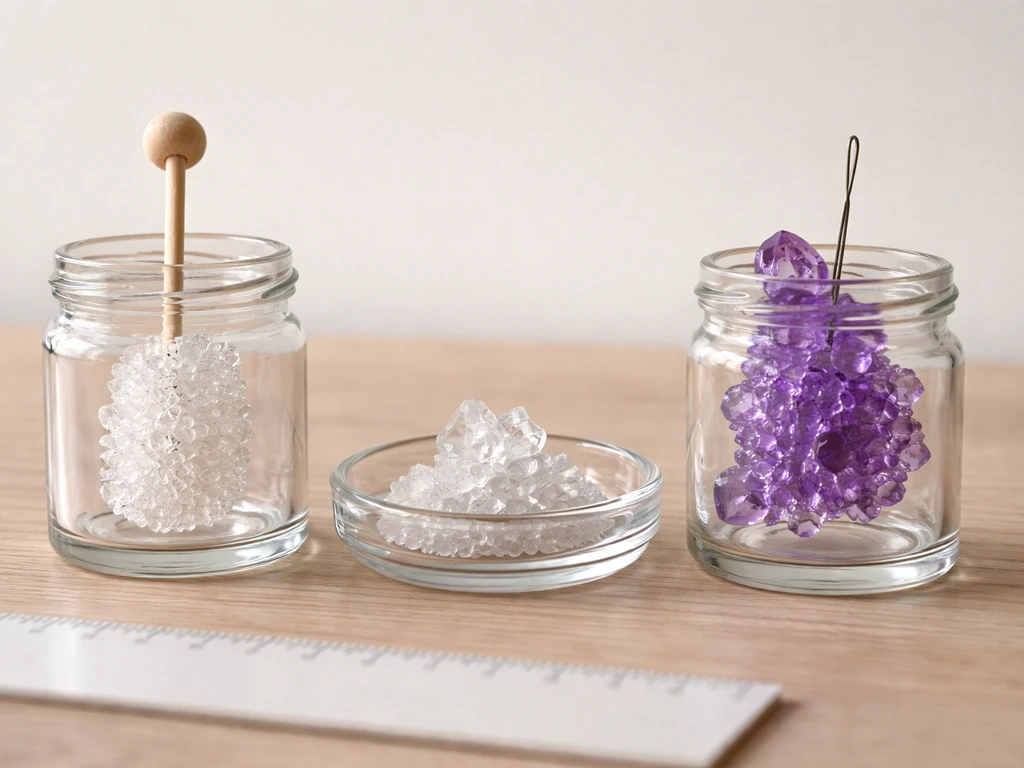
Here's what you can realistically expect from different approaches. These aren't ceilings, but they're honest central estimates for well-run experiments.
| Method | Typical achievable size | Time frame | Main limiting factor |
|---|---|---|---|
| Rock candy (sugar, string, jar) | 2–4 cm clusters | 1–2 weeks | Many nucleation sites on string; solute competition |
| Table salt (rapid evaporation, open dish) | 0.5–2 cm single crystals | Days to weeks | Fast evaporation; hard to control nucleation |
| Potassium alum (seed crystal, slow cooling) | 3–8 cm single crystal | 2–6 weeks | Secondary nucleation; solute supply |
| Alum with optimized lab setup | 10–15 cm single crystal | Several months | Diffusion limits; purity; patience |
| Industrial / research lab (e.g., quartz growth) | Decimeters to meters | Months to years | Cost, equipment, pressure control |
blank" rel="noopener noreferrer">Rock candy is the most forgiving because you're not trying to grow one crystal; you want many sugar crystals on a string. Roughening the string with sugar granules gives nucleation sites, which is exactly what you want for that application. Understanding why alum crystals grow the way they do, especially how temperature drives solubility, helps explain why alum responds so well to the slow-cooling approach and typically outperforms salt for single-crystal work at home. This is part of the reason alum crystals grow well: slow cooling helps maintain supersaturation without triggering too many new nuclei why do alum crystals grow.
For alum specifically, commercial "giant crystal" kits are designed around the same principles described here: controlled supersaturation, seed use, and slower cooling profiles. They reliably produce crystals noticeably larger than casual desk experiments, which tells you the method works, not just the material.
Common failure modes and how to troubleshoot
Most home crystal experiments go wrong in one of a handful of predictable ways. Here's how to identify and fix each one.
- Dozens of tiny crystals instead of one big one: supersaturation was too high during nucleation phase, or the seed crystal was too rough and provided too many nucleation sites. Fix: dissolve everything back at higher temperature, re-cool more slowly, and start fresh with a single smooth seed suspended away from container walls.
- Crystal stops growing after a few days: solution has approached equilibrium solubility (C is near C). Fix: gently add more concentrated solution to the container, or carefully transfer the crystal to a fresh batch of supersaturated solution. Check that temperature hasn't drifted up, which raises C and kills supersaturation.
- Crystal looks cloudy or frosted instead of clear: impurities have incorporated into the lattice, or growth was too fast (surface kinetics couldn't keep up). Fix: use distilled or filtered water and reagent-grade solute. Slow down cooling or evaporation rate.
- Crystal develops flat faces on some sides but not others (irregular shape): different faces grow at different rates depending on supersaturation and which impurities are present. Moderate supersaturation helps equalize face growth rates. Some asymmetry is normal and not a problem for size.
- Crystal falls apart or cracks: thermal shock from moving the container to a warmer or cooler spot, or mechanical shock from bumping. Fix: keep temperature stable and handle the container gently. If cracking is already a problem, the crystal may have incorporated too many internal defects during a period of fast growth.
- Solution forms a crust on the surface: evaporation is too fast, causing crystallization at the air-water interface before bulk supersaturation rises evenly. Fix: cover the container more tightly to slow evaporation.
- Alum not yielding expected amount of crystal: temperature control errors directly change C* (alum solubility is strongly temperature dependent), so even a few degrees of error shifts the supersaturation balance. Use a thermometer and track your solution temperature over the experiment.
How big crystals can get in nature (geology) vs at home
Natural crystals operate under entirely different timescales and boundary conditions, and the results are extraordinary. The largest known single crystal on Earth is a beryl from Malakialina, Madagascar: roughly 18 meters long, 3.5 meters in diameter, and weighing approximately 380,000 kilograms. That's not an anomaly; it reflects what happens when favorable geochemical conditions persist for geological timescales.
The physics isn't fundamentally different from your alum jar. Supersaturation drives growth; diffusion and transport control how fast; and the total available solute sets a ceiling on final size. What geology provides that home experiments can't is time (millions of years), enormous volumes of mineralizing fluid (kilometers of rock acting as a solute reservoir), and in some cases surprisingly rapid growth episodes. Studies of quartz crystals in pegmatite cavities have inferred growth rates as high as 10 to 100 millimeters per day during rapid episodes, driven by favorable cavity geometry and hydrothermal fluid transport. Sustained conditions like that, over long periods, are consistent with decimeter-scale crystals forming in days to weeks under the right geological scenario.
The Cave of Crystals in Chihuahua, Mexico offers another dramatic example: selenite (gypsum) crystals up to 11 meters long grew over hundreds of thousands of years in a flooded, temperature-stable cave environment where hydrothermal brines maintained near-constant supersaturation. Near-zero disturbance, consistent temperature, and a virtually unlimited solute supply. That's the geological version of the perfect home experiment, just scaled up by a factor of a million in time and space.
The key difference isn't chemistry, it's the absence of the practical constraints that limit home growth: finite solution volume, temperature fluctuations, impurity contamination, and the difficulty of maintaining steady supersaturation over weeks rather than millennia. During recrystallization in metamorphic rocks, existing minerals can reorganize and grains may grow longer Recrystallization processes in metamorphic rocks. Recrystallization processes in metamorphic rocks, where minerals grow and reorganize under heat and pressure, operate by similar driving forces but with the added energy of geological stress, which is worth exploring separately if you want to understand how grain size and crystal orientation relate to rock formation.
For your home experiment, think of natural crystals not as magic but as what happens when the same principles you're working with get unlimited resources and time. The physics is identical. The scale is just humbling.
FAQ
If I use more solution, will my crystal automatically get bigger?
More total solute helps, but only if you also keep conditions favorable long enough. If nucleation is high or supersaturation drops quickly to near equilibrium, extra volume will not translate into a larger single crystal, it will just increase the amount of total crystallized material (often as many crystals).
What’s the fastest way to reduce small crystals and get one big crystal?
Start with a single, well-formed seed and keep supersaturation moderate and steady. Avoid rapid temperature drops that spike nucleation, and minimize the chance of seed fragments breaking off (gentle handling, no bumping, and controlled stirring or none at all).
How do I tell when my solution is still too supersaturated and will nucleate?
Watch for the appearance of many new crystals throughout the liquid or a rapid cloud of microcrystals after you change temperature or start evaporation. If crystals suddenly multiply, you likely overshot the nucleation threshold, so slow the cooling, reduce evaporation, or lower agitation to restore a growth-focused supersaturation level.
Does stirring always help crystals grow larger?
No. Stirring improves transport only up to the point where mechanical effects remain gentle. If stirring is strong, it can mechanically chip the crystal surface or create fragments that seed secondary nucleation, reducing your chance of forming one large specimen.
Why do my crystals stop growing even though the solution still looks cloudy or saturated?
Cloudiness can come from ongoing microcrystal formation, which means solute is being consumed by new nuclei rather than your target crystal. Growth also stops when the bulk solution approaches equilibrium solubility, so if you see little change in your seed while new crystals appear, your system likely lost the supersaturation driving force or it got “spent” elsewhere.
Should I cover the container to slow evaporation, or is open-air better?
For single large crystals, slower, controlled evaporation is usually better. Open-air conditions can spike supersaturation and also shift where growth concentrates (often toward the liquid-air interface), leading to crusts that seal off regions and change which crystals dominate.
What’s the best way to place a seed crystal so it grows well?
Suspend it so it does not touch container walls or the bottom, since contact creates local depletion, contamination, and stress points that can trigger irregular growth. Tie it gently (string or inert support), and avoid pressing the seed into the solution where it can scrape or break.
Can impurities in tap water really limit crystal size?
Yes. Trace ions and organics can adsorb on active crystal faces, block growth, or introduce lattice defects. If your results are smaller and more irregular than expected, switching to purified water and using clean vessels can make a measurable difference because it reduces unwanted surface adsorption and defect formation.
How do I prevent secondary nucleation from seed fragments?
Handle the seed minimally, avoid vigorous agitation, and protect the crystal from impacts. If you must move or change the setup, do it slowly and keep the solution quiet afterward. Secondary nuclei can come from attrition, not just from the solution, so mechanical stability matters as much as chemistry.
Is there a practical limit I can estimate for my experiment size?
A rough ceiling comes from how much solute you started with and how close you get to equilibrium before your supersaturation stays in the growth zone. Large size requires a large initial solute inventory plus sustained conditions, otherwise diffusion limitations and solute starvation will slow growth long before you reach dramatic dimensions.
How can I tell whether diffusion limits me versus nucleation limits me?
If nucleation is low (few new crystals appear) but your seed growth rate drops as the crystal gets larger, you are likely facing diffusion-to-capture limits (solute reaching the surface becomes slow relative to crystal size). If, instead, new crystals keep forming while your seed growth lags, nucleation competition is probably the dominant limitation.
Next Article
Why Carbon Nanotubes Grow: Mechanisms, Conditions, Fixes
Learn why carbon nanotubes grow and what controls yield, length, and chirality through catalysts, kinetics, and limits.