Recrystallization during metamorphism causes grains to grow longer in the direction of the rock's deformation fabric, specifically along the foliation plane or mineral lineation, rather than expanding equally in all directions. The reason is not random chance. Stress fields, stored strain energy, and the anisotropic mobility of grain boundaries all conspire to push growth in one preferred direction and suppress it in others. If you are trying to solve a geology question or understand a thin section, that single sentence is your anchor: directional stress produces directional grain growth, full stop.
Recrystallization During Metamorphism and Anisotropic Grain Growth

Marcus Whitmore
6 May 2026
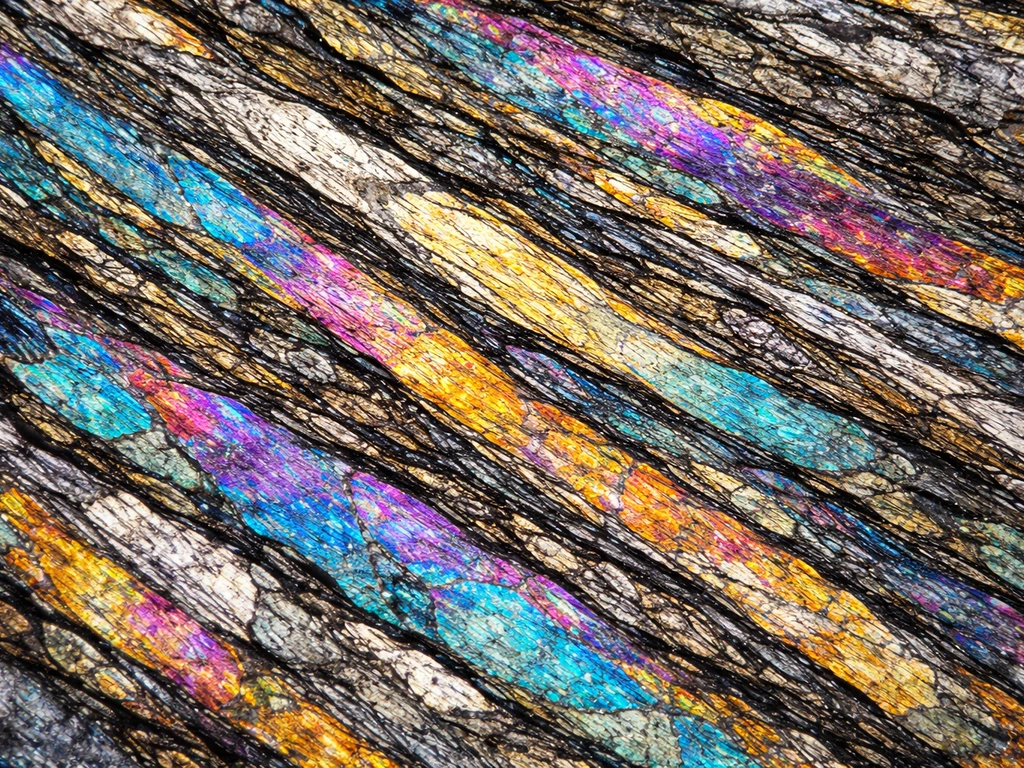
Why grains become longer during metamorphism
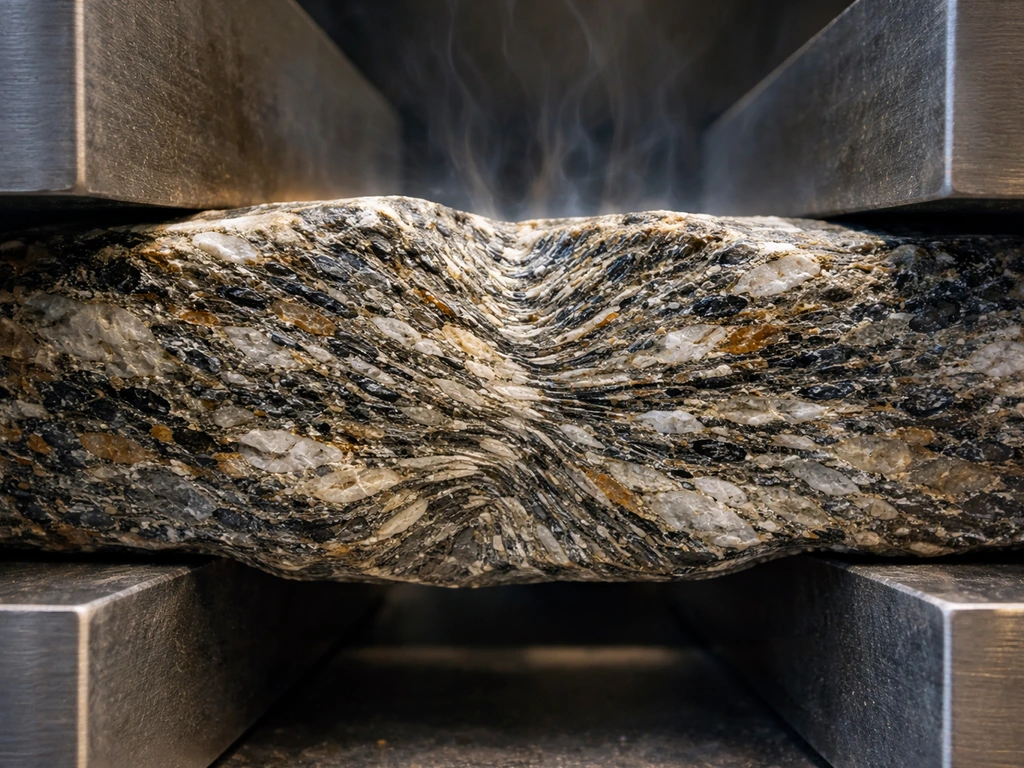
Picture a rock being squeezed from two sides while heat is cranked up. The mineral grains inside that rock are not passive passengers. They deform, rotate, and break down at the microscale while simultaneously trying to reduce their total internal energy. Recrystallization is basically the rock's way of relieving that internal stress, and it does so by reorganizing grain boundaries and growing new, lower-energy grains in the process.
The key point is that the driving force for recrystallization is not uniform. Grains that are highly deformed, full of dislocations, and misoriented relative to the applied stress field have much higher stored strain energy than their neighbors. New grains, or parts of existing grains, will preferentially consume those high-energy regions. Because the highest strain energy tends to accumulate in specific orientations relative to the stress axes, the growth that follows is not random. It is channeled along the directions where the energy payoff is greatest, which typically coincides with the foliation plane or lineation direction of the rock.
Think of it like water finding the path of least resistance down a hillside. The 'hill' here is the landscape of stored strain energy inside the rock, and recrystallization is the water flowing toward lower ground, growing grains longer in the directions where that energy gradient is steepest.
Role of recrystallization and grain-boundary migration
There are three main recrystallization mechanisms in metamorphic rocks, and which one is operating tells you a lot about the temperature and strain rate conditions at the time. In quartz-bearing shear zones, these mechanisms (including subgrain rotation recrystallization and grain boundary migration) control how quartz microstructures develop and how preferred orientation relates to shear-frame geometry as strain accumulates three main recrystallization mechanisms in metamorphic rocks.
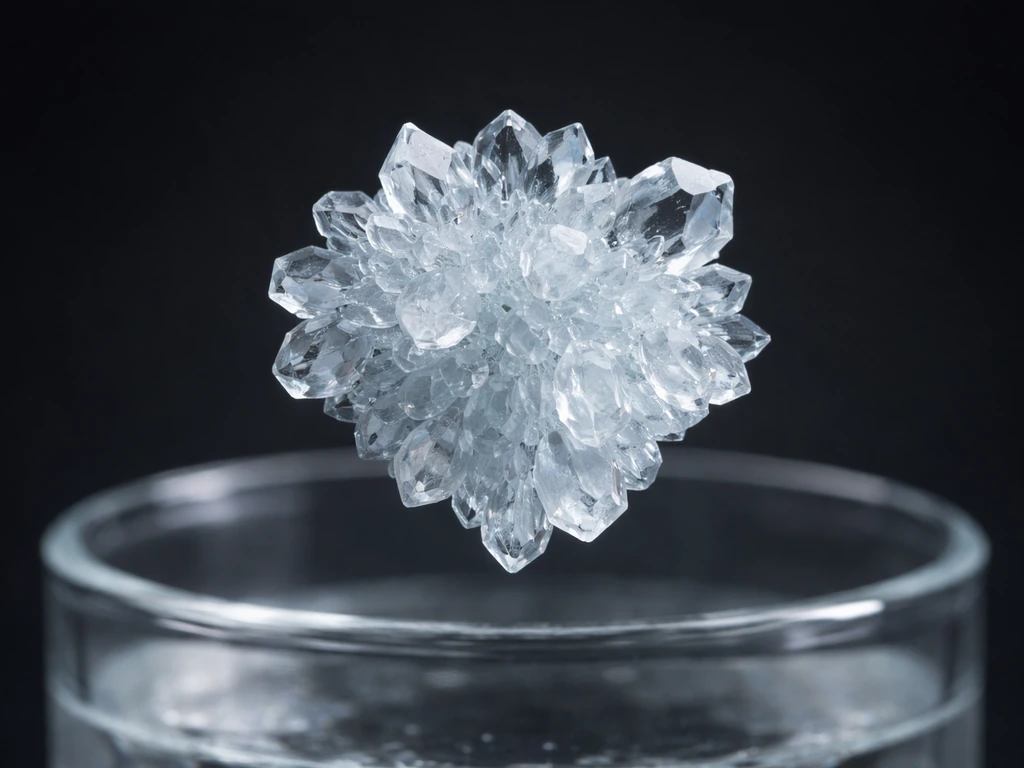
This is also why alum crystals often grow in a direction dictated by the local energy and stress conditions alum crystals grow. For quartz in water-present conditions, bulging recrystallization (BLG) dominates at roughly 280 to 400 degrees Celsius, subgrain rotation recrystallization (SGR) takes over from about 350 to 500 degrees Celsius, and grain boundary migration (GBM) becomes the dominant process above roughly 400 to 500 degrees Celsius.
These ranges shift depending on strain rate and fluid content, but the overall progression is well established. This mylonite and grain-size evolution is consistent with findings that grain-size evolution during dynamic recrystallization across a shear-zone boundary is controlled by competing microscopic processes, including grain-boundary migration driven by strain energy and its effects on the growth stage and extent of recrystallization grain boundary migration driven by strain energy.
Grain boundary migration is the mechanism most directly responsible for elongated grains. During GBM, boundaries between grains move through the crystal lattice in response to differences in free energy on either side of the boundary. A boundary migrates toward the side with higher strain energy, consuming deformed material and leaving behind a larger, cleaner grain. The critical detail is that this migration is not symmetric. Grain boundaries do not move equally in all directions because the energy and mobility of those boundaries vary with crystallographic orientation and the local stress state.
Research on grain growth in anisotropic systems confirms that boundary-energy anisotropy and boundary-mobility anisotropy both control which segments of a grain boundary advance fastest. In plain terms: some faces of a growing grain move quickly, others move slowly or not at all. When deformation is active, the stress field biases which faces experience favorable mobility conditions, and the result is a grain that stretches out rather than puffs up uniformly like a balloon.
Anisotropic (directional) grain growth vs random growth
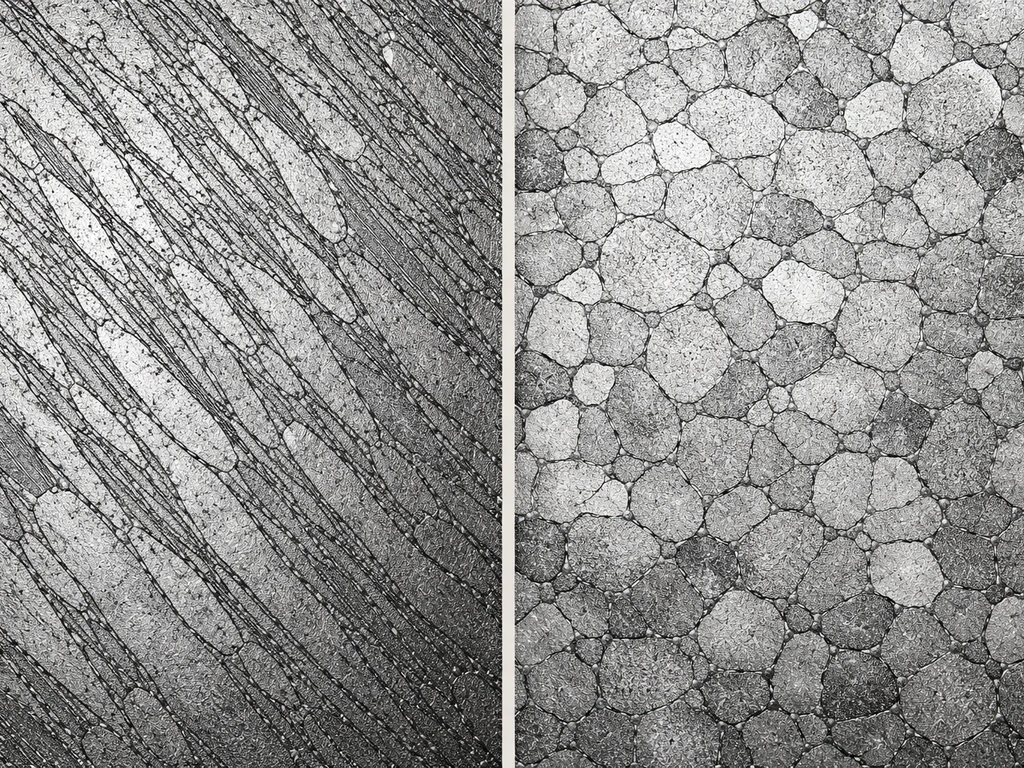
Random grain growth is what you get in a stress-free system with uniform temperature. Every boundary moves at about the same rate, grain shapes stay roughly equant (blocky or rounded), and the overall texture is isotropic. Metamorphic rocks under directed stress are the opposite of that scenario.
During migration recrystallization, new grains grow preferentially into the deformed matrix where stored strain energy is highest relative to grain-boundary energy. Because the distribution of that stored energy is tied to the orientation of grains relative to the stress axes, the grains that grow fastest are those oriented to take best advantage of the local energy gradient. This selective growth produces a crystallographic preferred orientation (CPO) and, at the grain-shape level, produces elongated grains aligned with the bulk deformation fabric.
There is also a shape preferred orientation (SPO) effect. As grains grow longer in one direction, they begin to mechanically interact with neighbors in a way that reinforces the fabric. Grain boundaries parallel to the foliation become stabilized because they are low-energy in that configuration; boundaries cutting across the foliation are higher energy and get consumed. The geometry feeds back on itself, amplifying the anisotropy over time.
| Growth type | Stress condition | Grain shape result | Typical context |
|---|---|---|---|
| Isotropic (random) | Hydrostatic / no directed stress | Equant, rounded grains | Static annealing, contact metamorphism away from shear zones |
| Anisotropic (directional) | Directed stress (compression or shear) | Elongated grains aligned with foliation/lineation | Dynamic metamorphism in shear zones, orogenic belts |
| Grain boundary migration (GBM) | High T, lower strain rate | Highly lobate, very elongated grains | Upper greenschist to amphibolite facies |
| Subgrain rotation (SGR) | Moderate T and strain rate | Moderately elongated, internal substructure visible | Greenschist facies |
| Bulging (BLG) | Lower T, higher strain rate | Small, slightly elongated new grains along old boundaries | Lower greenschist, blueschist |
Connection to deformation and fabric development (foliation and lineation)
Foliation is the planar fabric you see in schists and gneisses, that layered or flakey appearance. Lineation is the linear fabric, a direction within the foliation plane along which minerals visibly stretch or align. Both are expressions of the same underlying process: minerals grew, rotated, and recrystallized under a directed stress field, and the long axes of grains ended up pointing in directions that minimize their interaction energy with the stress.
For platy minerals like mica and chlorite, the dominant mechanism is rotation into the foliation plane. But for equant or prismatic minerals like quartz and feldspar, recrystallization-driven elongation is the primary way foliation and lineation are built. The long axes of recrystallized quartz ribbons in a mylonite, for example, define the stretching lineation directly. They grew longer in the direction of maximum elongation in the rock's bulk finite strain ellipsoid.
In simple shear zones (the geometry of most natural fault zones), the relationship between grain elongation direction and the shear plane is not perfectly parallel. New grains initially grow with their long axes at a low angle to the shear plane, then rotate toward it as deformation continues. This is why in highly strained mylonites, the recrystallized grains are nearly parallel to the foliation, while in less deformed rocks you still see that slight obliquity. That obliquity is actually a useful shear-sense indicator in the field.
Microstructural outcomes you should look for in rocks
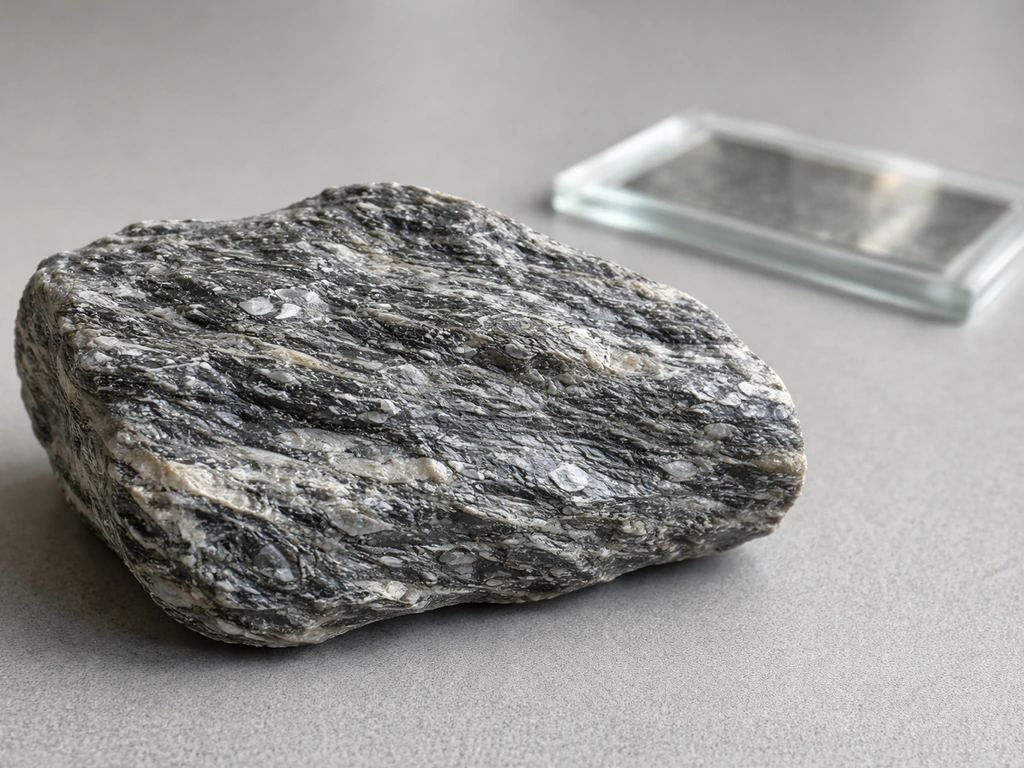
When you examine a metamorphic rock and want to confirm that directional recrystallization drove grain elongation, here is what you should actually see at different scales.
Hand sample scale
- A visible foliation: parallel alignment of micas, elongated quartz lenses, or compositional banding in gneisses
- A mineral lineation: a direction within the foliation along which minerals visibly streak out, like pencil marks across the rock surface
- Quartz ribbons or 'ribbon quartz': thin, highly elongated lenses of quartz that wrap around other minerals
- Porphyroblasts (large crystals like garnet or feldspar) surrounded by a finer-grained recrystallized matrix, often showing pressure shadows or strain caps aligned with the foliation
Thin section scale
- Shape preferred orientation (SPO): the long axes of grains statistically aligned in one direction, measurable by eye or by image analysis
- Lobate or sutured grain boundaries in quartz, indicating active grain boundary migration
- Subgrains visible within larger grains, showing that SGR was active at some stage
- Core-and-mantle structures: a large old grain (core) surrounded by smaller new grains (mantle) produced by bulging or subgrain rotation
- Undulose extinction in quartz under crossed polars, a sign of residual internal strain in grains that have not fully recrystallized
- Crystallographic preferred orientation (CPO): in quartz, this shows up as a non-random pattern of optical orientations across the section, best seen by rotating the stage
These microstructures are not just academic curiosities. They record the temperature, strain rate, and stress geometry that the rock experienced. A rock with GBM-dominated microstructures (lobate boundaries, highly elongated grains, strong CPO) tells a very different story than one with BLG-dominated microstructures (tiny new grains, irregular boundaries, weak CPO).
Reading those textures is reading the rock's growth history under constraints, which connects directly to the broader principle that growth in any system, whether biological or geological, is shaped and limited by the environment it occurs in. If you are asking whether your cermet will grow larger or change its microstructure, the key is what temperature, stress, and energy gradients are doing to grain boundaries is your cermet going to grow.
How to test and confirm the mechanism in the lab or in the field
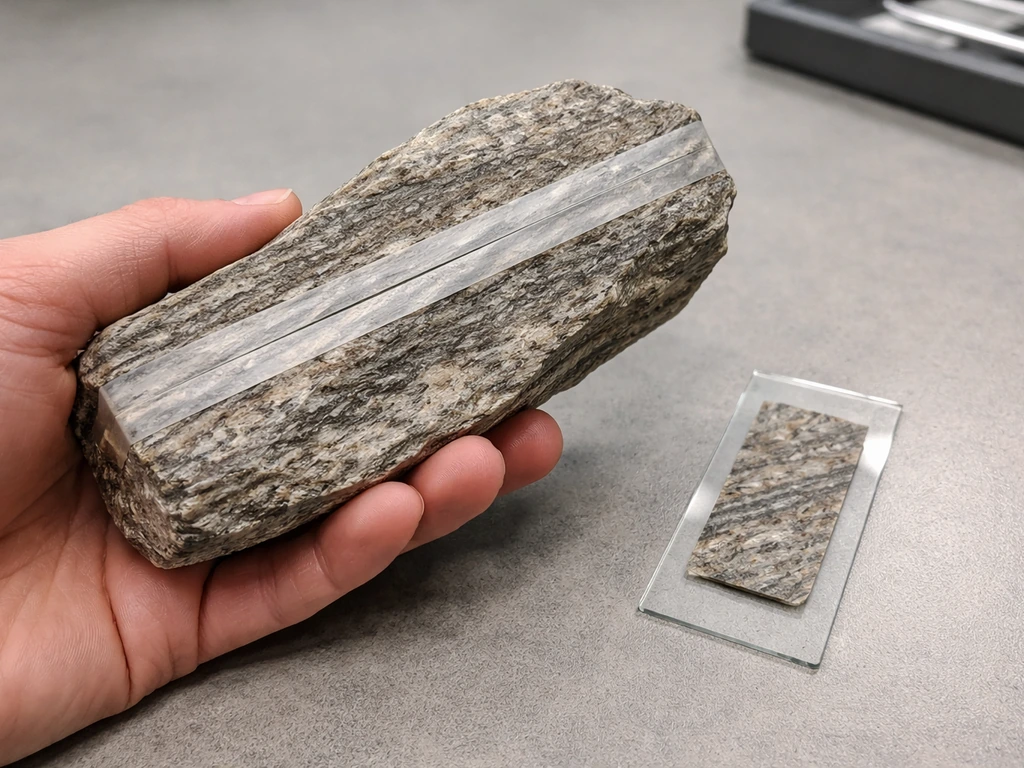
If you are working with a metamorphic sample and need to confirm that recrystallization drove directional grain elongation, here is a practical sequence of steps.
- Start with a hand sample orientation. Note the foliation plane (usually the most obvious planar fabric) and any visible lineation. Mark the sample before cutting so you do not lose spatial reference. Cut thin sections in at least two orientations: one parallel to lineation and perpendicular to foliation (the XZ plane of the strain ellipsoid), and one perpendicular to both (the YZ plane). You need both to fully characterize grain shape anisotropy.
- Use petrographic microscopy to measure shape preferred orientation. Under plane-polarized and cross-polarized light, document the long-axis orientations of 50 or more grains of your target mineral (quartz is easiest). Plot these on a rose diagram or histogram. If grain elongation is truly directional and tied to the fabric, the distribution will cluster strongly around the foliation/lineation direction rather than being random.
- Look for the specific recrystallization microstructures described above (lobate boundaries for GBM, core-and-mantle for BLG/SGR, undulose extinction). Identifying the dominant mechanism tells you the approximate temperature range and confirms that dynamic recrystallization, not static grain growth, is responsible for the elongation.
- Check for crystallographic preferred orientation (CPO) using the petrographic microscope. In quartz, rotate the stage and note whether c-axis extinction directions cluster. A strong CPO aligned with the fabric confirms that grain boundary migration was exploiting specific crystallographic orientations, the hallmark of anisotropic growth driven by the energy-mobility arguments described earlier. For a more rigorous measurement, electron backscatter diffraction (EBSD) analysis on a polished thin section will give you a full quantitative CPO in minutes.
- In the field, look for shear sense indicators to confirm that the grain elongation direction is consistent with the kinematics of the deformation zone. Asymmetric porphyroclast tails (sigma and delta structures), oblique foliation in shear bands, and S-C fabrics all help you confirm that the elongation is deformation-driven and not just a product of static annealing.
- If you have access to geochemical or geochronological tools, thermobarometry on mineral assemblages in the same rock can constrain the pressure-temperature conditions at the time of recrystallization. This lets you cross-check whether the microstructures you see (BLG, SGR, or GBM) are consistent with the temperature estimates, validating the whole interpretive framework.
One practical note: if your thin section shows equant, strain-free grains with straight or gently curved boundaries and no CPO, that is a sign of static recrystallization (annealing) rather than dynamic recrystallization. Annealing happens after deformation stops, driven by surface energy minimization alone, and it produces grains that grow more uniformly in all directions. Distinguishing dynamic from static microstructures is one of the most important calls you will make when interpreting a metamorphic rock.
Growth under constraints: the bigger picture
What makes metamorphic grain growth so interesting from a growth-science perspective is that it perfectly illustrates the universal principle that growth is never truly unlimited or undirected. In contrast to metamorphic grain growth, crystals in open systems are often limited by available space, time, and the transport of material to the growing surface limited by the environment. Just as biological cells cannot grow indefinitely because of surface-area-to-volume constraints and resource limits, mineral grains cannot grow isotropically in a directed stress field. The stress field is the constraint. It shapes which grain boundaries are mobile, which orientations are energetically favorable, and which directions receive the growth 'budget' that would otherwise be distributed equally.
The same logic applies when you compare metamorphic grain growth to other forms of directional growth, like how crystals grow on specific substrate surfaces, or how carbon nanotubes elongate along a preferred axis driven by catalytic and energetic constraints at the growth tip. This kind of directed elongation can also help explain why carbon nanotubes grow along a preferred axis under specific catalytic and energetic conditions carbon nanotubes elongate. That idea also helps explain why crystals can grow on charcoal, where surface chemistry and adsorption create preferred growth sites crystals grow on specific substrate surfaces. In each case, the growth is not random, it is steered by an asymmetry in the energy landscape, whether that asymmetry comes from stress, surface chemistry, or temperature gradients.
For metamorphic rocks, that asymmetry is written permanently into the rock fabric. Every elongated quartz grain in a mylonite is a tiny record of the direction in which growth was allowed to proceed, a physical signature of the forces that shaped the crust millions of years ago. Once you know what to look for, reading that signature becomes one of the most satisfying puzzles in geology.
FAQ
If my thin section shows elongated grains, how can I tell whether it reflects dynamic recrystallization during deformation or later annealing?
Yes. After deformation stops, grains can still recrystallize by annealing, but the texture tends to be more equant with weaker or absent crystallographic preferred orientation. Directional elongation aligned with foliation and lineation is much more diagnostic of dynamic, stress-assisted recrystallization than of static post-deformation recovery.
Can I use only grain elongation direction to infer which recrystallization mechanism dominated?
The mechanism you infer from texture is most reliable when multiple indicators agree. For example, GBM-favored rocks usually show larger, cleaner grains and strongly directional fabric, while BLG tends to produce a dense population of finer new grains. If CPO is weak while grain shape is elongated, that can indicate lower strain rate, partial annealing, or overprinting by a later event.
Are grain elongation direction and shear sense always uniquely linked in mylonites?
Be cautious. Similar-looking anisotropic grain shapes can be produced by different stress histories, including changes in shear sense or progressive rotation of the deformation field. A practical check is to compare the grain elongation direction with multiple microstructural features, such as boundary shapes, subgrain development, and whether the fabric is consistent across scales.
How do I avoid confusing elongation relative to foliation versus elongation relative to lineation when analyzing thin sections?
Often the direction you measure depends on what you can resolve. In foliated rocks, grain elongation is commonly reported relative to foliation-normal versus foliation-parallel directions, while lineation alignment is within the foliation plane. If your sample is cut or sectioned at an oblique angle, you may misinterpret the apparent elongation direction without transforming it to a consistent structural reference frame.
How do fluid content and hydration affect the temperature ranges for BLG, SGR, and GBM?
Hydration and other fluids can shift the temperature range where each recrystallization mechanism becomes dominant, by enhancing diffusion and boundary mobility. That can produce GBM-like elongation at lower temperatures than “dry” expectations, so fluid-rich rocks may show mechanism transitions at a different thermal budget than relatively dry samples.
If different minerals in the same rock have different grain shapes, does that break the interpretation of directional recrystallization?
Quartz and feldspar can show different microstructural “signatures,” so don’t assume the same mechanism controls all phases equally. You may see stronger elongation and CPO in quartz ribbons even when other minerals look more passive. A robust approach is to document phase-specific textures and whether the dominant fabric is carried by one mineral group or across multiple phases.
What if my rock still has elongated grains, but the CPO is weaker than expected, could it be overprinted?
It can. Strong CPO may reflect crystallographic preferred orientation developed during deformation, but later thermal events can reduce or partially reset it. If your sample experienced a post-deformation heating pulse, compare microstructure preservation (e.g., boundary forms) with the strength of CPO to judge how much overprinting occurred.
How do strain rate and deformation duration influence how strongly elongated the grains become?
Yes, and it changes what you should expect. Low strain rate or short-lived deformation can yield limited recrystallization, producing fewer new grains and less opportunity for boundary migration anisotropy to fully develop a strong fabric. Conversely, high strain rate can promote sustained dynamic recrystallization, giving a more mature, sharply defined elongation pattern.
What is a quick structural consistency test to confirm that directional recrystallization is recorded in the rock fabric?
You can check consistency using structural relationships. For example, if grains are elongated parallel to the stretching lineation and foliation, that supports stress-directed growth. If grain elongation is random relative to the bulk fabric, that suggests either near-static conditions, later annealing, or that your sample preserves multiple deformation fabrics with conflicting orientations.
Next Article
Why Do Alum Crystals Grow: Supersaturation to Crystal Size
Learn why alum crystals grow: supersaturation, nucleation, and factors like temperature, stirring, and impurities.