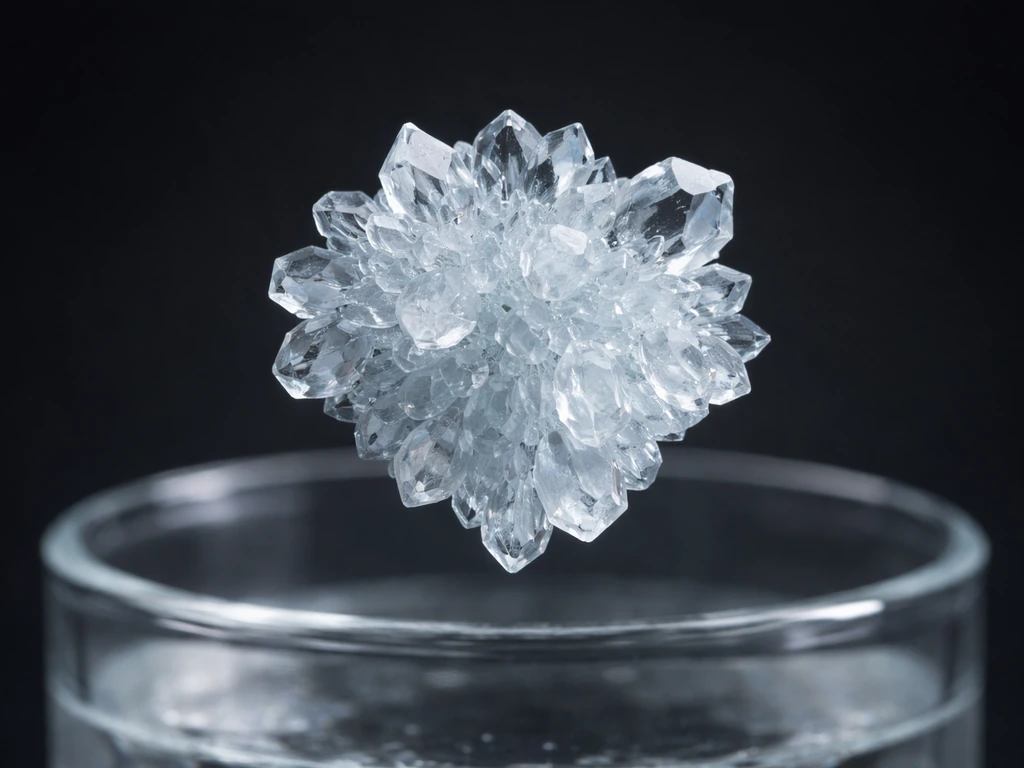
Alum crystals grow because the solution they sit in holds more dissolved alum than it can stably keep at a given temperature. That unstable, overcrowded state is called supersaturation, and it forces dissolved ions to leave the solution and lock into a solid lattice. The result is a crystal that gets bigger every time another layer of ions stacks onto its faces. Understanding that one mechanism, supersaturation driving ions onto a lattice, explains nearly everything: why crystals grow at all, why they stop, and why your batch sometimes gives you dozens of tiny grains instead of one beautiful single crystal.
Why Do Alum Crystals Grow: Supersaturation to Crystal Size
Marcus Whitmore
2 May 2026
What crystal "growth" actually means
Crystal growth is not one event, it is two sequential stages: nucleation and then enlargement. They are driven by the same force but behave very differently, and mixing them up is the reason most home experiments produce disappointing results.
Nucleation: the tiny birth of a crystal
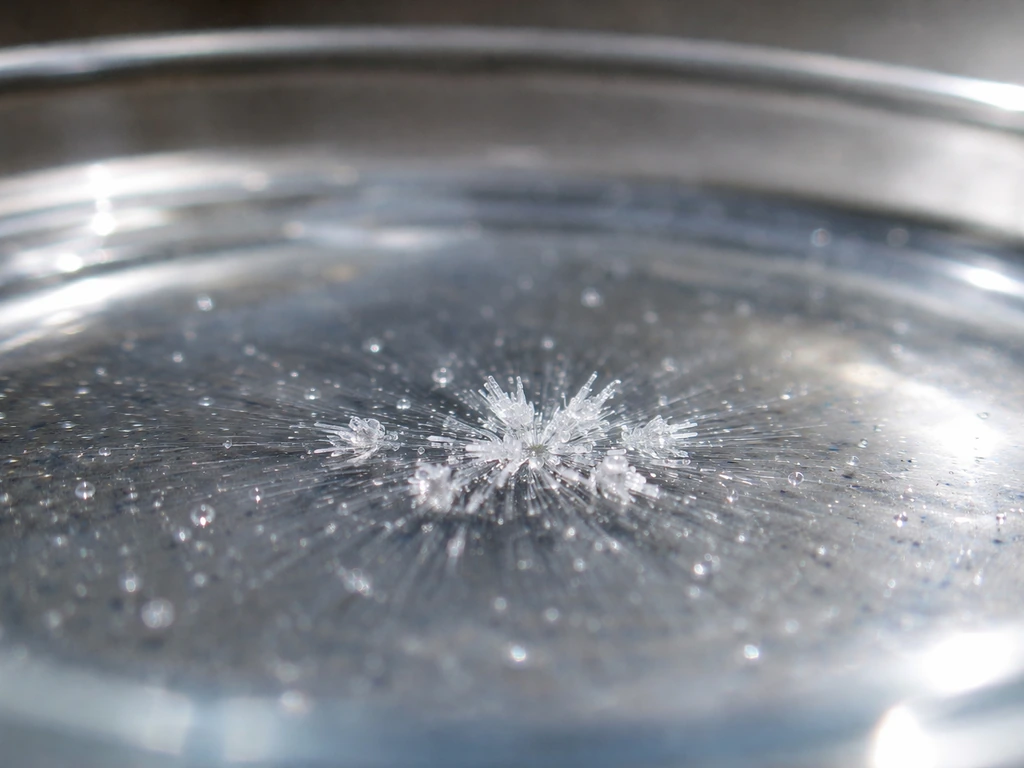
Nucleation is the moment when a handful of ions in solution first arrange themselves into a stable, ordered cluster small enough to count as a solid. Think of it like the first few people who commit to a group dance, once enough of them are moving in sync, others join. Below a critical cluster size the proto-crystal simply dissolves back into solution because surface energy costs outweigh any stability gained.
Cross that threshold and you have a nucleus, a seed of order that the rest of the growth process builds on. Nucleation can happen spontaneously in the bulk liquid (homogeneous nucleation) or be triggered by a surface like a dust particle, a scratch on the container wall, or a deliberately added seed crystal (heterogeneous nucleation).
In heterogeneous nucleation, this reduction of the energy barrier makes nucleation easier than in homogeneous nucleation, and the critical radius and free-energy barrier depend on the substrate or surface present the surface lowers the energy barrier. The surface option is far easier because the [surface lowers the energy barrier](https://www.
sciencedirect. com/topics/materials-science/nucleation).
Enlargement: building the lattice one layer at a time
Once a nucleus exists, growth is straightforward. Potassium and aluminum sulfate ions diffuse through the solution, reach a crystal face, and slot into the geometric positions that the existing lattice demands. Alum (potassium aluminum sulfate, KAl(SO4)2·12H2O) forms a cubic system, so faces grow in the characteristic octahedral or cubic shapes you see in finished crystals. Growth continues as long as the solution stays supersaturated. As ions leave the solution to join the crystal, the solution becomes less concentrated and supersaturation drops. The crystal is literally consuming its own driving force, which is why growth slows over time even if nothing else changes.
How temperature and solubility create supersaturation
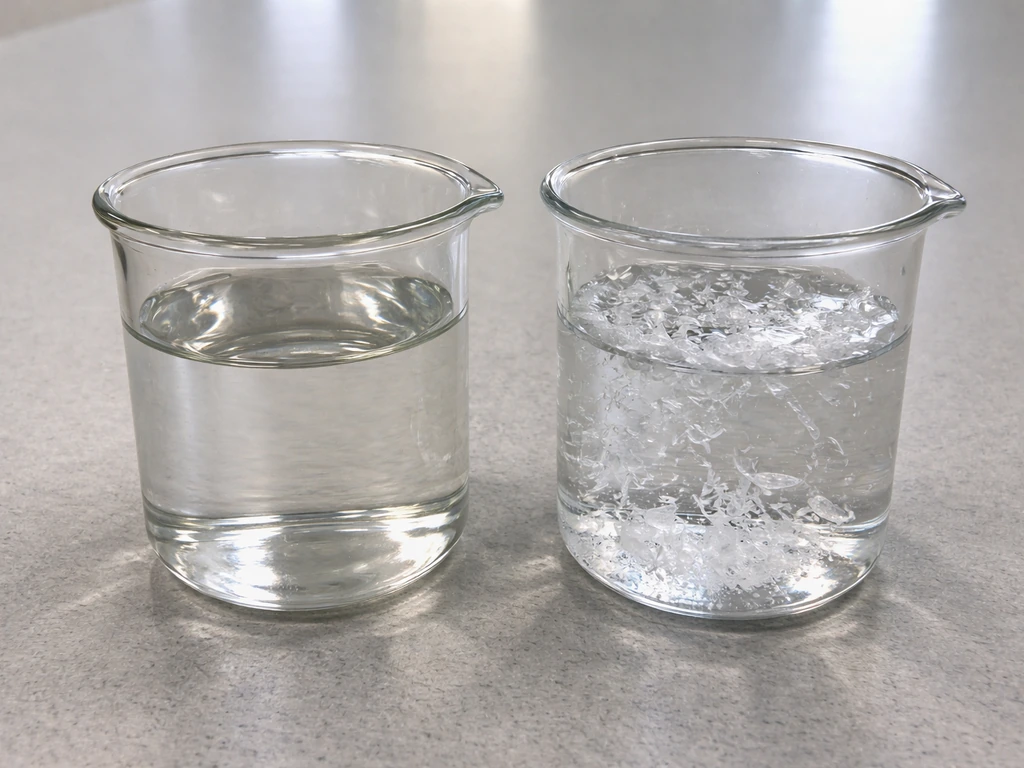
Alum is highly temperature-sensitive when it comes to solubility. At 20°C roughly 11 grams of alum dissolve per 100 mL of water, but at 80°C that jumps to around 320 grams per 100 mL. That steep curve is your best friend. Dissolve alum in hot water until no more will dissolve, then let the solution cool.
The water can no longer hold all that solute at the lower temperature, so the excess is chemically motivated to become solid. That motivation is what physicists call a higher chemical potential in the liquid phase relative to the solid phase, meaning the thermodynamics favor precipitation. Cooling is the most controllable way to create supersaturation for alum. Evaporation also works, because removing water raises the concentration of ions even at constant temperature.
Many long-term crystal-growing projects combine both: slow cooling creates the initial burst of growth, and then gentle ongoing evaporation keeps the solution slightly supersaturated for weeks.
Why seed crystals change everything
If you let a supersaturated alum solution do whatever it wants, it nucleates dozens or hundreds of tiny crystals almost simultaneously, each one competing for the same pool of dissolved ions. The result is a crust of small, jostling grains rather than one large crystal. A seed crystal short-circuits that problem.
A seed is a small, already-formed alum crystal with a clean, well-defined lattice. When you suspend it in a gently supersaturated solution, incoming ions find an existing lattice surface to attach to, so they never need to build a new nucleus from scratch. Because you are directing all available solute toward one surface, the crystal can grow much larger before the driving force is exhausted. The key practical point: the solution must be only mildly supersaturated when you introduce the seed. If the supersaturation is too high, new nuclei will still form spontaneously in the bulk and you are back to the many-small-crystals problem.
To make a good seed, dissolve alum in near-boiling water, let it cool slightly uncovered, and collect one of the first small crystals that form on the bottom. Pick the clearest, most geometrically regular one. You can tie it to a nylon thread or suspend it from a pencil laid across the top of your growing jar. Keep the seed away from the container walls, because wall contact encourages unwanted secondary nucleation.
Mass transport: how ions actually reach the crystal
Supersaturation tells you why growth happens. Mass transport tells you how fast. Ions do not teleport to the crystal face; they have to travel through the solution, and that journey is a bottleneck.
Diffusion in still solution
In an undisturbed solution, ions move by diffusion, random thermal motion that causes them to spread from high-concentration regions (near the bulk solution) to low-concentration regions (just above the crystal face, where ions have already been deposited). This creates a depletion zone right around the crystal, a thin layer of solution that is less concentrated than the bulk. Growth is limited by how fast ions can diffuse across that boundary layer. The good news is that slow diffusion also means smooth, well-formed faces, because ions arrive gently and have time to find the lowest-energy position in the lattice.
Stirring and evaporation
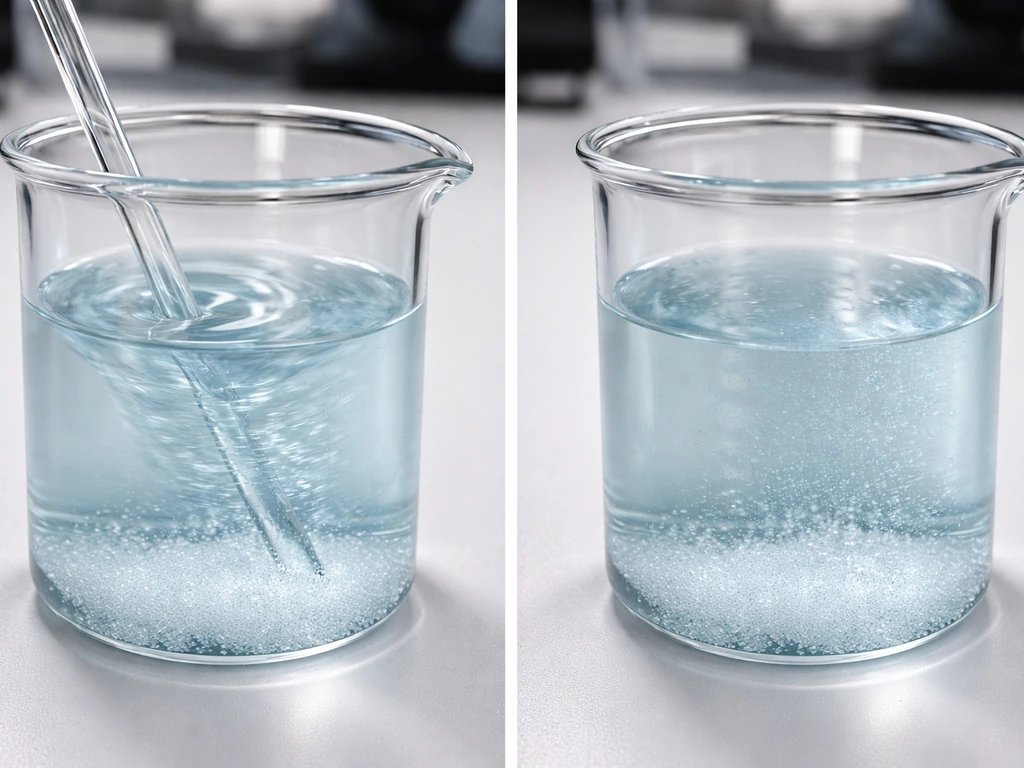
Stirring physically thins the depletion zone and delivers fresh, ion-rich solution to the crystal surface, which speeds up growth. But faster is not always better. High supersaturation combined with rapid delivery of ions encourages rapid, rough growth and can produce branching, tree-like structures called dendrites rather than flat faces. For best results, keep the solution still or use only very gentle convection. Evaporation acts differently: it does not move ions toward the crystal mechanically, but it does continuously raise the bulk concentration, maintaining supersaturation over longer periods. Covering your container loosely (not tightly sealed) lets some evaporation happen and extends the growth window from hours to weeks.
Solution chemistry: pH, impurities, and competing ions
Alum grows best in slightly acidic conditions, which is naturally where its ions are stable. Varying the conditions around your charcoal can change solution chemistry and help explain why crystals can appear to grow on it why crystals grow on charcoal. If the pH drifts too alkaline, aluminum ions hydrolyze (react with water) and precipitate as aluminum hydroxide rather than joining the crystal lattice. A small drop of white vinegar in your solution keeps pH in the right range without affecting the crystal chemistry.
Impurities are probably the single most underappreciated factor in amateur crystal growing. Even trace amounts of foreign ions can adsorb onto crystal faces and block the sites where new ions would normally attach. Sometimes this slows growth, sometimes it actually helps by suppressing unwanted nucleation sites or changing face growth rates in ways that produce better-defined shapes. But uncontrolled impurities almost always hurt. Use the purest alum you can find, filter the hot solution through a coffee filter before cooling, and keep dust and skin oils out of the jar.
If you are mixing alum yourself from separate chemicals, be careful about the stoichiometry. Excess sulfate ions or potassium ions shift the balance and can change which crystal faces grow fastest, producing irregular shapes. Use a single pre-mixed alum source (potassium alum, sold as a pickling or deodorant product) and dissolve it in distilled or filtered water rather than tap water, which contains calcium, chlorine, and other ions that interfere.
Practical conditions for growing larger, smoother crystals
Everything above translates into a handful of concrete choices you can make right now to get better results.
| Factor | What to do | Why it matters |
|---|---|---|
| Concentration | Dissolve alum in hot water near saturation (~80°C), then filter | Sets the maximum supersaturation available on cooling |
| Cooling rate | Cool slowly: 1–2°C per hour is ideal, room temperature is acceptable, fridge is too fast | Slow cooling keeps supersaturation low and growth smooth |
| Nucleation control | Use one seed crystal; remove all spontaneous crystals from the jar | Channels all solute into one growing crystal |
| Container surface | Use smooth glass; avoid plastic containers with scratches | Rough surfaces trigger unwanted heterogeneous nucleation |
| Evaporation | Cover loosely with paper or cloth, not an airtight lid | Sustains mild supersaturation over days to weeks |
| Disturbance | Keep the jar completely still; no stirring or shaking | Still solution favors smooth, face-controlled growth |
| Water quality | Use distilled or deionized water | Eliminates competing ions from tap water |
| pH | Add 2–3 drops of white vinegar per 250 mL | Keeps aluminum ions from hydrolyzing at neutral or alkaline pH |
Timing matters more than most people expect. The first 12–24 hours after placing the seed are critical. Check the solution the next morning: the crystal should be visibly larger and clear. If you see a crust of tiny crystals on the jar bottom, the supersaturation was too high or nucleation was triggered by an impurity. Remove those small crystals quickly (they compete with your seed) and let growth continue.
When things go wrong
No visible growth
If your crystal sits in solution and nothing happens, the solution is probably not supersaturated. The seed is simply in equilibrium with the liquid around it. Fix: warm the solution slightly, add more dissolved alum, and let it cool again before re-introducing the seed.
Dozens of tiny crystals instead of one large one
This is the most common problem and it means the supersaturation was too high when you started, triggering mass nucleation throughout the solution. Fix: make a fresh batch, cool it more slowly, and introduce a seed only when the solution is barely supersaturated (just slightly cooler than saturation temperature). If you want to know whether your cermet is going to grow, the key is controlling the conditions that create and sustain supersaturation while avoiding uncontrolled nucleation supersaturated. If you can measure temperature, aim for a 2–5°C drop below saturation before seeding.
Rough surfaces or branching (dendritic) growth
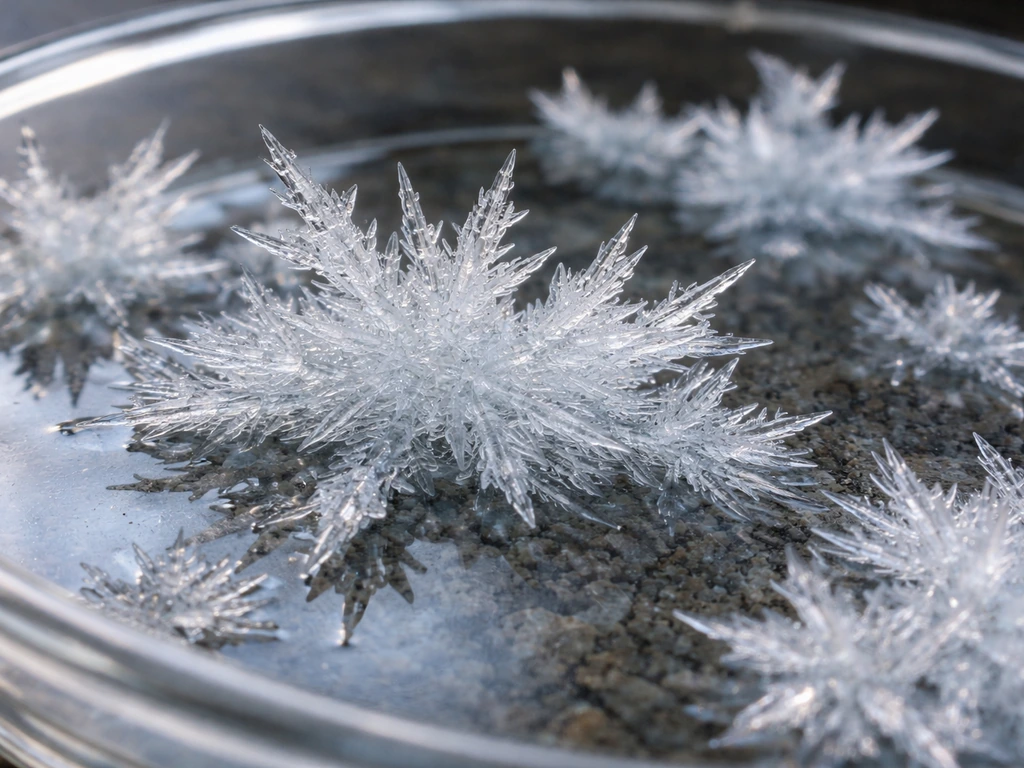
Dendritic or spiky growth means ions are arriving faster than the lattice can organize them. This happens when supersaturation is very high, when the solution is stirred or disturbed, or when impurities block certain faces and force ions to pile up on edges and corners. Fix: slow down by diluting the solution slightly with additional water, eliminate stirring, and filter out impurities. This is analogous to what happens in other fast-growth scenarios, like the way crystals growing during rapid metamorphic processes end up with irregular grain shapes rather than clean forms. In the Earth, recrystallization during metamorphism can likewise promote longer grain growth by reorganizing mineral material under changing conditions.
Crystal cracks or falls apart when removed from solution
Alum crystals contain water of crystallization (12 water molecules per formula unit). Removing them from solution too quickly causes the outer surface to dry faster than the interior, building up stress that cracks the crystal. Fix: after growth, remove the crystal and coat it immediately with a thin layer of clear nail varnish or PVA glue to slow dehydration. Store in a sealed container or damp environment.
Crystal dissolves after being placed in solution
If the seed or growing crystal visibly shrinks, the solution is undersaturated, meaning it can still dissolve more alum rather than depositing any. This happens if the solution was not prepared at full saturation, or if you placed a cold crystal into a warmer solution. Fix: remove the crystal, prepare a fresh saturated solution at high temperature, let it cool to your target temperature, confirm the temperature is stable, then re-introduce the seed.
The bigger picture of crystal growth
Alum is one of the most forgiving systems for studying how growth works because the solubility curve is steep, the crystals are large and optically clear, and the timescales are human-friendly. The same principles, supersaturation driving ion deposition onto an ordered lattice, nucleation controlling how many growth centers compete, and mass transport setting the growth rate, appear across many natural and industrial crystal systems.
Carbon nanotubes grow in a similar way in that supersaturation-like conditions and catalyst-controlled nucleation determine where growth starts and how it proceeds along the tube why carbon nanotubes grow. If you are curious about size limits in crystal growth more broadly, the same competition between nucleation and growth rate determines how big crystals can ultimately get, whether you are talking about alum in a jar or minerals forming deep in the Earth during metamorphism.
In practice, that balance between nucleation and growth rate helps explain how big crystals can grow before the driving force is exhausted how big can crystals grow.
The practical takeaway is simple: alum crystals grow because thermodynamics says excess solute in a supersaturated solution must move to the lower-energy solid state. Your job as the experimenter is just to control how that happens. Keep supersaturation mild and steady, minimize nucleation sites to one, let diffusion do the transport work slowly, and keep the chemistry clean. Do those four things and you will reliably get large, clear, geometrically perfect crystals.
FAQ
Why does my seed stop growing after it seemed to start well?
Alum can keep growing only while the surrounding liquid stays mildly supersaturated. If you hit full saturation and then let the solution cool too far, supersaturation can collapse quickly and the seed may stall, or it may trigger fresh nucleation if the liquid is still too concentrated. A practical check is to confirm the solution temperature is stable before seeding (avoid drafts and frequent opening), then monitor for growth over the next 12 to 24 hours.
Can stirring or moving the jar cause extra tiny crystals even if I used a seed?
Yes. Even with a seed present, stirring, bumping the container, or fast pouring can reintroduce nucleation events by disrupting the boundary layer and locally increasing ion concentration. For alum, gentle handling matters most in the first day, because that is when additional nuclei compete and can steal solute from the seed.
What should I do if tiny crystals show up after several hours of growth?
You should remove the first “second generation” clusters if they appear near the seed or the bottom crust. They compete for solute and also add surfaces that can promote further nucleation. Use clean tweezers or a skimmer, then re-check that the bulk solution looks clear around the main seed.
How can I tell when the solution is the right supersaturation level to add the seed?
A useful rule of thumb is to use a seed only when the solution is just barely beyond saturation at your target temperature. If you do not have a thermometer, approximate by cooling slowly and seeding only when the solution is still warm enough to remain clear but not visibly “extra concentrated” (no rapid, immediate cloudiness). The sharpest failures happen when seeding too early while the liquid is still far from the saturation point.
Why does my crystal become surrounded by many tiny crystals, even though I seeded?
If your solution is too supersaturated, new nuclei form throughout the bulk, not just on the seed. One fix is to dilute slightly with additional cooled water (not hot), then let the system sit undisturbed to re-establish a stable depletion layer around the seed. Another fix is making a fresh batch with slower cooling and seeding later.
Does where I place the seed in the jar change the outcome?
Seed position affects secondary nucleation. If the seed touches the container wall or sits in sediment, ions can deposit unevenly and the local chemistry near the surface can differ from the bulk. Suspend the seed in the center using a nylon thread and keep the bottom clear of floating dust.
Why do my crystals look cloudy or irregular when I used clean techniques but normal tap water?
Yes, because ionic impurities and residual cleaning chemicals can adsorb to faces or shift solution chemistry. Even small residues from soap, detergents, or dusty surfaces can reduce clarity and change growth habit. Rinse containers thoroughly, then use filtered or distilled water, and avoid contact with skin oils.
How do I fix a seed that visibly shrinks?
If the crystals shrink, the most common cause is undersaturation at the crystal’s actual temperature, or a temperature mismatch between seeding and later storage. Seeds placed into a warmer or less concentrated solution will partially dissolve. Re-make a saturated solution at high temperature, cool to the same temperature you plan to grow at, and avoid changing temperature during the first day.
Why do my alum crystals crack or turn powdery after I take them out of the solution?
Alum is a hydrate, and rapid dehydration can crack or powder the outer layer because the surface loses water before the interior equilibrates. After growth, remove the crystal quickly and seal it (for example with a thin clear coating) to slow further water loss, then store in a sealed container or damp environment.
Why does adding acid help, and what happens if the solution becomes too alkaline?
Changing pH can alter what species are present in solution, especially for aluminum. If pH drifts too alkaline, aluminum hydroxide can precipitate instead of incorporating into the alum lattice, leading to weak, patchy growth. Use only small, measured acid additions (like a tiny vinegar drop), then let the mixture rest so the chemistry stabilizes before seeding.
Can I grow alum crystals by evaporation alone instead of cooling?
Yes. If you rely on evaporation, the concentration increases gradually over time, which can keep supersaturation alive for weeks. However, evaporation also concentrates impurities, and it changes temperature slightly through airflow and condensation. Keep evaporation gentle by covering loosely, and periodically observe for cloudiness (a sign that uncontrolled nucleation or impurity precipitation is starting).
Next Article
What Controls When and How Fast Cells Grow and Divide
Learn what controls cell division timing and speed: checkpoints, signals, resources, DNA damage, stress, and failure lea