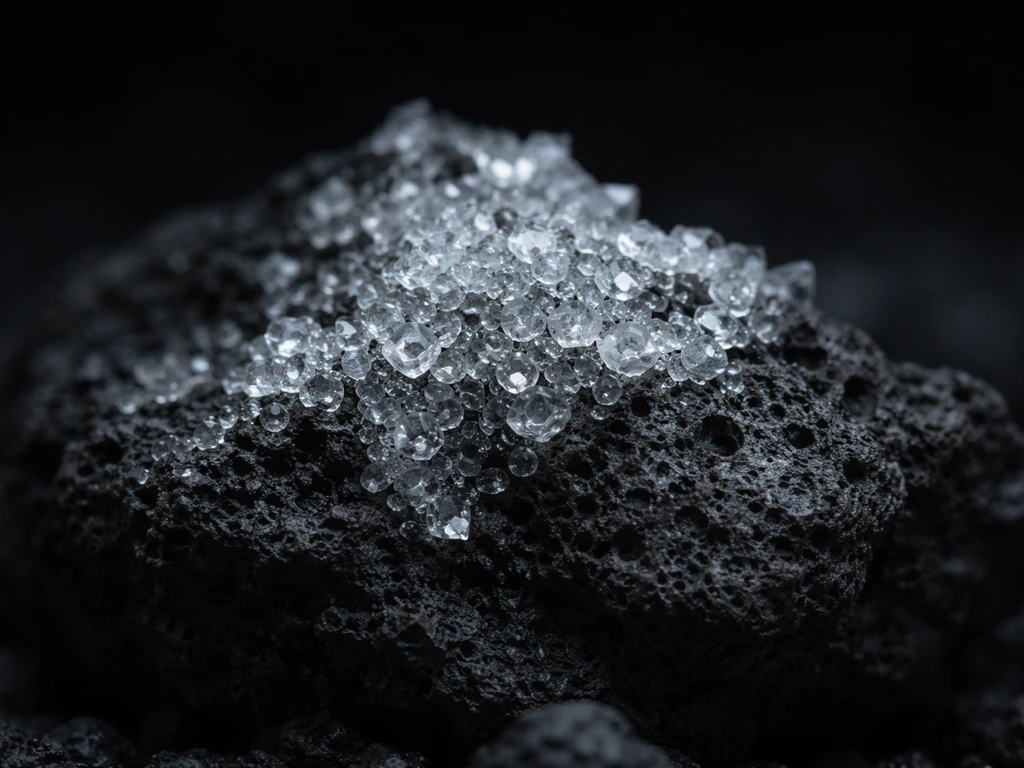
Crystals grow on charcoal because the charcoal's porous, high-surface-area structure gives dissolved ions a place to concentrate and lock into a solid lattice. The carbon itself isn't supplying anything. The crystals come entirely from whatever is dissolved in your solution, whether that's salt, alum, Epsom salt, or copper sulfate. Charcoal just happens to be an almost perfect scaffold: it pulls liquid deep into its pores through capillary action, accelerates evaporation at those surfaces, and provides thousands of tiny rough spots where crystal nucleation can get started without needing much encouragement.
Why Crystals Grow on Charcoal: Science and Troubleshooting

Marcus Whitmore
11 May 2026
What's actually growing: solute ions vs. minerals on charcoal
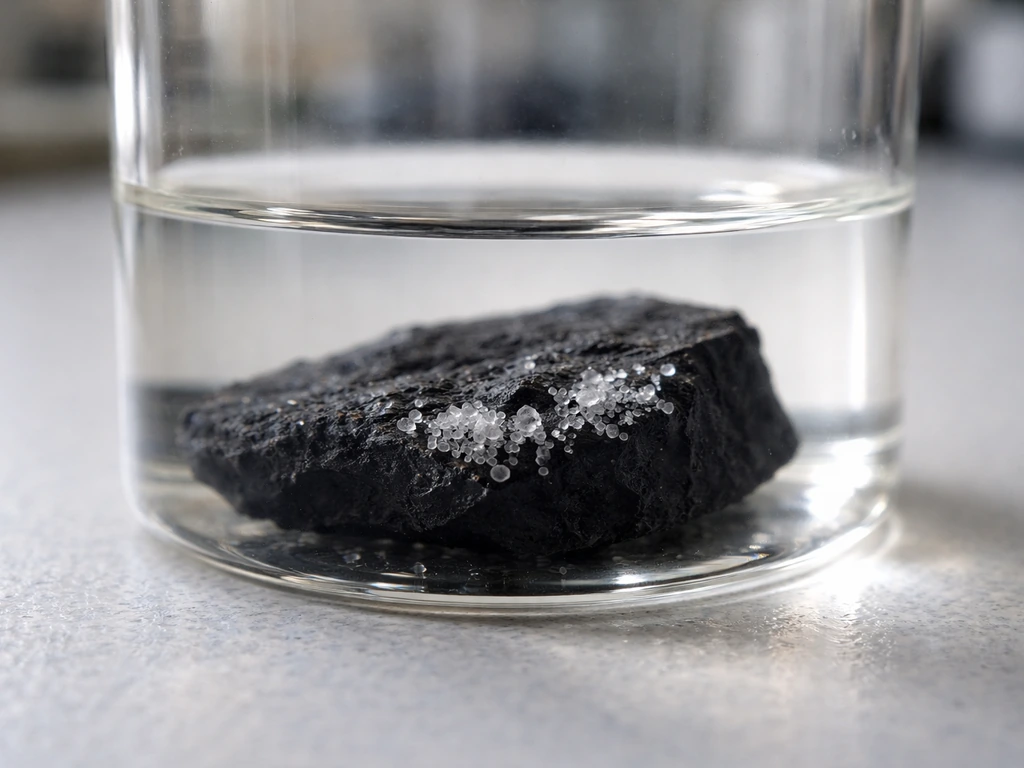
A lot of people assume the charcoal itself is transforming into something crystalline. It isn't. Carbon doesn't spontaneously rearrange into salt crystals or sulfate crystals under kitchen conditions. What you're watching grow is the solute, the stuff you dissolved in your water. When you soak charcoal in a saturated salt solution, the sodium and chloride ions travel with the water into every pore. As the water evaporates, those ions are left behind in higher and higher concentrations until the solution becomes supersaturated and they have no choice but to pack together into a crystal lattice.
There is one exception worth knowing: if your charcoal came from a natural source like wood ash or BBQ briquettes, it may already carry trace minerals, calcium compounds, potassium salts, or other residues. These can seed tiny crystals on their own, even without you adding a solute. That's interesting, but it also means your results can be inconsistent if you're working with impure charcoal. If you want predictable, photogenic crystals, you want to control what's in the solution, not guess what's leaching out of the charcoal.
Why charcoal helps: porosity, surface area, nucleation, and adsorption
Think of charcoal as a sponge made of carbon tunnels. Activated charcoal in particular has an internal surface area that can reach hundreds to thousands of square meters per gram, all folded into a piece you can hold in your hand. That surface area does several things that are genuinely useful for crystal growth.
First, capillary action draws the solution up into tiny pores, spreading it over enormous surface area. More surface area means faster evaporation, which means the solution reaches supersaturation sooner than it would in a flat dish. Second, every tiny scratch, edge, and pore opening is a potential nucleation site. Nucleation is the process where ions first organize themselves into a stable crystal embryo, and it's much easier to start that process on a rough surface (called heterogeneous nucleation) than in pure open solution. University of Kentucky physical chemistry resources describe this as the key distinction: heterogeneous nucleation on surfaces or impurities requires far less energy than homogeneous nucleation from scratch in a clean liquid.
Third, activated carbon can adsorb metal ions from solution, actually pulling certain cations like copper, nickel, and iron toward its surface, as documented in peer-reviewed adsorption studies. This locally increases ion concentration near the charcoal surface compared to the bulk solution, giving crystals an even bigger head start there. The effect is stronger with metal-based solutes like copper sulfate than with simple salts, which explains why copper sulfate crystals on charcoal often look especially vivid and fast-growing.
Key conditions that control crystal size and shape
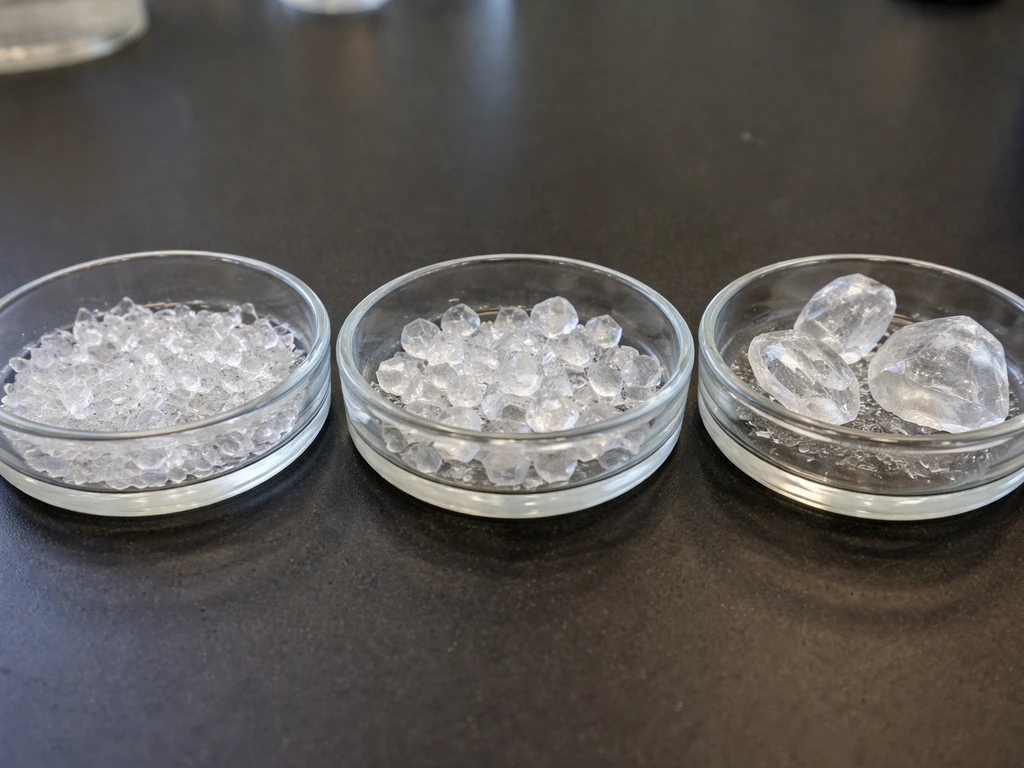
Whether you end up with a dramatic cluster of large crystals or a disappointing crust of powder depends almost entirely on how you manage three variables: concentration, temperature, and evaporation rate.
Concentration
Your starting solution needs to be saturated or close to it. If it's too dilute, you won't hit the supersaturation threshold needed for nucleation before the water is gone. If it's wildly oversaturated, you get an explosion of nucleation sites all at once, producing hundreds of tiny crystals competing for the same ions instead of a few large ones growing slowly. MIT's crystal-growth guidance makes this point clearly: too many nucleation sites is the enemy of large crystals. You want a few good nuclei that can grow large, not thousands of tiny ones that stay small.
Temperature
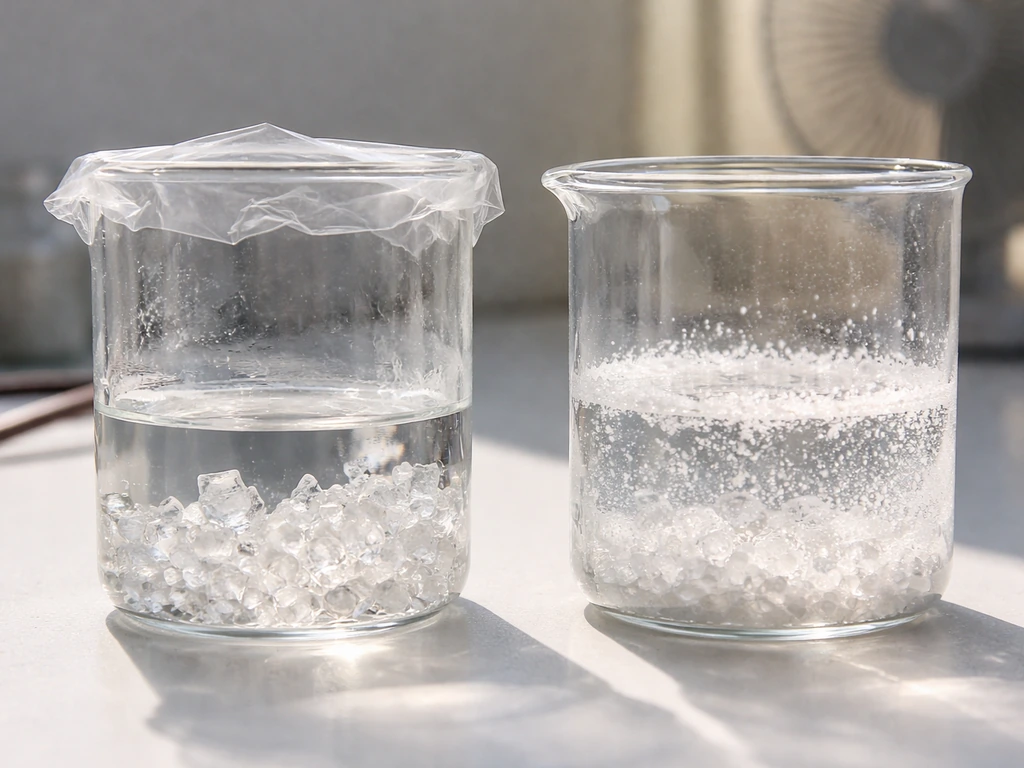
Most crystal-growing solutes are more soluble in hot water. Making your solution hot, then letting it cool slowly, is a classic way to drive supersaturation without evaporation. On charcoal, you can combine approaches: soak the charcoal in a hot saturated solution, then let the whole setup cool and evaporate at room temperature. Avoid putting your setup somewhere with big temperature swings because that causes repeated dissolving and re-nucleation, which keeps crystals small and messy.
Evaporation rate
Slow evaporation is almost always better. When evaporation is fast (hot room, fan blowing across the setup, direct sunlight), ions pile up at the surface faster than they can organize into an orderly lattice. The result is powdery crust rather than faceted crystals. Slow evaporation gives ions time to find their correct positions in the growing lattice, producing the clean flat faces and sharp edges that make crystals actually look like crystals.
MIT’s crystal-growing guidance notes that slow evaporation helps produce better crystals and that controlling nucleation sites is important for forming larger crystals Slow evaporation gives ions time to find their correct positions in the growing lattice.
Chemistry LibreTexts crystallization theory puts it well: hurried crystallization traps solutes indiscriminately, while slower processes allow more controlled equilibrium at the crystal surface.
Why you might get no crystals or only powder
If your setup isn't working, here are the most common culprits and what to change first. If you're wondering, is your cermet going to grow, the key is whether the material has the right conditions for sustained, organized growth rather than a chaotic powdery outcome.
- Solution too dilute: make a fresh batch, dissolving as much solute as possible in hot water, then filter out any undissolved particles before soaking the charcoal.
- Too many nucleation sites competing: this happens with rough charcoal in highly oversaturated solution. Try a slightly less concentrated solution and let it evaporate more slowly.
- Contamination in the water: tap water often contains chlorine and mineral impurities that interfere with regular crystal lattice formation. Switch to distilled or deionized water.
- Charcoal not rinsed: unwashed charcoal releases ash, oils (if it came from a grill), and mineral residues that act as competing nucleation sites and contaminate the solution.
- Filtration skipped: if you dissolved your solute in hot water but didn't filter it before use, undissolved particles and dust are in the solution, causing premature nucleation and powdery results.
- Environment too humid or too dry: high humidity slows evaporation so much that crystals barely form; extremely dry conditions speed evaporation and produce powder. Aim for a stable room-temperature environment.
- Vibration or disturbance: bumping or stirring the setup after crystals have started forming can break nuclei and restart the process, keeping everything small.
How to set up a reliable crystal-growing experiment on charcoal
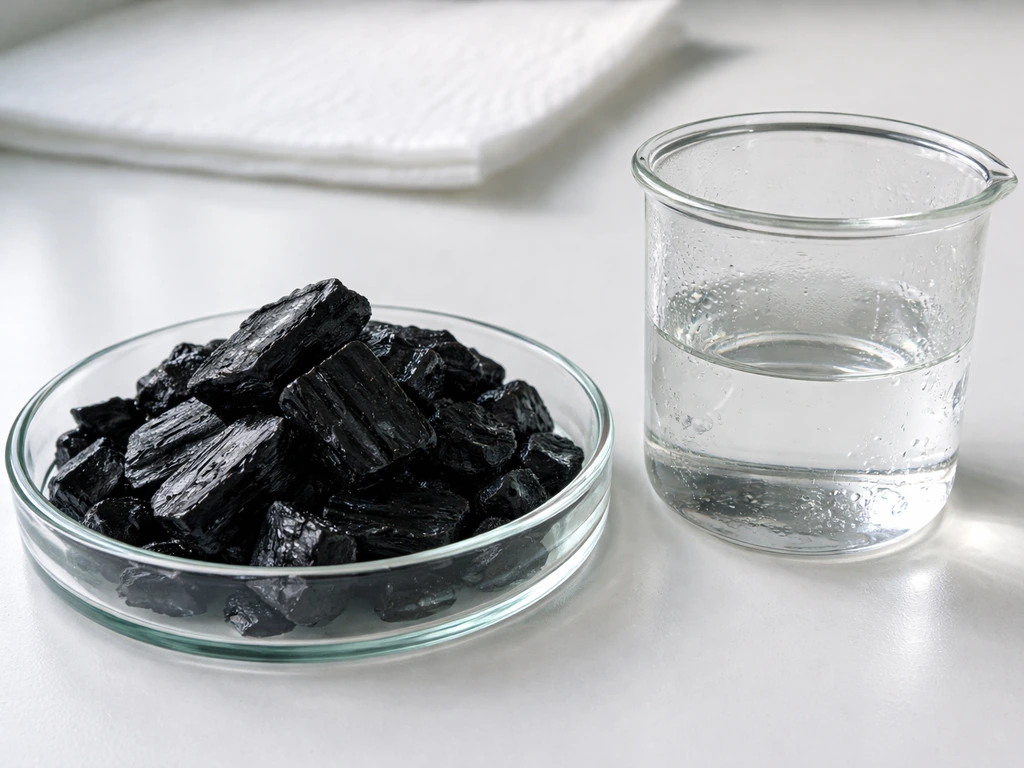
This method works well for common solutes like table salt, alum, Epsom salt, or copper sulfate. Adjust amounts based on your solute's specific solubility, but the steps are the same.
- Prepare your charcoal: rinse it thoroughly under distilled water to remove ash, dust, and any surface residue. Let it drain but don't let it fully dry out before the next step.
- Make a saturated solution: heat distilled water to near boiling, then dissolve your chosen solute gradually, stirring until no more will dissolve. You want the maximum amount possible in solution.
- Filter the hot solution: pour it through a coffee filter or fine mesh to remove any undissolved particles or impurities. This step makes a bigger difference than most beginners expect.
- Soak the charcoal: submerge the charcoal pieces in the hot filtered solution for at least 10 to 15 minutes, turning them to ensure all pores are penetrated.
- Arrange in a shallow dish: place the soaked charcoal in a shallow container, then pour just enough of the remaining solution to barely cover the bottom of the dish. You want the top surfaces of the charcoal exposed to air.
- Choose a stable, low-traffic spot: set the dish somewhere with consistent room temperature, no direct sunlight, and no fans or drafts nearby. Cover loosely with a sheet of paper (not plastic) to slow evaporation without blocking airflow entirely.
- Wait and observe: first crystals typically appear within 24 to 48 hours for fast-growing solutes like salt or Epsom salt. Alum and copper sulfate may take 3 to 7 days for well-formed crystals.
- Add solution as needed: if the dish dries out completely before large crystals form, carefully add a small amount of fresh saturated solution without disturbing the charcoal.
- Photograph or preserve: once crystals reach a size you're happy with, remove the charcoal and let it dry in open air. Crystals can be sealed with a light coat of clear acrylic spray to preserve them.
Charcoal preparation and choosing the right type
Not all charcoal behaves the same way, and the type you choose will noticeably affect your results.
| Charcoal Type | Surface Area | Adsorption Ability | Best For | Watch Out For |
|---|---|---|---|---|
| Activated charcoal (granular) | Very high (500–1500 m²/g) | Strong, especially for metal ions | Fast nucleation, vivid results with copper sulfate | Can adsorb so much solute that bulk crystal growth slows |
| Activated charcoal (powder) | Extremely high | Very strong | Dense crystal carpets | Hard to handle; may produce powder instead of large crystals |
| Hardwood lump charcoal | Moderate | Low to moderate | Good balance of surface area and crystal size | Contains variable mineral residues; always rinse well |
| Briquettes (BBQ) | Low to moderate | Low | Budget experiments | Often contain binders, fillers, and accelerants; rinse extensively or avoid |
| Aquarium activated carbon | High | Moderate | Clean, consistent results | Usually very clean; good choice for beginners |
For most people reading this, hardwood lump charcoal or aquarium activated carbon are the easiest starting points. Aquarium carbon is already cleaned and sized consistently, which removes a lot of variables. If you use BBQ briquettes, rinse them multiple times and soak in distilled water for an hour before your experiment. The binders and accelerants in briquettes can contaminate your solution badly enough to prevent any crystal formation at all.
Water purity matters just as much as charcoal purity. Distilled water is the standard for a reason: it contains no competing ions or dissolved minerals that could hijack your nucleation sites or alter your crystal chemistry. Using tap water isn't always a disaster, but if your results are inconsistent or powdery, switching to distilled water is often the single change that fixes everything.
Safety and cleanup
Salt, sugar, and alum (potassium aluminum sulfate) are the safest solutes for this experiment and are fine for home use with basic hygiene precautions. Epsom salt (magnesium sulfate) is similarly low-risk. Copper sulfate is a different story.
- Copper sulfate is toxic to aquatic life and can irritate skin and eyes. Wear gloves when handling the solution, and never pour copper sulfate solutions down a drain that connects to a waterway. Neutralize and dispose of it according to your local chemical waste guidelines.
- Keep all crystal-growing solutions away from children and pets. Even 'safe' solutes like alum can cause GI irritation if ingested.
- Label all containers clearly, including the date and what's in the solution. Crystal solutions can look like plain water.
- When handling charcoal, especially activated charcoal powder, work in a ventilated space and consider a dust mask. Fine carbon particles are unpleasant to inhale.
- After the experiment, dissolve residual crystals in water before disposal. Dry crystals that crumble can send fine particles into the air.
- Wash hands thoroughly after any handling, even with the 'safe' solutes.
How this connects to bigger principles of structured growth
Crystal growth on charcoal is a surprisingly clean illustration of something that shows up across all forms of growth: structure only emerges when conditions are right, resources are available but not overwhelming, and there's a scaffold or template to organize around. Too much supply too fast and you get chaotic powder. Too little and nothing forms at all. The sweet spot is a narrow band of supersaturation where organized, large-scale structure can emerge.
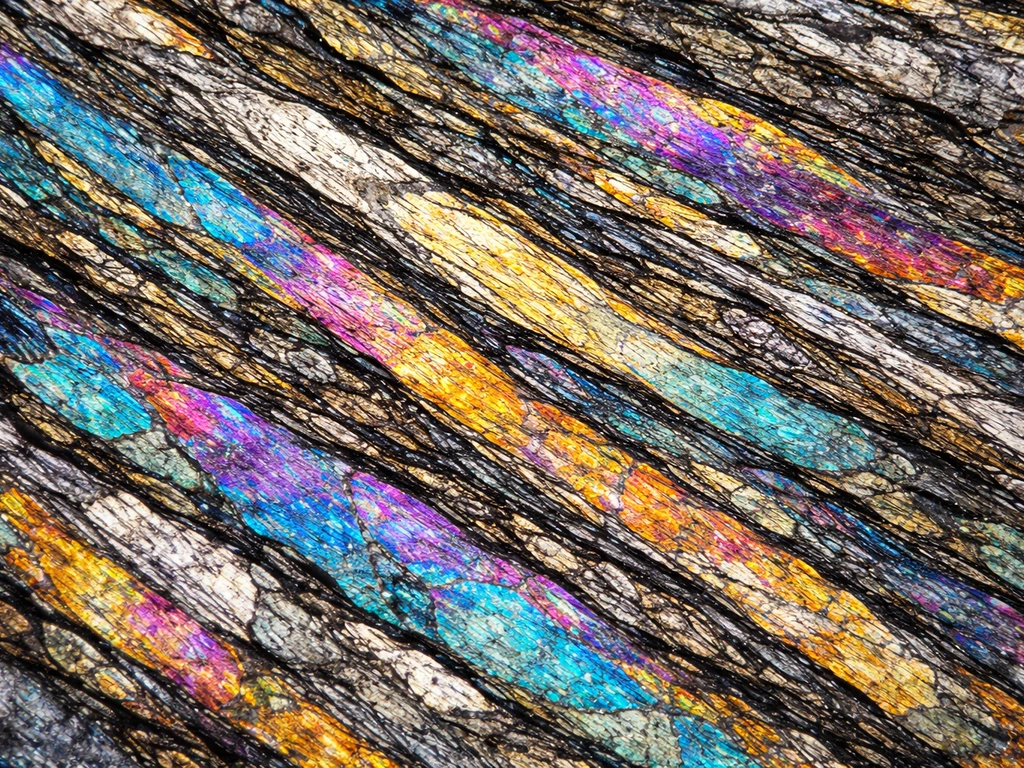
This mirrors biological growth constraints in a striking way. Cells, organisms, and crystals alike can't grow indefinitely. For crystals, growth slows as the surrounding solution drops back out of supersaturation and the driving force for more ions to join the lattice weakens. During metamorphism, recrystallization can cause grains to grow longer as the crystal lattice reorganizes under changing pressure and temperature recrystallization during metamorphism. MIT's crystal-growth research frames it this way: as nuclei form and grow, they deplete the solution, pulling it back toward equilibrium and naturally limiting further growth. The system self-regulates. That same principle, of growth constrained by available resources and feedback from the environment, appears in everything from cell division to glacier formation.
If you're curious how these limits play out at larger scales, the question of how big crystals can ultimately grow touches on the same supply-and-constraint logic: growth continues as long as the supersaturation gradient exists and the environment supports it. Similarly, if you've ever grown alum crystals in a beaker, the mechanism driving those results is the same heterogeneous nucleation process at work on charcoal, just without the scaffolding that makes charcoal results so dramatic and fast.
Charcoal doesn't make the rules of crystal growth different. It just makes the conditions easier to achieve, compressing the timeline and concentrating the action into a small, visible space. Once you understand that the charcoal is a scaffold and the solute is the building material, you have real control over the experiment and real insight into one of the most fundamental processes in the physical world.
FAQ
How can I tell whether the crystals are coming from my dissolved salt versus impurities in the charcoal?
Crystals should start appearing as new solid “seeds” along pores and rough edges, not as the charcoal itself turning into salt. If you see only dark staining or a fuzzy film, that usually means you are getting adsorption of organics or dye-like residues from impure charcoal, not crystallization of your added solute.
What should I do if no crystals form at all on the charcoal?
If nothing grows, the most common causes are (1) the solution never reached supersaturation (too dilute), (2) the temperature dropped too slowly or too quickly so you never crossed the crystallization threshold, or (3) the charcoal leached something that suppresses nucleation. A quick fix is to re-make the solution freshly with distilled water, heat to dissolve completely, then cool to room temperature without disturbance and keep evaporation slow.
Why do I end up with powdery crust instead of faceted crystals on charcoal?
If you get a powdery crust, you likely overshot supersaturation or evaporated too fast, which creates huge numbers of nuclei that compete and stay small. To correct it, remake a solution closer to saturation, use a cooler room with minimal airflow, and cover loosely (not airtight) to slow evaporation.
Does stirring or moving the setup during growth affect crystal size?
Yes, if your goal is larger crystals, avoid agitation once nucleation begins. Stirring or bumping redistributes ions and detaches fragile early crystals, leading to more nucleation events and smaller outcomes.
How do temperature changes influence crystal formation on charcoal?
Many people accidentally create repeated cycling by moving the container between warm and cool spots or putting it near vents or sunlight. Temperature swings can redissolve crystals, then re-precipitate them, which increases “churn” and reduces the chance for well-formed facets.
Why does copper sulfate behave differently on charcoal than table salt or alum?
Copper sulfate solutions are more likely to form messy or overly fast patterns because they are strongly affected by adsorption and local concentration changes near charcoal. If copper sulfate is involved, use a fresh batch of distilled water, keep evaporation slow, and consider lowering the concentration slightly so you stay in a narrower supersaturation window.
Will any type of charcoal work, or does brand and processing matter?
Activated carbon is not all equivalent. Some products are more fine-grained, have different pore sizes, or contain ash and manufacturing residues that change adsorption and nucleation. For more consistent results, use aquarium-grade activated carbon or the same charcoal lot each run and rinse/saturate it in distilled water before use.
What’s the best way to deal with unknown charcoal impurities from BBQ briquettes or wood ash?
If your charcoal came from BBQ briquettes or wood ash, it may release ash components like calcium or potassium salts that can seed unwanted crystals or shift which solid forms first. Rinsing alone may not remove everything, so soaking in distilled water and discarding that rinse is often the better control step.
If I use distilled water, why do results still vary run to run?
Distilled water helps because it has no competing dissolved ions, but it is not the only factor. Even with distilled water, tap-water contamination can enter from dirty glassware, pipettes, or dust from the environment. If results vary between runs, clean containers thoroughly and let surfaces air-dry before starting.
What control knob should I adjust first if I want bigger crystals?
You can influence nucleation density by changing how quickly ions accumulate. A practical decision rule is: higher evaporation rate tends to increase nucleation sites and reduce crystal size, while slower evaporation and near-saturation conditions tend to favor fewer nuclei and larger crystals.
Next Article
Recrystallization During Metamorphism and Anisotropic Grain Growth
Why metamorphic recrystallization makes grains lengthen along foliation lineation, producing anisotropic, oriented growt