A glacier grows when it gains more ice than it loses, and it retreats when it loses more than it gains. That's really the whole answer in one sentence. But the interesting part is understanding what drives those gains and losses, how fast the system responds, and why the same glacier can advance in one decade and shrink dramatically in the next. If you want to understand what's happening to a specific glacier, you need to think about it the same way you'd think about a bank account: income in, expenses out, and what's left over at the end of the year.
What Causes a Glacier to Grow or Recede
Marcus Whitmore
7 Apr 2026
Glacier growth vs retreat: the mass-balance idea
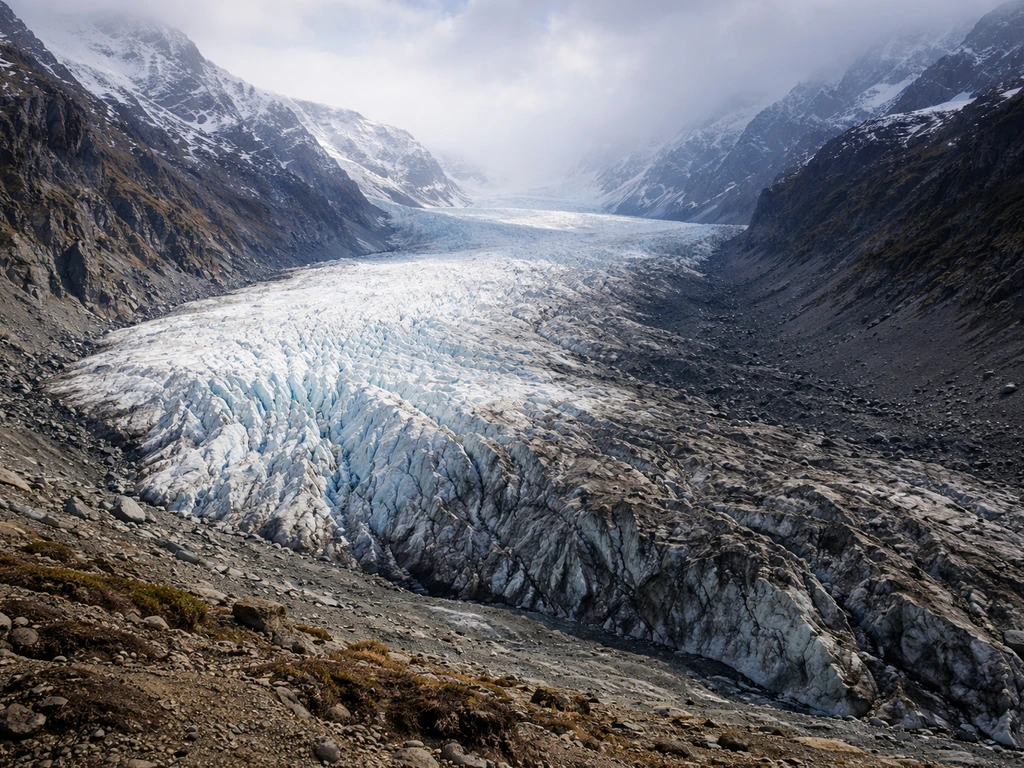
The USGS describes glacier mass balance as "balancing a glacier's checkbook." The income side is snow accumulation, and the expense side is ablation, which is every process that removes snow or ice. Add them together over a year and you get the net annual mass balance. If it's positive, the glacier gained mass. If it's negative, it lost mass. If losses and gains stay roughly equal over many years, the glacier is in a kind of steady state. The IPCC defines it the same way: mass balance is the difference between mass input and mass loss over a stated time period.
Scientists express mass balance in water-equivalent units (abbreviated w.e.) rather than raw ice thickness, because snow and ice have different densities. A meter of fresh snow contains far less water than a meter of dense glacier ice, so comparing depths directly would be misleading. Converting everything to water equivalent puts accumulation and ablation on the same scale, which makes the checkbook comparison actually work.
To really dig into how this plays out over time, it helps to understand how glaciers grow from first principles, because the accumulation side of the ledger has its own interesting physics. The short version: snow falls, compacts into firn, and eventually recrystallizes into dense glacial ice. That process is a form of growth that mirrors how other natural structures build themselves incrementally over time.
What adds ice: snowfall accumulation and how it varies
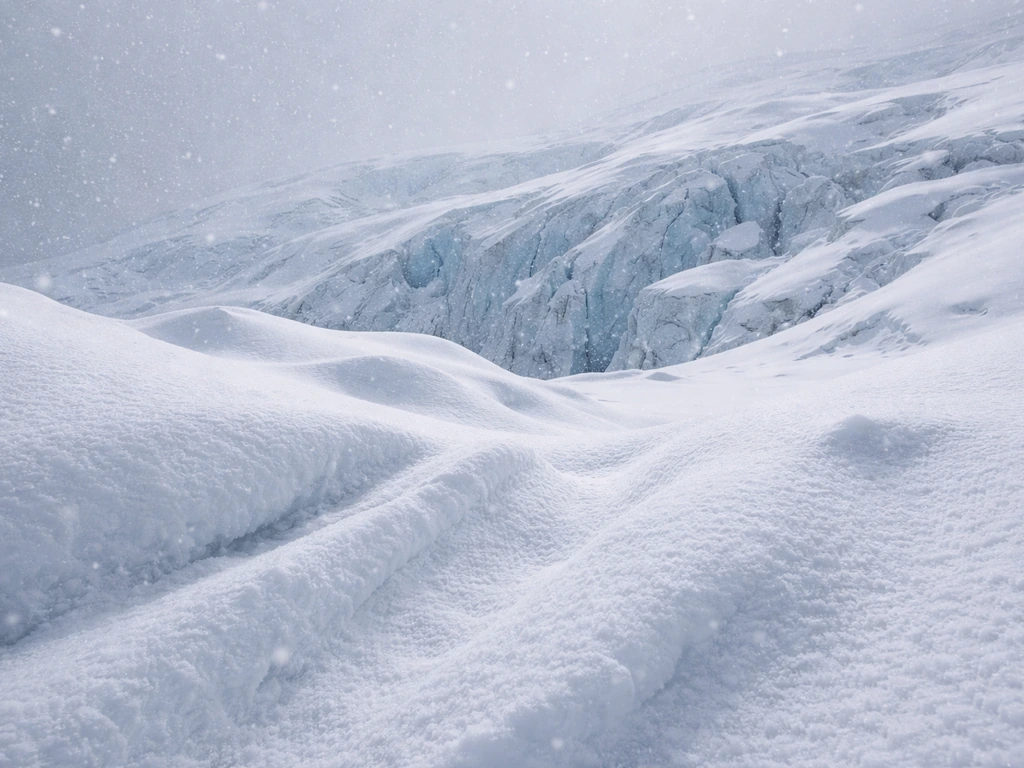
Accumulation is dominated by snowfall, but it also includes contributions from freezing rain, wind-blown snow drifting onto the glacier surface, and avalanches depositing snow from surrounding slopes. The accumulation zone is the upper portion of the glacier where snow input exceeds loss, and scientists measure it using networks of stakes and snow pits to track how much snow equivalent has been added each winter.
Snowfall variability is a bigger driver of mass balance than most people expect. Research in the Himalaya-Karakoram region found that snowfall variability strongly dictates glacier mass-balance variability, with improved correlations when summer temperatures are also factored in. In other mountain ranges, a warmer atmosphere can actually shift precipitation from snow to rain, which means a glacier receives the same total precipitation but less of it contributes to accumulation. One modeling study found that warming can reduce the snowfall fraction during the accumulation season and cause snow cover to retreat earlier in spring, compressing the window when the glacier is actually building up mass.
High-altitude snowfall is also tricky to measure directly. Weather stations are usually located in valleys for practical reasons, and precipitation increases with elevation in complex, non-linear ways. Researchers working on the Tibetan Plateau noted that snowfall in high mountains is poorly understood precisely because of the scarcity of climate stations at high elevation. Modern approaches combine satellite data with reanalysis climate data and machine-learning tools to reconstruct winter mass balance across elevation gradients, helping fill in where direct measurements are absent.
What removes ice: melting, sublimation, and evaporation
Ablation is the collective term for all the processes that remove mass from a glacier. The NSIDC definition covers melting, sublimation, evaporation, and even wind erosion and avalanching off the glacier surface. Of these, surface melting driven by warm air temperatures is the biggest contributor for most mountain glaciers. Meltwater runs off the glacier surface and into streams, so that water is simply gone from the system.
Sublimation, the direct conversion of ice to water vapor without passing through a liquid phase, matters more than many people realize. It's strongest in dry, warm, and windy environments, which is exactly why glaciers in dry mountain ranges like the Andes or parts of Central Asia can lose significant mass through sublimation even when air temperatures are below freezing. Humidity is the key variable: low humidity allows the atmosphere to absorb water vapor directly from the ice surface, bypassing the melt step entirely.
It's worth noting that these ablation processes work on the same basic physics as other ice-growth phenomena. The same thermodynamic rules that govern how ice crystals grow in clouds also determine how quickly those crystals are destroyed when conditions reverse. Growth and loss are two sides of the same physical coin.
Ice loss beyond melting: calving, runoff, and ice flow/dynamics
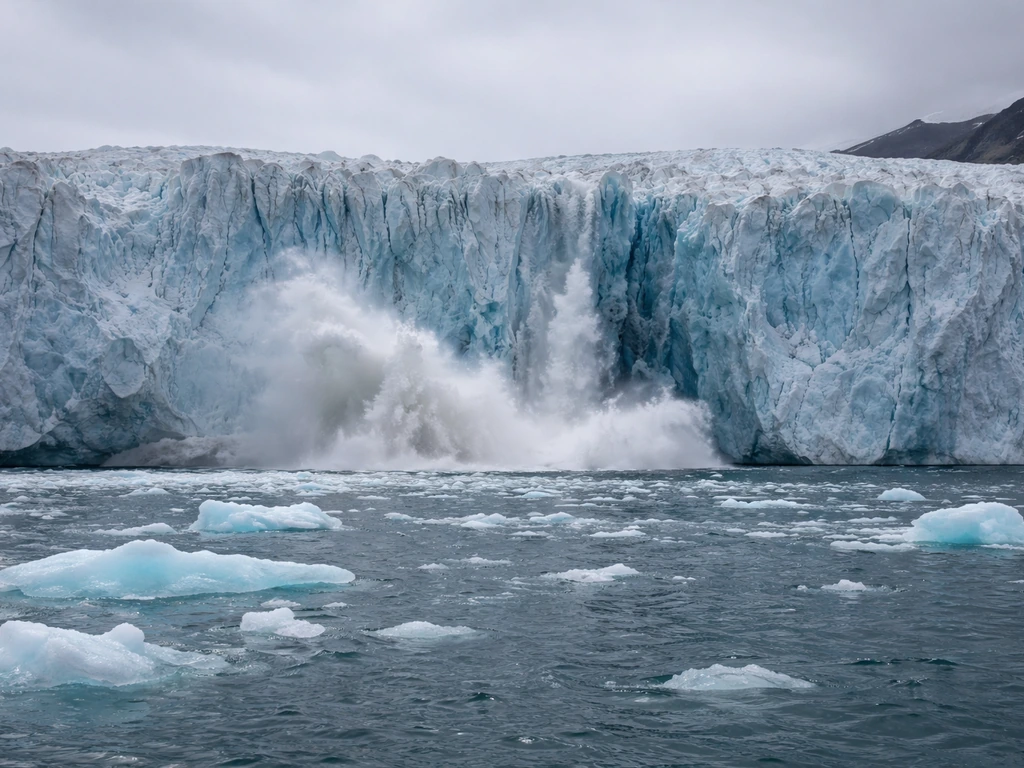
For tidewater glaciers, those that end in the ocean or a lake, calving is often the dominant ablation mechanism. Calving is the release of icebergs from the glacier terminus. It's not driven purely by surface temperature; it's controlled by the structural integrity of the ice at the front, ocean water temperature melting the ice from below the waterline, and how fast ice is flowing toward the terminus from upstream.
Jakobshavn Glacier in Greenland is one of the most dramatic examples on record. When its floating ice tongue broke up, the glacier's speed roughly doubled and ice discharge into the Davis Strait nearly doubled as well. This is a dynamic contribution to retreat: the glacier wasn't just melting faster at the surface, it was physically moving more ice to the ocean faster. A 2025 dataset analyzing 49 tidewater glaciers in Greenland made an important distinction between terminus-position-driven mass change and solid ice discharge, because the two processes respond to different forcing mechanisms and on different timescales.
Subglacial dynamics add another layer of complexity. Work on Thwaites Glacier in Antarctica has shown that subglacial lake discharge events can affect grounding-line stability and ice flow, which in turn influences how quickly mass is lost. This means that even without any change in surface climate, internal plumbing events beneath the ice can temporarily accelerate or modify retreat rates.
The biggest climate controls: temperature, precipitation, and variability
Temperature and precipitation are the two master knobs. Temperature controls how much of the year's precipitation falls as snow versus rain, how long and intense the melt season is, and whether snowpack survives into summer or disappears early. Precipitation controls how much raw material enters the accumulation zone in the first place. These two variables can work together or against each other: a warmer, wetter year might still result in a positive mass balance if snowfall increased enough to offset greater melt, while a slightly warmer but much drier year could produce a large negative balance.
Research consistently finds that glacier mass balance is more sensitive to air temperature than to precipitation in most contexts. This is partly because temperature affects both sides of the ledger simultaneously: it reduces accumulation by shifting snow to rain and increases ablation by extending the melt season. Precipitation only affects the accumulation side directly.
The EPA cautions that observed changes in benchmark glaciers reflect a combination of global and local variations in both temperature and precipitation. This is a useful reminder that a glacier retreating in one region might be driven primarily by temperature rise, while a glacier retreating in another region might be responding to a long-term decline in winter snowfall. You need regional data to distinguish them.
It's also worth thinking about how atmospheric moisture and precipitation processes work at the cloud scale, because that's where snowfall originates. The Bergeron process causes cloud droplets to grow because of the difference in vapor pressure between ice crystals and liquid water droplets at the same temperature. Changes in cloud dynamics and atmospheric circulation patterns upstream of a mountain range can shift how much of that precipitation actually reaches the glacier surface as snow.
Feedbacks that speed up or slow down change (albedo/soot/dust)
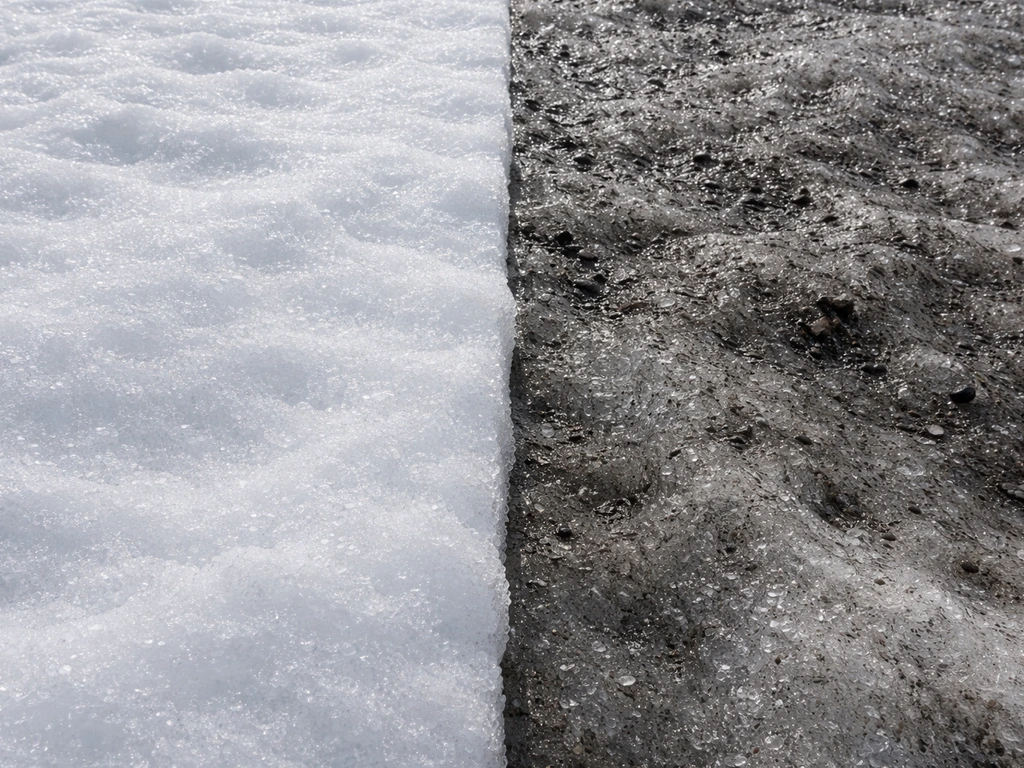
Glaciers don't just passively respond to climate. They participate in feedbacks that can amplify or dampen change. The albedo feedback is the most important one. Fresh snow reflects up to 90% of incoming solar radiation. As a glacier retreats, it exposes darker ice, bare rock, and eventually soil and vegetation, all of which absorb far more solar energy. More absorption means more warming at the surface, which drives more melting, which exposes more dark surface. The feedback accelerates itself.
One 2025 study found an empirical correlation where roughly a 0.5°C increase in summer temperature corresponds to about a 0.02 decrease in albedo for North American glaciated regions. That might sound small, but over a large glacier surface over a full melt season, the additional energy absorbed is substantial.
Deposited impurities make this worse. Black carbon (soot) from combustion sources and mineral dust from desert regions can settle on glacier surfaces and dramatically reduce reflectivity. Typical measured black carbon concentrations in field snow run between 10 and 20 parts per billion, but maxima up to around 500 ppb have been recorded. In snow with active melt forms, light-absorbing impurities can reduce albedo by up to 19% under some conditions. A 2025 study on Argentière Glacier in France quantified how Saharan dust reduced snow albedo, increased melt rate, and lowered surface mass balance over 2019 to 2022. NASA has used Landsat imagery to study dust deposition over Himalayan glaciers, tracking how albedo changes before and after dust storm events.
There's an interesting parallel here to questions about whether dynamic natural systems like clouds exhibit growth-like behavior. Clouds can move and grow, but they're not living, and glaciers are the same way: they show complex growth and decay dynamics driven by physical feedbacks, not biology. The feedbacks are just as real and just as self-reinforcing.
How fast glaciers respond and why timing can mislead you
One of the trickiest things about interpreting glacier change is that glaciers don't respond to climate instantaneously. There's a lag between when climate forcing changes and when the glacier terminus actually moves to reflect it. This lag is called the glacier response time, and it varies enormously depending on the glacier's size, shape, and mass-balance gradient.
Response time is formally defined as the e-folding time for glacier volume to evolve from one steady state to another after a step change in climate. In practical terms, this means that a small, steep glacier with a steep mass-balance gradient might fully adjust to a climate change within a decade or two, while a large, low-slope glacier might still be retreating in response to warming that happened 100 or more years ago. The mass-balance gradient, which describes how net balance changes with altitude (governed largely by the temperature lapse rate), is a key control on how quickly a glacier can redistribute mass and adjust its geometry.
This lag creates a real attribution problem. If you see a glacier advancing today, it might be responding to a cool, snowy decade 30 years ago rather than to current climate. Conversely, a glacier retreating today might be responding to warming that peaked before you were born. Kinematic wave theory from glaciology explains how mass-balance perturbations propagate down a glacier as waves of thickening or thinning, eventually reaching the terminus on a timescale set by the glacier's geometry and flow speed. This is why comparing a glacier's current size to current weather is almost never the right comparison to make.
Practical next steps: how to figure out likely causes for a given glacier/region
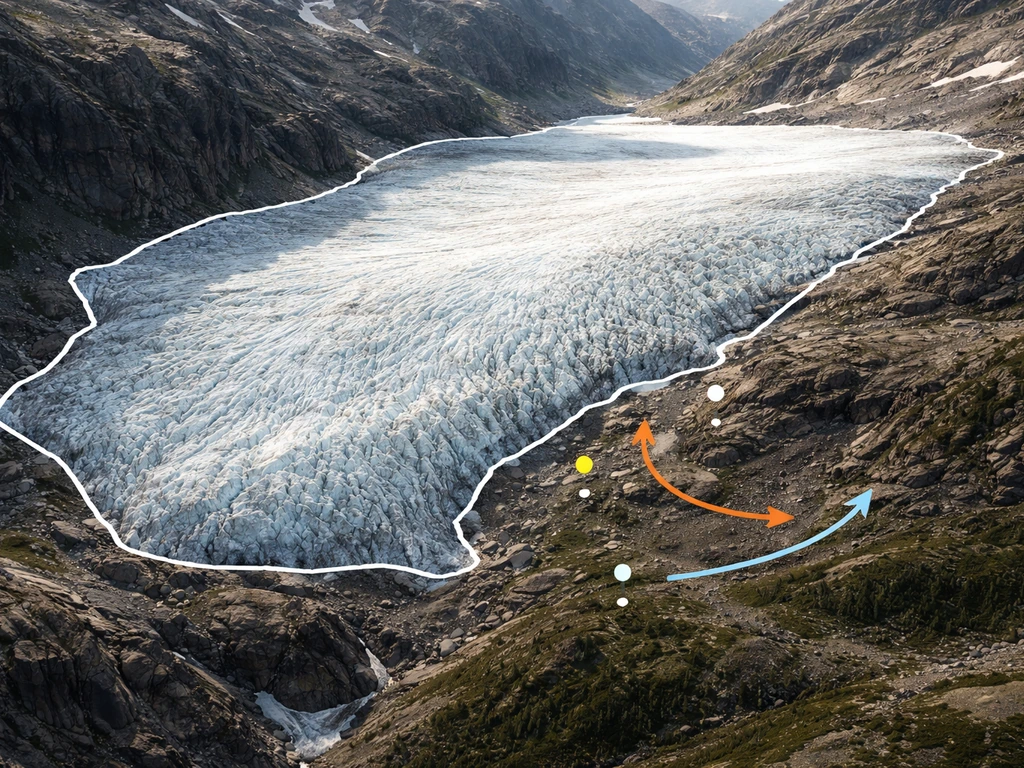
If you're trying to understand what's driving change for a specific glacier or region, here's a practical workflow that doesn't require advanced modeling.
- Start with nearby weather station data. Look at summer temperature trends (June, July, August in the Northern Hemisphere) and winter precipitation trends separately. The USGS pairs field mass-balance measurements with adjacent weather stations specifically to isolate these two drivers. If summer temperatures are trending up and winter snowfall is flat or declining, temperature-driven ablation is the primary suspect.
- Check whether the glacier is land-terminating or tidewater. If it calves into the ocean or a lake, dynamic ice discharge is likely a major component of mass loss, and surface melt alone won't explain the retreat rate. Look for data on ice velocity or terminus position change over time.
- Look for regional reanalysis products. ERA5 and similar datasets provide gridded estimates of precipitation and temperature at elevation, which you can use to assess whether the accumulation or ablation side of the mass balance is the main variable changing over time.
- Assess impurity loading. If the glacier is downwind of industrial regions, major dust source areas, or has experienced recent wildfire smoke, albedo effects from black carbon and dust may be accelerating melt beyond what temperature trends alone would suggest. Landsat or Sentinel imagery can show visible darkening of the ice surface.
- Account for response time before drawing conclusions. If you find a climatic signal, check whether the glacier's size change is consistent with the lag expected for that glacier's type and size. A large plateau glacier may need decades to respond; a small cirque glacier may adjust within a few years.
- Compare to neighboring glaciers. If glaciers across a whole region are retreating at similar rates, a large-scale climate driver (regional temperature rise or precipitation decline) is likely dominant. If one glacier is retreating much faster than its neighbors, local factors like debris cover, aspect, valley geometry, or soot deposition deserve investigation.
- Use the USGS or WGMS mass-balance records if the glacier is monitored. These datasets separate winter balance (accumulation) from summer balance (ablation) annually, which directly tells you which side of the ledger is driving the trend. Many benchmark glaciers have records going back to the 1950s and 1960s.
The core idea is always the same: treat glacier change as a mass-balance problem, separate accumulation from ablation, identify which one is changing and why, then layer in dynamics and feedbacks where they're relevant. You don't need a supercomputer to make that assessment for most glaciers. You need good temperature data, good precipitation data, and a clear understanding of what each process physically does.
Quick-reference: drivers at a glance
| Driver | Side of ledger affected | Primary mechanism | Fastest signal in |
|---|---|---|---|
| Rising summer temperatures | Ablation (loss) | Extends melt season, shifts snow to rain | Small, steep glaciers |
| Declining winter snowfall | Accumulation (gain) | Reduces ice input directly | All glacier types |
| Black carbon / dust deposition | Ablation (loss) | Reduces albedo, increases solar absorption | Glaciers near pollution or desert sources |
| Calving / ice discharge | Ablation (loss) | Dynamic ice loss to ocean or lake | Tidewater and marine-terminating glaciers |
| Albedo feedback | Ablation (loss) | Dark surfaces absorb more heat, accelerating melt | Glaciers losing snow cover early in season |
| Subglacial water events | Dynamics | Lubricate base, speed flow and discharge | Marine glaciers with subglacial drainage |
Glaciers are, in this sense, one of the clearest natural records of climate we have. Every year of snowfall and every degree of summer warmth gets written into their mass balance. Learning to read that record is simply a matter of knowing which physical processes are adding to the ledger and which ones are drawing it down.
FAQ
Can a glacier advance even if average temperatures are rising?
A glacier can grow even in a warm year if snowfall increases enough, or if the melt season shortens (for example, colder spring weather preserves snow into summer). The deciding metric is net annual mass balance, not whether temperatures ever cross freezing.
What if temperatures stay about the same but a glacier still recedes?
A glacier can shrink without an obvious increase in air temperature if precipitation changes from snow to rain, winter snowfall declines for years, or if dry, windy conditions raise sublimation. In other words, ablation can increase through humidity and wind effects, not just heat.
Why might the glacier front not match the glacier’s mass balance?
Mass balance and terminus position are related but not identical. A glacier may lose mass internally (thinning) while the snout moves slowly, or it may show temporary front movement due to dynamics like speed changes, not because the overall mass budget became positive.
How do I tell whether receding is caused more by melting or by reduced snowfall?
Look for evidence on both sides of the ledger. If summer warmth is driving melting, you will usually see longer or more intense melt seasons and strongly negative surface mass balance, while a snowfall-driven decline shows weaker accumulation and persistence of dry winters across multiple years.
How can I avoid blaming current weather for past glacier changes?
The relevant comparison is the timing of forcing and the glacier’s response time, often decades to centuries. Comparing today’s size to today’s weather can mislead, because thickening or thinning signals can take time to propagate through the ice.
What determines how quickly a glacier reacts to climate change?
Response time is controlled by glacier geometry (size, slope, thickness) and by how net balance changes with altitude (the mass-balance gradient). Small, steep glaciers with strong elevation differences can adjust quickly, while larger, gentler glaciers may lag far behind recent climate.
Why doesn’t “more rainfall” always mean “more snow accumulation”?
For accumulation, the same precipitation amount can contribute very differently depending on the snow versus rain fraction, and that fraction depends on near-surface temperature and timing of storms. So “more precipitation” does not automatically mean more glacier growth.
Can sublimation cause major ice loss even when air temperatures are below freezing?
Sublimation can be significant where air is dry and windy, even if temperatures are below freezing. If humidity drops and winds increase, ice can be removed directly as water vapor, creating mass loss that looks like “cooling didn’t help.”
Why might a tidewater glacier calve aggressively without big surface-temperature changes?
Calving is strongly influenced by whether the ice front is structurally stable and how warm ocean or lake water is below the terminus waterline. That means a tidewater glacier can respond to ocean conditions even if surface weather above is not dramatically different.
What is the difference between terminus movement and ice discharge, and why does it matter?
Glacier change can be decomposed into terminus-position change and solid-ice discharge for tidewater systems, and they can respond to different forcings on different timescales. If you only track front location, you can miss whether the system is mainly exporting more ice.
Do dust and soot affect glacier melt only at high temperatures?
Impurities like black carbon and dust reduce reflectivity and can increase melt during periods when melt is already occurring. The effect can vary sharply by surface condition, for example, impurities matter more when there is active melting and light-absorbing material is exposed at the surface.
Why can glaciers near each other behave differently?
Even with similar climate trends, local factors (shading, wind patterns, valley location of weather stations, debris cover, and terrain-driven snowfall) can make adjacent glaciers behave differently. That is why attributing change often requires local measurements or careful downscaling rather than relying on broad averages.
Next Article
What Controls When and How Fast Cells Grow and Divide
Learn what controls cell division timing and speed: checkpoints, signals, resources, DNA damage, stress, and failure lea