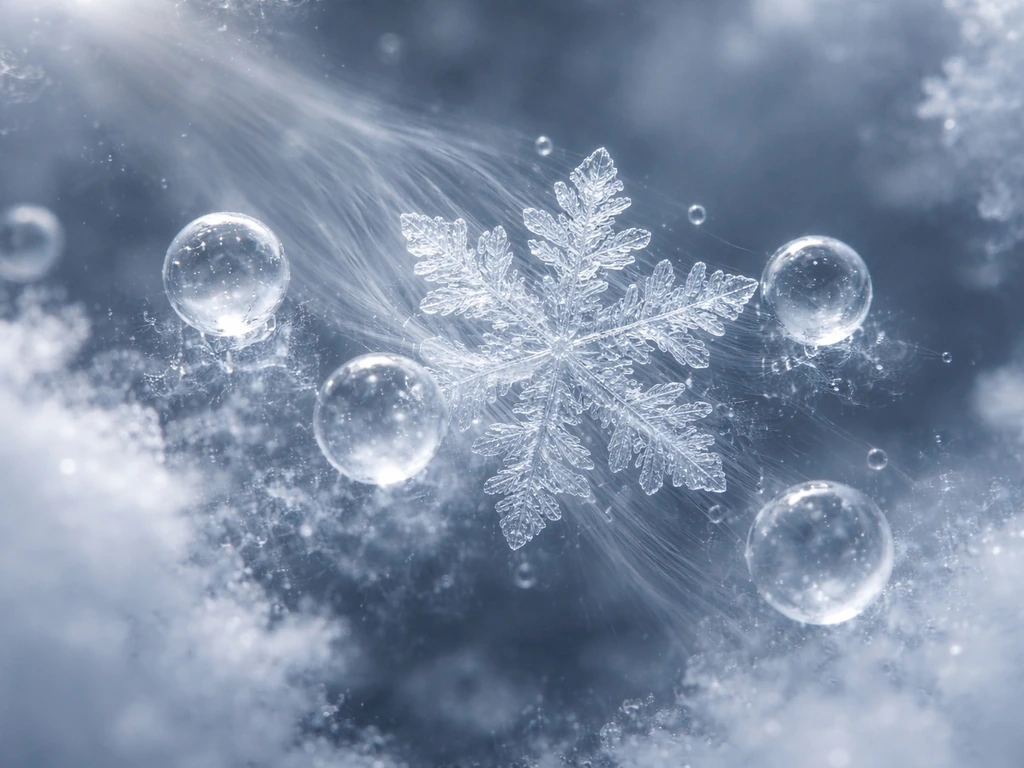
Ice crystals grow by pulling water vapor directly out of the surrounding air and adding it molecule by molecule onto an existing ice surface, a process called deposition. It starts with nucleation (a tiny ice seed forms around a dust particle or other surface), and from there, the crystal builds outward in a hexagonal pattern dictated by the geometry of water molecules. Temperature and humidity control how fast growth happens and what shape the crystal takes. Warm it up, cool it down, or starve it of moisture, and growth stops, or reverses into sublimation.
How Do Ice Crystals Grow Into Snow Crystals Step by Step
Marcus Whitmore
29 Apr 2026
What ice crystals actually are and what 'growth' means here
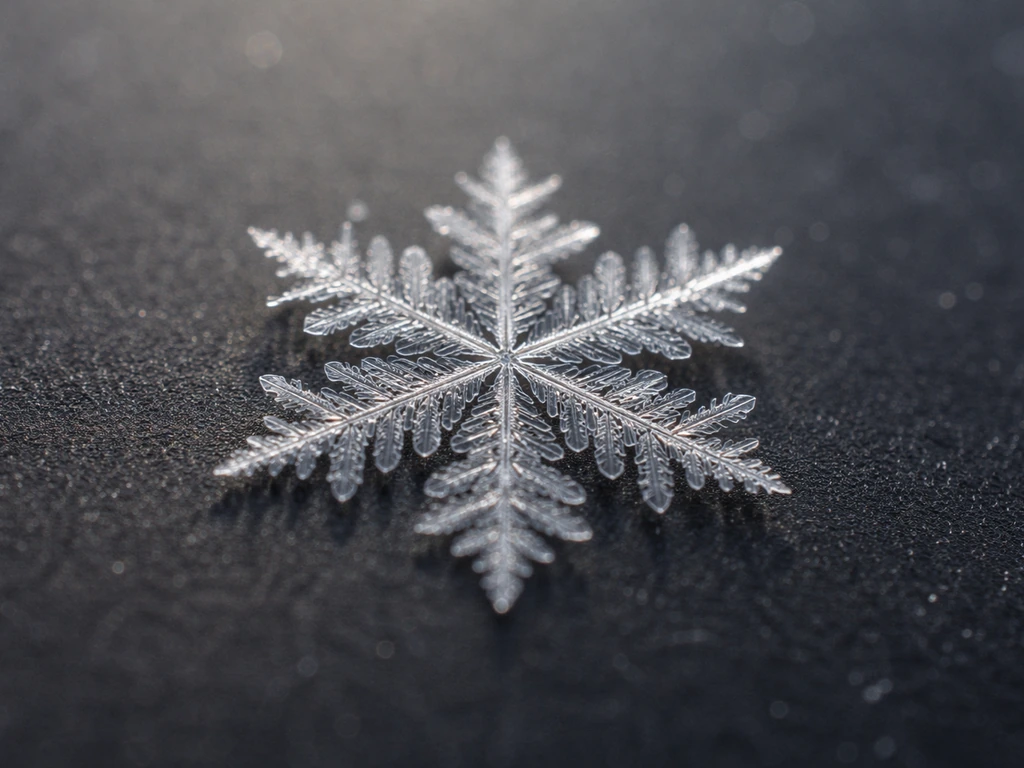
An ice crystal is water molecules arranged in a repeating, ordered lattice. Unlike liquid water, where molecules jostle freely, ice locks them into a hexagonal network held together by hydrogen bonds. 'Growth' in this context doesn't mean cells dividing or organisms eating, it means water molecules leaving the vapor phase and attaching to the crystal surface, extending that lattice outward. Snow crystals are simply ice crystals that grew in the atmosphere, usually starting on a tiny airborne particle and building up as they fall through different humidity and temperature zones.
This is worth separating from bulk freezing (a pond surface locking up, for example). When a lake freezes, liquid water transitions to ice across a large volume. When a snowflake grows, individual water molecules travel through air as vapor and attach to a solid surface. Same substance, very different mechanism, and that distinction explains almost everything about why snowflakes look the way they do.
If you've read about how glaciers grow or what drives the Bergeron process in clouds, you're already circling the same physics. Ice crystal growth is the atomic-scale version of those larger phenomena, the same thermodynamic rules, just playing out at the level of individual molecules.
How freezing actually starts: nucleation
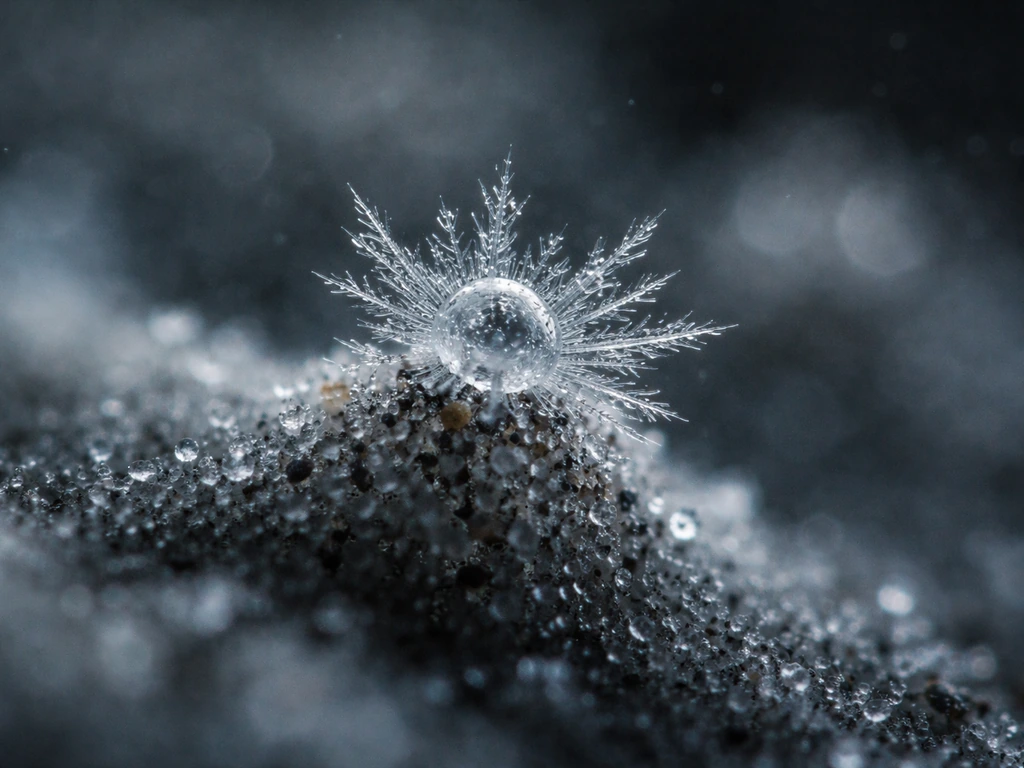
Before a crystal can grow, something has to get it started. That first event is nucleation, the formation of a stable ice embryo. And here's the thing: pure water doesn't freeze at 0°C. If you cool a tiny, perfectly clean droplet of water, it can stay liquid all the way down to about 231–235 K (roughly -38 to -42°C) before ice nucleation kicks in spontaneously. This spontaneous freezing below roughly -38°C is consistent with homogeneous ice nucleation, where ice embryos form without ice-nucleating particles about 231–235 K (roughly -38 to -42°C) before ice nucleation kicks in spontaneously. At that point, the nucleation rate explodes, on the order of 10^15 nuclei per cubic centimeter per second, and the whole droplet freezes essentially at once. That extreme supercooling requirement is why liquid water exists in clouds at temperatures well below freezing.
In practice, ice in the atmosphere almost never forms this way. Instead, it relies on heterogeneous nucleation, where a foreign surface, a dust grain, a pollen fragment, a clay mineral, even a bacterial cell, lowers the energy barrier for ice to form. The water molecules near that surface don't have to organize themselves spontaneously from scratch; they get a template. This cuts the required supercooling dramatically, allowing ice to nucleate at temperatures as warm as -5 to -10°C depending on the particle type.
The different ways nucleation can happen
Scientists distinguish several nucleation modes, and the terminology matters for understanding which pathway dominates in different cloud conditions.
- Deposition nucleation: water vapor deposits directly onto an ice-active surface without passing through a liquid phase first. Recent research suggests this often happens inside tiny pores or cavities on a particle's surface, where the geometry helps organize vapor into ice.
- Immersion freezing: a liquid droplet contains an ice-nucleating particle, and that particle triggers freezing when the droplet cools to a characteristic threshold temperature.
- Contact freezing: an ice-nucleating particle collides with the outside of a supercooled droplet and triggers freezing at the point of contact.
- Homogeneous freezing: no foreign surface involved — pure supercooled liquid freezes spontaneously at around 231–235 K, as noted above.
For snow crystal growth specifically, deposition nucleation and immersion freezing are the most common starting points. Once that initial ice embryo exists, even if it's only a few nanometers across, it becomes the seed onto which vapor deposition builds the full crystal.
From seed to snowflake: water vapor deposition and supersaturation
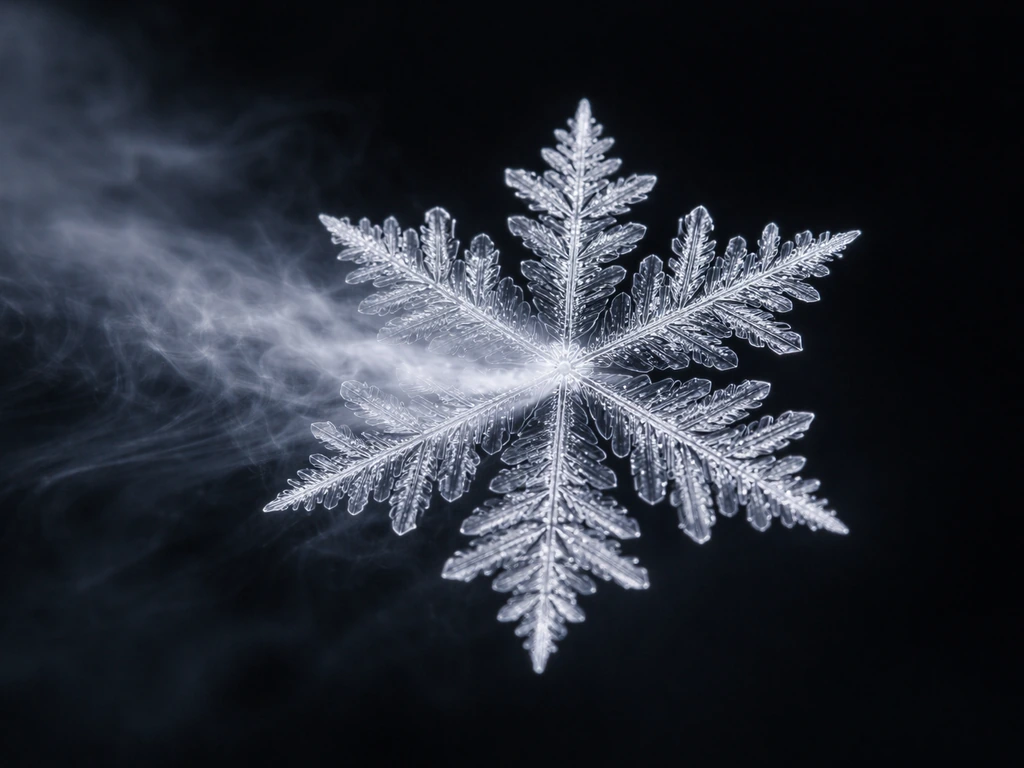
Once a tiny ice nucleus exists, growth happens through deposition: water molecules in the vapor phase drift to the crystal surface and attach. The driving force is supersaturation, the air holds more water vapor than it would at equilibrium over an ice surface. Think of it like a crowded room where everyone is looking for a seat. The vapor molecules are 'looking' for somewhere stable to land, and the crystal surface offers exactly that.
Here's a critical detail: the equilibrium vapor pressure over liquid water is higher than over ice at the same temperature. This means that in a mixed-phase cloud containing both ice crystals and liquid droplets, the air can be simultaneously undersaturated with respect to liquid (so droplets don't grow) but supersaturated with respect to ice (so crystals do grow). The ice crystals essentially steal water vapor from the droplets. This is the core mechanism behind the Bergeron process in cloud physics, and it's why ice crystals can grow rapidly even when liquid droplets in the same cloud aren't.
The degree of supersaturation controls how fast deposition happens. Higher supersaturation means more vapor molecules are hitting the crystal surface per unit time, so growth is faster. But it also influences which parts of the crystal grow fastest, and that's where shape comes in.
Temperature, humidity, and airflow: the three dials that shape a crystal
If you want to understand why snowflakes look different from one another, these three variables are your answer. They don't just control growth rate, they control the entire architecture of the crystal.
Temperature: the biggest shape-shifter
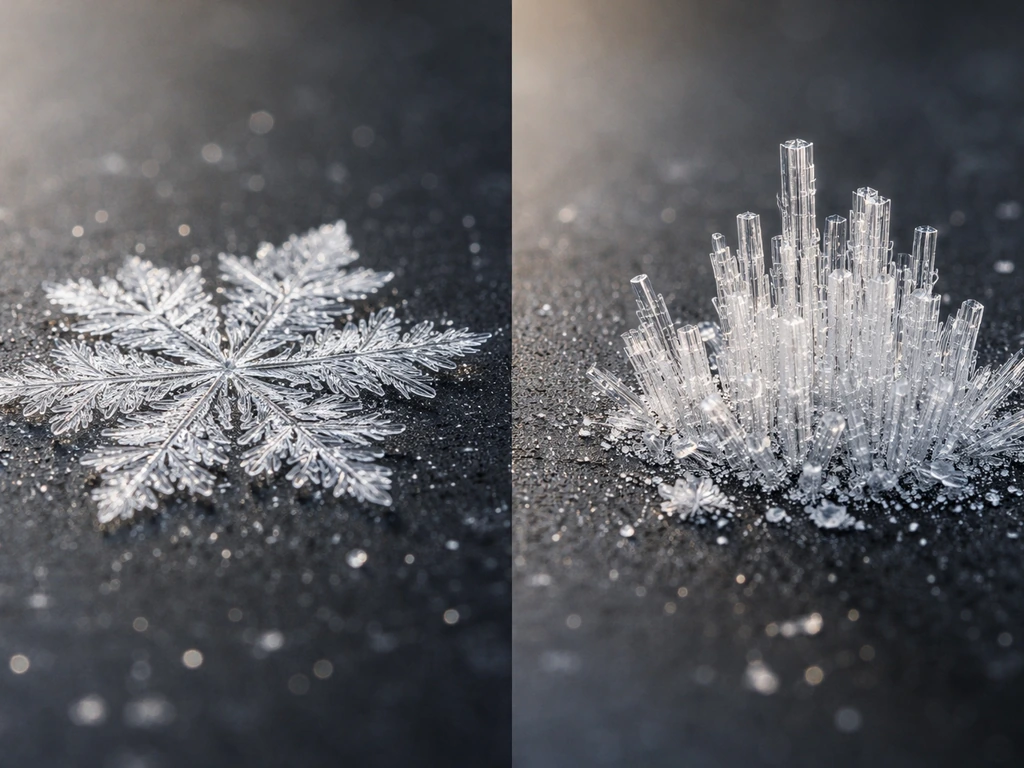
Temperature determines which crystal faces grow faster. At just below 0°C (roughly -1 to -3°C), ice tends to grow as thin plates. Drop to around -5°C, and needles and columns dominate. Between about -10°C and -22°C, you get the large, branching, stellar plate shapes, the classic star-shaped snowflake. Below -22°C, plate-like forms tend to return. This temperature dependence is one of the most striking things about ice crystal growth because it's not linear or intuitive; it zigzags. The explanation sits in which crystal faces (the basal face vs. the prism faces) are more energetically favorable for molecule attachment at a given temperature.
Humidity (supersaturation): how elaborate the crystal gets
Within any given temperature range, higher supersaturation produces more complex, highly branched crystals. Lower supersaturation at the same temperature gives you simpler, more blocky shapes. This is because at high supersaturation, the tips and edges of the crystal receive vapor molecules faster than the flat faces can, causing dendritic (branching) growth. At low supersaturation, growth is slower and more even, filling in flat faces before branching occurs.
Airflow: the underappreciated variable
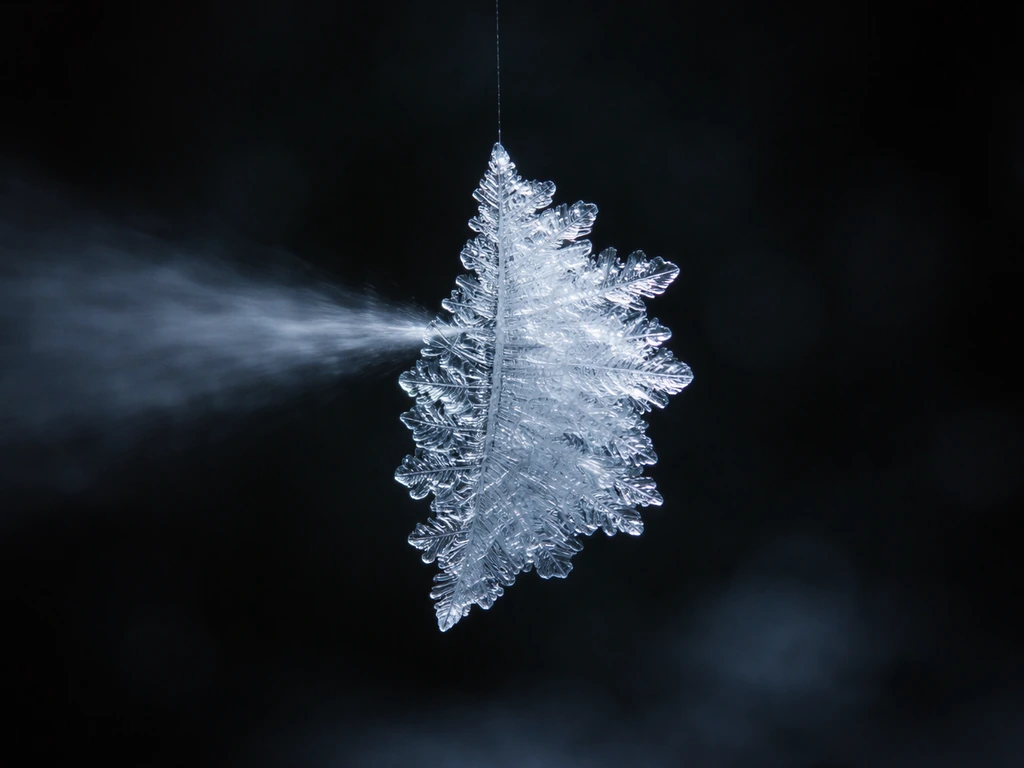
Moving air replenishes water vapor at the crystal surface. This same vapor-and-growth logic is also why clouds can move and grow as conditions change, raising the question of whether those clouds are living in any sense water vapor at the crystal surface. A crystal sitting in stagnant air quickly depletes the vapor immediately around it, slowing growth. A falling snowflake, tumbling through the atmosphere, is constantly encountering fresh, moisture-laden air, which is one reason natural snowflakes can develop more elaborate structures than crystals grown in a still lab chamber. Airflow also matters if you're trying to grow crystals yourself, gentle circulation can dramatically speed things up.
Why ice is hexagonal: the crystal structure behind every snowflake
All of the shape variation in snowflakes comes from one underlying constraint: water molecules in ice always bond in a hexagonal lattice. Each water molecule (H2O) forms hydrogen bonds with four neighbors arranged in a tetrahedral geometry, and when those tetrahedra stack in the most stable configuration, you get a six-sided (hexagonal) ring structure. This is Ih ice, the ordinary ice that forms at atmospheric pressure and temperatures above about -200°C.
Because the basic building block is a hexagon, everything that grows from it inherits that symmetry. A growing ice crystal has six equivalent prism faces and two basal faces (top and bottom). Depending on which faces grow faster, you get either a plate (basal faces slow, prism faces fast), a column (prism faces slow, basal faces fast), or a needle. Branching happens when growth concentrates at the six corners of the hexagonal plate, where the local supersaturation is highest, causing arms to extend outward in six directions simultaneously.
The classic 'no two snowflakes are alike' observation follows naturally from this. Six arms all start from the same seed and experience the same average conditions, so they grow with the same basic symmetry. But the exact path through temperature and humidity that each arm experiences as the snowflake falls is unique to that snowflake, producing subtle differences in branching detail that add up to an effectively infinite variety.
Common crystal habits at a glance
| Temperature range | Humidity | Typical crystal habit |
|---|---|---|
| 0°C to -3°C | Low to moderate | Thin hexagonal plates |
| -3°C to -5°C | Low to moderate | Needles |
| -5°C to -10°C | Low to moderate | Hollow columns, sheaths |
| -10°C to -22°C | Low | Sector plates, simple stars |
| -10°C to -22°C | High | Large dendritic stellar plates, fernlike branches |
| Below -22°C | Variable | Plates, solid columns |
Why crystals stop growing, and sometimes disappear entirely
Crystal growth isn't permanent. Several things can bring it to a halt or reverse it entirely, and understanding these limits is just as important as understanding the growth process itself.
Vapor depletion
As a crystal grows, it consumes water vapor from the air immediately around it. If that vapor isn't replenished fast enough (poor airflow, or simply a large crystal that has already drawn down the local supply), the supersaturation drops. When the air reaches equilibrium with the ice surface, net deposition stops. The crystal sits at a stable size as long as temperature and vapor pressure stay constant.
Temperature changes
A warming environment shifts the equilibrium. As temperature rises toward 0°C, the equilibrium vapor pressure over ice increases, meaning more and more vapor is needed just to maintain the crystal, let alone grow it. If the ambient vapor can't keep up, the crystal starts to sublimate (surface ice converts back to vapor) or, near 0°C, begins to melt. A falling snowflake that passes through a warm layer near the ground is doing exactly this: the crystal it spent its whole life building evaporates or melts away in seconds.
Kinetic limits on attachment
Even with plenty of vapor available, there's a physical limit to how fast molecules can attach and organize into the lattice. Water molecules arriving at the crystal surface don't immediately lock in, they need to migrate to a low-energy site (a step or a kink in the lattice edge) and shed the right amount of energy. At very high supersaturation, molecules arrive faster than the surface can organize them, which can lead to less ordered, rougher crystal faces and slower effective growth than the raw vapor supply would suggest.
Aggregation and riming
In real clouds, falling ice crystals collide with each other and with supercooled liquid droplets. Droplets that freeze on contact (riming) coat the crystal surface and can mask its geometry entirely, turning a delicate stellar dendrite into a lumpy graupel pellet. Ice crystal riming requires crystals to reach a critical threshold size and droplets to be sufficiently large before riming occurs Droplets that freeze on contact (riming) coat the crystal surface. Aggregation, crystals sticking together, produces snowflakes that are composites of multiple crystals, and growth of individual arms effectively stops when the surface is buried under other ice.
How to observe or replicate ice crystal growth yourself
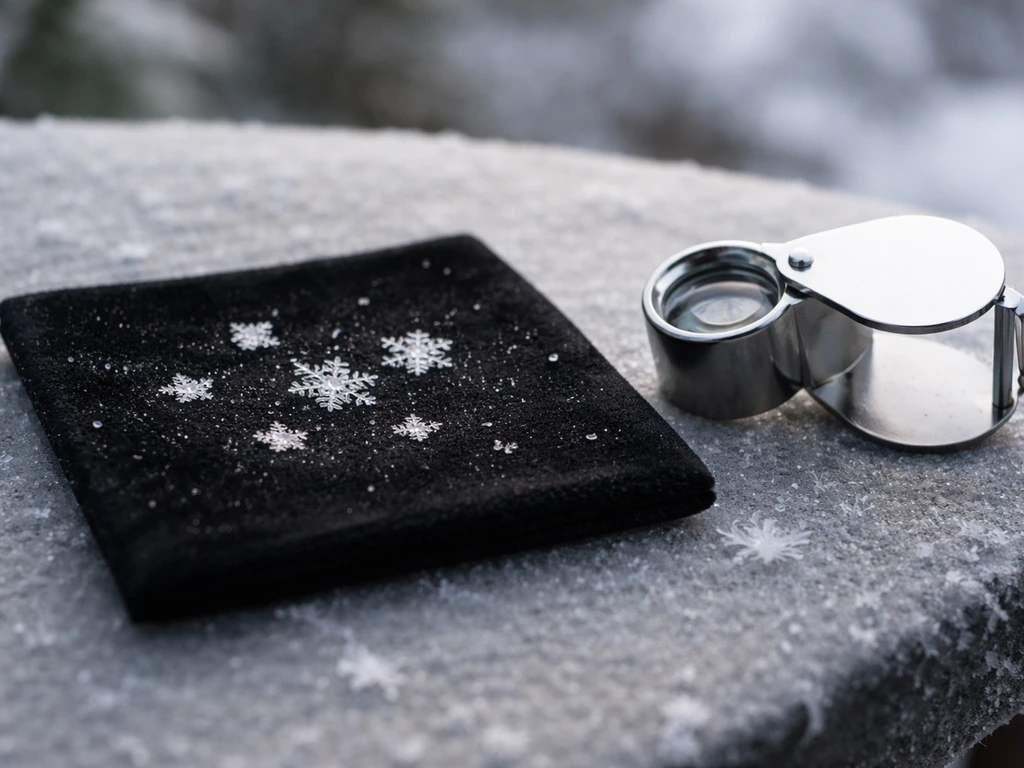
If you want to actually see this process rather than just read about it, a few approaches work well depending on what you have available.
- Catch snowflakes on a cold, dark surface (a piece of black felt or velvet works well) and examine them with a loupe or macro lens within a few seconds of landing. Look for the hexagonal symmetry and try to identify the crystal habit from the temperature-habit table above. If you know the approximate air temperature, you can predict what shapes you expect to see.
- For lab replication, the classic Nakaya chamber method suspends a cold fiber (cooled with dry ice or liquid nitrogen) in humid air. Ice crystals nucleate on the fiber and grow visibly over minutes. You can vary temperature and observe the habit change in real time.
- Check local atmospheric conditions: surface temperature alone isn't enough. The growth zone is in the cloud, typically several kilometers up. A radiosonde (weather balloon) sounding will show you the temperature and humidity profile at altitude, letting you predict which crystal habits are likely forming right now.
- For a simple home demonstration, breathe gently onto a very cold window pane or a metal surface chilled in a freezer. The frost crystals that form are ice growing by deposition from the moist air in your breath — the same physics as a snowflake, on your window.
The most important thing to measure is the supersaturation relative to ice, not just temperature. Two storms at the same ground temperature can produce very different crystal shapes because the humidity profile inside the clouds differs. If you're serious about predicting or replicating crystal habits, relative humidity over ice (not over liquid water) is the number to track.
Ice crystal growth sits at an intersection of physics that shows up across many scales, from the individual hydrogen bonds that make water hexagonal, all the way up to how clouds evolve and how glaciers build mass over centuries. Glacier growth follows related principles, since ice mass builds as water freezes or deposits and then accumulates over long timescales how glaciers grow. The same temperature, moisture, and airflow controls that govern ice crystal growth also determine what makes glaciers gain or lose mass over time glaciers build mass over centuries. The mechanism is always the same: supersaturation drives molecules from vapor to solid, and temperature and airflow control the architecture of what gets built.
FAQ
What conditions do I need for an ice crystal to grow if there is no liquid water present?
In air, ice growth is driven by deposition, not by the crystal “freezing” the air. The key condition is supersaturation relative to ice, meaning the ambient vapor pressure is high enough that molecules have a net tendency to leave the gas phase and attach to the ice surface.
Why can relative humidity be high but ice crystals still not grow?
If the air is only saturated relative to liquid water, droplets may persist or even grow, but ice may still shrink if the vapor is not supersaturated relative to ice. To predict growth, you need the humidity with respect to ice, not just relative humidity in general.
Can ice crystals grow even when the air temperature is below freezing but the air is not “humid enough” for snow?
Water vapor can deposit onto an already-formed seed even if that seed is far below the surrounding air temperature where melting would occur, because the relevant comparison is equilibrium vapor pressure versus the actual vapor pressure. As long as supersaturation relative to ice is positive, net deposition can continue.
Why do crystals sometimes end up as graupel even though deposition and branching should produce delicate shapes?
Yes. In cloud conditions, riming and aggregation can dominate the final form. A crystal may be growing by deposition, but if it repeatedly collides with supercooled droplets, the surface can become coated, creating graupel-like lumps that do not reflect the original stellar habit.
Can a single snowflake switch crystal shapes as it falls through different cloud layers?
Supersaturation is usually transient, and it can vary strongly with height and turbulence. A snowflake can start as a plate, then later pass into conditions that favor columns, causing mixed or unusual habits along its growth history.
Does growth slow down just because the crystal gets bigger?
Often, yes, because the local vapor supply near a growing crystal can be depleted. Experiments and outdoor cases differ in airflow, so a stagnant environment can make growth slow or stop even if the bulk air is nominally humid.
Why doesn’t “more humidity” always create more perfect, more detailed snowflakes?
Very high supersaturation can produce rougher, less orderly surfaces and effectively reduce the crystal’s ability to incorporate arriving molecules into clean lattice sites. That means faster vapor arrival does not always mean smoother or more “ideal” snow crystal faces.
How can a snowflake disappear without immediately melting?
If a crystal enters a warmer, higher-vapor-pressure air mass, the sign of the net phase change can flip. When the vapor pressure drops below the equilibrium value over ice, the crystal can sublimate instead of depositing, leading to shrinkage before it melts.
If I try to grow ice crystals in a chamber, how do I choose airflow so the result matches atmospheric growth?
In a lab, gentle airflow helps by constantly replacing the vapor-depleted boundary layer around the crystal. If circulation is too weak, growth can be limited by local supersaturation near the surface rather than by the far-field humidity.
Does the way the first ice forms determine the final snowflake shape?
Not necessarily. Many “ice crystals” in the atmosphere can form through heterogeneous nucleation on aerosol particles, but they still grow mainly by deposition once a seed exists. So the nucleation pathway matters for where seeds appear, while habit is largely controlled by later temperature, supersaturation, and airflow.
How can two separate ice crystals create a snowflake that looks like one complex crystal?
Yes. Collisions and sticking can create composite snowflakes where different branches belong to different crystals. In that case, the classic six-arm symmetry may reflect multiple seeds aggregated, which changes what you’d infer from deposition habits alone.
What does it mean for crystal growth to stop, and is it tied to 0°C?
The relevant “no growth” point is equilibrium with ice, not the freezing point of water. Near equilibrium, net deposition is essentially zero, so the crystal size may stay steady even though ice is present and conditions are changing.
Next Article
The Bergeron Process Causes Cloud Droplets to Grow Because Ice Lowers Vapor Pressure
Ice lowers saturation vapor pressure, so droplets evaporate while ice grows, boosting droplet size via accretion.