
A cell can only grow so large before it starts running into serious physical and biological problems. The short answer: as a cell gets bigger, its surface area grows much more slowly than its volume, which means it can no longer import nutrients or export waste fast enough to keep the interior alive. Layer on top of that the hard limits of diffusion physics, the toxicity of accumulating waste products, the requirement that the cell coordinate its growth with DNA replication, and the mechanical stress on the membrane and cytoskeleton, and you have a clear picture of why cells stay small. There is no single magic number, but the converging pressures are real and well-understood.
What Limits How Large a Cell Can Grow

Marcus Whitmore
14 Apr 2026
The short answer: why cells can't grow without bound
Cells do not grow indefinitely for the same reason a warehouse can't be supplied through a single door: the bigger the interior gets, the more inadequate any fixed-size entrance becomes. Every resource a cell needs, oxygen, glucose, amino acids, signaling molecules, has to cross the cell membrane. Every waste product, CO2, lactate, ammonia, has to leave through that same barrier.
The membrane is the door, and it simply cannot keep up once the cell's volume gets too large relative to its surface area. On top of this, the cell's own control machinery (checkpoints, regulatory proteins, cycle timers) actively prevents growth from outrunning division. Understanding why cells can't grow indefinitely means understanding all of these constraints working together, not just one in isolation.
Surface area vs volume: the fundamental scaling problem
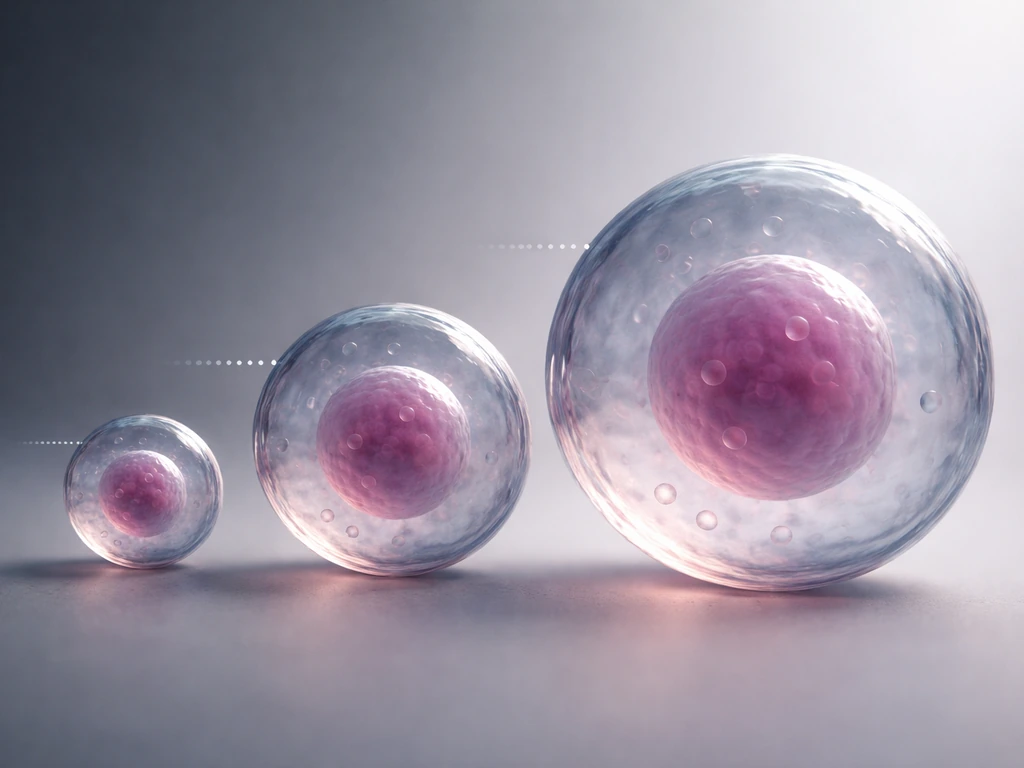
This is the foundational concept, and it is worth spending a moment on the geometry. For any roughly spherical object, surface area scales with the square of the radius (4πr²) while volume scales with the cube (4/3πr³). The ratio of surface area to volume therefore scales as 1/r: every time you double the cell's radius, the SA:V ratio is cut in half. A cell with radius 1 μm has an SA:V ratio 10 times higher than a cell with radius 10 μm. That ratio matters because all nutrient intake and waste export happens across the surface, while all the metabolic demand is generated by the volume.
Think of it this way: a small cube of bread toasts evenly because the surface is large relative to the interior. A thick loaf stays doughy in the middle for exactly the same geometric reason. Cells face the same physics. The bigger you grow, the worse your surface-to-volume ratio, and the harder it becomes to keep the interior adequately supplied. This is not a peripheral concern, it is the central constraint around which almost every other size limit is organized. If you want to reason practically about cell size limits, this is the place to start.
Diffusion and transport limits: nutrients, oxygen, and signals
Diffusion is fast over short distances and agonizingly slow over long ones. The key relationship is d² = 2Dt, where d is the distance a molecule travels, D is the diffusion coefficient, and t is time. For oxygen in an aqueous or cytosolic environment, D is roughly 10⁻⁵ cm²/s. Plug in the numbers and you find that oxygen can reliably diffuse across distances of tens of micrometers in a reasonable time, but beyond about 100–200 μm, diffusion alone cannot supply an actively metabolizing cell interior fast enough to prevent hypoxia.
Concrete modeling of oxygen transport in tissue supports this directly. Using a skeletal-muscle oxygen consumption rate of about 10⁻² ml O2 per cm³ per minute, the critical radius at which a spherical cell is just barely adequately supplied from the outside is roughly 1 mm. In real oxygen-consuming tissue, the maximum distance oxygen can diffuse from a blood vessel before it is exhausted is typically reported as just 20–100 μm.
That is why multicellular organisms develop circulatory systems with capillaries spaced close together, the physics simply does not allow passive diffusion to carry oxygen to a cell interior much larger than a few hundred micrometers across. A PubMed review and modeling study on oxygen diffusion from capillary layers with concurrent flow supports this diffusion-driven picture by coupling capillary-layer geometry and flow to diffusion, consumption, and oxygen distribution [maximum distance oxygen can diffuse from a blood vessel](https://pubmed. ncbi. nlm.
nih. gov/28943658/).
Nutrients face similar constraints. Interestingly, for very small cells, uptake is not purely diffusion-limited but can also be transporter-limited: there is a size-dependent crossover where the density of membrane transporters and their kinetics set the ceiling, not diffusion itself. As cells grow, they may hit the diffusion limit before they max out their transporters, or vice versa. The important insight is that both mechanisms are real, and neither vanishes just because the other is more prominent at a given size. Membrane permeability and characteristic crossing times for gases like oxygen also contribute to the overall bottleneck, meaning the membrane itself is not just a passive window but an active participant in setting limits.
There is one more diffusion-related complication: the cytoplasm is not a clean, watery solution. It is a dense, crowded environment packed with proteins, organelles, ribosomes, and structural filaments. Macromolecular crowding slows effective diffusion significantly compared to free solution, which means the practical diffusion distances inside a large cell are even shorter than the clean-water estimates suggest. A larger cell is not just fighting a worse SA:V ratio at the membrane; it is also dealing with increasingly sluggish internal transport in a more crowded interior.
Waste accumulation and why clearance sets a ceiling
Getting resources in is only half the problem. Cells continuously generate waste, and if that waste builds up inside a growing cell, it becomes toxic. The two biggest offenders in actively growing cells are lactate and ammonia. Lactate accumulates as a product of glycolysis, particularly under high metabolic demand, and its export depends on specific monocarboxylate transporter proteins (MCTs) in the membrane. Studies show that limiting lactate efflux via MCT4 changes the extracellular lactate and pH microenvironment, which in turn affects cell viability. This is not a theoretical concern. Transport capacity for waste is a real, measurable ceiling on how hard and how long a cell can sustain high metabolic activity.
Ammonia is arguably even more insidious. In rapidly growing cells, much of it arises from glutamine metabolism, and ammonia accumulation in cell cultures at concentrations that appear when cells grow densely can inhibit growth and disrupt normal cell cycle progression. Research connecting ammonia buildup to cell-cycle outcomes makes the mechanism concrete: it is not just that the cell feels sluggish, the toxin actively interferes with the molecular machinery controlling division. CO2 presents a similar but often overlooked issue. CO2 diffusing back into a cell reacts with water to form carbonic acid, lowering intracellular pH, which disrupts enzyme function and can destabilize the cytoplasm if the cell grows large enough that CO2 clearance cannot keep pace with production.
The practical takeaway is simple: as a cell grows, the volume generating waste increases as r³ while the membrane surface available for clearance increases only as r². Past a certain size, the cell is losing the waste-clearance race even if it wins the nutrient-uptake race, and toxic byproducts start accumulating in the interior. This is one of the clearest reasons to explain why cells don't just continue to grow larger even when nutrients are plentiful.
Cell-cycle control: growth must be coordinated with DNA replication and division
Even if a cell could somehow solve the diffusion and waste problems, there is a second class of limits built into the cell's own regulatory machinery. A cell must reach a proper size before it commits to DNA replication and mitosis. This is not a suggestion; it is enforced by checkpoint proteins. The G1/S checkpoint acts as a size sensor, and CDK activity is restrained by inhibitory phosphorylation through the Wee1/Cdc25 control loop, which prevents cells that are too small (or too stressed) from entering division. The same logic applies in reverse: a cell that grows too large without dividing creates imbalances in the DNA-to-cytoplasm ratio that the cell's own signaling pathways detect as problematic.
The checkpoint kinase pathway (ATR, CHK1, WEE1) that restrains CDK activity during normal DNA replication is a good example of how growth and replication are coupled. These kinases monitor the integrity of the replication process and can halt progression if conditions are not right, including when cell size or resource status is inadequate. The cell cycle, in other words, is not just a timer that runs in the background while the cell passively grows; it is an active gatekeeper that integrates size information with replication readiness. Grow too large, replicate too slowly, or accumulate damage, and the checkpoints fire.
This coordination is also why we do not want our cells to grow uncontrolled. When checkpoint signaling breaks down, cells can bypass size limits and division coordination, leading to the unrestrained proliferation characteristic of cancer. The checkpoints exist precisely because unchecked growth is dangerous, not just physically inefficient but genetically destabilizing.
Physical and structural limits: membrane, mechanics, and internal organization
Beyond chemistry and genetics, there are straightforward physical limits. As a cell swells, membrane tension increases. The lipid bilayer can only accommodate so much stretching before it risks rupture or loses the ability to function normally as a regulated barrier. Cells have limited reserves of membrane material, and synthesizing new membrane lipids and proteins takes time and resources, creating yet another coupling between growth rate and structural integrity.
The cytoskeleton, the internal scaffold of actin filaments, microtubules, and intermediate filaments, also faces scaling problems. A small cell can maintain organization with a relatively simple cytoskeletal network. A much larger cell must somehow organize a proportionally larger interior, keep organelles spatially arranged, direct vesicle traffic, and ensure the mitotic spindle can accurately segregate chromosomes during division. These tasks become geometrically harder as size increases. The cytoskeleton also interacts with the membrane to regulate shape, and loss of this mechanical coupling at larger sizes can cause internal organization to degrade.
Macromolecular crowding ties into this as well. A denser, more crowded cytoplasm physically constrains diffusion of signaling molecules and enzymes, meaning that even if a large cell could import enough nutrients, its internal reaction kinetics slow down as crowding increases with growth. Research has shown that crowding can limit growth under pressure, providing experimental evidence that excluded-volume physics is not just a theoretical concern but a measurable constraint on how a cell can actually function as it expands.
How real cells bypass these limits
Here is where biology gets creative. Cells have evolved several strategies to push back against the size constraints described above, and understanding them deepens your intuition for why the limits exist in the first place.
Shape changes and surface amplification
The most elegant workaround is changing shape. A sphere has the minimum possible SA:V ratio for a given volume. Cells that need high exchange rates use shapes that maximize surface area: long thin extensions, flattened discs, irregular lobes. Intestinal epithelial cells take this to an extreme with microvilli, dense finger-like projections that pack enormous membrane surface area into a tiny apical face. Proteins like villin and espin promote microvillar growth and maintenance, effectively giving the cell a surface area far beyond what a smooth membrane of the same volume would provide. This is a direct, molecular-level answer to the SA:V problem, and it is why the brush border of the intestine looks the way it does.
Transporter upregulation
Cells can also increase the density of specific membrane transporters to push more nutrient import or waste export through the same area of membrane. MCT transporters for lactate, glucose transporters, amino acid permeases: these can be upregulated when demand increases, buying extra capacity within the physical limits of the available surface. This is transporter-limited rather than diffusion-limited territory, and it shows that the membrane is not a fixed throughput ceiling but a tunable one, within reason.
The multicellular solution
The most radical bypass is not staying a single cell at all. Multicellular organisms divide the metabolic work among billions of small cells, each of which maintains a favorable SA:V ratio, and then build circulatory systems to deliver oxygen and nutrients convectively to within 20–100 μm of every cell. This is why capillaries are spaced so closely in active tissue: the physics of oxygen diffusion at roughly 10⁻⁵ cm²/s simply demands it.
Multicellularity is, at its core, a solution to the diffusion and SA:V problems that no single giant cell could solve on its own. It is worth noting that this logic also parallels why populations of organisms don't grow indefinitely: at every scale of life, resources and physical constraints impose ceilings.
Exceptions: cells that are genuinely large

Some cells do get large, but they cheat in interesting ways. Ostrich eggs store most of their volume as metabolically inert yolk; the active cytoplasm is a thin layer at the surface. Neurons extend their signal-carrying processes across meters but keep the metabolically active soma compact. Some giant algae cells use streaming cytoplasm (active, motor-driven flow) to overcome diffusion limits. Which structures cannot grow indeterminately often comes down to exactly this question: does the cell have a workaround for SA:V and diffusion, or is it bound by them? Even these apparent exceptions, when examined closely, turn out to be clever engineering around the same fundamental constraints.
It is also worth knowing that cell cultures that can grow indefinitely (immortalized cell lines) are not actually escaping size limits at the individual cell level. They bypass the normal checkpoints that halt proliferation, allowing continuous division, but each individual cell in the culture is still constrained by the same SA:V, diffusion, and mechanical rules. Indefinite proliferation and indefinite individual growth are very different things.
A quick comparison of the major limiting factors
| Limiting factor | Core mechanism | Typical scale where it bites | Cell's main workaround |
|---|---|---|---|
| SA:V ratio | Surface grows as r², volume as r³; nutrient/waste flux per unit volume drops with size | Becomes significant above ~10 μm radius for high-metabolism cells | Non-spherical shapes, microvilli, cell division |
| Oxygen diffusion | D ≈ 10⁻⁵ cm²/s; diffusion time scales as d²/2D | ~100–200 μm from oxygen source before concentration crashes | Circulatory systems, streaming, thin cell geometry |
| Waste clearance | Lactate, ammonia, CO2 build up faster than they can be exported | Depends on metabolic rate; fast-growing cells hit this earlier | Upregulate MCTs and other efflux transporters |
| Cell-cycle checkpoints | Wee1/Cdc25/CDK loops enforce size-before-division rules | Triggered when DNA:cytoplasm ratio goes out of balance | Coordinated growth-division coupling (normal physiology) |
| Mechanical/structural limits | Membrane tension, cytoskeletal organization, crowding-limited diffusion | Varies by cell type; membrane rupture risk rises with swelling | Cytoskeletal remodeling, controlled osmotic balance |
How to reason about cell size limits yourself
If you want to test your intuition, here is a simple mental framework. Start with the SA:V argument: pick a cell radius, calculate 3/r (for a sphere, SA:V = 3/r), and ask whether the resulting ratio is high enough to supply the metabolic demand. Then apply the diffusion time argument: use d² = 2Dt with D = 10⁻⁵ cm²/s and ask how long it takes oxygen to diffuse to the center of that cell. If the time is longer than the cell's metabolic rate demands, you have your answer. Finally, ask whether the cell-cycle checkpoints would fire: is the DNA-to-cytoplasm ratio maintained, and is the growth rate synchronized with replication?
These three checks, SA:V, diffusion time, and cell-cycle coordination, will get you a solid working answer for almost any cell size question. The deeper you go into specific cell types, the more you will find interesting exceptions and adaptations, but the underlying constraints never go away. They are geometric and physical, and no amount of evolutionary innovation fully escapes them, only routes around them. That is what makes this topic so satisfying: the answer connects high school geometry to cutting-edge cell biology, and it actually explains why cells can't grow too large in a way that makes immediate intuitive sense.
FAQ
Is there a single “maximum cell size” number that applies to all cells?
No. Different cell types face different bottlenecks (oxygen, waste removal, membrane tension, or cell-cycle timing), so the size limit is context-dependent. Even within one organism, limitations shift with metabolic rate, oxygen availability, and transporter expression.
What happens first as a cell gets larger, nutrient supply or waste removal?
It can vary, but waste often becomes the limiting factor at larger sizes because waste production scales with volume while clearance scales with surface area. If export transporters are near saturation, the cell can fail even when external nutrients are abundant.
Can a cell solve the diffusion problem by simply speeding up internal transport?
It can to a degree, for example by using active transport, but there is still a distance and time constraint. Also, diffusion is slowed further by cytoplasmic crowding, so boosting transport efficiency only helps until the internal reaction and signaling kinetics and transport bottlenecks catch up.
How does cell shape affect the “surface area to volume” limit in practice?
Shape can dramatically change exchange efficiency. Flattened cells and cells with membrane projections increase effective surface area without increasing volume as much, which improves both nutrient uptake and waste clearance compared with a smooth sphere of the same volume.
Why do microvilli on intestinal cells matter for size limits?
Microvilli expand membrane area in a highly localized region, reducing the effective diffusion distance from the membrane to exchanged molecules. They also concentrate transport and adhesion proteins, improving functional uptake capacity relative to a flat surface.
What does “transporter-limited” mean, and when does it occur?
It means membrane transporter throughput is capped by transporter number and kinetics, not by diffusion through the surrounding fluid. Small cells can hit this ceiling first, while larger cells may instead be limited by diffusion distance to the center and slower internal transport.
Do checkpoints stop growth at a specific size, or do they respond to problems during growth?
They respond to both size and internal readiness. Size sensors couple to cell-cycle regulators, but checkpoints also integrate stress signals like DNA replication issues or damage, so a cell may fail to divide even if it is in the “right” size range.
Can cancer cells become very large because checkpoints are broken?
They can sometimes bypass coordinated size-control and keep cycling, but physical constraints still apply. Even if division timing is altered, SA:V, diffusion, waste accumulation, and mechanical integrity still limit how large a single cell can become.
If a cell has plenty of oxygen outside, does diffusion still limit how large it can get?
Yes, because the limiting step is often getting oxygen to the interior, not the availability at the surface. If oxygen consumption is high and diffusion time to the center exceeds what metabolism demands, the interior becomes hypoxic even when the outside is oxygen-rich.
Why does cytoplasm crowding make size limits stricter?
Crowding slows effective diffusion of molecules, including enzymes and signaling factors. That means transport to where reactions happen becomes slower, so large cells experience slower kinetics and stronger gradients even if membrane exchange improves.
How do cells avoid waste buildup besides “exporting more”?
They can increase specific efflux transporter expression, change metabolic pathways to produce different waste profiles, or reduce net growth/metabolic rate. In many systems, the key is preventing internal waste levels from crossing thresholds that disrupt enzyme activity and the cell-cycle machinery.
Why do some cells have metabolically inert regions, like an ostrich egg yolk?
They compartmentalize activity. A large total volume can be mostly inert, with active metabolism confined to a thinner layer, which reduces the distance over which diffusion must carry oxygen and nutrients and slows waste accumulation in the active compartment.
Do immortalized or “indefinitely growing” cell lines escape size limits within each cell?
No. They primarily bypass cell-cycle checkpoint controls, so they can keep dividing. But each individual cell still faces SA:V geometry, diffusion to the center, internal crowding, waste toxicity, and mechanical constraints on membrane and cytoskeleton.
Is it possible for a cell to survive being larger than its diffusion limit temporarily?
Sometimes, but viability depends on time. If metabolism can be slowed, if oxygen consumption drops, or if diffusion gradients are buffered, a cell may persist transiently. However, sustained growth typically requires matching production and clearance rates, which eventually fails.
What are practical ways to estimate whether a given cell size is feasible?
A useful approach is to compare SA:V for nutrient and waste exchange and to check diffusion time to the center against oxygen (or other key substrate) delivery needs. Then verify whether the cell cycle can stay synchronized with that growth rate and maintain DNA-to-cytoplasm balance.
Next Article
Why Populations of Organisms Don’t Grow Indefinitely
Learn why populations stop growing: carrying capacity, density dependence, competition, predators, disease, and exponent