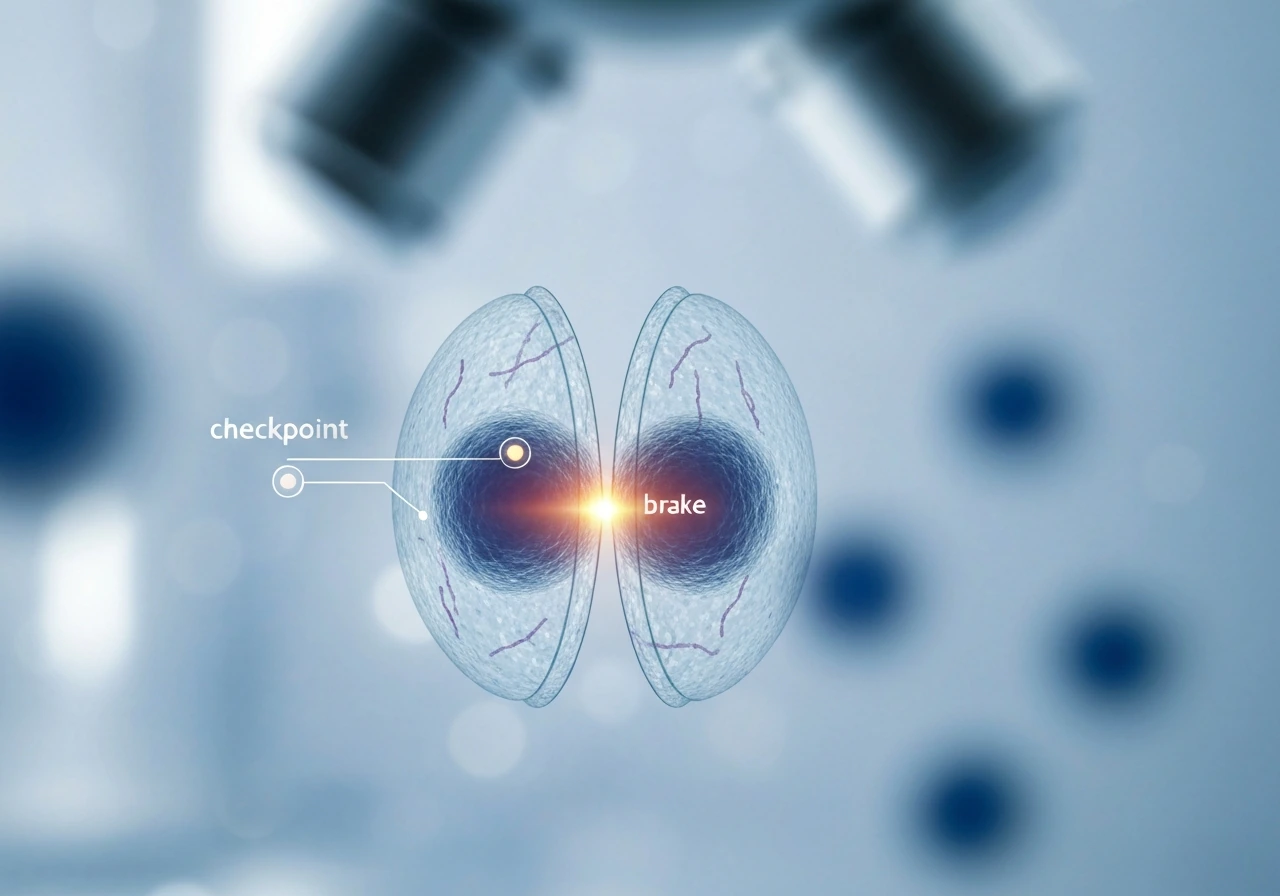
Cells can't grow indefinitely because the physics of size works against them. As a cell gets bigger, its volume balloons far faster than its surface area can keep up, and that imbalance eventually makes it impossible to import enough nutrients, export enough waste, or replicate DNA safely. When those limits are hit, the cell either divides or enters a growth arrest. There is no workaround that lets a cell just keep expanding forever.
Why Can’t Cells Grow Indefinitely? Key Limits Explained
Marcus Whitmore
7 Apr 2026
What 'indefinitely' would actually mean for a cell
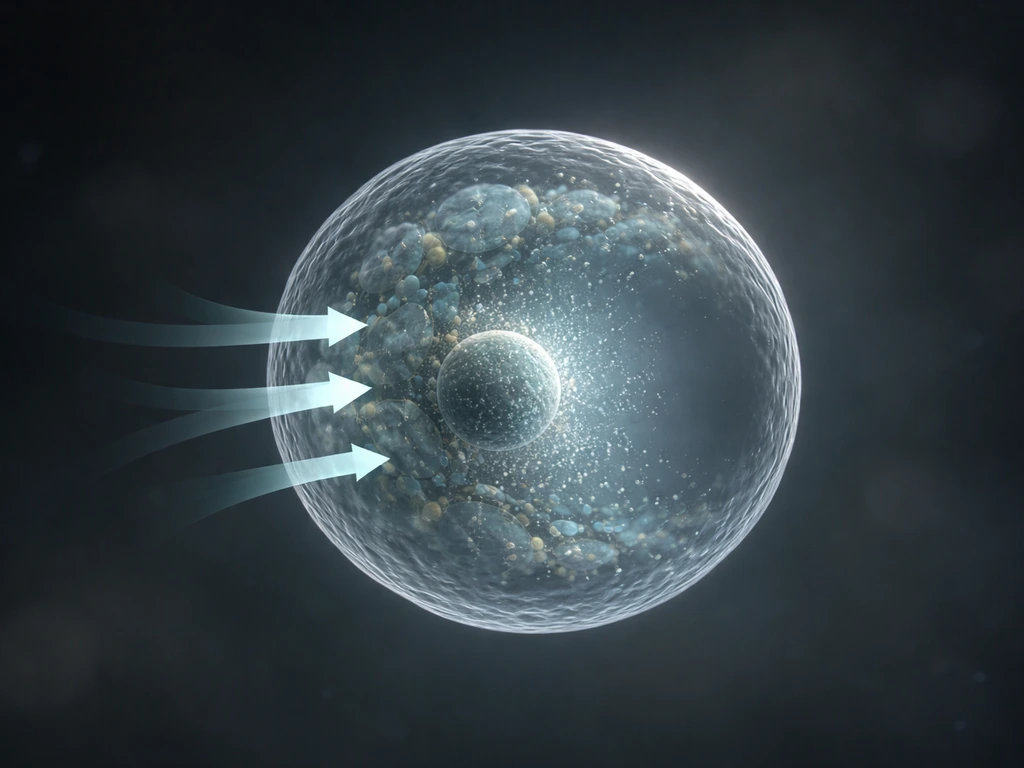
Picture a cell that never divided and simply kept growing. It would need to keep importing glucose, oxygen, and raw materials at a rate that matched its rising internal demand. It would need to export waste just as fast. It would need its single nucleus to control an ever-expanding volume of cytoplasm. And it would eventually need to copy its DNA in preparation for any future division. Every one of those requirements hits a hard wall as size increases. Indefinite growth isn't just biologically inconvenient, it's physically impossible given how chemistry, geometry, and molecular transport actually work.
It's also worth distinguishing this from what happens at the population level. A single cell can't grow without bound, but why populations of organisms don't grow indefinitely is a separate question driven by resource competition and ecology rather than the intracellular physics we're focusing on here.
The surface-area-to-volume problem is the core of it
This is the argument you'll see in almost every textbook, and it holds up because the geometry is unforgiving. For a spherical cell, surface area equals 4πr² and volume equals (4/3)πr³. That makes the surface-area-to-volume (SA:V) ratio equal to 3/r. Double the radius, and volume increases 8 times while surface area only increases 4 times. The SA:V ratio drops by half. Keep growing and it keeps dropping.
Why does that matter? Because everything the cell needs, oxygen, glucose, signaling molecules, enters through the surface membrane. Everything the cell needs to get rid of, CO₂, metabolic byproducts, leaves the same way. Surface area is your exchange capacity. Volume is your demand. When demand grows 8x but capacity only grows 4x, you're already losing the race.
Empirical data backs this up: surface area scales sublinearly with volume, roughly with a negative power dependence, meaning exchange capacity per unit of internal volume keeps falling as a cell enlarges. This is exactly what limits how large a cell can grow before its internal chemistry starts to fail.
| Cell radius | Surface area (4πr²) | Volume (4/3 πr³) | SA:V ratio (3/r) |
|---|---|---|---|
| 1 µm | 12.6 µm² | 4.2 µm³ | 3.0 |
| 2 µm | 50.3 µm² | 33.5 µm³ | 1.5 |
| 4 µm | 201.1 µm² | 268.1 µm³ | 0.75 |
| 8 µm | 804.2 µm² | 2,144.7 µm³ | 0.38 |
| 16 µm | 3,217 µm² | 17,157 µm³ | 0.19 |
The numbers make the trend obvious. Each time the radius doubles, the SA:V ratio is cut in half. A cell at 16 µm radius has less than one-tenth the exchange efficiency per unit volume of a cell at 1 µm radius. That's not a small disadvantage, it's a functional collapse.
Diffusion and transport: why size slows everything down inside
Even if enough nutrients could get through the membrane, they still have to travel to where they're needed inside the cell. Cells don't have circulatory systems. Small molecules move by diffusion, and diffusion time scales with the square of distance (t ∝ d²). That's a brutal relationship. Double the cell's diameter and the time it takes a molecule to diffuse across the interior quadruples. Triple it and diffusion time goes up ninefold.
To put real numbers on it: blank" rel="noopener noreferrer">oxygen has a diffusion coefficient of roughly 10⁻⁹ m²/s in aqueous environments, while glucose is closer to 10⁻¹⁰ m²/s. A diffusion-coefficient table for water at 25°C reports oxygen at about 20.0×10⁻⁶ cm²/s and glucose at about 6.7×10⁻⁶ cm²/s (in cm²/s units) blank" rel="noopener noreferrer">oxygen has a diffusion coefficient of roughly 10⁻⁹ m²/s in aqueous environments, while glucose is closer to 10⁻¹⁰ m²/s. In tissues, oxygen diffusion becomes limiting at around 100–200 µm from the nearest oxygen source. Beyond that range, cells start experiencing hypoxia. This is why, in tumors and dense tissues, cells more than about 200 µm from a capillary often can't survive without compensatory mechanisms. A single cell trying to grow into that size range would face the same problem entirely on its own.
This is also why cells can't grow too large without losing internal coherence, the cytoplasm at the center becomes effectively cut off from timely nutrient delivery. The cell's interior chemistry starts running on empty long before the surface stops accepting molecules.
Metabolic demand scales with volume, supply doesn't
Here's the metabolic version of the same problem. A cell's energy consumption is tied to how much living material it contains, which scales with volume. But its ability to harvest energy and exchange raw materials is tied to membrane surface area, which scales with r². For isomorphic (same-shape) cells, surface area scales allometrically with volume at roughly the 2/3 power. That means every time volume increases by a factor of 8, surface-based exchange only increases by a factor of 4. The metabolic gap widens continuously.
Think of it like a city that keeps adding residents but never expands its water supply infrastructure. At some point, everyone is rationing. Inside an oversized cell, reactions start competing for substrates, ATP production lags behind demand, and waste products accumulate faster than they can be cleared. The cell becomes metabolically compromised well before it reaches any theoretical maximum size.
This is the full picture of why cells don't just continue to grow larger, it's not one bottleneck but a cascade of worsening ratios that all stem from the same geometric reality.
Cell cycle control: why cells stop and divide instead of just... growing
Biology didn't just leave cell size to chance. There's an active control system that monitors cell state and decides when to stop growing and trigger division. This is the cell cycle, and it has multiple checkpoints built in specifically to prevent runaway growth.
The key checkpoint in early cell cycle progression is the G1 restriction point. Here, a cell integrates signals about growth factor availability, nutrient status, and internal size before committing to DNA replication. The molecular machinery behind this involves cyclin D–CDK4/6 complexes, which phosphorylate the retinoblastoma protein (Rb). When Rb is phosphorylated, it releases the transcription factor E2F, which drives expression of genes needed for S-phase entry. But this only happens if growth factor signals are strong enough. No growth factor signal, no CDK4/6 activation, no Rb phosphorylation, no S-phase. The cell stays in G1.
This isn't just an on/off switch. It's a size and condition sensor. A cell that hasn't accumulated enough resources or received the right signals simply doesn't get the green light. And importantly, once a cell does commit to division, the goal is to produce two daughter cells of manageable size, not one ever-growing giant.
It's also worth noting what happens when this system breaks down. When cells bypass normal growth controls and divide without regulation, the results are dangerous. Understanding why we don't want our cells to grow uncontrolled gets into cancer biology, but the short version is that unregulated growth doesn't produce healthy, functional cells, it produces dysfunction and disease.
DNA, replication checkpoints, and why big cells can't safely copy their genome
There's another layer on top of the size and metabolic limits: DNA integrity. A cell can only safely replicate its genome if conditions are right. Checkpoints exist at G1, during S phase, and at the G2/M transition specifically to catch problems before they propagate.
When DNA damage is detected, the tumor suppressor p53 is stabilized and induces expression of p21, a CDK inhibitor. p21 blocks the activity of cyclin A/CDK2 and cyclin E/CDK2, the complexes that would otherwise drive S-phase entry. The result is G1 arrest, the cell stops growing and dividing until damage is repaired or, if it can't be repaired, the cell enters senescence or apoptosis.
Here's the connection to size: a cell that keeps growing without dividing accumulates more DNA replication stress. Rushing into S phase without proper preparation creates replication errors and strand breaks. Research shows that hyperactive or expedited S-phase entry drives genome instability. There's also a specific failure mode called endoreplication, where DNA is replicated again without the cell actually dividing, producing polyploid cells with 8N or higher DNA content. Studies have shown that when p53 is absent, cells can enter another round of DNA replication even when division is blocked, illustrating exactly how the replication/division coupling can fail and why checkpoints exist to prevent it. CDK4/6 activity during G2 arrest is actually required to prevent this kind of endoreplication from happening under stress.
The bottom line: a continuously growing cell that never divides would eventually try to replicate an enormous volume of cytoplasm with a single nucleus controlling increasingly distant regions of the cell. The logistics break down. Checkpoints catch this and enforce arrest.
A note on cells that can grow indefinitely in culture
Cell cultures that can grow indefinitely are called immortalized cell lines, and they're a special case worth understanding. These cells have typically lost normal checkpoint controls, often through p53 mutations or other alterations, and can keep proliferating without entering senescence. But here's the key distinction: they're not growing bigger without dividing. They're dividing continuously. The size limits on individual cells still apply. What's bypassed is the limit on the number of divisions, not the physics of cell size. Each daughter cell is still constrained by the same SA:V ratio and diffusion limits as any other cell.
A quick thought experiment to lock it in
Imagine you're trying to supply a city of 1,000 people using a single road. That's manageable. Now the city grows to 8,000 people but the road only widens enough to handle 4,000. Traffic collapses. Now imagine the city grows to 64,000 but the road can only handle 16,000. Nothing gets in, nothing gets out. That's exactly what happens to a cell as it grows, the 'road' (surface area) can never keep pace with the 'city' (volume). Division is the cell's way of building a new city with a proportional road instead of trying to widen an insufficient one indefinitely.
This also connects to a broader pattern in biology. The question of which living things cannot grow indeterminately turns out to have the same answer at its core: physical and chemical constraints always impose a ceiling, whether you're talking about a single cell or an entire organism.
Answer-key recap: use this for your worksheet or lab report
If you need a clean, exam-ready explanation, here's how to structure it. Cover these four points and you'll hit every mark most instructors are looking for.
- SA: V ratio decreases as cell size increases. For a sphere, SA:V = 3/r. Doubling the radius cuts the ratio in half, meaning the cell has less surface membrane per unit of internal volume to use for exchange.
- Diffusion time scales with distance squared (t ∝ d²). Larger cells have longer average diffusion paths, so nutrients arrive more slowly and waste accumulates faster at the interior.
- Metabolic demand scales with volume; exchange capacity scales with surface area (roughly volume²/³). The mismatch grows as the cell enlarges, eventually making energy supply insufficient.
- Cell cycle checkpoints (G1, S-phase, G2/M) actively stop growth and enforce division or arrest. Growth factors regulate CDK/cyclin complexes that control Rb/E2F; DNA damage stabilizes p53, which induces p21 to halt S-phase entry. Cells that bypass these controls risk genome instability, endoreplication, and dysfunction.
For a lab or worksheet question asking you to 'explain why cells divide rather than growing indefinitely,' a strong answer combines at least two of these mechanisms: the geometric SA:V argument plus either the diffusion constraint or the cell cycle checkpoint explanation. Mentioning all four puts your answer in A-range territory.
What to double-check in your notes
- Make sure you know the SA: V formula for a sphere (3/r) and can explain what happens to it as r increases.
- Be able to name at least one cell cycle checkpoint and the protein that enforces it (p53 and p21 at G1/S is the classic answer).
- Understand the difference between a cell growing larger versus a cell dividing — division resets the SA:V ratio for daughter cells.
- Know that diffusion time increases with the square of distance, not linearly.
- Remember that the 100–200 µm oxygen diffusion limit is a real physiological constraint, not just a textbook abstraction.
The core idea is this: cells are not choosing to divide out of habit. They are forced to divide by physics, chemistry, and molecular logic that all converge on the same conclusion, a cell beyond a certain size cannot function. Division is the biological solution to a geometric and biochemical problem that has no other fix.
FAQ
What specific advantage does cell division give compared with just growing larger?
Because division resets the distance scales. When a cell becomes too large, molecules must travel farther (slower diffusion), and demand outpaces membrane exchange. Splitting produces two smaller cells, each with a higher surface area-to-volume ratio and shorter internal diffusion paths, so the logistics become manageable again.
Are there any real cells that get very large, and do they contradict this idea?
Yes, but only within limits. Some organisms and cell types can become relatively large (for example, certain muscle cells or megakaryocytes), but even then the cell still faces SA:V, transport, and DNA/chromatin regulation constraints. Large cells typically rely on special adaptations or compartmentalization, not indefinite expansion.
If a cell could import nutrients faster, would that allow indefinite growth?
The main bottleneck shifts with size, but it does not disappear. Diffusion, membrane transport, and metabolic coupling keep worsening together as size increases, so even if nutrient uptake is improved in one way, waste removal and intracellular distribution still eventually become limiting.
Which limitation tends to become critical first, membrane transport or diffusion inside the cell?
They break together, but not equally fast. Surface-area-to-volume decreases immediately with increased radius, while diffusion delays grow with the square of distance. In practice, diffusion and intracellular delivery often become limiting before membrane transport alone fully explains the failure of growth.
How can cells survive in low oxygen if diffusion becomes limiting at ~100 to 200 micrometers?
Oxygen diffusion constraints often set a practical survival distance, but the outcome depends on the cell’s metabolic strategy. Cells can reduce reliance on oxygen by shifting pathways (for example toward glycolysis), which can extend viability temporarily, but it still requires sufficient glucose supply and cannot remove geometry-driven limits on scaling.
How does the cell cycle “know” the cell is too big if it is not measuring size with a ruler?
Most size-control systems are sensitive to growth conditions and internal state, not just “size” as a single variable. Signals like growth-factor availability, nutrient status, and replication stress determine whether checkpoints allow S-phase entry or trigger arrest.
If DNA damage causes G1 arrest, does that also fix the transport and metabolic problems of an oversized cell?
Checkpoint arrest mainly prevents additional DNA replication and division, it does not automatically solve transport and metabolic imbalance. An arrested oversized cell can still experience nutrient delivery and waste buildup problems, so arrest is a safety response that stops proliferation rather than a cure for failing cellular logistics.
Why can immortalized cell lines proliferate long-term, but cells still cannot grow indefinitely in size?
Mostly no. Immortalized cell lines can bypass certain checkpoint-triggered senescence pathways and keep dividing, but they still cannot create a physics-free cell. Each daughter cell must still satisfy SA:V and diffusion constraints, so individual cells do not grow without bound.
Does nutrient availability at the level of a whole culture guarantee that every cell can keep expanding?
Not really. In a realistic tissue, spatial architecture matters, cells compete for shared resources, and diffusion distances to the nearest source vary by position. Even if the average population has enough nutrients, inner or poorly supplied cells can still hit diffusion and oxygen limits and enter arrest or death.
What goes wrong if replication can proceed but normal division controls fail?
Not if division is blocked. DNA integrity stress can increase with repeated attempts at replication or with replication stress, and specific failure modes like endoreplication can create polyploidy when the usual replication-divide coupling breaks. This shows why checkpoints exist to prevent unsafe genome copying under conditions where division is not proceeding properly.
Why does the cell cycle tie DNA replication readiness to the ability to divide?
Because division increases the membrane area available per unit of genetic material and resets the planning horizon for replication. Practically, checkpoints enforce that DNA replication and chromosome segregation happen only when the cell is prepared to produce daughter cells that can each maintain functional exchange and intracellular transport.
Next Article
Why We Don’t Want Cells to Grow Uncontrolled: Causes and Next Steps
Explains how cell-cycle brakes prevent cancer, why they fail, and what to do next to reduce risk.