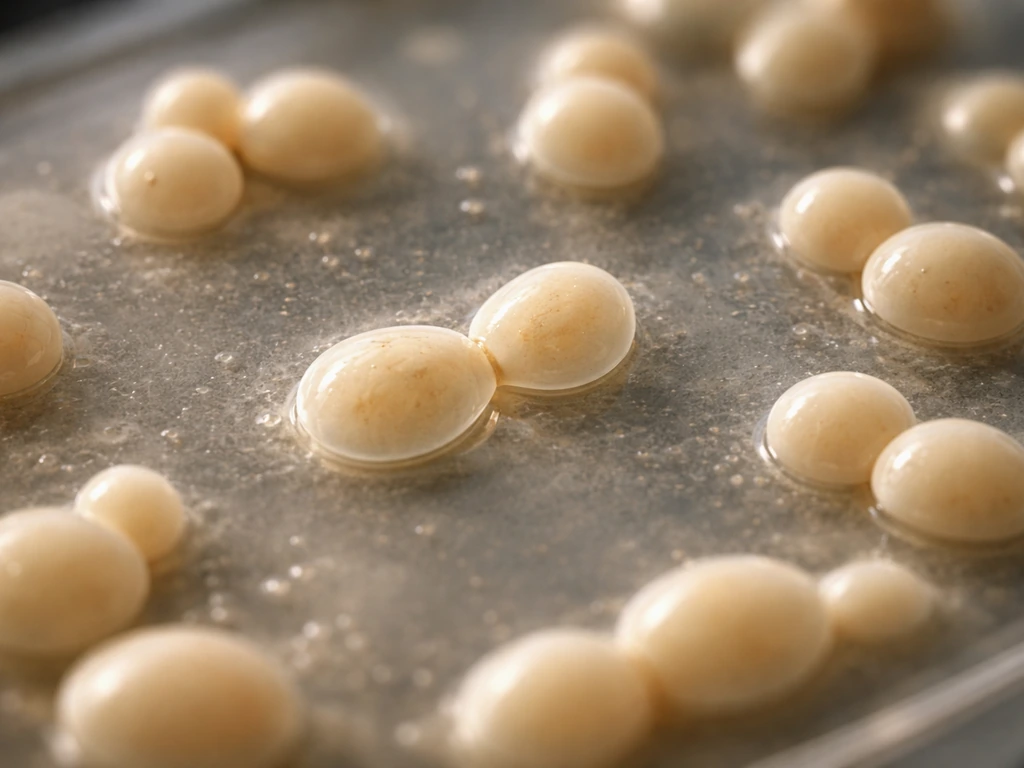
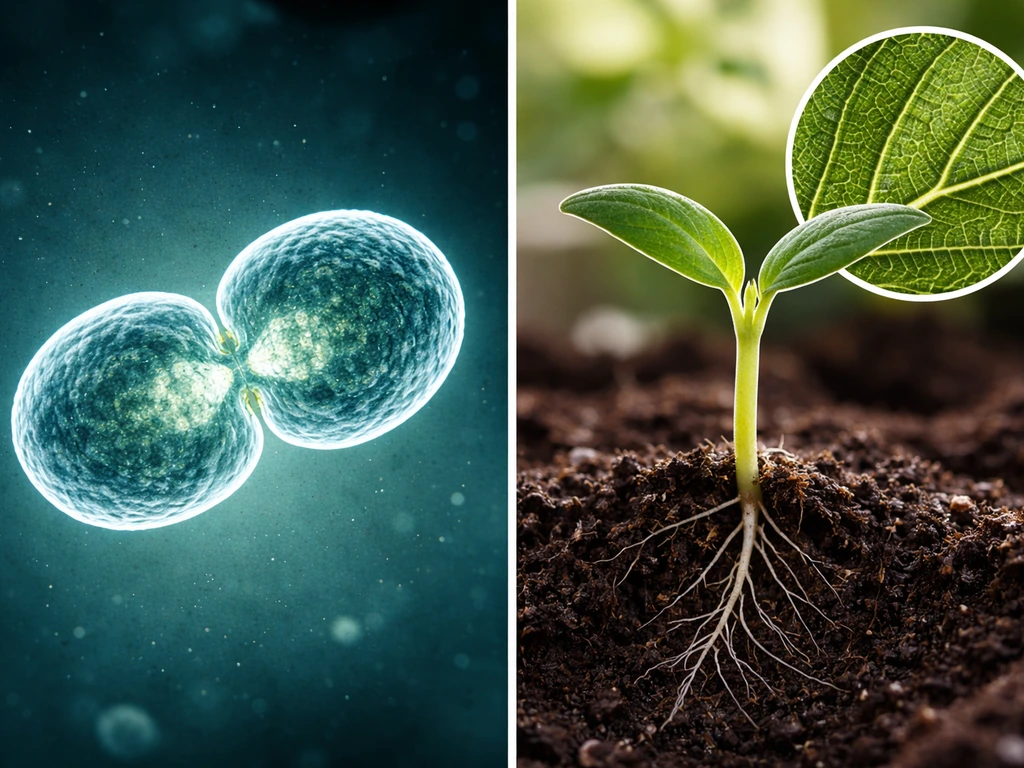
The confusion usually comes from conflating growth with getting bigger in the way a dog or a tree gets bigger. For a unicellular organism, growth means increasing in biomass and cell size up to the point where the cell divides into two new cells. The organism itself doesn't accumulate size over a lifetime the way a multicellular creature does. Instead, growth feeds directly into reproduction. One cell grows, divides, and now there are two. That population-level increase is the visible result of cellular growth.
Growth vs. development: they're not the same thing
Before going further, it's worth separating two terms that get muddled constantly: growth and development. Growth is an increase in biomass, size, or cell number. Development is a change in form, function, or life-cycle stage, and it doesn't always require an increase in size. A unicellular organism can do both, but they're distinct processes.
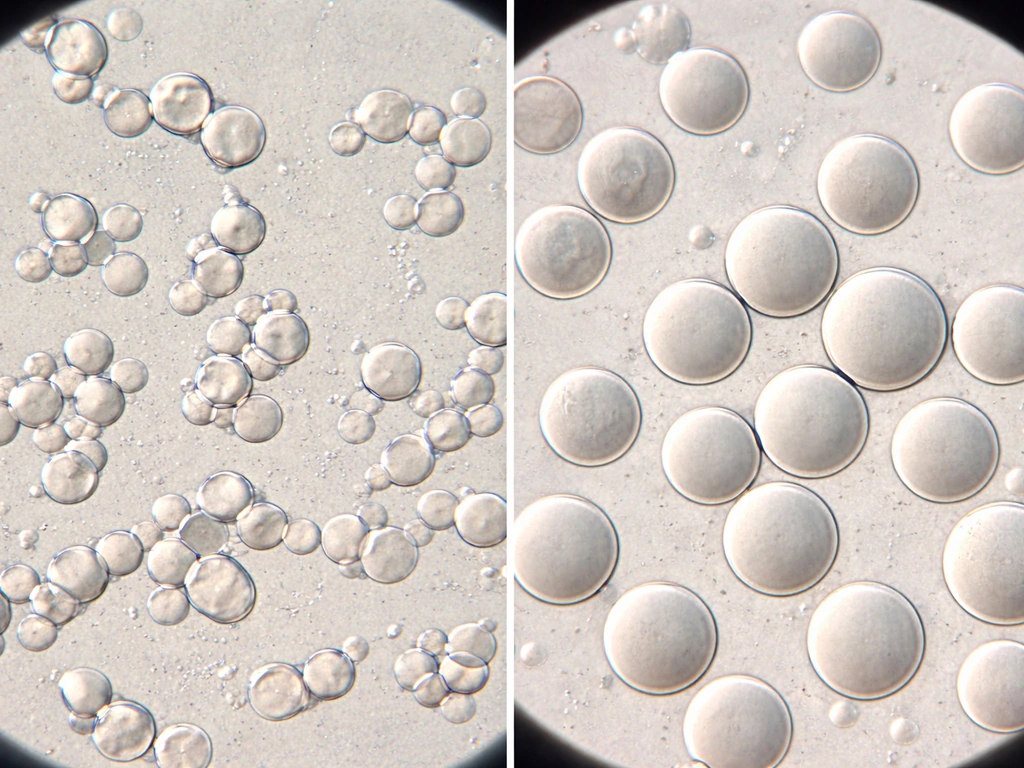
Take budding yeast as an example. Under normal conditions it divides as a single oval cell. But deprive it of nitrogen and it can switch to a filament-like form called pseudohyphal growth, a change in growth pattern tied to changes in how the cell moves through its own cell cycle. That's a developmental shift. The cell isn't just getting bigger; it's changing its phenotype, sometimes even without dividing. So when we ask whether unicellular organisms grow, we're mostly talking about the biomass-and-division kind of growth, but it's good to know that development-like changes also happen at the single-cell level.
A useful way to think about it: growth is the engine, development is a change in direction. For unicellular organisms, growth is the main event, and reproduction is its natural endpoint.
How unicellular organisms actually grow: the basics of cell division
The primary growth mechanism depends on whether you're dealing with a prokaryote (like a bacterium) or a eukaryote (like a yeast or amoeba). The end goal is the same: one cell becomes two. The path there is different.
Bacteria: binary fission
Bacteria grow and divide through a process called binary fission. The cell starts by replicating its single circular chromosome while simultaneously elongating its body. Once DNA replication is complete, a structure called the division septum forms at the cell's midpoint, essentially a wall that grows inward and pinches the cell in two. To complete this cleanly, the outer layers, including the cell wall and membranes, have to be remodeled around the new division plane. The result is two roughly equal daughter cells, each with a full copy of the genome and a full set of cellular machinery.
Binary fission is fast and efficient. Under ideal conditions, a bacterial cell can double in as little as 20 minutes. That speed is why a small bacterial colony in your sourdough starter or a lab flask can become millions of cells overnight. Each round of division is the organism completing one cycle of growth.
Eukaryotic unicellular organisms: mitosis and the cell cycle
Single-celled eukaryotes like yeast and amoeba use a more elaborate process: the eukaryotic cell cycle, which leads to mitosis. The cell cycle has four stages, G1, S, G2, and M, and each one has a specific job.
| Stage | What happens | Growth or division? |
|---|
| G1 (Gap 1) | Cell increases in size; proteins and organelles are produced | Growth |
| S (Synthesis) | DNA is replicated; chromosome count doubles | Preparation |
| G2 (Gap 2) | Cell continues growing; checks for DNA replication errors | Growth + quality check |
| M (Mitosis + Cytokinesis) | Chromosomes are separated; cell physically divides into two | Division |
The key insight here is that actual size increase happens mostly during interphase, which is the combined G1, S, and G2 stages. The cell grows continuously during interphase. Mitosis itself, the dramatic chromosome-segregation phase with prophase, metaphase, anaphase, and telophase, typically occupies only a small fraction of the total cell cycle. The cell is doing most of its growing long before it starts pulling chromosomes apart. By the time telophase wraps up and the nuclear envelope reassembles into two daughter nuclei, the hard work of building cell mass is already done.
What increases cell size vs. what increases cell number
This distinction trips people up, so it's worth being direct about it. Cell size increases during G1 and G2, when the cell is actively synthesizing proteins, lipids, and other cellular components to bulk up. Cell number increases during M phase, when one cell becomes two. These are separate events happening in sequence.
For a unicellular organism, the organism-level outcome of growth is an increase in population size, not an increase in the size of any one individual cell over its lifetime. Each daughter cell starts relatively small after division and then grows through G1 again before the next round. This coupling between growth rate and cell cycle phase is precisely regulated. Research in budding yeast, for instance, has shown that cell size control depends on keeping growth and division in sync, and that cells entering their final divisions before death can actually increase more in size than usual. The system is tuned so that division happens only when the cell has grown enough to sustain two viable daughters.
What unicellular organisms need in order to grow
Growth doesn't happen in a vacuum. A unicellular organism needs the right inputs and the right environment. When conditions are good, growth is fast. When they're not, the cell stalls or dies. Understanding these requirements also explains the famous bacterial growth curve, which traces population change through four phases: lag, log, stationary, and death.
Energy and nutrients
Building new cell mass requires raw materials and energy. Cells need carbon sources to build proteins, lipids, and nucleic acids. They need nitrogen for amino acids. They need phosphorus for DNA and ATP. Without adequate nutrients, cells hit stationary phase, where growth and death rates balance out, and eventually decline. In a batch culture, the maximum population a culture can sustain is called its carrying capacity, and it's determined both by the organism type and the specific culture conditions, including available nutrients.
The right environment
Nutrients alone aren't enough. The physical and chemical environment matters just as much. The major environmental variables include:
- Temperature: most microbes have a narrow optimal range; too hot or too cold slows or stops growth
- pH: enzyme activity depends on it, and most organisms prefer a fairly specific range
- Oxygen: aerobic organisms need it; anaerobes are inhibited or killed by it; as cell numbers rise in log phase, oxygen depletion contributes to growth slowdown
- Osmotic pressure: cells shrink or swell depending on the solute concentration around them
- Light: critical for photosynthetic unicellular organisms like algae
- Humidity and barometric pressure: relevant in certain environments and for airborne microbes
The lag phase, the quiet period right after you introduce cells to a new environment, exists because cells are adjusting to these conditions before committing to rapid division. They're not dormant; they're calibrating. Once conditions are confirmed favorable, the culture shifts into exponential (log) growth, where cell numbers increase at a constant rate through continuous binary fission or mitotic division.
Why unicellular organisms can't grow forever
Here's where physics steps in and sets hard limits. Even if nutrients and environment were perfect indefinitely, a single cell still cannot keep growing larger without consequence. Two interconnected problems stop unlimited growth in its tracks.
The surface-area-to-volume problem
As a cell grows larger, its volume increases faster than its surface area. why can unicellular organisms grow larger Think of inflating a balloon: the inside expands much more than the skin. For a cell, the surface area is the membrane through which everything, nutrients in, waste out, must pass. The volume is the metabolically active interior that keeps demanding those nutrients. When the ratio of surface area to volume drops too far, diffusion simply can't keep up with the cell's needs. Nutrients can't get in fast enough, and waste builds up inside. The cell becomes metabolically inefficient in proportion to its size.
This is why cells divide rather than just keep enlarging. Division resets the surface-area-to-volume ratio back to a favorable level for both daughter cells. It's an elegant solution to a geometry problem.
Resource depletion and population-level limits
At the population level, growth in a finite environment hits a wall when resources run out. As bacterial numbers climb through log phase, nutrients deplete and, for aerobic species, oxygen levels drop. Growth slows, and the population enters stationary phase, where new cell production roughly equals cell death. Eventually, in the death phase, the death rate exceeds the growth rate, and the population declines. Some bacteria in stationary phase even shift their gene expression toward survival strategies, including expressing virulence factors, which is a reminder that growth limitation has real biological consequences beyond just population numbers.
Cell-size checkpoints
At the individual cell level, the cell cycle itself enforces size limits through checkpoints. A cell won't enter S phase or commit to mitosis unless it has grown to a sufficient size during G1. These checkpoints exist precisely to prevent cells from dividing before they're large enough to produce two viable daughters. The system is self-regulating: growth drives the cell toward division, and division resets cell size. There's no mechanism for just getting continuously bigger without dividing, because the cell cycle's logic is built around the grow-then-split sequence.
Unicellular vs. multicellular growth: a quick comparison
If you want to contrast how unicellular and multicellular organisms handle growth (a topic worth exploring on its own), the core difference is what happens after division. In a unicellular organism, the two daughter cells separate and each becomes its own independent organism. Growth at the population level means more individuals. In a multicellular organism, daughter cells stay together, differentiate, and contribute to building a larger, more complex body. Growth at the organism level means a bigger body, so if you’re asking how does a multicellular organism grow, this is where the details matter. The cell-level mechanics, including DNA replication, mitosis, and cytokinesis, are remarkably similar. The fate of the daughter cells is what diverges.
Where to take your understanding next
If this topic has your curiosity running, there are a few specific threads worth pulling. The cell cycle and its checkpoints are the best starting point for understanding how growth is regulated at the molecular level. Understanding what triggers G1 exit into S phase, and what the cell is actually checking for, will give you a much deeper picture of why cells grow at the rate they do and what can go wrong when those controls fail.
From there, looking at how one-celled organisms grow under stress conditions, like nutrient starvation or temperature extremes, connects the molecular machinery to real-world microbiology. The bacterial growth curve is a practical tool that maps directly onto the concepts here: lag phase is the cell cycle calibrating, log phase is the cell cycle running at full speed, stationary phase is the resource limits hitting, and death phase is the system collapsing under constraints.
For a broader perspective, comparing unicellular growth to how multicellular organisms grow shows you just how much evolutionary tinkering it took to go from a cell that simply divides to one that stays attached, differentiates, and builds a body. The single-cell version of growth is where all of that complexity started.